Lysmata kuekenthali - Marine Aquarium Livestock UK
24–26°C · pH 7.9–8.3
£38.99
Camel shrimp (Rhynchocinetes durbanensis) is a red and white striped marine shrimp from the Indo-Pacific that grows to about 4 cm. It needs a mature marine aquarium with plenty of rock crevices and only reef-safe fish for company; each purchase is one live shrimp.
Adult size is the maximum length this species reaches at full maturity (scientific sources). The livestock you receive will be younger and smaller. Product-photo provenance and any image-specific limitations are stated on the listing.
Rhynchocinetes durbanensis
Camel shrimp (Rhynchocinetes durbanensis) is a red and white striped marine shrimp from the Indo-Pacific that grows to about 4 cm. It needs a mature marine aquarium with plenty of rock crevices and only reef-safe fish for company; each purchase is one live shrimp.
Adult size is the maximum length this species reaches at full maturity (scientific sources). The livestock you receive will be younger and smaller. Product-photo provenance and any image-specific limitations are stated on the listing.
Maintain these water conditions for optimal health and vibrant colors
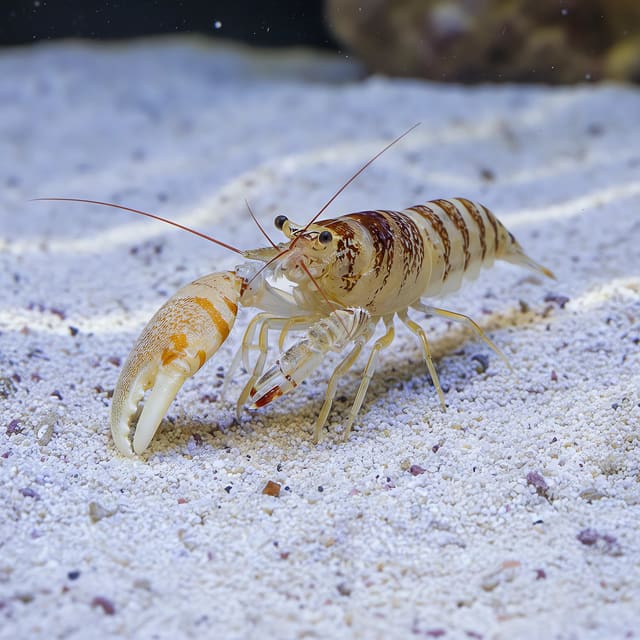
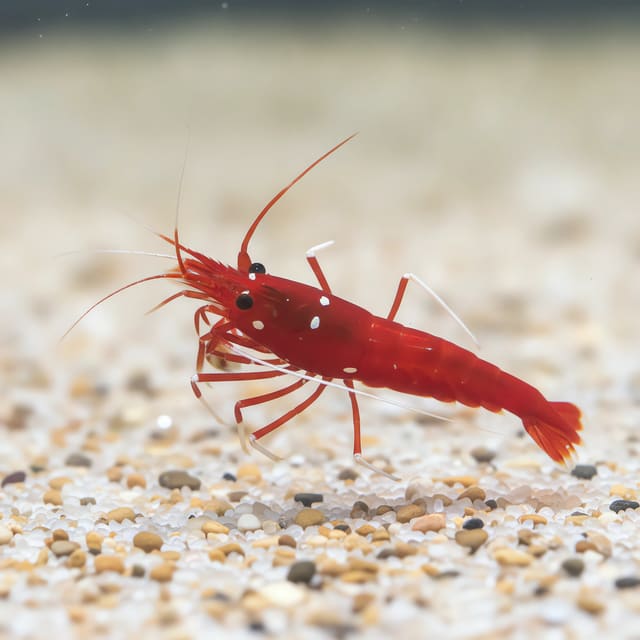
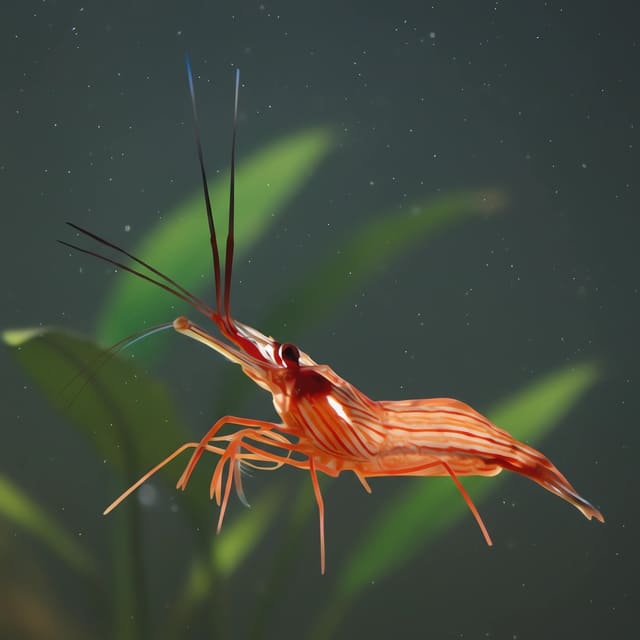
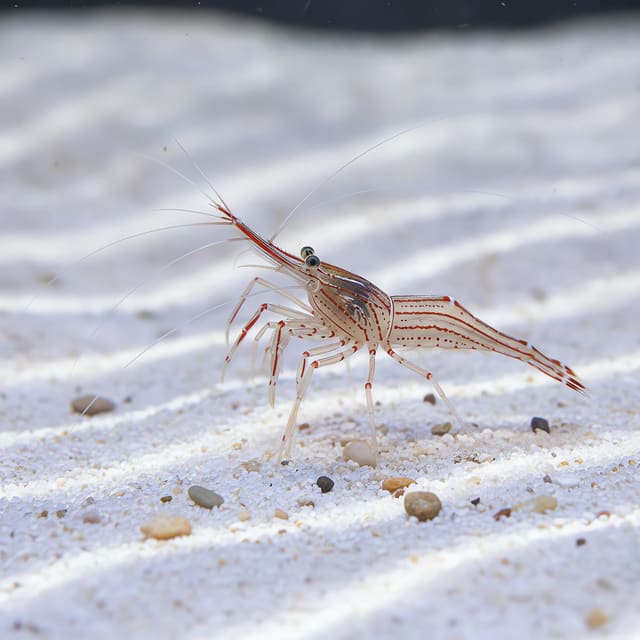
The camel shrimp, Rhynchocinetes durbanensis, is a small marine shrimp from the Indo-Pacific. Its translucent body is crossed by red and white lines and dotted with white spots, and it has a pair of large black eyes. It is also known as the hingebeak prawn. Adults reach about 4 cm, so this is an animal for close viewing among rockwork rather than a bold centrepiece.
It rewards keepers who enjoy small details. The pattern of lines and spots is best appreciated from a few centimetres away, and because the species naturally lives in company, a planned group working its way through the rock makes a very different display from a single fish in open water.
Everything about keeping it well follows from where it lives. Wild camel shrimp shelter in hollows and crevices, often in groups of dozens, so the aquarium needs to be fully marine, properly matured and built with enough rock for the shrimp to tuck itself away. Just as important is the company it keeps: a 4 cm crustacean is food to any fish that hunts shrimp.
| Suits | An established marine aquarium with plenty of rock crevices and peaceful, reef-safe fish |
|---|---|
| Think twice if | The tank is newly set up, sparsely decorated or home to fish that eat crustaceans |
| Adult size | Up to about 4 cm |
| Water | Seawater at salinity 1.023–1.026, 24–26°C and pH 7.9–8.3 on OATA’s broad guide for marine crustaceans |
| Food | Small frozen foods, nori and pellets alongside whatever it grazes from the rock |
| Set-up | A mature filter, generous live or artificial rock and steady salinity |
| Company | Reef-safe fish, and other camel shrimp when there are crevices for all of them |
Some marine shrimps are bought to do a job. OATA notes that peppermint shrimp will eat unwanted Aiptasia anemones and that cleaner shrimp may eat parasites on larger fish. The camel shrimp is not sold for either role. Choose it for its intricate markings, for the way it brings the rockwork to life and for the chance to keep a crevice-dwelling species in conditions that suit its natural habits.
A camel shrimp can be kept in a fish-only marine aquarium or in a reef system, provided the fish are reef-safe and the rockwork is generous. A reef adds one more layer of planning: OATA notes that water parameters in a reef are adjusted for the more sensitive animals in it, and the tank mates section below explains how to approach corals and other invertebrates.
Run through this short list first. If every point is already true of your aquarium, a camel shrimp should slot in without major changes:
Each purchase is one live camel shrimp. The listing has a single option and does not name a body length, so the shrimp that arrives may still be growing towards its adult size. Like other crustaceans it grows in steps, shedding its shell each time. Sex is guaranteed only when the selected option explicitly states male or female. This Rhynchocinetes durbanensis listing has no sex-guaranteed option. If you would like several, order the number you want; the section on keeping more than one explains how to plan for a group.
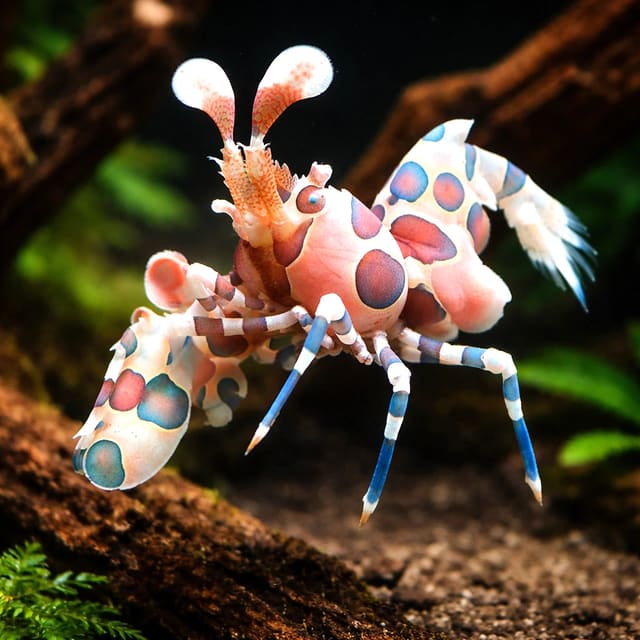
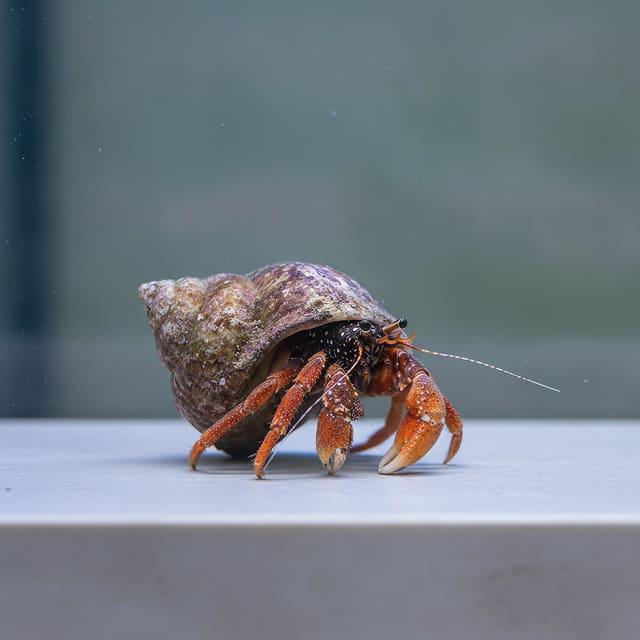
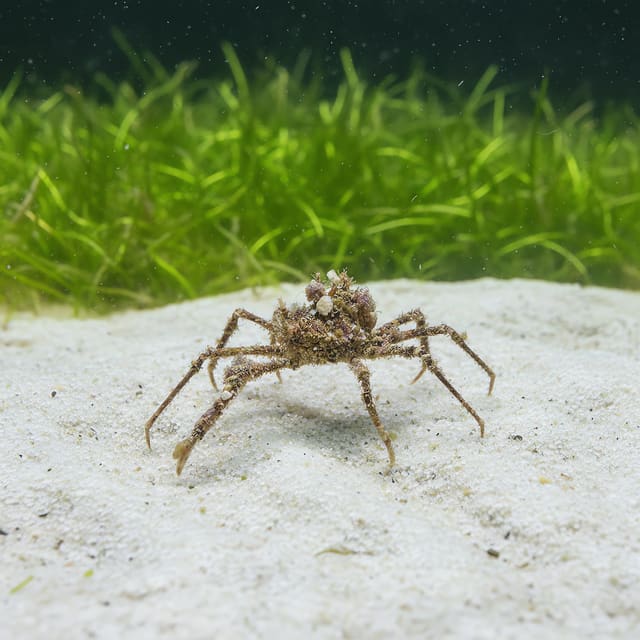
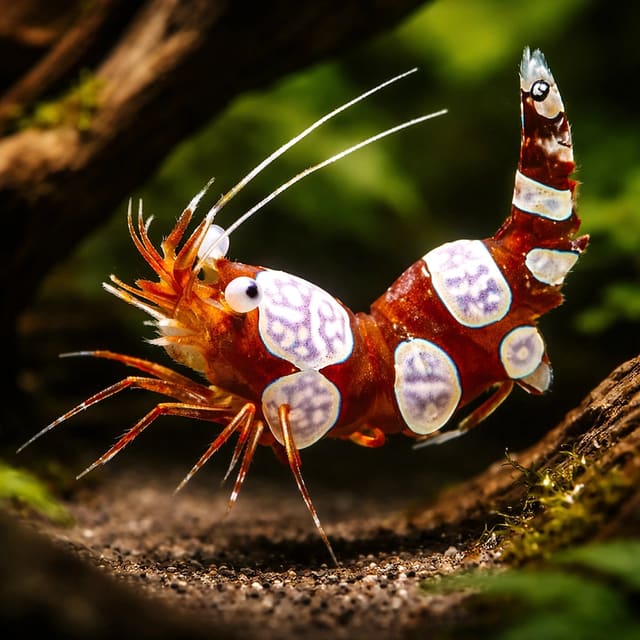
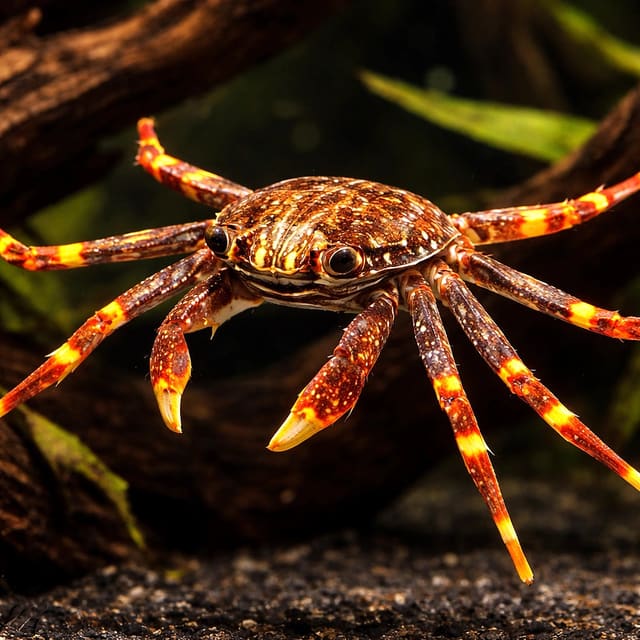
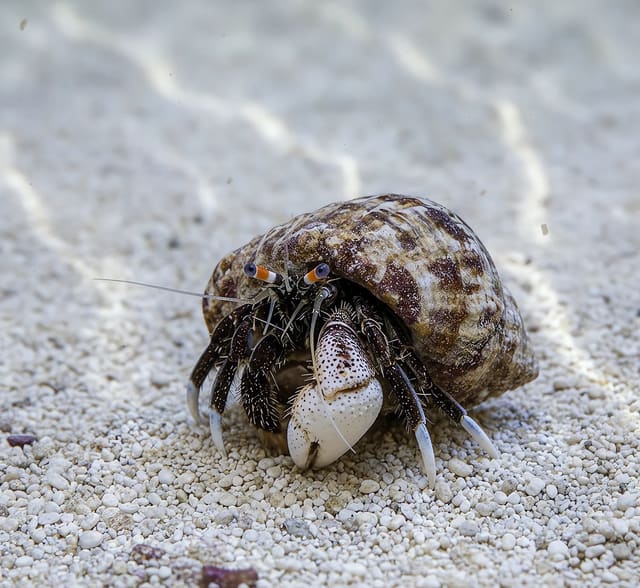
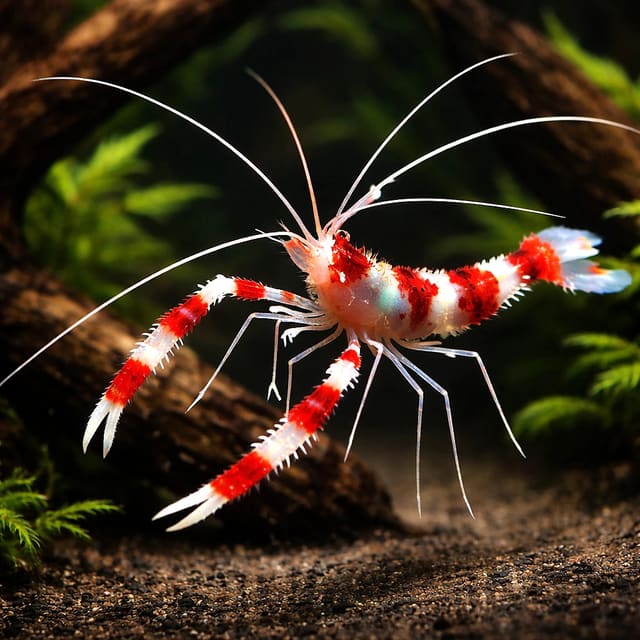
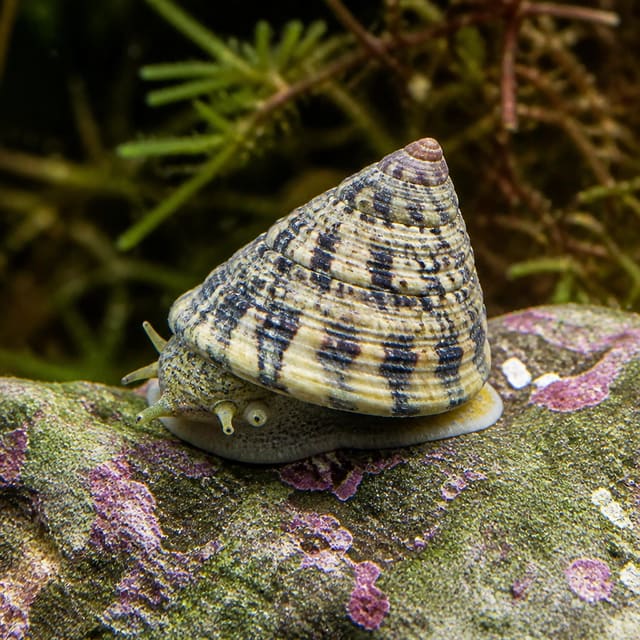
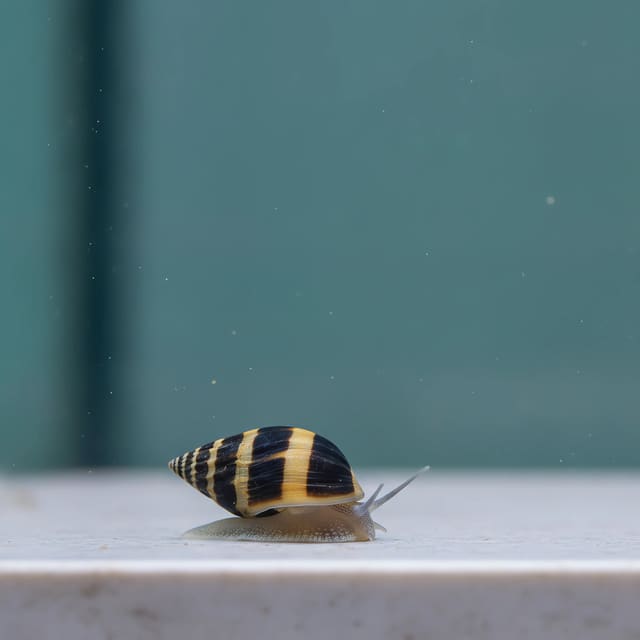
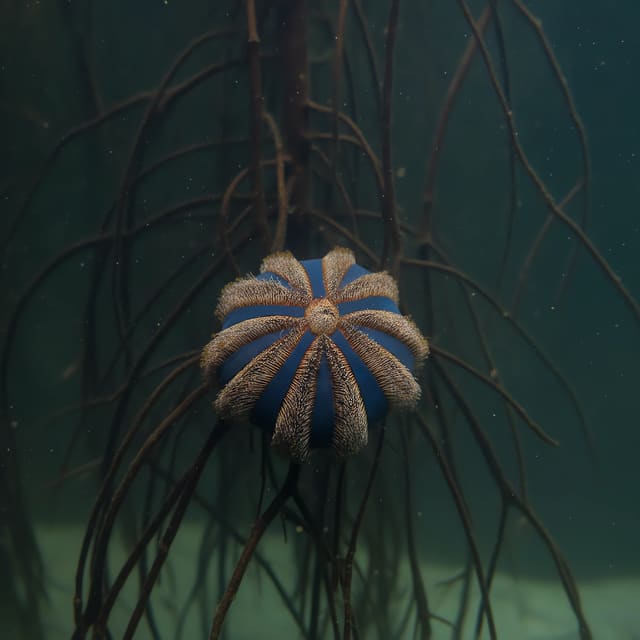
Gallery images have been digitally enhanced to improve image quality. Natural colour, pattern, size and maturity can vary between live animals. Whatever the backdrop in a photograph, this is a fully marine animal: plan for seawater and rock, not wood and green leaves. If you are putting together a wider group of reef animals, you can compare it with other shrimps, crabs and snails in our marine invertebrates collection.
Close up, the camel shrimp is a surprisingly detailed animal. The body is translucent, crossed by red and white lines, with many small white spots (ocelli) scattered across the shell and a Y-shaped white mark on the upper front part of the carapace, the section of shell that covers the head and front of the body. The eyes are large and black. These are the features described in the species account for Rhynchocinetes durbanensis, and they are the ones worth looking for when your shrimp is settled and moving about in the open.
In English the species goes by two common names, camel shrimp and hingebeak prawn. It was first described scientifically by Isabella Gordon in 1936. The World Register of Marine Species lists Rhynchocinetes durbanensis Gordon, 1936 as an accepted species in the family Rhynchocinetidae, within the decapod crustaceans, the same order that includes crabs and lobsters. That accepted name is the one we use throughout this page.
Rhynchocinetes durbanensis has frequently been confused with Rhynchocinetes uritai, and it closely resembles Rhynchocinetes brucei. In practice that means names and photographs of “camel shrimp” can be mixed up between these relatives. When you compare pictures, the Y-shaped white mark on the front of the carapace and the pattern of white spots are the details this species is described with.
The species is strongly sexually dimorphic. Dominant males develop a noticeably larger first pair of chelipeds, the claw-bearing front legs. The difference is described for dominant males, so a young or less dominant male may not show it clearly, and claw size alone is not a dependable way to sex a small shrimp. Sex is not selected for this listing, as explained in the overview.
Camel shrimp are found across the Indo-Pacific. They live in hollows and crevices from 5 to 35 metres deep, where they form groups of dozens of individuals. Those two facts, a life spent in crevices and a habit of living together, are the most useful guide you have to building a home for one.
None of this calls for an unusual set-up. A well-run marine aquarium with generous rockwork already provides most of what a camel shrimp needs; the planning work is in choosing its neighbours and in keeping the water stable.
The Ornamental Aquatic Trade Association (OATA) advises buying an aquarium as large as you reasonably can, and recommends at least 40 litres for smaller species of crabs and shrimps. Larger crustaceans need larger tanks. OATA’s own examples run from the sexy shrimp at about 2 cm to the blue spiny lobster at over 30 cm. At about 4 cm the camel shrimp sits towards the small end of that range, so 40 litres is the floor rather than the goal: extra rock, more fish or a small group of shrimp all call for more water, and a larger volume is also slower to change when something goes wrong.
A filter is essential whatever the size of the tank. For marine aquariums OATA lists three workable approaches: live rock with sufficient water movement, an internal or external filter, or a sump-based system. A protein skimmer is useful too, because it removes dissolved organic waste before it breaks down into more harmful substances.
The filter matters because of what it houses. As the RSPCA’s guidance on aquarium filtration explains, a working biological filter supports beneficial bacteria that convert toxic ammonia into nitrite, which is also toxic, and then into the less harmful nitrate. A camel shrimp relies on that process running smoothly every day.
Marine crustaceans need very little in the way of decoration, but live or artificial rock is essential. It gives the shrimp surfaces to graze and gives freshly moulted animals somewhere to hide. For this species, build the rock so it creates real crevices rather than a solid wall:
Add the camel shrimp to an aquarium that has already matured, not to a tank that is still cycling. OATA explains that stocking too quickly can cause “new tank syndrome”: the nitrifying bacteria cannot keep up with the extra waste, ammonia and nitrite rise, and invertebrates can become ill or die. Before the shrimp arrives, test the water and confirm that ammonia and nitrite are both at zero. After it arrives, increase the number of animals slowly so the bacterial population has time to grow with the feeding.
Marine crustaceans are usually undemanding of water chemistry. The figures below come from the OATA care sheet for marine crustaceans, a general guide for the group as a whole, not a species-specific optimum for camel shrimp. Use them to set a steady routine, and aim for consistency above all.
| Parameter | OATA guide for marine crustaceans |
|---|---|
| Salinity (specific gravity) | 1.023–1.026 |
| Temperature | 24–26°C |
| pH | 7.9–8.3 |
| Ammonia | Zero mg per litre |
| Nitrite | Zero mg per litre |
| Nitrate | Not above 50 mg per litre |
| Carbonate hardness | 8–12 dKH |
| Calcium | 380–450 ppm |
| Magnesium | 1250–1350 ppm |
If the shrimp is going into a reef aquarium, OATA notes that some of these parameters will need adjusting to suit the more sensitive species in the system. In practice a reef is run to the needs of its corals, and the shrimp is then kept within that stable routine; what matters most for the shrimp is that the values do not swing.
Crustaceans can be stressed by even the smallest amounts of ammonia and nitrite, and that stress can lead on to disease. A reading that looks “only slightly” above zero is therefore worth acting on. Keep a simple log of your test results so you can spot a drift before it turns into a problem, and test again after any change to stocking, feeding or equipment.
Salinity is usually read as specific gravity with a hydrometer or refractometer, and the 1.023–1.026 band above is the range to hold. Evaporation removes water but leaves the salt behind, so salinity creeps upwards between top-ups. Replace evaporated water with fresh water prepared for aquarium use rather than more seawater, and check the reading again afterwards. Small, regular top-ups keep the shrimp in steadier conditions than one large correction.
The routine target in this guide is the 24–26°C band. You may come across higher and lower temperatures in research on this species’ eggs, described in the reproduction section; those were study conditions, not recommendations for keeping the shrimp.
OATA’s guidance for marine crustaceans is that most species are omnivorous, taking algae, detritus and small meaty items. A varied diet is the goal, and the care sheet suggests three simple building blocks:
Larger crustaceans such as lobsters need bigger meaty pieces, for example lancefish, cockles or mussels. A 4 cm camel shrimp is at the other end of that scale, so keep portions small and choose foods it can handle easily.
Part of a camel shrimp’s food comes from what it picks off mature rock. OATA points out that crustaceans kept to graze algae need extra algae, such as nori sheets, once they have eaten what the tank provides. The same logic applies here: in a very clean or newly aquascaped tank, add a small piece of nori so the plant part of the diet is not missing.
Many crustaceans graze throughout the day, so there is no fixed number of meals to follow. How much extra food a camel shrimp needs depends on what it can find for itself in the aquarium, and a tank with plenty of mature rock offers more to pick over than a new one. When you do add food, offer small amounts and watch what happens to it.
Overfeeding is the easy mistake. Uneaten food builds up and breaks down, releasing toxic waste into the water, and that is exactly the kind of ammonia and nitrite rise crustaceans handle badly. If you find food still lying on the rock or sand some time after feeding, cut the amount next time.
In a tank with fish, food is often eaten before it reaches the rock. Watch the shrimp for a few feeds after it arrives and check that some food is reaching it; if it is not, let a little sink close to its preferred crevice rather than simply adding more for everyone.
Like all crustaceans, the camel shrimp has a hard outer skeleton and sheds it in order to grow. Finding an empty shell in the aquarium is common. After a moult the new exoskeleton takes a couple of days to harden, and the shrimp will often hide during that time. If you spot what looks like a whole shrimp lying still on the rock, check whether it is simply a cast shell before assuming the worst.
This soft-shelled window is when good rockwork earns its place. A shrimp that can retreat into a crevice while its shell hardens is far less exposed to curious tank mates.
Every shrimp behaves a little differently, but OATA suggests watching for changes in these areas so that problems are caught early:
Most of these signs point back to the aquarium itself, so start with a water test for ammonia, nitrite and nitrate, and check salinity and temperature against your usual readings. Before adding any treatment to a tank that holds a camel shrimp, read the label for warnings about invertebrates and follow them.
Good husbandry is what keeps crustaceans healthy, and the routine is straightforward. Following OATA’s maintenance advice:
Nitrate is the end point of the filter’s work, so it builds up steadily between water changes. OATA’s guide keeps it no higher than 50 mg per litre, and regular partial water changes are the simplest way to hold it there. A steady weekly rhythm is kinder to a small shrimp than occasional large clean-ups, which change the water faster than it can adjust.
| When | What to do |
|---|---|
| Every day | Look for the shrimp at feeding time, note anything unusual and check the temperature |
| At least once a week | A 25% partial water change with matched seawater, plus tests for ammonia, nitrite, nitrate and pH |
| As needed | Top up evaporation with fresh water, rinse filter media in removed aquarium water and clean the protein skimmer |
Get the aquarium ready in advance: ammonia and nitrite at zero, salinity and temperature in your usual range, and a crevice or two where the new shrimp can settle. Everything is hand-packed by our team. Your shrimp is bagged in pure oxygen inside an insulated box, with a heat pack when the weather calls for it, and travels with a licensed live-animal courier. We email you the tracking number and your confirmed delivery date so you know when to be in, and you can follow the parcel once tracking is active.
If anything has gone wrong, contact us the same day, with WhatsApp the quickest route, and send your order number and the unboxing video; we will arrange a replacement or refund. The full terms are on our delivery and Live Arrival Guarantee page, which also has short clips from our own fishroom on unpacking and acclimatising.
Expect the shrimp to find a crevice and explore from there. Feed the tank as usual and check over the next few feeds that it is getting some food. Hold off on adding further animals for a while so the filter can adjust to the new arrival.
Wild camel shrimp form groups of dozens in hollows and crevices, so the species is used to living alongside its own kind. A small group can make an eye-catching display, but it works best when it is planned rather than improvised.
Start with one or two, watch how they use the rock over the following weeks, and grow the group from there.
The reproduction figures for this species come from scientific study. Females carrying eggs are described as ovigerous, and one study found that they carry between 267 and 1764 eggs. In the same study the eggs took 9 days to hatch after spawning at 29.2°C, or 18 days when the temperature was below 22.0°C.
Buy camel shrimp for their markings and the interest they bring to a rock-filled tank, and treat any eggs you see as a bonus.
Marine crustaceans vary in how well they mix with other animals, so plan the camel shrimp’s neighbours before it arrives. At about 4 cm it is small enough that the main risk runs one way: from fish and crustaceans that might eat it.
OATA’s rule for marine crustaceans is clear. They will generally mix with fish considered “reef-safe”, but fish that are not reef-safe are likely to prey on them and should not be kept with them. Check the reputation of every fish in the tank, and of any you plan to add later, before the shrimp goes in; a fish that tolerates the shrimp at first can become a problem as it grows.
Some scavengers, lobsters and crabs in particular, are opportunistic and may prey on slow-moving tank mates, so they need to be mixed carefully. A camel shrimp is most exposed just after a moult, when its new shell is still soft, which is another reason to give it plenty of crevices.
If your tank also holds hermit crabs, give them ample food and plenty of spare shells. OATA explains that this stops them attacking snails for their shells.
Several camel shrimp can share one aquarium, as described in the care section on keeping more than one. Dominant males grow larger front claws, so a group will not be uniform; give each animal its own retreat.
Because marine crustaceans differ so much from one species to the next, plan any coral or mixed-invertebrate display individually. Add the shrimp where you can watch it closely for the first weeks, and be ready to move it if it takes an interest in its neighbours. If you are unsure about a particular combination, we are happy to talk it through before you order.
| Tank mate | Guidance |
|---|---|
| Reef-safe fish | Generally a good match |
| Fish that are not reef-safe | Keep apart; likely to prey on the shrimp |
| Crabs and lobsters | Mix carefully; opportunistic scavengers |
| Other camel shrimp | Workable with enough crevices for each |
Adults reach about 4 cm in length, which puts it among the smaller marine crustaceans. The shrimp you receive may be smaller and still growing; like other crustaceans it grows in steps, shedding its shell each time.
OATA recommends an aquarium of at least 40 litres for smaller species of crabs and shrimps, and as large as you can reasonably manage. It should be a mature marine system with a working filter and plenty of live or artificial rock arranged into crevices. A group of shrimp, or shrimp alongside fish, needs more space than that starting point.
Wild shrimp of this species live in groups of dozens, sheltering in hollows and crevices. Several can share an aquarium when there is enough rock for each to have its own retreat; add them gradually so the filter can keep up.
It suits a keeper who already runs a stable, mature marine aquarium. Marine crustaceans are usually undemanding of water chemistry, but they can be stressed by even small amounts of ammonia and nitrite, so a new or unsettled tank is the wrong place to start.
OATA describes most marine crustaceans as omnivores that take algae, detritus and small meaty items. Offer a varied mix such as nori sheets, small frozen foods like brine shrimp and pellets, and avoid overfeeding, because uneaten food fouls the water.
OATA’s broad guidance for marine crustaceans is 24–26°C, pH 7.9–8.3, salinity 1.023–1.026 and carbonate hardness 8–12 dKH, with ammonia and nitrite at zero. Stable readings matter more than hitting an exact number.
Marine crustaceans generally mix with fish considered reef-safe. Fish that are not reef-safe are likely to prey on them and should be kept apart, while crabs and lobsters are opportunistic scavengers that need to be mixed carefully.
It is hand-bagged in pure oxygen in an insulated box and carried by a licensed live-animal courier. Someone must be in to receive it. Film a continuous unboxing video from the sealed parcel, open and inspect it the same day, then float the sealed bag for 20–30 minutes and release the shrimp without the bag water. Contact us the same day with the video if anything is wrong under our Live Arrival Guarantee.
These are the public sources behind the care and identification advice on this page.
No reviews for this item yet. Bought one? Honest reviews only, good or bad.
What customers say about ordering from us
Easy website plenty of info on fish your buying great to pick a time slot
TRACEY DURRANT · 7 Oct 2026
Got some lovely fish thank you
Kevin Mackie · 7 Oct 2026
Reviews of our shop, collected by Judge.me, an independent third-party review collector. Newest first.