


Moderate
Red Fin Cichlid 4-7 cm (Tropheops tropheops)
24–28°C · pH 7.5–8.5 · 250L
£11.99

Territorial Lake Malawi mbuna for hard, alkaline rock aquariums. Best for 250L+ setups with vegetable-led feeding and robust cichlid tank mates.
Adult size is the maximum length this species reaches at full maturity (scientific sources). The livestock you receive will be younger and smaller — pick a size variant above for the actual shipping size. Photos are AI-enhanced, so the animal may show subtle colour or marking differences.
Tropheops tropheops
Red Fin Cichlid are a shoaling species — they need 6+ to feel safe and show their full colour.
Territorial Lake Malawi mbuna for hard, alkaline rock aquariums. Best for 250L+ setups with vegetable-led feeding and robust cichlid tank mates.
Adult size is the maximum length this species reaches at full maturity (scientific sources). The livestock you receive will be younger and smaller — pick a size variant above for the actual shipping size. Photos are AI-enhanced, so the animal may show subtle colour or marking differences.

Cichlids are one of the most diverse fish families in the hobby. From tiny apistogrammas to massive oscars, this guide covers the basics of keeping them well.
Maintain these water conditions for optimal health and vibrant colors
The Red Fin Cichlid, Tropheops tropheops, is one of the most eye-catching aquarium livestock that aquarists can add to a rocky African setup. Known for its bold body shape, vivid red-orange fin edging, and classic Mbuna attitude, this Lake Malawi cichlid UK favourite brings movement, colour, and strong personality to medium and large aquariums. Adults reach around 14 cm, can live up to 8 years, and are best described as a moderate-care fish with assertive, territorial behaviour. That makes the species a strong choice for fishkeepers moving beyond a basic tropical fish tank beginner's guide and into more specialised African cichlid UK keeping.
When comparing Red Fin Cichlid (Tropheops tropheops) with similar livestock, focus on clear identification, settled feeding, accurate care guidance, careful packing and a realistic match for your aquarium. Those details matter far more than a low headline price, especially with specialist species.
Tropheops tropheops belongs to the rock-dwelling Mbuna group from Lake Malawi. In the aquarium hobby, the Red Fin Cichlid Fish is valued for its algae-grazing behaviour, compact but muscular body, and strong territorial displays. It sits alongside other popular African cichlids kept in hard, alkaline water, but it has its own appeal thanks to its red-edged finnage and active mid-level swimming style.
The Red Fin Cichlid comes from Lake Malawi in East Africa, where it inhabits rocky shoreline zones with strong light, mineral-rich water, and plenty of algae-covered surfaces. In the wild, this species spends much of its day browsing aufwuchs, the natural mix of algae, tiny crustaceans, microorganisms, and organic film that grows over stones. That wild feeding style explains why a correct red fin cichlid diet in captivity should focus on plant-based foods rather than rich meaty fare.
This is not a fish from a soft, tannin-stained river. It evolved in a stable, alkaline environment, so red fin cichlid hard water care is essential. The natural habitat has excellent clarity and oxygenation, which is why hobbyists asking why is my tropical fish tank cloudy, why my tropical fish tank is cloudy, or why does my tropical fish tank smell should see those as warning signs that their Malawi setup is drifting away from what this species needs. A healthy tropical fish tank ecosystem for this fish is bright, rocky, clean, and biologically mature.
Because it is a rock-dwelling Mbuna, the species uses crevices for shelter, spawning, and social boundaries. That makes the red fin cichlid Malawi tank setup very different from a planted community aquarium. While some keepers search for what tropical fish keep the tank clean or which tropical fish clean the tank, Red Fin Cichlids do help graze surfaces, but they are not a substitute for maintenance. They are best understood as active herbivorous cichlids, not janitors.
In UK fishkeeping, they remain a solid choice for anyone building a dedicated all pond solutions tropical fish style Malawi system or comparing this fish against a red fin cichlid or alternative species for a large rocky display. They are not pond fish, despite searches such as tropical fish pond uk or tropical fish pond royal oak; they require heated indoor aquariums with stable chemistry.
Mimicking the natural rocky habitat improves colour, lowers stress, and reduces line-of-sight aggression. In practice, that means stacked rock piles, multiple caves, and open swimming lanes rather than a sparse tank with one decorative ornament.
The most important part of any red fin cichlid care guide is accepting that this species needs space, structure, and stable water. The red fin cichlid minimum tank size is 250 litres, but a longer tank with a broad footprint is better than a tall narrow one. A 100cm tropical fish tank is a practical starting point for a small group, while a 60cm tropical fish tank is too small for long-term care. This is not one of the what tropical fish can live in a small tank species.
The best social arrangement is usually one male with three or more females, or a carefully balanced group in an overstocked Mbuna setup designed to spread aggression. That means the ideal red fin cichlid tank size depends on stock plan, but 250-350 litres is far safer than trying to force them into a compact aquarium. If you are asking what size tank for tropical fish, what size tropical fish tank, or what tank do you need for tropical fish, this species belongs firmly in the medium-to-large category.
The correct red fin cichlid temperature is 24-28°C, with 25-26°C working well for routine care. If you have ever wondered what temp is tropical fish tank, what temp tropical fish tank, or what temperature should a tropical fish tank be kept at, the answer depends on species, and for this one the safe tropical fish tank temperature range is warm, stable, and never allowed to swing sharply. The red fin cichlid ideal temperature sits in the middle of that range, especially in mixed Mbuna systems.
Aim for pH 7.5-8.5 and hardness 10-25 dGH. For keepers asking what ph for tropical fish tank, what should tropical fish tank ph be, what should my tropical fish tank levels be, or what should tropical fish tank levels be, this species wants alkaline, mineral-rich water rather than neutral community conditions. The temperature of tropical fish tank, pH, and hardness should all be consistent. Sudden shifts stress fish and increase aggression.
A strong tropical fish tank filter and heater combination is essential because Mbuna are active, messy, and often stocked in numbers. Use a canister filter or a high-capacity internal filter rated above the tank volume. If you are planning a tropical fish tank complete setup, include mechanical and biological filtration, surface agitation, and a reliable tropical fish tank heater. Many keepers search for a tropical fish tank heater and filter or tropical fish tank heater position; place the heater where water flow is strong so heat spreads evenly.
The correct tropical fish tank heater setting should match the species, not a generic label on the box. For Red Fin Cichlids, set it around 25-26°C and verify with a thermometer. Questions like what should tropical fish tank temperature be, what temperature does tropical fish tank need to be, and what temperature should you keep a tropical fish tank all come back to species-specific needs. If the tropical fish tank temperature too hot, oxygen drops and stress rises quickly.
Use sand or fine gravel with piles of stable rockwork. Build caves directly on the tank base before adding substrate so digging fish cannot undermine the structure. This species is not ideal as a red fin cichlid for planted aquarium centrepiece, because many Mbuna nip or uproot soft plants. If customers ask what plants for tropical fish tank, hardy options like Anubias attached to rock and Vallisneria in protected spots can work, but a rocky aquascape is usually best.
For a dedicated Malawi display, consider compatible cichlids such as the Yellow Elongatus Cichlid - Chindongo Elongatus or the Rubin Red Peacock Cichlid - Aulonocara only if you understand the temperament differences. If you are still at the stage of tropical fish tank how to set up or what do you need for a tropical fish tank, prioritise tank volume, filtration, heater, rocks, test kit, dechlorinator, and a mature nitrogen cycle before fish.
Always cycle the aquarium for 4-6 weeks before adding Mbuna. A rushed setup is the main reason new keepers struggle with ammonia, aggression, and cloudy water in a fresh Malawi tank.
The red fin cichlid diet should be herbivore-focused. In the wild, these fish graze algae and biofilm from rocks, so captive feeding must lean heavily toward spirulina flakes, quality herbivore cichlid pellets, algae wafers, and blanched greens such as spinach, courgette, or shelled peas. This is one of the biggest differences between proper Mbuna care and the feeding habits used for carnivorous cichlids.
A common mistake is offering too much protein. Bloodworm, beefheart, or rich meaty foods can trigger digestive stress and Malawi bloat. That is why the best staple foods are plant-based and high in fibre. If you are searching pet fish food shop online, think beyond convenience and choose foods made specifically for herbivorous African cichlids. Good feeding also helps reduce opportunistic picking at tropical fish tank algae, though some grazing is natural and healthy.
Feed spirulina flakes or herbivore cichlid pellets once or twice daily. A good routine is small portions they can finish in 30-60 seconds. This keeps waste down and supports colour, digestion, and stable water quality. Overfeeding quickly worsens tropical fish tank brown algae, tropical fish tank green algae, and poor clarity because excess nutrients feed nuisance growth.
Supplement with algae wafers, blanched lettuce, spinach, or courgette slices. In a mature setup, fish will also browse naturally on rock surfaces. If you are using live plants, remember that heavy feeding and light imbalance can increase tropical fish tank hair algae or tropical fish tank black hair algae. Balanced feeding is one part of effective tropical fish tank algae treatment.
| Time | Food | Amount |
|---|---|---|
| Morning | Spirulina flakes or herbivore pellets | Small pinch, eaten within 1 minute |
| Evening | Algae wafer or blanched vegetable | Light portion, remove leftovers after 2 hours |
Use a quality tropical fish tank heater and stable tropical fish tank water temperature because digestion slows in cool water and stress rises in fluctuating conditions. In a properly heated system, fish feed more consistently and show better colour.
Overfeeding causes ammonia spikes, dirty filters, and digestive issues. For Mbuna, too much animal protein is especially risky and can lead to bloat, lethargy, and sudden losses.
A useful comparison species if you are building a herbivore-focused Mbuna feeding routine and want fish with similar dietary needs.
Another algae-grazing cichlid type often researched by keepers interested in structured vegetable-heavy feeding plans.
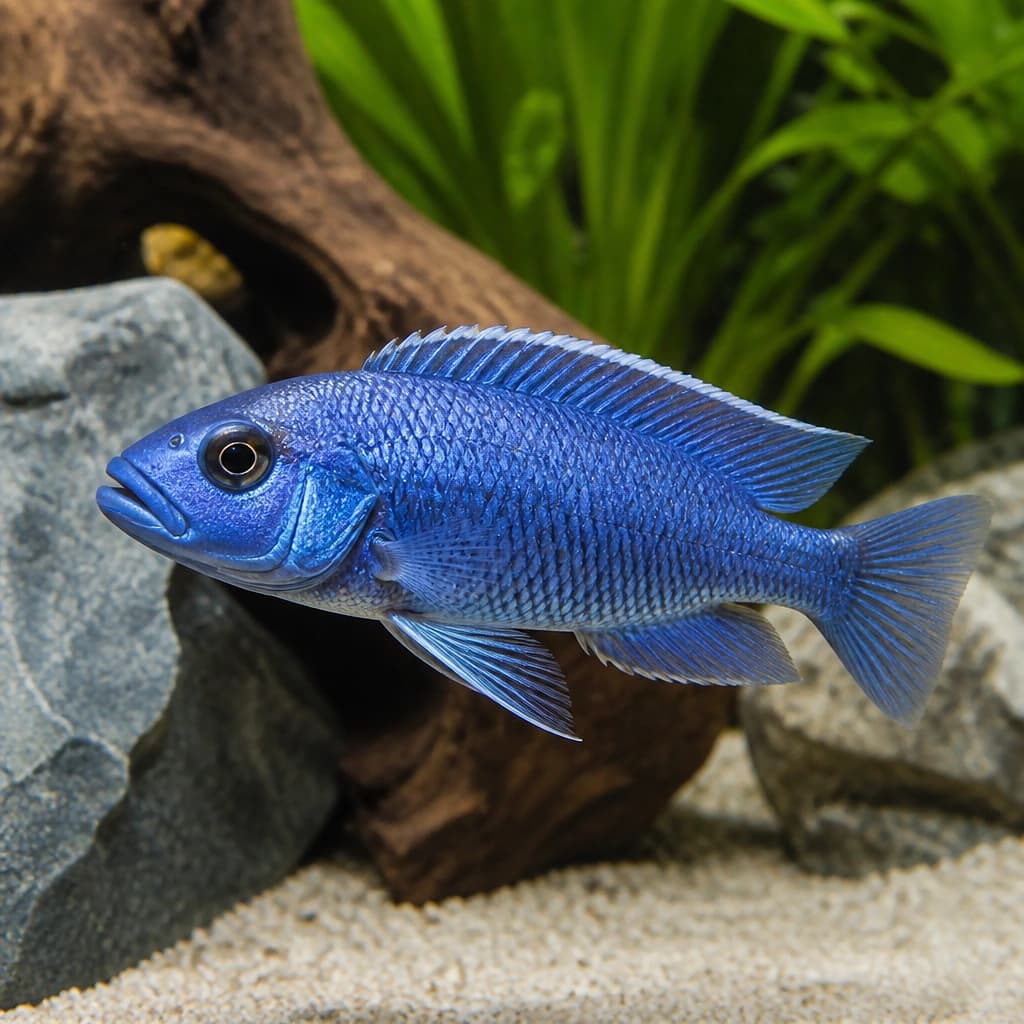
The Red Fin Cichlid is a sturdy, laterally compressed Mbuna with a sloping forehead, strong jawline, and continuous dorsal fin. Adult size reaches around 14 cm, making it a medium cichlid with enough presence to stand out in a mixed rock-dweller display. The body colour can vary with mood, hierarchy, and locality, but many specimens show earthy brown, bronze, or bluish tones contrasted by warm red to orange edging on the fins.
In good conditions, males usually display stronger colour than females, especially when holding territory. Females tend to be subtler, though healthy females still show attractive contrast and body sheen. This is why our photos show the intense finnage and body tone achieved through proper diet, hard alkaline water, and low-stress housing. If you are comparing red fin cichlid for beginners options, appearance is a major reason hobbyists choose this species once they are ready for a more assertive fish.
Good lighting and dark rock backgrounds help the fin colour stand out. A pale substrate can brighten the whole tank, while dark caves give fish security. The species is best viewed in a longer aquarium where individuals can establish territories without constant collision. In terms of red fin cichlid water conditions, colour is strongest when the fish are kept in the correct alkaline range with low nitrate and a stable red fin cichlid ideal temperature.
The short answer is that red fin cichlid tank mates must be chosen carefully. This is not a peaceful community tropical fish species in the same sense as tetras, rasboras, or livebearers. Anyone searching red fin cichlid community tank or red fin cichlid for community tank should think in terms of a robust African cichlid community, not a mixed beginner aquarium. The fish is territorial, especially males, and it defends rockwork actively.
The best red fin cichlid compatible fish are other assertive Mbuna of similar size and temperament, plus tough bottom-dwellers such as Synodontis catfish. Good options to research include the Yellow Elongatus Cichlid - Chindongo Elongatus, Orange I Blunthead Cichlid - Tropheus, and in some larger, carefully managed displays, species such as Aulonocara kandeense or the Aulonocara Sp Neon Red Calico Peacock may be considered with caution due to different temperaments and feeding styles.
If you are building a tropical fish tank mates chart, place Red Fin Cichlids in the “aggressive African cichlid” category. Avoid tiny fish, slow fish, long-finned fish, shrimp, and most snails. People often ask what tropical aquarium fish eat snails; while this species is not a specialist snail hunter, it may harass invertebrates and certainly should not be trusted with ornamental shrimp. It is also a poor match for peaceful South American cichlids such as Guianacara Dacrya - South American Cichlid or Thorichthys Maculipinnis - Elliot'S Cichlid - because water chemistry and temperament differ.
For stocking, many keepers deliberately overstock Mbuna tanks slightly to spread aggression, but that only works with excellent filtration and disciplined maintenance. If you are learning how to maintain tropical fish tank, how to keep tropical fish tank clean, or how to keep tropical fish tank water clear, understand that a busy Mbuna aquarium demands regular testing, filter care, and weekly water changes.
| Species | Compatible? | Notes |
|---|---|---|
| Yellow Elongatus Cichlid - Chindongo Elongatus | ✅ Yes | Similar Malawi requirements and robust enough for Mbuna-style setups. |
| Rubin Red Peacock Cichlid - Aulonocara | ⚠️ Caution | Possible only in larger tanks; peacocks are often less aggressive and need careful feeding balance. |
| Shrimp, small tetras, guppies | ❌ Avoid | Too small, too peaceful, and unsuitable for hard alkaline Mbuna conditions. |
When people search best tank mates for red fin cichlid or tropical fish tank mates, the answer is always species with matching water chemistry, body shape, and confidence level. This fish should not be mixed into a random “assorted tropicals” setup. It also is not one of the tropical fish for beginners if the goal is a peaceful community.
Always quarantine new arrivals for 2-4 weeks before adding them to a Malawi tank. This protects established fish from parasites and gives you time to observe feeding response, waste, and any signs of stress.
Red fin cichlid breeding is considered relatively easy once the fish are mature, healthy, and kept in the correct social ratio. Like many Mbuna, they are maternal mouthbrooders. The ideal setup is a red fin cichlid breeding pair or, more realistically, one male with several females in a rocky species group. A dominant male will claim a flat stone or cave entrance and intensify in colour when ready to spawn.
Breeding usually starts after heavy conditioning on a proper herbivore diet and stable water. If you are wondering what is tropical fish tank breeding success built on, the answer is mature filtration, stable chemistry, and low chronic stress. Keep pH in the alkaline range and maintain the correct red fin cichlid ideal temperature around 25-27°C. Many breeders ask about tropical fish tank eggs or even yellow eggs in tropical fish tank; with this species, eggs are usually picked up by the female almost immediately, so you may never see them resting on the substrate.
After spawning, the female holds the eggs and later fry in her mouth for roughly 18-24 days depending on temperature and individual fish. During this period she may eat very little. Some breeders strip fry artificially, but many hobbyists prefer to let the female release naturally in a quiet rearing tank. Once free-swimming, fry can be fed finely crushed spirulina flake and powdered herbivore foods several times daily.
If you are planning a breeding project, remember that what should tropical fish tank levels be matters even more with brooding females. Nitrate should stay low, pH stable, and oxygen high. A sudden drop in water quality can cause a female to spit early or swallow the brood. This species is not suitable for a tiny nursery; even fry do best in clean, heated, filtered water with regular small changes.
To improve fry survival, move holding females only if absolutely necessary and only after the first week of brooding. Moving them too early often causes stress-spitting, while moving them too late can mean fry are released in the main tank and quickly eaten.
Many fishkeepers comparing Malawi cichlids want to know whether the Red Fin Cichlid is the right fit or whether another species would suit their tank better. The answer depends on aggression level, colour preference, and whether you want a classic Mbuna rock grazer or a slightly calmer display fish.
| Feature | Red Fin Cichlid | Yellow Elongatus Cichlid |
|---|---|---|
| Max Size | 14 cm | 12-13 cm |
| Care Level | Moderate | Moderate |
| Temperature | 24-28°C | 24-28°C |
| Price | £8.71 | Varies |
| Best For | Rocky Mbuna displays with strong structure | Bright mixed Mbuna communities |
| Feature | Red Fin Cichlid | Rubin Red Peacock Cichlid |
|---|---|---|
| Temperament | Aggressive, territorial | Moderately assertive |
| Diet Focus | Herbivore | Omnivore/insectivore leaning |
| Decor Style | Heavy rockwork | Open sand with caves |
| Best For | Dedicated Mbuna keeper | Colourful show tank with more open swimming space |
| Mixing Risk | High if tank is small | Needs careful stock planning with Mbuna |
Choose the Red Fin Cichlid if you want a classic rock-dwelling Mbuna with strong grazing behaviour, bold finnage, and interesting territorial displays. If you want a calmer fish for a more mixed display, the Rubin Red Peacock Cichlid - Aulonocara or Aulonocara kandeense may be easier choices. If you want another active algae-focused cichlid, the Kiriza Yellow Cichlid - Tropheus Moorii is often researched by hobbyists looking at similar behaviour patterns.
A healthy Red Fin Cichlid is alert, feeds eagerly, holds good body weight, and patrols its territory with confidence. Faded colour, clamped fins, heavy breathing, hiding, stringy white waste, or a swollen belly are all signs that something is wrong. In Mbuna, the biggest health risks usually come from diet mistakes, poor water quality, and stress from incompatible stocking.
Common tropical fish tank diseases seen in cichlid systems include Malawi bloat, bacterial infections secondary to fighting, white spot, and external parasites. Prevention starts with stable water and correct feeding. If you are asking how to test tropical fish tank water, use a liquid test kit for ammonia, nitrite, nitrate, and pH. If you are asking what chemicals do i need for a tropical fish tank or what chemicals do you need for a tropical fish tank, the essentials are simple: a dechlorinator, possibly buffer support if your source water is too soft, and targeted medication only when genuinely needed.
Good maintenance matters. Learn how to clean tropical fish tank, how to clean small tropical fish tank if you use a grow-out system, and how to change tropical fish tank water safely. Weekly partial water changes of 25-40% are common in Mbuna tanks. Use matched-temperature water and avoid deep-cleaning all filter media at once. If the tank turns milky and you start asking why is tropical fish tank cloudy or why is my tropical fish tank going green, review feeding, lighting, and maintenance rather than adding random cures.
A separate tropical fish quarantine tank is strongly recommended for all new fish. This is especially important when you choose tropical fish online or source multiple fish for a new Malawi setup. Quarantine gives you time to observe appetite, faeces, respiration, and any parasite signs before the fish enters the main display.
Never use medication blindly in an African cichlid tank. Treat the diagnosis, not the symptom, and remember that poor diet and unstable water often cause the same visible stress signs as disease.
The Red Fin Cichlid is active, alert, and highly aware of territory. It spends much of the day cruising the middle levels, darting through rockwork, and grazing surfaces. Males are especially focused on claiming and defending a chosen area, while females move more freely unless brooding.
This is not a schooling species, so the idea of red fin cichlid school size does not apply in the same way it would for tetras. Instead, success depends on social structure and visual barriers. In the right group, you will see chasing, displaying, and grazing behaviour that looks natural rather than chaotic. In the wrong group, one fish may dominate the entire tank.
To encourage natural behaviour, provide layered rock piles, multiple retreats, and enough fish to spread aggression without overloading filtration. This species is a strong choice as a red fin cichlid for large tank centre fish in an Mbuna layout, but not as a peaceful mixed-species showpiece.
When comparing Red Fin Cichlid (Tropheops tropheops) with similar livestock, focus on clear identification, settled feeding, accurate care guidance, careful packing and a realistic match for your aquarium. Those details matter more than repeated search phrases or a low headline price, especially with specialist species.
When comparing Red Fin Cichlid (Tropheops tropheops) with similar livestock, focus on clear identification, settled feeding, accurate care guidance, careful packing and a realistic match for your aquarium. Those details matter more than repeated search phrases or a low headline price, especially with specialist species.
Each order is packed for the season using insulated boxes, secure fish bags, and heat packs in winter where needed. Tracked delivery helps reduce transit uncertainty, and a live arrival guarantee applies in line with our livestock terms. We also include care support so customers moving from Similar species such as fish available pets at home, tropical fish pets at home, or even free tropical fish can make a more informed choice about long-term care. This species is not a casual impulse purchase, and that is exactly why clear guidance matters.
When comparing Red Fin Cichlid (Tropheops tropheops) with similar livestock, focus on clear identification, settled feeding, accurate care guidance, careful packing and a realistic match for your aquarium. Those details matter more than repeated search phrases or a low headline price, especially with specialist species.
Build a stronger Malawi setup with carefully matched species and comparisons. The Yellow Elongatus Cichlid - Chindongo Elongatus is a solid companion for robust Mbuna communities. The Orange I Blunthead Cichlid - Tropheus appeals to keepers who enjoy active grazing cichlids with bold social behaviour. For a brighter show contrast, consider the Rubin Red Peacock Cichlid - Aulonocara or Aulonocara Sp Neon Red Calico Peacock in suitably planned larger systems. If you are comparing regional styles, the Guianacara Dacrya - South American Cichlid and Thorichthys Maculipinnis - Elliot'S Cichlid - show how different cichlid care can be outside hard-water African tanks.
24–28°C · pH 7.5–8.5 · 250L

24–28°C · pH 7.5–8.5 · 250L

23–27°C · pH 7.4–8.4 · 150L

24–28°C · pH 7.5–8.5 · 200L

24–28°C · pH 7.5–8.5 · 200L
24–27°C · pH 7.8–8.6 · 250L

18–26°C · pH 6.5–8 · 30L

23–27°C · pH 7.4–8.4 · 500L

20–27°C · pH 6–7 · 54L

24–28°C · pH 6.5–7.8 · 300L

20–24°C · pH 7–8 · 45L

24–28°C · pH 6.5–7.5 · 2000L

24–28°C · pH 5.5–7 · 60L

18–25°C · pH 6–8 · 100L

24–28°C · pH 7–8 · 120L

18–28°C · pH 6.5–8 · 20L

24–27°C · pH 7.5–8.8 · 150L

22–26°C · pH 6–7.5 · 60L

24–28°C · pH 7.5–8.5 · 40L

24–28°C · pH 7.5–8.5 · 500L