−15%
Advanced
Orinoco F1 Altum Angelfish (Pterophyllum altum)
28–32°C · pH 4.8–6.2
£134.29£157.99

The Inirida F1 Altum Angelfish (Pterophyllum altum) is a South American cichlid from the upper Negro and upper Orinoco drainages that reaches 18 cm. It suits advanced keepers planning at least 300 litres under OATA’s American-cichlid guidance, with a pair or group and the FishBase and Seriously Fish overlap of 28–31°C, pH 4.8–6.2 and 1–5 dGH. Sold individually in dispatch sizes from 1.5-2 cm to XL.
Adult size is the maximum length this species reaches at full maturity (scientific sources). The livestock you receive will be younger and smaller — pick a size above for the actual shipping size. Product-photo provenance and any image-specific limitations are stated on the listing.
Pterophyllum altum
Save when buying multiple fish. Each quantity is one fish; sex and pair formation are not guaranteed unless the selected variant explicitly states them.
Confirm your email, then we’ll send an availability message for this exact item if it returns within 180 days.
This request is only for this product—no newsletter or other promotions. A mail-provider retry may very rarely duplicate the same availability message. Unconfirmed addresses are removed after 48 hours. See our privacy policy.
The Inirida F1 Altum Angelfish (Pterophyllum altum) is a South American cichlid from the upper Negro and upper Orinoco drainages that reaches 18 cm. It suits advanced keepers planning at least 300 litres under OATA’s American-cichlid guidance, with a pair or group and the FishBase and Seriously Fish overlap of 28–31°C, pH 4.8–6.2 and 1–5 dGH. Sold individually in dispatch sizes from 1.5-2 cm to XL.
Adult size is the maximum length this species reaches at full maturity (scientific sources). The livestock you receive will be younger and smaller — pick a size above for the actual shipping size. Product-photo provenance and any image-specific limitations are stated on the listing.
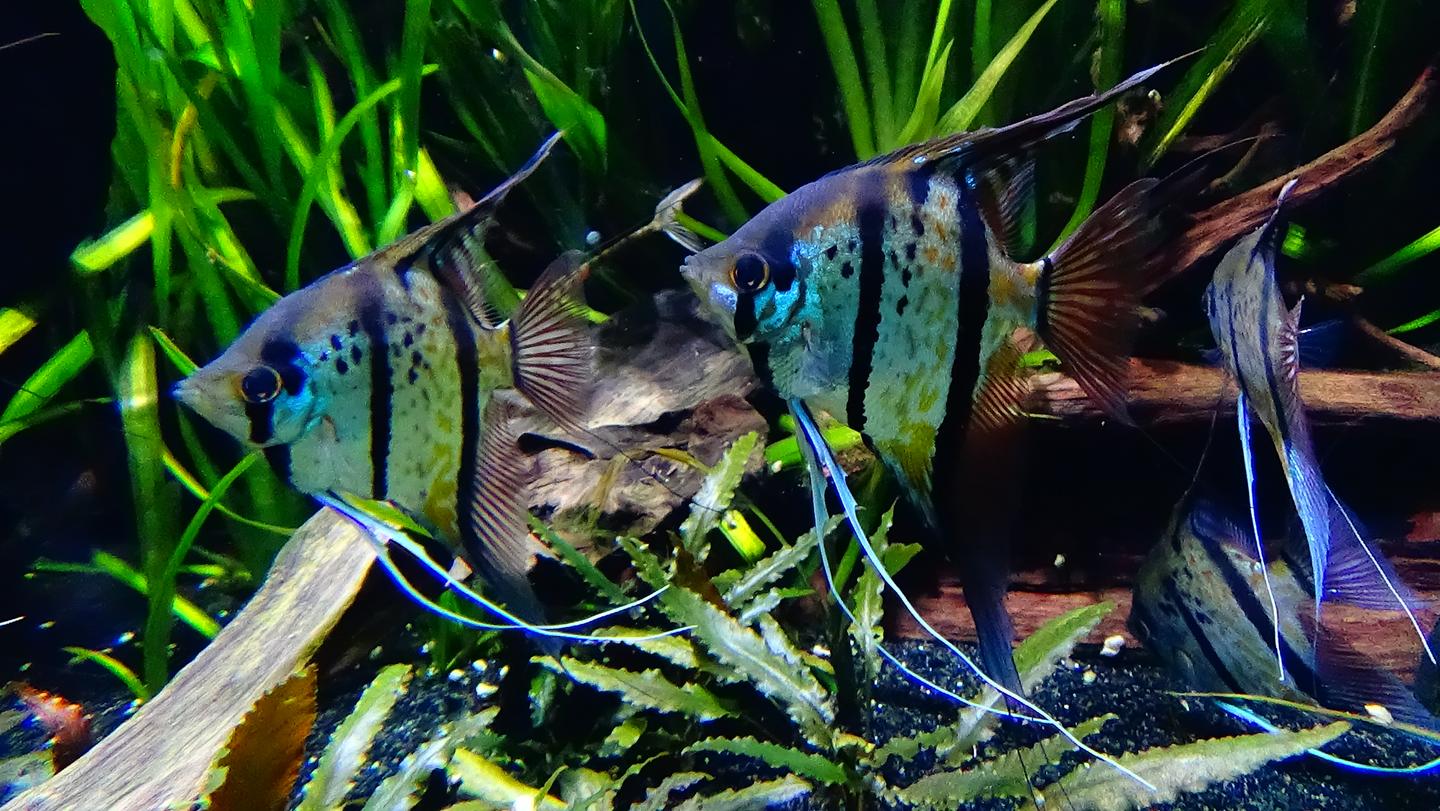
Freshwater angelfish are tall South American cichlids, not small community fish. OATA gives 120 litres as an industry floor for a compatible pair and says the aquarium must be sufficiently tall. We prefer planning around roughly 200 litres, a 100 × 40 cm footprint and about 50 cm height for an adult pair, with more space and an exit plan for a group.
Maintain these water conditions for optimal health and vibrant colors
The Inirida F1 Altum Angelfish (Pterophyllum altum) is a freshwater South American cichlid from the upper Negro drainage and upper Orinoco tributaries, including the Inírida and Atabapo rivers. It reaches a recorded maximum total length of 18 cm. This is a fish for an advanced keeper who can provide warm, very soft, acidic water, a tall mature aquarium and measured stocking.
The FishBase account for Pterophyllum altum places it in the family Cichlidae, identifies it as a river-dwelling freshwater fish and gives 18 cm as its maximum total length. Plan every permanent decision around that adult figure, not around the compact proportions of a dispatch-size animal.
This is not the same species as the familiar Pterophyllum scalare. The Seriously Fish Altum profile describes demanding water chemistry, high temperatures, feeding challenges and sensitivity to nitrate accumulation and stress. Those combined requirements support our advanced care assessment. A well-prepared keeper gains a clear decision framework: establish the correct water first, choose sufficient height and capacity, mature the biological filter and screen every companion before adding the fish.
| Suits | Not suited to |
|---|---|
| Advanced keepers able to maintain 28–31°C, pH 4.8–6.2 and 1–5 dGH | Aquariums harder or less acidic than 1–5 dGH and pH 4.8–6.2 |
| Tall, mature aquariums planned around an 18 cm cichlid | Shallow or newly established aquariums |
| A pair or appropriately planned group with peaceful larger companions | Solitary long-term keeping or communities containing mouth-sized fish |
| Keepers prepared to monitor feeding and water quality closely | Set-ups where fast companions monopolise food |
Before choosing this fish, record the aquarium’s measured temperature, pH and general hardness, then confirm that all three sit within 28–31°C, pH 4.8–6.2 and 1–5 dGH. Check that the mature aquarium has sufficient height for extended fins and enough capacity for the planned pair or group. Finally, list every intended companion by adult size, water needs and feeding behaviour. A suitable result in one category cannot compensate for a conflict in another.
One purchase supplies one Inirida F1 Altum Angelfish in the size selected on the live selector. The selector labels are 1.5-2 cm, 3-3.5 cm, 4-5 cm, 5-5.5 cm, 5.5-6 cm, 6-7 cm and XL. Choose by the aquarium space and feeding plan you can provide immediately, while retaining a permanent plan for an adult fish that reaches 18 cm.
The size you select is the size supplied, not the adult size. A dispatch measurement is not an age, sex or final-growth claim. Smaller fish still require the same long-term water chemistry, social planning and adult accommodation. An XL label is a dispatch grade rather than a numerical adult-size statement.
Sex is guaranteed only when the selected option explicitly states male or female. This Inirida F1 Altum Angelfish listing has no sex-guaranteed option. Seriously Fish describes this species as difficult to sex, with a male’s nuchal hump generally becoming apparent only around breeding time. Appearance in the gallery must therefore never be used to predict the sex supplied.
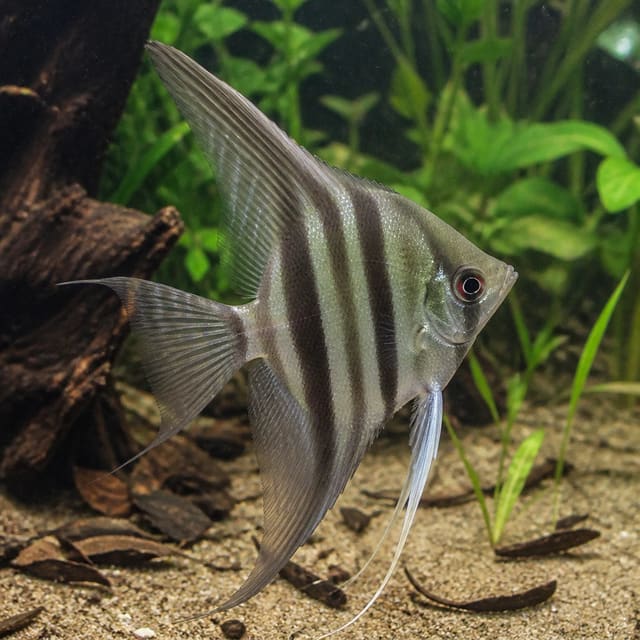
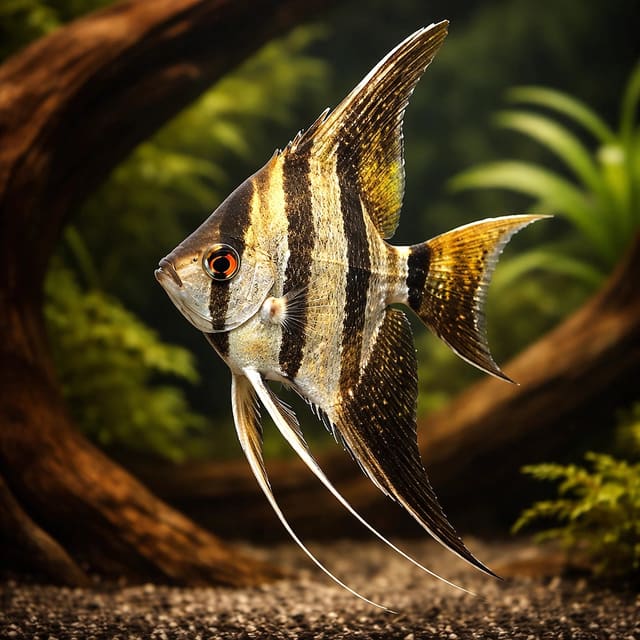
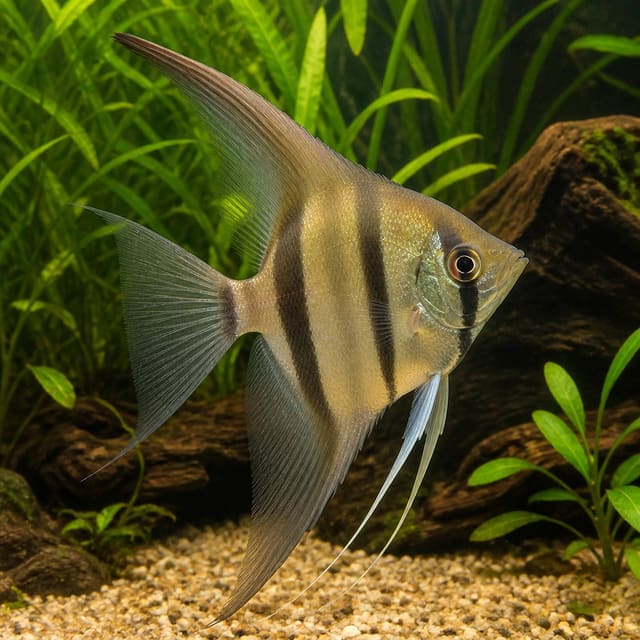
The gallery images are representative of this type of animal rather than photographs of the exact animal supplied, so colours can look slightly different from the live animal. Make the purchase decision from the written identity, selected dispatch size and care requirements.
The Inirida F1 wording identifies the named form on this page; routine care follows the requirements of Pterophyllum altum. Keep that distinction clear when comparing fish through our angelfish collection, because other angelfish species and forms must be assessed against their own adult size and water needs.
Plan at least 300 litres for this fish and choose an aquarium tall enough for an adult to hold its extended fins naturally. This volume is a planning minimum from OATA’s broad American-cichlid guidance for species over 15 cm, applied here because Pterophyllum altum reaches 18 cm. Aquarium shape matters alongside litres: a shallow vessel can hold considerable water while still giving a tall angelfish poor vertical clearance.
The OATA American-cichlid guidance recommends at least 300 litres for larger species and says angelfish need sufficient height when fully grown. It also gives 40 litres per adult fish as a stocking allowance for shoaling angelfish. Treat 300 litres as the starting point for a pair, then add 40 litres for every further adult angelfish and more room for any other fish.
FishBase also says the species may reach about 20 cm in height. Allow for that height as well as the 18 cm total length when choosing the aquarium. Leave open vertical corridors between the substrate and floating cover, and assess ornaments at the adult scale before the fish grows around them.
Keep this Altum at 28–31°C, pH 4.8–6.2 and 1–5 dGH. These values are the overlap between FishBase’s 27–31°C, pH 4.8–6.2 and 1–5 dH environmental range and Seriously Fish’s aquarium range of 28–32°C, pH 4.8–6.2 and 0–5 dGH. Using the overlap keeps routine conditions inside both sets of species values.
OATA’s wider American-cichlid water table covers a diverse family and runs cooler, harder and more alkaline than the Altum ranges. For this animal, use the narrower values above. Seriously Fish says soft water with virtually undetectable hardness is mandatory and that the fish will not usually do well at all in less acidic conditions.
Our water-chemistry guide explains what the common aquarium tests measure. Enter measured results into the water matcher to compare them with 28–31°C, pH 4.8–6.2 and 1–5 dGH before committing livestock.
If any value falls outside the range, adjust the aquarium plan before introduction. Recheck after changes and again before the fish enters the aquarium. The goal is a repeatable routine that holds all three values together, not a single reading obtained immediately before purchase.
Provide a densely planted, well-covered aquarium with floating plants, broad-leaved plants and root-like wood. Seriously Fish recommends this combination to dim the aquarium and reflect the branch-filled structure associated with the species’ river habitat. Keep enough open space for a tall fish to turn and move between pieces without brushing its extended fins.
Use sand or fine gravel as the substrate because Altums may dig. Check each piece of wood from the perspective of a deep-bodied adult: stable roots and overhanging branches should create cover without forming narrow traps. Place broad leaves and vertical wood around the edges of swimming routes rather than filling every route with decoration.
Keep water movement very slow. Seriously Fish associates the species with very slow-flowing rivers and specifically advises against a great amount of current. Filtration still has to process waste effectively, but position and adjust the return so the fish is not forced to swim continuously against a strong stream.
Observe how food and fish move after the system is running. If every meal is swept rapidly across the aquarium or the fish must work constantly to hold position, reduce or redirect the flow while preserving filtration. If debris settles heavily behind roots, remove it during maintenance rather than increasing the current beyond the species’ preference.
Use a fully established biological filter and confirm ammonia and nitrite are both zero before introduction. The RSPCA aquarium guidance explains that fish release toxic ammonia, which filter bacteria convert first into toxic nitrite and then into safer nitrate. A filter is therefore part of the animal’s life-support system, not an optional device for making the water look clear.
Prepare and mature the aquarium before livestock enters it. Our first tropical aquarium guide gives the practical sequence for establishing the system. OATA advises adding fish slowly because every increase in fish and feeding requires the filter’s bacterial population to process more waste. Adding too much livestock too quickly can cause new tank syndrome, with ammonia and nitrite rising faster than the filter can manage.
A clear aquarium can still contain ammonia or nitrite, so use test results rather than clarity as the decision. If either toxic compound is detectable, pause the introduction and restore biological stability. Keep the mature filter running continuously and avoid changes that remove or overwhelm its bacterial population.
Begin with suitable live foods and be prepared to offer them regularly while confirming that the fish is feeding. Seriously Fish describes feeding Altums as potentially troublesome and recommends live food, followed by a gradual transition to frozen food by mixing frozen and live items at the same meal. Once the fish accepts food reliably, a quality dried product can add variety; flake may also be accepted by aquarium-raised Altums.
Feed only what the fish can consume within a few minutes, once a day. That amount and schedule come from OATA’s American-cichlid guidance. Watch the individual take food instead of relying on food disappearing somewhere in a planted aquarium. Long fins, tall wood and group dynamics can make it difficult to see which fish actually ate.
Do not compensate for a missed meal by adding repeated large portions. OATA warns that overfeeding can lead to excess faeces or uneaten food that breaks down and releases toxic waste. Uneaten food also adds to the waste the filter has to process.
When several fish share the aquarium, place food where each animal can reach it without entering another fish’s immediate space. Observe the full group until every individual has taken food. A fish that hangs back while companions feed needs a check of social pressure, flow and food placement rather than a larger aquarium-wide ration.
Arrange for someone to receive the parcel because live fish must not be left unattended. Tropical Fish Co hand-bags fish in pure oxygen, uses an insulated poly box and adds a heat pack when the weather calls for it. The parcel is carried by a service licensed to transport live animals, with tracking and the confirmed arrival details sent by email.
Follow our delivery and Live Arrival Guarantee policy in this order.
Check the prepared aquarium before the fish arrives. Confirm zero ammonia and zero nitrite, maintain 28–31°C, pH 4.8–6.2 and 1–5 dGH, and complete the layout and compatibility assessment before the fish enters the community.
After release, watch the fish’s swimming, breathing, colour, temperament and feeding closely. Increase the aquarium’s livestock load slowly so the mature filter can respond to the extra waste and food. Give the new fish a clear opportunity to feed, especially where established companions move rapidly at mealtimes.
The first practical checkpoint is simple: the fish should be able to hold position in the slow flow, move through the layout without obstruction and access food without persistent exclusion. If one of those conditions fails, correct that specific environmental or social factor rather than changing several parts of the aquarium at once.
Change 25% of the water at least once every week and test ammonia and nitrite at least weekly. Siphon solid waste from the substrate during the partial change, and treat replacement tap water with conditioner to remove chlorine or chloramine before it enters the aquarium.
Prepare replacement water so the aquarium remains at 28–31°C, pH 4.8–6.2 and 1–5 dGH. Check the result after maintenance, particularly when the source water varies. A repeatable preparation method protects this soft, acidic set-up from drifting outside the narrow routine range.
If filter media needs cleaning, rinse it lightly in aquarium water removed during the partial change. Do not rinse it under the tap, because chlorine or chloramine may kill the beneficial bacteria established in the media. Clean only as needed to restore function rather than stripping every filter component at once.
Track results from week to week. A rising nitrate trend, recurring debris behind wood or falling filter flow calls for a specific adjustment to waste removal, feeding or filter maintenance. Ammonia and nitrite must remain zero; any detectable reading takes priority over cosmetic work in the aquarium.
Check the fish during feeding and again while it moves normally through the aquarium. OATA identifies changes in swimming, colour, temperament, breathing, appearance, body condition and food intake as useful early warnings. Learn the individual’s normal posture and pace so a change is noticeable before it becomes severe.
| If you see | Do this first |
|---|---|
| Hanging at the surface, sitting on the bottom or erratic swimming | Test ammonia, nitrite and temperature, then check flow and social pressure |
| Faster or slower gill movement | Test water quality immediately and observe whether the fish can hold position comfortably |
| Darker or paler colour, increased hiding or changed aggression | Review companions, cover, feeding access and recent water results |
| White spots, fluffy growths, ulcers, bumps, or loss of fins or scales | Record the change and test ammonia, nitrite, nitrate and temperature straight away |
| Reduced food intake or declining body condition | Confirm the fish can access food, then recheck temperature and water chemistry |
Seriously Fish describes Altums as very weak to nitrate build-up and extremely prone to stress-related diseases. Keep nitrate within OATA’s limit of no more than 20 mg per litre above the normal tap-water level, while maintaining zero ammonia and zero nitrite. Correct a measurable water problem promptly and preserve the biological filter while doing so.
A short written log helps separate a one-off observation from a developing pattern. Note the water readings, feeding response, breathing rate and which companions were nearby. This makes the next action more precise and prevents repeated changes that obscure the original cause.
Choose peaceful larger fish that share 28–31°C, pH 4.8–6.2 and 1–5 dGH. Seriously Fish warns that anything able to fit inside an Altum’s mouth is potential prey and specifically includes Neon Tetras, Guppies and Pygmy Rasboras. Avoid those examples and any other fish whose adult body size leaves it vulnerable to being swallowed.
Discus are a named possibility because Seriously Fish says Altums can live with them and notes similar water requirements. OATA names angelfish among the calmer American cichlids that can be mixed in a robust community aquarium with larger shoaling species. Neither description makes every Discus, shoaling species or individual aquarium an automatic match; adult size, aquarium capacity, water chemistry and feeding access still have to align.
Watch individual behaviour after any introduction. Persistent chasing, damaged fins, hiding, missed meals or confinement to one part of the aquarium means the combination is failing, even if the species names appeared reasonable on paper. Separate the animals or revise the stocking plan before body condition declines.
Check every other companion against the same four points. For a planned mix, check every companion against the aquarium’s volume and height, the measured water values, each animal’s adult size and the number of each fish. Base the stocking on the actual aquarium rather than on a general tank-mate label.
Keep angelfish as a pair at minimum or in a suitably planned group. OATA describes angelfish as social and warns that solitary fish may become stressed. It also advises allowing 40 litres per adult angelfish when planning stocking, while its larger-cichlid threshold sets at least 300 litres for fish over 15 cm.
Apply both figures to the finished adult community. A pair calculated at 80 litres still falls under the at-least-300-litre threshold used for a species reaching 18 cm. For a group, start from 300 litres for the first pair and add 40 litres for every further adult before allowing space for other animals. Larger populations or additional fish increase the required capacity beyond that baseline.
Seriously Fish discusses growing six young Altums when the keeper’s specific aim is to find a breeding pair. That is a breeding-planning example rather than a compulsory household group size. Use the OATA pair-or-group instruction for routine social planning, then let aquarium capacity, adult size and observed behaviour determine how large the group can responsibly be.
If one animal stops feeding, hides more than normal or loses condition, test the water and assess social access immediately. Do not respond by adding more fish automatically. First confirm that the existing aquarium has sufficient capacity, height, cover and feeding opportunities for the animals already present.
It reaches a recorded maximum total length of 18 cm. Plan the permanent aquarium around that adult figure rather than the selected dispatch size.
Plan at least 300 litres and choose a tall aquarium that accommodates its extended fins. The volume is OATA’s broad American-cichlid guidance for fish over 15 cm, applied to an Altum that reaches 18 cm.
OATA’s angelfish guidance says to keep a pair at minimum or a group because solitary angelfish may become stressed; allow 40 litres per adult while retaining the at-least-300-litre larger-cichlid threshold.
We rate it advanced because it needs the FishBase and Seriously Fish overlap of 28–31°C, pH 4.8–6.2 and 1–5 dGH, plus a mature filter, slow flow and close attention to feeding and nitrate.
Start with suitable live food, then mix in frozen food as it settles and accepts meals; a quality dried product can add variety. Feed only what it consumes within a few minutes, once a day.
Keep it at 28–31°C, pH 4.8–6.2 and 1–5 dGH. These routine values are the overlap of the FishBase environmental range and the Seriously Fish aquarium range.
It will treat any fish small enough to fit in its mouth as food, including Neon Tetras, Guppies and Pygmy Rasboras, but it is fine with other peaceful, larger fish. Choose peaceful larger companions and act if chasing, fin damage, hiding or exclusion from food develops.
Seriously Fish names peaceful larger fish and Discus, while OATA names larger shoaling fish for calmer angelfish communities. Each companion must share the FishBase and Seriously Fish overlap of 28–31°C, pH 4.8–6.2 and 1–5 dGH and be too large to swallow.
Start a short continuous unboxing video while the parcel is still sealed, showing it being opened and the fish still in the bag, and make sure someone is present to receive it. Tropical Fish Co hand-bags it in pure oxygen, packs it in an insulated poly box with a heat pack when weather calls for one, and uses a licensed live-animal service. Float the bag for 20–30 minutes before release and never pour bag water into the aquarium.
No reviews for this item yet. Bought one? Honest reviews only, good or bad.
What customers say about ordering from us
I have a small group of long finned mountain minnows. So was delighted to be able to order ten of this variety to increase the genetics in my tank . The ones I recieved are healthy but it’s to early to give a verdict on wether they are of a long finned type since they are small currently.
Gordon Walker · 23 Sept 2026
100% success travel and "installation". Pleased with quality of purchase. The Siamese fighter a bit "shy" so have not yet seen him at his best yet but looking good. Happy customer. GG
George E Garratt · 21 Sept 2026
Reviews of our shop, collected by Judge.me, an independent third-party review collector. Newest first.