Advanced
Gunther's Zanzibar Gold Nothobranch (Nothobranchius guentheri)
22–25°C · pH 6–7
£10.99

South American annual killifish supplied at 3-5 cm. Best in a covered 40 L+ species setup at 18-22 C with soft, clean water, fine spawning media and small live or frozen foods.
Adult size is the maximum length this species reaches at full maturity (scientific sources). The livestock you receive will be younger and smaller. Product-photo provenance and any image-specific limitations are stated on the listing.
Austrolebias bellottii
Save when buying multiple fish. Each quantity is one fish; sex and pair formation are not guaranteed unless the selected variant explicitly states them.
Confirm your email, then we’ll send an availability message for this exact item if it returns within 180 days.
This request is only for this product—no newsletter or other promotions. A mail-provider retry may very rarely duplicate the same availability message. Unconfirmed addresses are removed after 48 hours. See our privacy policy.
South American annual killifish supplied at 3-5 cm. Best in a covered 40 L+ species setup at 18-22 C with soft, clean water, fine spawning media and small live or frozen foods.
Adult size is the maximum length this species reaches at full maturity (scientific sources). The livestock you receive will be younger and smaller. Product-photo provenance and any image-specific limitations are stated on the listing.
Maintain these water conditions for optimal health and vibrant colors
Argentine Pearl Killifish is a specialist South American annual killifish best presented under the current accepted name Austrolebias bellottii. The older supplier wording Cynolebias bellotti, and the common spelling Cynolebias bellottii, still matter because they appear in older hobby material, supplier data and search behaviour. We keep those names naturally for recognition while using the accepted name for the main product identity and care notes.
The fish supplied here are dispatched at 3-5 cm. FishBase gives Austrolebias bellottii a maximum length of about 7 cm total length, so plan for a compact but robust annual killifish rather than a tiny community filler. It is peaceful in temperament, but it is not a generic warm community fish. Its best home is a covered, quiet species setup where feeding, temperature and substrate can be managed around annual-killifish behaviour.
FishBase lists this species as Austrolebias bellottii, the Argentine pearlfish, and places it in the lower Parana and Uruguay River basins. ITIS treats Cynolebias bellottii as an invalid original combination with Austrolebias bellottii as the valid name, while GBIF also treats Austrolebias bellottii as accepted and keeps Cynolebias combinations as synonyms. That is why the current accepted name leads the page while the older name remains as helpful synonym context.
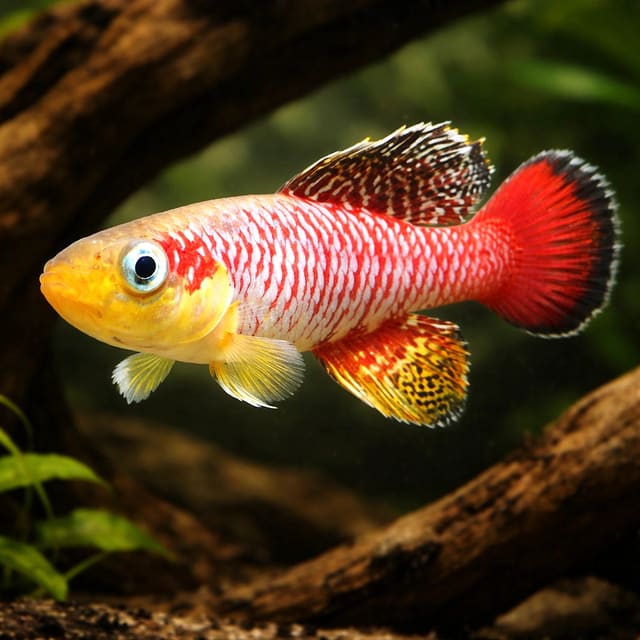
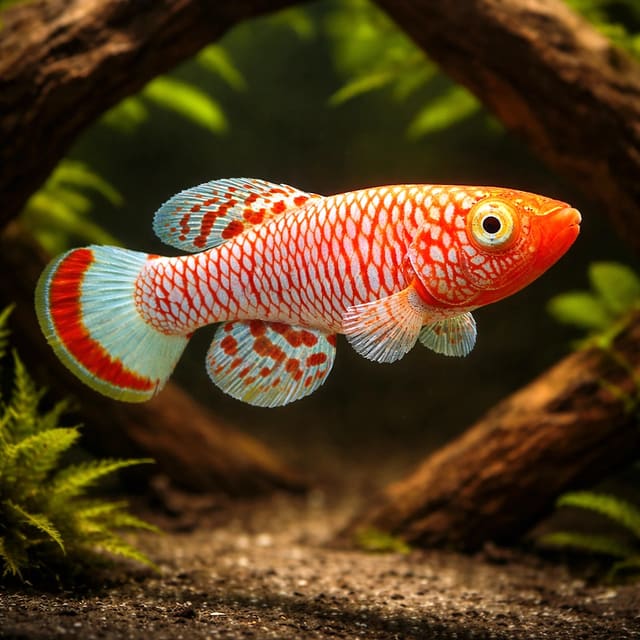
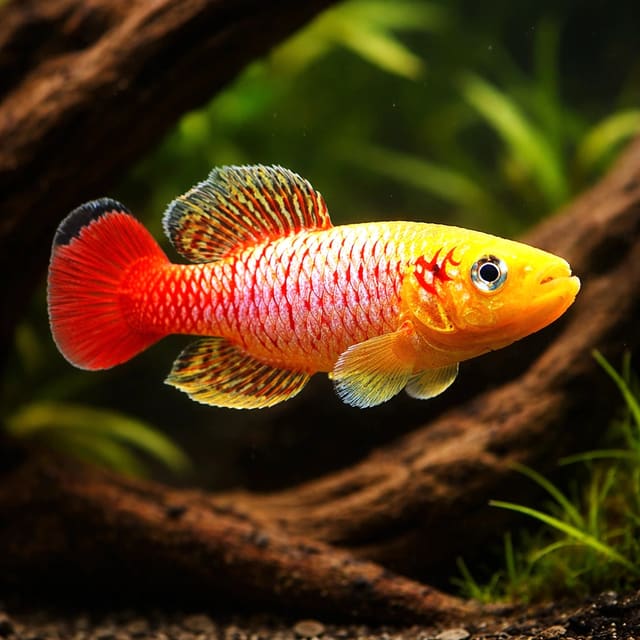
The original reference image for this listing has been added to the site-owned media set as a clean source-photo file. The gallery images are supporting aquarium-scene views. The source photo is the visual anchor for the fish itself: a blue-faced, gold-to-amber male with pearly spotting, blue lower fins and a rounded caudal fin edged with pale colour.
Austrolebias bellottii is tied to seasonal waters in Argentina and Uruguay. FishBase describes it as a seasonal toothcarp from waters that dry during the dry season: adults complete their life cycle while water is present, then eggs survive in the mud and hatch when rains return. USGS gives the same annual-fish pattern, with rapid growth and development paired with diapausing eggs buried through the dry period.
For aquarium care, that habitat history is more useful than the word tropical on its own. Keep the aquarium cool to moderate, quiet, covered and soft-water focused. The species does not need strong current or a bright open display. It needs clean water, cover, a gentle filter, stable cool-room temperatures and a substrate or spawning container that respects its annual-killifish biology.
Settled males can be very attractive: the source photo shows a bright blue face, warm amber body colour, fine pale spotting and electric blue on the lower fins. The body shape is sturdy for a small annual killifish, with a rounded tail and bold head colour. Under harsh light the fish can look flatter, so use floating plants, a darker base and side cover to let the colours show naturally.
Females are usually plainer and fuller-bodied, which is normal for this group. Males may display strongly when conditioned and comfortable. A calm planted tank with low glare, leaf litter, Java moss and fine spawning media gives the fish a chance to behave naturally rather than simply hiding from bright light or fast tank mates.
A 40 litre aquarium is a sensible minimum for a pair or carefully managed small group. Use a secure lid: killifish jump, and annual species are no exception. Gentle filtration, a sponge pre-filter, floating plants and broken lines of sight are more important than high flow. Avoid over-clean, exposed aquascapes where the fish has nowhere to pause.
Fine sand, leaf litter, Java moss, coco coir, peat fibre or a removable spawning container can all work, depending on whether the goal is display or breeding. If you want to breed them, keep the setup simple enough that eggs or spawning medium can be managed. If the goal is display, still give them a soft base and plenty of low cover so the fish can feed calmly and show colour.
The range above follows FishBase closely and is safer as routine advice for this species. Short warm spells can happen in homes, but do not keep this as a hot-water community fish. Stable, clean, cool to moderate water will usually give better condition and a calmer fish.
This is a carnivorous killifish. FishBase notes worms, crustaceans and insects; in the aquarium, use small live and frozen foods such as daphnia, cyclops, baby brine shrimp, mosquito larvae, grindal worm, blackworm and finely chopped bloodworm. Some individuals may sample fine prepared foods after settling, but live and frozen foods should be the foundation, especially for condition and breeding.
Feed small portions and remove uneaten food. Annual killifish can be enthusiastic, but they are still small fish in specialist setups, so water quality can slip quickly if rich foods are overused. If they are kept with other fish, make sure they are not being outcompeted at feeding time.
Argentine Pearl is peaceful in the sense that it is not a predatory bully, but that does not make it ideal for a busy community aquarium. It is best treated as a species-first fish. Males may display, breeding pairs need calm space, and the fish benefits from controlled feeding and a soft substrate. Very calm, similarly sized fish with matching cool, soft-water needs may work in a larger carefully managed aquarium, but that is a compromise rather than the best route.
Avoid large fish, boisterous barbs, fast competitive feeders, fin nippers, hot hard-water community setups and ornamental shrimp you would be upset to lose. Snails are usually the safest companions. If you want to see the fish at its best, build the tank around the killifish rather than asking it to adapt to a mixed display.
This is where Austrolebias bellottii becomes genuinely fascinating. It is a seasonal bottom spawner. In nature, eggs survive in drying mud while adults disappear with the seasonal pool. In aquariums, breeders usually provide peat fibre, coco coir or a similar medium, then incubate collected eggs damp rather than submerged before re-wetting at the right stage.
FishBase notes bottom spawning and a long egg incubation period, while specialist annual-killifish practice adds the practical details: condition adults with small live foods, give them a removable spawning medium, keep notes, and expect fry to need tiny live food at first. This is not a casual livebearer-style breeding project, but it is exactly the kind of life cycle that makes annual killifish so rewarding for patient keepers.
If you are comparing specialist South American annual killifish, also look at Black Pearlfish, White's Cynolebias / Rio Pearlfish, Featherfin Pearlfish, Ladiges' Gaucho and Black-Band Fighting Gaucho. Those pages help compare care style across similar annual killifish before choosing a setup.
When this fish is in stock, it is packed for livestock transport through our licensed live-animal courier process. The useful promise is simple: careful packing, temperature-aware dispatch planning and our Live Arrival Guarantee. Availability, price and dispatch timing are shown by the live product controls on this page.
Care and identity notes were checked against FishBase for Austrolebias bellottii, ITIS taxonomy for Cynolebias bellottii, GBIF synonym data, USGS annual-fish ecology notes and reference media/data.
No reviews for this item yet. Bought one? Honest reviews only, good or bad.
What customers say about ordering from us
I have a small group of long finned mountain minnows. So was delighted to be able to order ten of this variety to increase the genetics in my tank . The ones I recieved are healthy but it’s to early to give a verdict on wether they are of a long finned type since they are small currently.
Gordon Walker · 23 Sept 2026
100% success travel and "installation". Pleased with quality of purchase. The Siamese fighter a bit "shy" so have not yet seen him at his best yet but looking good. Happy customer. GG
George E Garratt · 21 Sept 2026
Reviews of our shop, collected by Judge.me, an independent third-party review collector. Newest first.