Advanced
Gunther's Zanzibar Gold Nothobranch (Nothobranchius guentheri)
22–25°C · pH 6–7
£10.99

Brazilian annual killifish supplied at 2.5-5 cm. Best in a covered, quiet species setup at 20-23 C with soft clean water and peat or coco-coir spawning media.
Adult size is the maximum length this species reaches at full maturity (scientific sources). The livestock you receive will be younger and smaller. Product-photo provenance and any image-specific limitations are stated on the listing.
Simpsonichthys constanciae
Save when buying multiple fish. Each quantity is one fish; sex and pair formation are not guaranteed unless the selected variant explicitly states them.
Confirm your email, then we’ll send an availability message for this exact item if it returns within 180 days.
This request is only for this product—no newsletter or other promotions. A mail-provider retry may very rarely duplicate the same availability message. Unconfirmed addresses are removed after 48 hours. See our privacy policy.
Brazilian annual killifish supplied at 2.5-5 cm. Best in a covered, quiet species setup at 20-23 C with soft clean water and peat or coco-coir spawning media.
Adult size is the maximum length this species reaches at full maturity (scientific sources). The livestock you receive will be younger and smaller. Product-photo provenance and any image-specific limitations are stated on the listing.
Maintain these water conditions for optimal health and vibrant colors
The Feather-Fin Pearl Fish, also written as Featherfin Pearlfish, is a small Brazilian annual killifish supplied here at about 2.5-5 cm. FishBase and Killi.co.uk currently list the species as Simpsonichthys constanciae; the trade name Cynolebias constanciae is the older trade name and some specialist killifish keepers may also know the fish as Ophthalmolebias constanciae. The listing keeps those names together so customers and search engines can connect the same fish without forcing awkward keyword phrases into the copy.
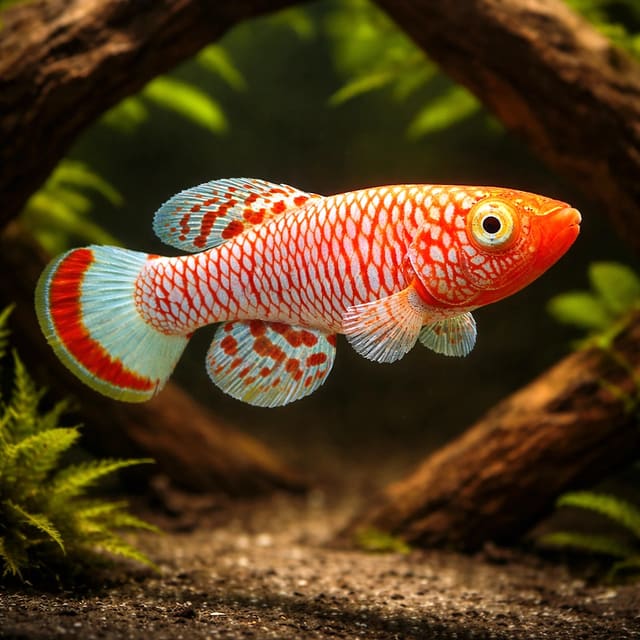
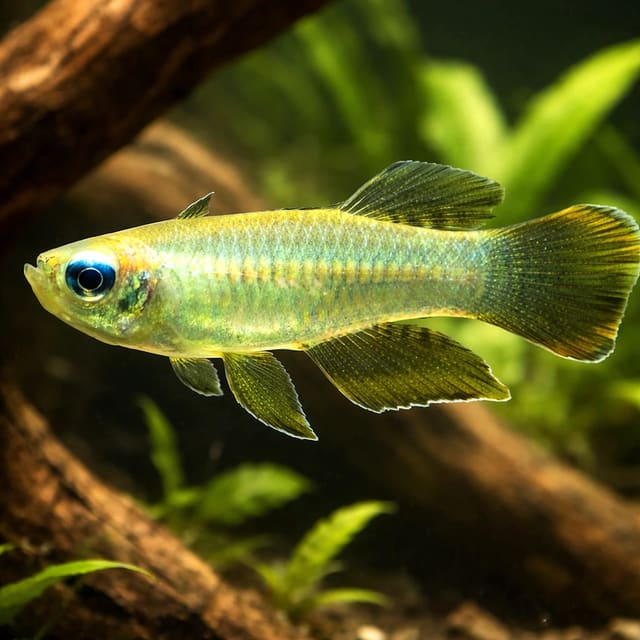
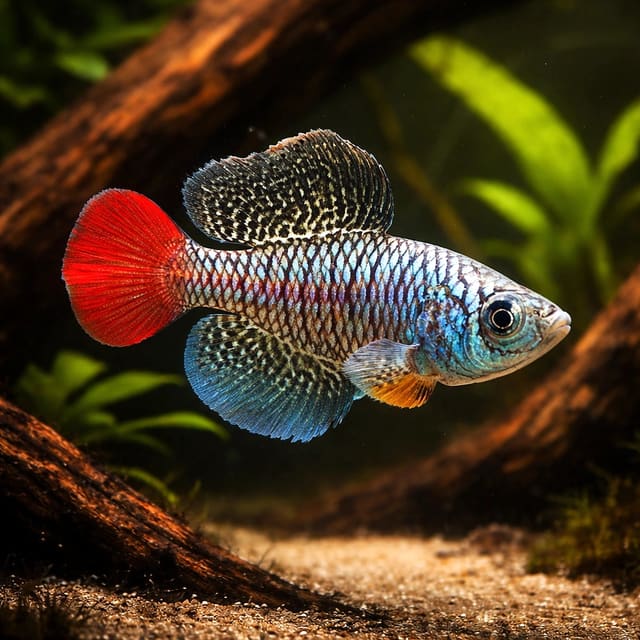
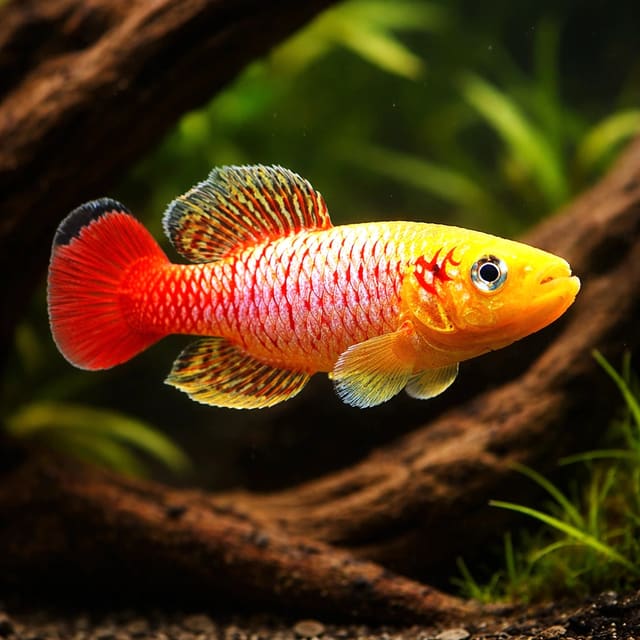
This is a rewarding specialist fish rather than a casual community-tank impulse buy. It comes from temporary freshwater habitats in Brazil, with aquarium references pointing to Sao Joao basin / Rio de Janeiro annual-killifish habitat, soft to neutral water and bottom-spawning behaviour. The beauty of the species is subtle at first: males develop extended dorsal and anal-fin rays with pearly, gold, green and blue highlights that show best under calm lighting over a dark, planted setup.
Simpsonichthys constanciae is tied to temporary freshwater pools and pond-like habitats in Brazil. In nature, annual killifish live quickly because their pools can dry out; the adults spawn into soft bottom material, while the eggs survive a damp resting period before the next wet season. That life history is exactly why this species should be kept with more intention than a normal community fish. Stable water, a secure lid and low-stress tank mates matter more than a large, busy display.
In the aquarium it is best treated as a quiet species fish. Males display with raised fins and rich speckling, and they can show territorial behaviour around spawning sites, but this is not a rough cichlid-style fish. The safest display is a pair or small group in a covered aquarium with shaded planting, floating plants, leaf litter or wood, and a removable peat or coir container for spawning. Very active barbs, fin nippers, large fish and shrimp that could be eaten are poor choices.
A 40 litre or larger covered aquarium is a better retail recommendation than the tiny breeding tubs sometimes used by experienced annual-killifish breeders. Use gentle filtration, an established biological filter and a soft substrate area. Floating plants such as Salvinia, frogbit or water lettuce help break up light, while Java moss, fine-leaved plants and root tangles give females and subdominant fish places to rest. Leave open feeding room at the front so you can check that every fish is eating.
Keep the water cool-stable rather than hot. FishBase gives aquarium conditions around 22 C, while Killi.co.uk breeding reports cluster strongly around 20-23 C with some warmer reports. For a home display, aim for 20-23 C, pH around 6.0-7.2 and soft to moderate hardness. A small weekly water change is safer than large swings, especially for fish that have just arrived. Ammonia and nitrite must stay at zero.
Featherfin Pearlfish are micropredators. Offer small frozen or live foods such as cyclops, daphnia, baby brine shrimp, mosquito larvae, finely chopped bloodworm and white worm in modest amounts. Settled fish may take high-quality small granules or crushed freeze-dried foods, but colour, condition and breeding response are best when frozen and live foods form the core of the diet. Feed lightly once or twice a day and remove leftovers because annual-killifish setups are often small and soft-water systems do not forgive pollution.
This fish suits keepers who enjoy specialist behaviour, careful observation and source-backed husbandry. It is peaceful enough for very calm companions of similar size and requirements, but the best result is normally a species setup. Avoid fast danios, robust barbs, aggressive cichlids, large livebearers, fin nippers and small ornamental shrimp. If you want to breed it, keep it species-only and give the fish a dedicated spawning container from the beginning.
The natural lifespan of annual killifish is shorter than many community species, so the value of this fish is not just how long one individual lives. The real pleasure is seeing male display, courtship, feeding response and, for experienced keepers, the annual egg cycle. Buy it if you are happy to keep a covered, quiet aquarium and feed small foods well; choose a hardier community species if you want a low-maintenance mixed tank.
This is a bottom-spawning annual killifish. Specialist reports describe peat or similar spawning substrate, and the Killies and Splitfins spotlight describes the pair diving into soft mud in nature or peat/coco coir in aquaria. A practical setup is a small pot or tub of boiled, rinsed peat fibre or coco coir deep enough for the fish to push into. Condition adults with live and frozen foods, then remove and inspect the substrate on a schedule that suits your experience level.
FishBase notes a bottom-spawning habit and a four-month incubation reference, while breeder reports vary with temperature and method. For a retail care page it is better to say several months and to treat eggs carefully rather than promise a fixed hatch date. Keep the substrate damp, not wet, and research annual-killifish incubation before attempting to dry or hatch eggs.
The source photo has been added because it gives a real visual reference for SKU 3072. The gallery views are supporting aquarium-scene illustrations, but the source image should be used when judging colour and body shape. Stock is sent through our live-fish packing process with heat or cool control as needed, licensed live-animal courier handling and the Live Arrival Guarantee.
Care facts were checked against FishBase for size, temperature, pH, bottom-spawning and aquarium-use notes; Killi.co.uk breeder reports for soft acidic water, 20-23 C breeding reports and peat-style spawning; Killies and Splitfins for diving-spawner behaviour, male colour notes and coir/peat spawning context; and our stock records for supplied size and the trade name printed in the stock list.
No reviews for this item yet. Bought one? Honest reviews only, good or bad.
What customers say about ordering from us
I have a small group of long finned mountain minnows. So was delighted to be able to order ten of this variety to increase the genetics in my tank . The ones I recieved are healthy but it’s to early to give a verdict on wether they are of a long finned type since they are small currently.
Gordon Walker · 23 Sept 2026
100% success travel and "installation". Pleased with quality of purchase. The Siamese fighter a bit "shy" so have not yet seen him at his best yet but looking good. Happy customer. GG
George E Garratt · 21 Sept 2026
Reviews of our shop, collected by Judge.me, an independent third-party review collector. Newest first.