Expert
Magnificent Sea Anemone (Radianthus magnifica)
24–27°C · pH 8.1–8.4 · 500L
£78.99
The Heteractis malu yellow (Heteractis malu) is a single-polyp marine anemone suited to experienced aquarists. Keep it at 24–26°C, pH 8.1–8.3 and salinity 1.023–1.026; OATA recommends at least 80 litres for most anemones. Sold individually as one live marine anemone per purchase.
Heteractis malu
The Heteractis malu yellow (Heteractis malu) is a single-polyp marine anemone suited to experienced aquarists. Keep it at 24–26°C, pH 8.1–8.3 and salinity 1.023–1.026; OATA recommends at least 80 litres for most anemones. Sold individually as one live marine anemone per purchase.
Maintain these water conditions for optimal health and vibrant colors
The Heteractis malu yellow (Heteractis malu) is a marine sea anemone: a single-polyp invertebrate that can move when changing location, does not build a calcium carbonate skeleton and obtains nutrition through both photosynthesis and prey capture. Its demanding water, lighting and compatibility needs make it better suited to an experienced marine aquarist than a first-time keeper.
WoRMS now lists it as Radianthus malu and places the accepted species in Heteractidae. This listing uses the aquarium name Heteractis malu. Wikipedia also records the common names malu anemone, delicate sea anemone and white sand anemone.
This is not a coral. An anemone has one polyp, lacks the hard skeleton produced by some corals and may relocate after introduction or later in its life. That mobility shapes nearly every keeping decision: reserve clearance around the animal, screen nearby livestock for stinging and predation risk, and keep water chemistry stable enough that relocation is not compounded by deteriorating conditions.
Keep this anemone only in a filtered marine aquarium that can hold 24–26°C, pH 8.1–8.3 and salinity 1.023–1.026 without rapid swings. OATA’s anemone guidance gives those values for the group, together with carbonate hardness of 8–12°dKH. Use them as group guidance, ask us about any species-specific requirements before buying, and expect some values to need adjusting for more sensitive species kept alongside it.
OATA recommends an aquarium of at least 80 litres for most anemones because smaller volumes may undergo rapid changes in water chemistry. This is a stability baseline, not an adult-size prediction. Choose more space when necessary to leave safe clearance around the tentacles, support the filtration load and prevent contact if the animal changes position.
| Suits | Not suited to |
|---|---|
| Experienced marine aquarists | A first marine-animal project |
| A stable, filtered aquarium | An aquarium with detectable ammonia or nitrite |
| Moderate-to-high anemone lighting | A setup with inadequate lighting for photosynthesis |
| Space around a mobile, stinging animal | A crowded layout where contact cannot be prevented |
| Careful prey feeding and water testing | Heavy feeding without waste control |
Our advanced care label reflects the combination of exacting marine chemistry, photosynthetic lighting, direct feeding and tank-mate screening. It does not mean that more food improves care. Success comes from holding the stated ranges, maintaining filtration and reacting promptly to changes in the mouth, tentacles, colour, tissue, feeding or movement.
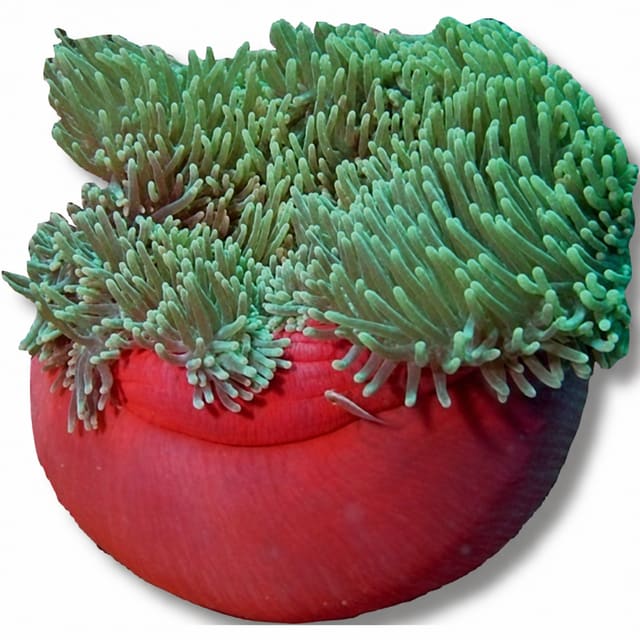
Sold individually, with one purchase supplying one live anemone. Neither its arrival size nor the spread in the representative gallery image is an adult-size promise. Plan permanent clearance around the animal’s fully expanded tentacles and retain room for it to change location.
Sex is guaranteed only when the selected option explicitly states male or female. This Heteractis malu yellow listing has no sex-guaranteed option.
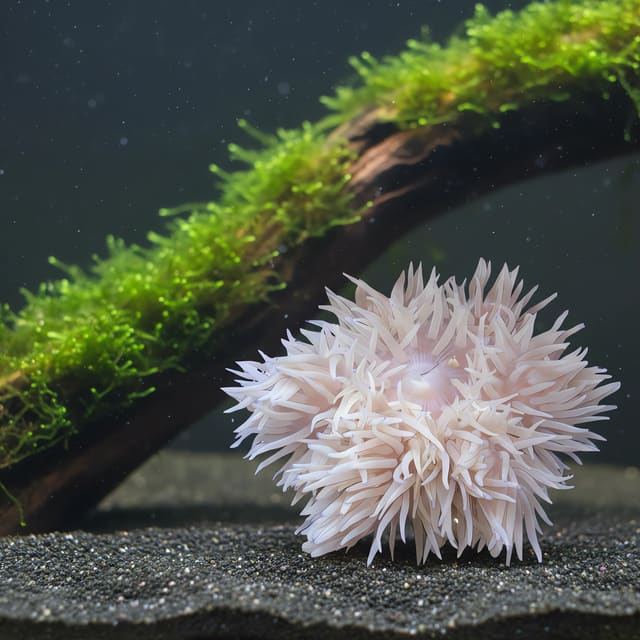
The gallery images are representative of this type of animal rather than photographs of the exact animal supplied, so colours can look slightly different from the live animal.
The word yellow names the colour form; the care below is the same. Base husbandry on the anemone requirements set out here: stable marine chemistry, effective filtration, appropriate lighting, careful prey feeding and enough separation to prevent stinging contact. Colour alone must not be used to infer sex, age, origin, adult size or compatibility with a particular clownfish.
You can also browse the marine invertebrates collection when comparing livestock for the space, but do not treat proximity in a collection as proof of compatibility.
Keep the aquarium at 24–26°C, pH 8.1–8.3 and salinity 1.023–1.026. Maintain carbonate hardness at 8–12°dKH, calcium at 380–450 ppm and magnesium at 1,250–1,350 ppm. These values belong together: a temperature reading inside range does not compensate for unsuitable salinity, accumulating nitrogen waste or unstable carbonate hardness.
| Measurement | Working instruction |
|---|---|
| Temperature | Keep between 24 and 26°C |
| pH | Keep between 8.1 and 8.3 |
| Salinity | Keep between 1.023 and 1.026 |
| Carbonate hardness | Keep between 8 and 12°dKH |
| Calcium | Keep between 380 and 450 ppm |
| Magnesium | Keep between 1,250 and 1,350 ppm |
| Ammonia | Keep at zero mg/l |
| Nitrite | Keep at zero mg/l |
| Nitrate | Do not exceed 40 mg/l |
| Phosphate | Do not exceed 0.05 mg/l |
Test before introduction and continue testing as part of routine maintenance. Ammonia and nitrite require immediate attention at any detectable level because anemones may be stressed by even small amounts. Nitrate and phosphate also need active monitoring so that feeding and accumulating organic waste do not push them above their stated maxima.
Record results consistently enough to see movement before a limit is crossed. A nitrate result rising towards 40 mg/l calls for waste control and maintenance before it reaches the maximum. A pH reading moving from the middle of 8.1–8.3 towards an edge calls for investigation rather than an abrupt correction. Keep changes controlled, because the purpose of the range is stable husbandry, not repeated movement from one boundary to the other.
Run an effective filter at all times. OATA identifies filtration as essential for anemone aquaria and lists live rock with sufficient water flow, an internal or external filter, or a sump-based filter as possible marine arrangements. The correct choice is the one that maintains zero ammonia and zero nitrite while supporting the aquarium’s full livestock and feeding load.
The RSPCA explains the role of biological filtration: beneficial bacteria process toxic ammonia into nitrite and then into the safer nitrate. That process makes a mature bacterial population essential before livestock is added. Each increase in livestock and feeding creates more waste, so add animals slowly enough for the bacterial population to adjust.
A protein skimmer can help maintain water quality by removing dissolved organic waste before it breaks down into more harmful substances. It does not replace biological filtration, testing or water changes. Clean it regularly enough to maintain its performance and assess its contribution by the aquarium’s water results rather than by assuming equipment alone guarantees stability.
Rapid stocking may cause new tank syndrome when the bacterial population cannot process the increased waste. For this animal, the practical safeguard is simple: establish filtration first, verify zero ammonia and nitrite, add livestock slowly and recheck water after any change in stocking or feeding load.
Provide a moderate-to-high amount of aquarium light as the starting requirement for an anemone. Lighting matters because algae called zooxanthellae live within the animal and generate nutrition through photosynthesis. Prey feeding remains necessary, but it does not make inadequate lighting suitable.
Anemone lighting requirements vary by species, so ask us for guidance on placing it under the correct light and keep the stated water values while it settles. Reduced tentacle extension, failure to open, darkening or bleaching are all changes that require investigation. Check water chemistry alongside lighting because the same visible change may occur while more than one husbandry condition is deteriorating.
Anemones are mobile rather than permanently sessile. A settled individual may remain in one place, but it can detach and move when changing location. Build the layout around that ability instead of treating the first position as permanent. Leave enough open clearance that relocation does not immediately bring tentacles into contact with corals.
Place the animal, then preserve safe spacing as it settles.
A stable position is useful information, but movement alone is not a reason to force the animal back. Movement by an anemone that had been settled for some time is a warning sign to pair with water tests and a wider husbandry check.
Support both photosynthesis and prey capture. Light powers nutrition produced by the zooxanthellae living within the anemone, while the tentacles sting and capture prey before moving it to the mouth for digestion. Aquarium care therefore combines suitable lighting with deliberate feeding.
Offer anemone foods such as pellets or frozen lance fish, cockle or mussel. Place a manageable food item into the tentacles so the animal can recognise it and move it towards its mouth. The item must not be so large that the anemone rejects it.
Avoid overfeeding. Uneaten food breaks down and releases waste, which can drive the aquarium away from zero ammonia and nitrite and towards excessive nitrate or phosphate. Feeding success is therefore measured by acceptance and stable water quality, not by the amount placed into the aquarium.
Reduced food intake and repeated expulsion of stomach contents are warning signs. If either occurs, stop treating additional food as the automatic answer. Test the water, check the wider pattern of mouth position, tentacle extension, colour, tissue and movement, and correct the husbandry condition indicated by those observations.
Variety can be provided within the named pellet and frozen prey choices, but every portion still needs to meet the same test: manageable size, clear acceptance and no accumulation of decomposing food. Keep the feeding method direct so that the anemone receives the item and the rest of the aquarium is not unnecessarily loaded with waste.
Tropical Fish Co hand-bags livestock in pure oxygen, uses an insulated poly box and adds a heat pack when the weather calls for it. Transport is handled through a licensed live-animal courier.
These are the receipt, video and acclimatisation steps in the Tropical Fish Co delivery and Live Arrival Guarantee policy.
Separately, OATA’s anemone guidance says to check that ammonia and nitrite are zero before adding an anemone, and the aquarium should already be holding the group values of 24–26°C, pH 8.1–8.3 and salinity 1.023–1.026. Acclimatisation cannot compensate for unsuitable destination water, an immature biological filter or a compatibility conflict.
Allow for the fact that anemones can change location. Observe the mouth, tentacle extension, colour, tissue, feeding response and movement as the animal settles. Do not interpret the first chosen position as permanent, and recheck clearance from corals if it relocates.
Add other livestock slowly. OATA warns that stocking too quickly can exceed the capacity of the beneficial bacteria established while the aquarium filter matures. The immediate priority after introduction is therefore stable water and observation, not another increase in livestock or feeding load.
Change 25% of the aquarium water at least once every week. Use the change to remove accumulated waste and to keep nitrate, phosphate, pH and the wider marine chemistry within their stated ranges. A siphon can help remove solid waste from the substrate during this work.
Check and clean filters regularly enough to prevent blockages. When filter media needs cleaning, do not rinse it under the tap because chlorine or chloramine may kill the beneficial bacterial population. Rinse it lightly in aquarium water removed during the partial water change so fewer bacteria are lost.
Clean a protein skimmer regularly to maintain its performance. Treat it as support for dissolved-organic removal, not as permission to skip water changes or testing. If filter output or skimmer performance changes, investigate the equipment before water quality follows the same direction.
Do not wait for visible distress before carrying out this routine. Anemones may be stressed by even small amounts of ammonia and nitrite, while uneaten food can break down into toxic waste. Weekly maintenance, controlled feeding and trend-based testing work together to prevent that sequence.
After maintenance, check that equipment is operating normally and observe the anemone. A change in mouth position, opening, colour, tissue, feeding or movement should prompt another water test rather than an assumption that completing the routine has ruled out a water-quality problem.
Watch the mouth, tentacles, colour, tissue, feeding and movement. These six areas give practical early warnings and should be considered together rather than in isolation.
| If you see | What to do |
|---|---|
| A gaping mouth outside defecation | Test water and review the full husbandry pattern |
| Reduced tentacle extension or no opening | Check water values, lighting and recent changes |
| Darkening or bleaching | Check lighting together with water chemistry |
| Brown dead tissue or tissue recession | Test water promptly and escalate the concern |
| Reduced intake or repeated expulsion | Stop adding excess food and investigate conditions |
| Movement after being settled | Recheck water and restore safe clearance |
The normal comparison is the individual animal’s usual appearance and behaviour. A single observation should lead to a structured check: test ammonia, nitrite, nitrate, pH and the wider marine values; inspect filtration and skimmer performance; consider recent feeding; then examine lighting and nearby livestock.
If you are concerned, test the water, correct any measurable water or equipment problem and contact us for guidance.
A gaping mouth combined with failure to open, tissue recession, repeated food expulsion or a measurable water problem deserves prompt action. Prevent additional food from decomposing, stabilise the aquarium within the working range and preserve biological filtration while seeking guidance. The aim is to act on concrete observations without making abrupt, unexplained changes to several parts of the system at once.
Plan aquarium space around the animal’s fully expanded spread, its ability to move and the reach of its stinging tentacles. Do not turn the photographed spread or the animal’s size on arrival into a fixed adult-size prediction.
OATA illustrates how widely anemone sizes differ: flower anemones are unlikely to grow over 20 cm, while carpet anemones can grow over 60 cm. Those examples explain why a group name alone is not a safe size estimate for another anemone. Keep the comparisons as context and reassess the actual animal’s clearance as it expands.
The 80-litre figure is a stability recommendation for most anemones, not a guarantee that every individual or species will fit that volume. Larger species require larger aquaria, and any animal whose spread cannot be safely separated from its neighbours needs a larger or less crowded layout.
Review space again whenever the animal expands farther than before or changes position. The useful measurement is the occupied and reachable area when fully open, not just the oral disc or the place where it was first introduced. If a move reduces clearance, relocate vulnerable neighbours through an aquarium-layout decision rather than forcing a compatibility assumption.
This approach also protects future maintenance access. Keep enough room to observe the mouth and tissue, remove rejected food and inspect nearby equipment without brushing the tentacles against other animals.
Screen every fish by swimming speed, where it spends its time and whether it may attack the anemone. This animal can sting and capture prey, so compatibility is not defined simply by calling a fish peaceful or reef-safe.
For clownfish, identify both species before deciding. If the purpose is to pair the anemone with clownfish, the chosen anemone must be capable of hosting that clownfish species. An incompatible pairing is likely to result in the clownfish being stung or eaten. An anemone is not essential to keeping clownfish, so do not force a pairing merely to recreate an association.
| Screening question | Decision |
|---|---|
| Is the fish slow-moving? | Avoid the pairing |
| Does it remain near rockwork? | Avoid the pairing |
| Is it a puffer or triggerfish? | Avoid the pairing |
| Is it a clownfish? | Avoid the pairing unless the exact species match is suitable |
| Is its behaviour outside these examples? | Assess swimming route, attack risk and available separation |
For any animal not named here, assess both directions of harm: could the fish be stung or caught, and could the fish bite or damage the anemone? Use the exact animal names, aquarium volume and layout so the stocking assessment reflects the real combination rather than a universal tank-mate claim.
Corals can share an aquarium with anemones only when there is enough room to prevent stinging contact. Plan separation around the anemone’s tentacle reach and mobility, not only the distance between the animals at the moment they are placed.
Anemones differ from sessile corals because they can change location. A layout that appears safe on the first day can become unsafe if the anemone moves towards a coral. Recheck spacing whenever its position or degree of expansion changes.
Do not classify all corals as automatically suitable or unsuitable. They can be kept together only when enough room prevents the anemone from stinging them. Where the aquarium is too crowded to preserve that separation, do not use the pairing.
The same two-way check applies to other invertebrates. Consider whether the anemone can sting or capture the neighbour and whether the neighbour may damage the anemone. A shared marine label, similar water range or nearby position in a shop category does not settle that behavioural question.
If an anemone has remained open in one position but later detaches, first test the water and inspect its other health signs. At the same time, protect neighbouring corals from contact by restoring clear separation. The move is both a health observation and a compatibility change; dealing with only one side leaves the other risk active.
Continue checking separation during feeding and maintenance. Direct food placement, waste removal and equipment access should be possible without pushing the animal or a neighbouring coral into contact.
Plan its space by its fully expanded spread and leave room for movement and stinging reach. OATA notes that anemone sizes vary widely—from flower anemones unlikely to exceed 20 cm to carpet anemones over 60 cm—so neither comparison should be assigned to this animal.
Use at least 80 litres as OATA’s recommendation for most anemones; choose a larger aquarium when needed to prevent rapid chemistry shifts and provide safe clearance around the animal.
Add one individual at a time, then reassess filtration, water quality and physical separation before considering another livestock addition. OATA advises increasing livestock slowly so the biological filter can adjust to the extra waste and feeding load.
It is best suited to experienced marine aquarists. OATA says anemones can have specific requirements and are best kept by more experienced aquarists.
It receives nutrition through photosynthesis and prey capture. OATA recommends pellets or large frozen items such as lance fish, cockles or mussels, sized so they are not rejected and placed into the tentacles without overfeeding.
Keep it at 24–26°C and pH 8.1–8.3; OATA’s anemone guidance also gives salinity of 1.023–1.026 and carbonate hardness of 8–12°dKH.
Fin-nipping is not the relevant risk: its tentacles sting and can catch animals that come within reach. Avoid slow-moving fish and those that spend much of their time near rockwork.
Corals can share the aquarium when enough room prevents stinging contact. Avoid incompatible clownfish pairings, dragonets and other slow-moving fish, and puffers or triggerfish that may damage anemones.
Tropical Fish Co hand-bags the animal in pure oxygen, uses an insulated poly box and adds a heat pack when the weather calls for it. Someone must receive the parcel. Start filming before opening it, show the sealed parcel, open it in one continuous take and show the animal in the bag, then float the bag for 20–30 minutes before release and never pour bag water into the aquarium.
No reviews for this item yet. Bought one? Honest reviews only, good or bad.
What customers say about ordering from us
Easy website plenty of info on fish your buying great to pick a time slot
TRACEY DURRANT · 7 Oct 2026
Got some lovely fish thank you
Kevin Mackie · 7 Oct 2026
Reviews of our shop, collected by Judge.me, an independent third-party review collector. Newest first.