Moderate
Acei Cichlid (Pseudotropheus sp. 'Acei')
24–26°C · pH 7.5–8.5 · 300L
£7.99
Copadichromis virginalis Fire crest is an utaka cichlid endemic to northern Lake Malawi that reaches 13.2 cm. It suits keepers with at least a 150 × 45 cm aquarium base and the 25–27°C, pH 8.0–8.5 and 12–18 dGH overlap of Seriously Fish and OATA guidance; plan one male with at least three females. Sold individually in dispatch sizes from 3–4 cm to 9–14 cm.
Adult size is the maximum length this species reaches at full maturity (scientific sources). The livestock you receive will be younger and smaller — pick a size above for the actual shipping size. Product-photo provenance and any image-specific limitations are stated on the listing.
Copadichromis virginalis
Save when buying multiple fish. Each quantity is one fish; sex and pair formation are not guaranteed unless the selected variant explicitly states them.
Copadichromis virginalis Fire crest is an utaka cichlid endemic to northern Lake Malawi that reaches 13.2 cm. It suits keepers with at least a 150 × 45 cm aquarium base and the 25–27°C, pH 8.0–8.5 and 12–18 dGH overlap of Seriously Fish and OATA guidance; plan one male with at least three females. Sold individually in dispatch sizes from 3–4 cm to 9–14 cm.
Adult size is the maximum length this species reaches at full maturity (scientific sources). The livestock you receive will be younger and smaller — pick a size above for the actual shipping size. Product-photo provenance and any image-specific limitations are stated on the listing.

Cichlids are a family of roughly 1,800 accepted species, not one care type. Before buying, identify the exact species and source, then compare adult measurement, usable tank dimensions, social system, territory, tested water, diet and an exit plan. No family-wide minimum tank, water range or tank-mate list is safe.
Maintain these water conditions for optimal health and vibrant colors
The Fire crest (Copadichromis virginalis) is a freshwater utaka cichlid endemic to the northern end of Lake Malawi. FishBase records a maximum adult size of 13.2 cm total length. It suits a keeper who can provide a spacious, mature hard-water aquarium, preserve open swimming lanes and choose restrained Malawi companions.
Unlike rock-dwelling mbuna, utaka are associated with open water, where the genus uses large eyes and a protrusible mouth to take drifting planktonic food. This active feeding style explains the need for clear swimming lanes and small foods rather than a tank filled from end to end with rockwork. FishBase identifies the species as a freshwater, demersal and sand-dwelling member of the cichlid family and assesses it as Near Threatened. Seriously Fish separately records 13 cm standard length.
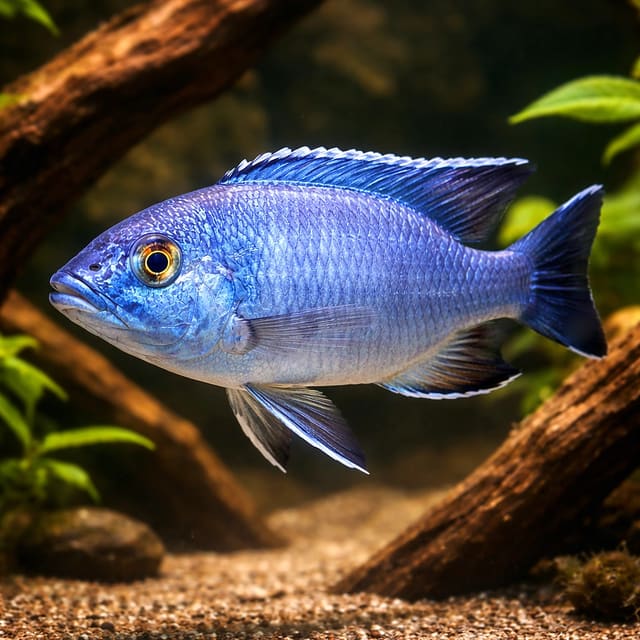
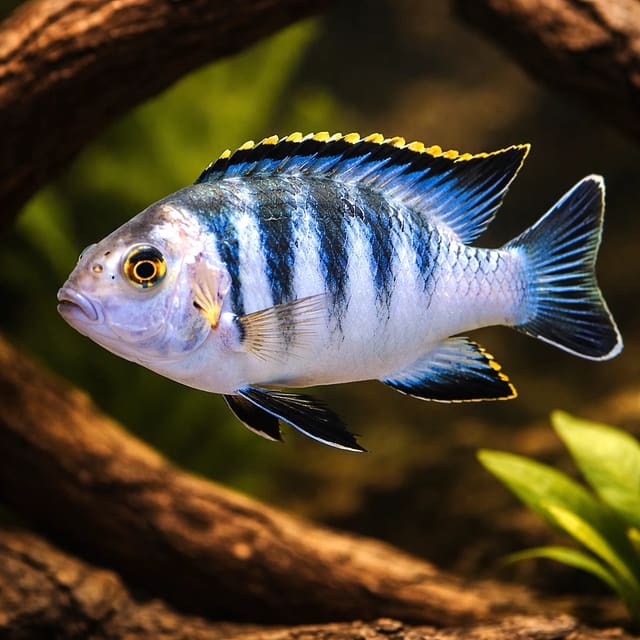
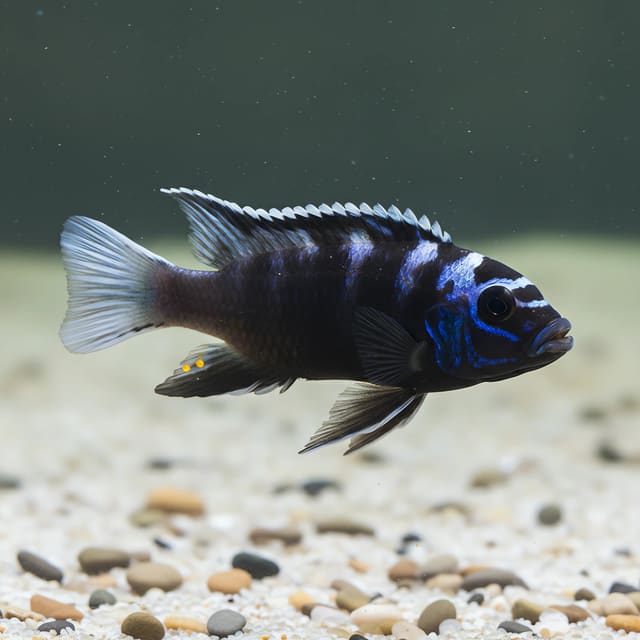
Adult males are described as larger, more colourful and longer-finned than females. Those differences become relevant to social planning, but they should not be used to infer the sex of a selected fish from its size or gallery appearance. The Fire crest image shows the streamlined blue body, iridescent scales and orange-gold dorsal area associated with this colour form.
Browse the wider African cichlid collection to compare animals, but screen every proposed combination against the compatibility rules below rather than treating all Malawi cichlids as interchangeable.
One purchase supplies one animal in the size selected on the live selector. The selector labels are 3-4 cm, 4-5 cm, 5,5-7 cm, 7-9 cm and 9-14 cm. Use the live selector when choosing the dispatch size; static description text should not be used to judge which choice can be ordered.
The size you select is the size supplied, not the adult size. A smaller selection therefore changes the measurement at dispatch, not the aquarium footprint, water targets or long-term compatibility plan. Prepare the permanent aquarium before ordering rather than treating a smaller fish as justification for a temporary undersized setup.
| Selector wording | What it means |
|---|---|
| 3-4 cm to 9-14 cm | The dispatch measurement band for the selected animal |
| One purchase quantity | One fish, not a group or breeding set |
| Adult planning figure | Up to 13.2 cm total length recorded by FishBase |
Sex is guaranteed only when the selected option explicitly states male or female. This Copadichromis virginalis Fire crest listing has no sex-guaranteed option.
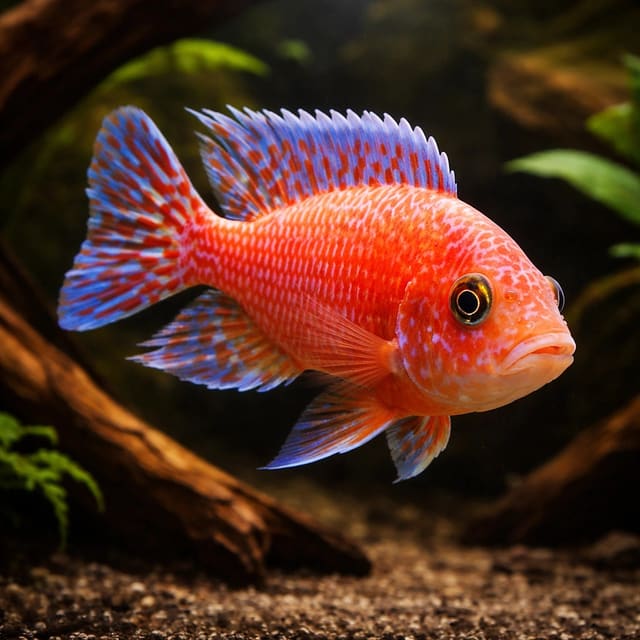
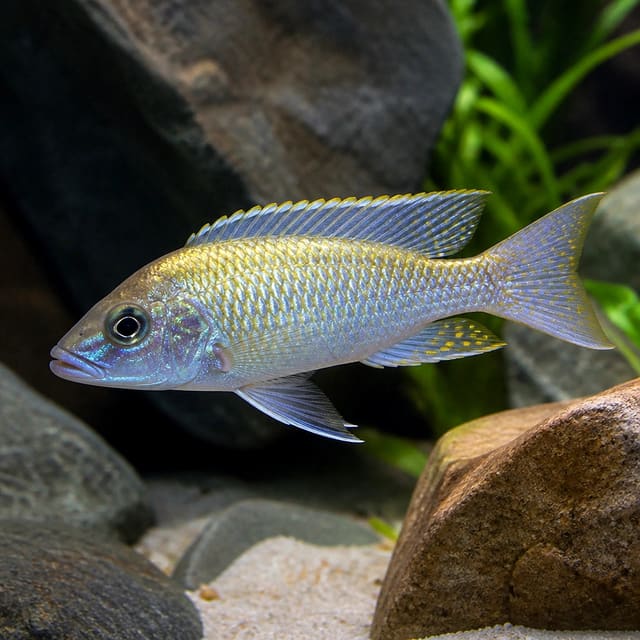
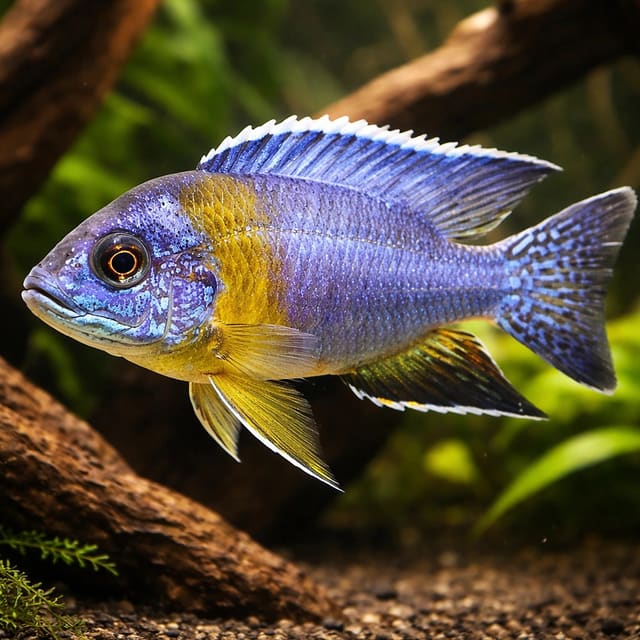
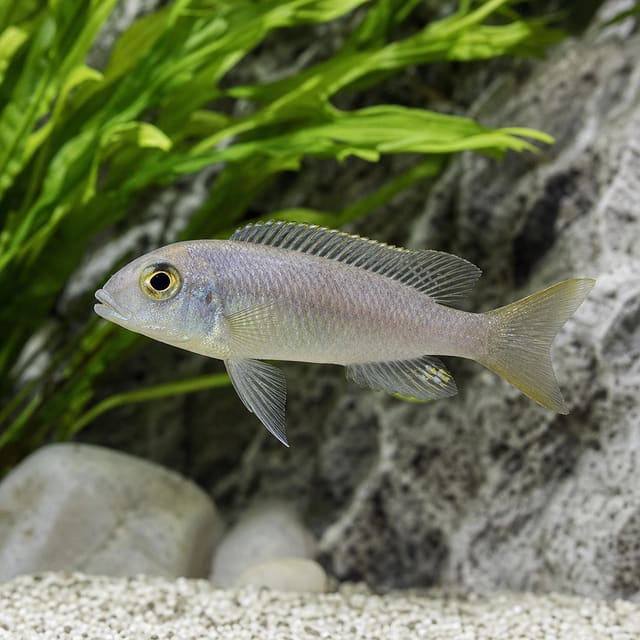
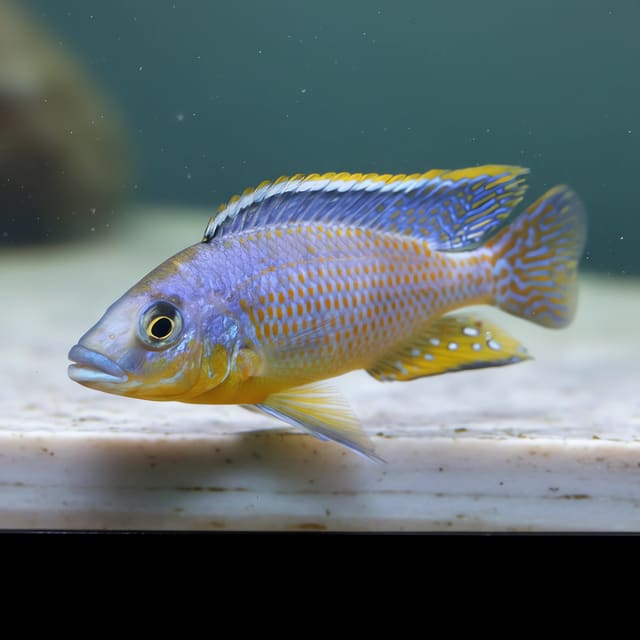
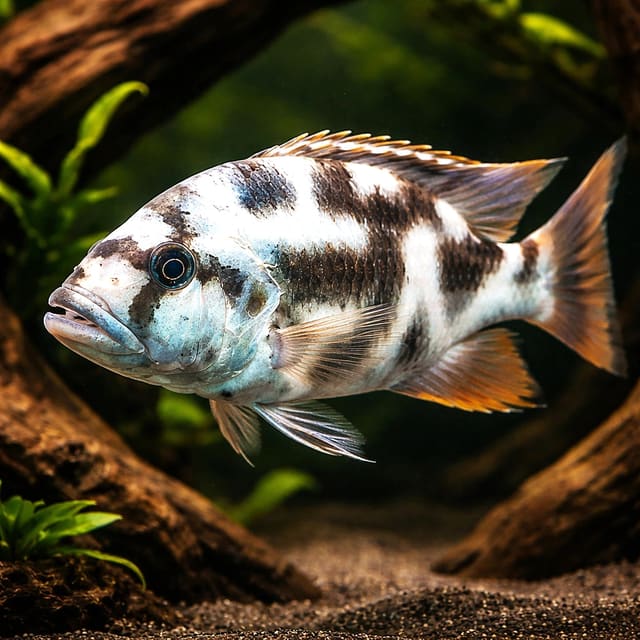
The gallery images are representative of this type of animal rather than photographs of the exact animal supplied, so colours can look slightly different from the live animal.
Because the social recommendation is based on a known male-to-female ratio, do not assume that several unsexed purchases will create that ratio. Decide whether your aquarium has enough space for the fish you intend to keep, then make a stocking assessment around the animals and sexes already present.
Seriously Fish recommends a base of at least 150 × 45 cm and describes a 150 × 45 × 45 cm aquarium as approximately 304 litres. The fish is particularly active and should not be kept in a smaller footprint. Length and unobstructed swimming room are central requirements, not optional upgrades.
Its species range is 25–29°C, pH 7.5–8.5 and 10–25 dGH. OATA’s broad Malawi-cichlid guidance gives 23–27°C, pH 8.0–8.6 and 12–18 dGH. Using the overlap keeps routine aquarium conditions within both: 25–27°C, pH 8.0–8.5 and 12–18 dGH.
| Planning point | Working requirement |
|---|---|
| Base dimensions | At least 150 × 45 cm |
| Example volume | Approximately 304 litres at 150 × 45 × 45 cm |
| Routine temperature | 25–27°C |
| Routine pH | 8.0–8.5 |
| General hardness | 12–18 dGH |
| Suits | Not suited to |
|---|---|
| A long aquarium with open swimming space | An aquarium with a base smaller than 150 × 45 cm |
| Hard, alkaline water within the routine range | Water outside the stated temperature, pH or hardness range |
| Restrained, carefully screened Malawi companions | Mbuna, rowdy or belligerent companions |
| A mature aquarium with effective biological filtration | An aquarium with measurable ammonia or nitrite |
Choose this fish only when those conditions can be held steadily in a mature, filtered aquarium. The decisive fit is a long swimming footprint, hard alkaline water, zero ammonia, zero nitrite and restrained companions. A tank that misses one of those requirements needs adjustment before the fish is introduced.
Start with a sand substrate and preserve a wide route through the aquarium for sustained swimming. Sand is essential because males build nests in it, while the open area suits the species’ active utaka behaviour. A crowded rock maze designed around mbuna works against both needs.
Use rock piles selectively to create variation, refuge and boundaries without filling the central swimming area. Place the rocks so that fish can move behind them when avoiding attention, yet retain an uninterrupted route along the length of the aquarium. Rock piles are especially important when compatible rock-associated animals are part of a carefully assessed community.
At the cited 150 × 45 cm minimum base, the footprint is 6,750 cm². Treat that calculation as a layout aid, not as permission to shorten one dimension while preserving the same area. The recommendation specifically prioritises a 150 cm length for this particularly active fish.
Plants are optional. The species is not expected to harm them, and hard-water-tolerant choices named by Seriously Fish include Vallisneria, Anubias and Sagittaria. Keep planting in restrained groups so it does not erase the swimming lane. Malawi cichlids will often dig and rearrange the substrate, which can disturb rooted plants.
Before introducing the fish, inspect the layout from end to end. If the route is repeatedly blocked by tall rocks or dense planting, remove or move décor. If every retreat is concentrated in one corner, create another separated refuge so one dominant fish cannot control all shelter from a single position.
Run the aquarium at 25–27°C, pH 8.0–8.5 and 12–18 dGH. These working values are the overlap between the Seriously Fish species range and OATA’s Malawi-cichlid guidance. Stability within the range matters more than trying to move the reading to a particular endpoint.
Test the water rather than judging it by appearance. Our water chemistry guide explains the values to measure, and the water matcher helps compare measured aquarium water with the required range. Record results consistently so a gradual drift can be recognised before it becomes a sharp change.
| Test result | Decision |
|---|---|
| 25–27°C | Keep the heater setting steady |
| pH 8.0–8.5 | Suitable alkaline range |
| 12–18 dGH | Suitable hard-water range |
| Ammonia above 0 mg/l | Do not add fish; correct the biological filtration problem |
| Nitrite above 0 mg/l | Do not add fish; correct the biological filtration problem |
OATA sets ammonia and nitrite at zero and says nitrate should not exceed 20 mg per litre above the normal tap-water level. Test the source water as well as the aquarium so the nitrate comparison has a real baseline. If the tank reading rises while the tap-water reading remains similar, review feeding, stocking and the weekly water-change routine.
Coral sand or a similar substrate is recommended in the Malawi guidance because it can help buffer the water. The species requirement for sand and the group recommendation for a buffering substrate can therefore be met through a suitable sand choice. Test afterwards rather than assuming the substrate alone will create the required chemistry.
When a result is outside range, make the aquarium suitable before introducing the fish. Avoid repeated swings between corrective actions. A stable result inside the working band gives the biological filter, fish and future water changes a consistent operating point.
A working biological filter is essential. RSPCA aquarium guidance explains that fish release toxic ammonia; filter bacteria convert it first to nitrite, which is also toxic, and then to the safer nitrate. The aquarium must be matured before livestock is added so that this bacterial population is established.
If this is your first aquarium, follow our guide to preparing and maturing a tropical tank before setting an introduction date. Do not use clear-looking water as a substitute for ammonia and nitrite tests. Both must read zero.
For an aquarium of approximately 304 litres, Seriously Fish recommends turnover of four to five times the volume per hour. It illustrates this with two filters rated at 610–760 litres per hour each. Together, that gives a nominal total of 1,220–1,520 litres per hour.
The same example uses roughly 150–225 W across two heaters to maintain 25–29°C when the room is around 20°C. For the routine 25–27°C target, select and control heating so the actual water temperature remains in that narrower band. Check the aquarium thermometer rather than relying solely on the heater dial.
OATA recommends an oversized filter and strong aeration for Malawi communities, where stocking can place heavy demands on water quality and dissolved oxygen. Add fish gradually so the beneficial bacteria can increase with the biological load. If ammonia or nitrite appears, stop further additions and restore safe water quality.
Copadichromis are specialised zooplankton feeders in nature. They face moving water and use their eyes to locate drifting organisms, then rapidly extend the upper jaw and draw the prey into the mouth. In the aquarium, this biology points towards varied, appropriately small foods rather than a single large or coarse item.
Offer a mixture of small live, frozen and dried foods. Artemia nauplii are specifically recommended, and suitable prepared choices include a quality dried product, freeze-dried Artemia and an algae-based food. Include vegetable matter through blanched spinach or a good-quality Spirulina flake. OATA also notes that larger utaka may take food with a higher animal content and frozen choices such as brine shrimp, prawns or cockles.
The schedule is deliberately based on consumption time rather than a fixed spoonful. The correct quantity changes with the number and size of fish, but the endpoint remains the same: the food should be eaten within a few minutes. Uneaten food breaks down and releases waste, adding pressure to the biological filter.
| If you observe | Do this |
|---|---|
| Food remains after several minutes | Reduce the next portion |
| One food is repeatedly ignored | Use another supported small food while retaining variety |
| Reduced interest in all food | Test water quality and check for other health changes |
| Ammonia or nitrite above zero | Stop increasing food and correct water quality |
Distribute food where the fish can take it in open water without forcing it into a rowdy feeding contest. Compatibility remains part of feeding care: belligerent companions can prevent this generally peaceful species from feeding normally even when the diet itself is suitable.
Complete the aquarium, filtration cycle and compatibility plan before delivery. Test ammonia and nitrite at zero, confirm 25–27°C, and check that pH and hardness sit within the working ranges. Leave the sand area, swimming lane and refuges in their final positions so the fish enters a stable environment.
Add livestock slowly. Each addition increases feeding and waste, while the filter bacteria need time to increase with that load. Stocking too quickly can cause new tank syndrome, with ammonia and nitrite rising because the biological filter cannot yet process the additional waste.
These steps follow our current delivery and Live Arrival Guarantee policy. Keep the order number and continuous unboxing video. Send both if you make a Live Arrival Guarantee claim.
During the first day, distinguish close observation from constant interference. Watch for hanging at the surface, sitting on the bottom, erratic swimming, unusually fast or slow gill movement, marked colour change or immediate aggression. Test water quality when behaviour changes rather than assuming the cause from appearance alone.
Carry out a partial water change of 25% at least once every week. In a 304-litre aquarium, 25% is approximately 76 litres. Treat that as a worked example: calculate 25% from the aquarium’s actual water volume.
Condition replacement tap water before it enters the aquarium so chlorine or chloramine is removed. Use a siphon to remove solid waste from the substrate while preserving the open sand areas. Keep replacement conditions consistent with the aquarium’s 25–27°C, pH 8.0–8.5 and 12–18 dGH routine.
Do not run biological filter media under the tap. Chlorine or chloramine may kill the bacteria that process ammonia and nitrite. Cleaning the media lightly in removed aquarium water reduces bacterial loss while clearing debris.
| Change in the fish | Immediate response |
|---|---|
| Surface hanging or bottom sitting | Test water quality |
| Erratic swimming | Test water and inspect aggression |
| Faster or slower gill movement | Check water quality and aeration |
| White spots, fluffy growths or damaged scales | Test water and contact us for health guidance |
| Reduced food intake | Test water and review recent social changes |
Do not choose a treatment from one symptom alone. Changes in swimming, breathing, colour, temperament, appearance, body condition or appetite are prompts to test the aquarium and assess the fish as a whole. The weekly record helps show whether the change coincided with a water-quality drift, increased feeding or a stocking change.
This is a shoaling species by nature, but rival males require enough space to establish individual territories. The species recommendation is one male with at least three females in most setups. Several males may be kept only in a bigger aquarium with a correspondingly larger female group and enough room for separate territories.
The retail offer does not guarantee sex, so buying several fish does not guarantee a one-male-to-three-female group. Build the plan around known animals rather than assuming size or colour establishes sex. Adult males are described as larger, more colourful and longer-finned, but appearance in a representative gallery image is not a promise about the fish supplied.
The female majority reduces the chance that one female receives all male attention. Space remains essential even with the intended ratio: a numerical plan cannot compensate for an aquarium that is too short or lacks distinct refuges.
Copadichromis virginalis is a maternal mouthbrooder. A male prepares a simple depression in the sand, often under or beside a stone, and the female carries the brood. If breeding behaviour develops, preserve areas of open sand and include flat rocks, while recognising that a community aquarium gives fry a lower survival rate than a species aquarium.
Breeding behaviour can also intensify territorial pressure. Watch whether displays remain local or turn into repeated pursuit across the aquarium. Rearranging décor may help reset territories, but it does not remove the need for adequate dimensions, an appropriate ratio and compatible companions.
This is described as generally peaceful even by Copadichromis standards, but that does not make it a general community fish. Rowdy or belligerent companions can prevent it from feeding and settling normally. Start with behaviour: reject fish that are likely to dominate open-water feeding or pursue it continuously.
Avoid mbuna. Their aggressive, rock-focused behaviour is a poor match for this more restrained utaka, and Seriously Fish says the two should not be combined. Also avoid similarly coloured fish because they may provoke an aggressive response.
Do not combine it with other Copadichromis species because they can hybridise. This is an identity as well as a temperament decision: even a calm member of the genus fails the screen when hybridisation is possible.
| Candidate | Decision |
|---|---|
| Mbuna | Avoid |
| Rowdy or belligerent fish | Avoid |
| Similarly coloured fish | Avoid |
| Other Copadichromis | Avoid because of hybridisation |
| Most Aulonocara species | Potential candidate after individual assessment |
| Peaceful haps such as Cyrtocara moorii | Potential candidate after individual assessment |
| Some Lake Malawi Synodontis | Assess the exact species and aquarium |
Most Aulonocara species and peaceful haps such as Cyrtocara moorii are named as better candidates, not universal companions. OATA limits the wider Malawi screen to other Malawi cichlids or some Synodontis species, but the exact fish still has to pass the behaviour, colour, water and space checks.
For a proposed community, compare the adult size, temperament, water range and territory needs of every animal. Send us the aquarium dimensions, current fish, known sexes and planned additions when you need a stocking assessment. The answer depends on that exact combination rather than a general tank-mate label.
Add the more peaceful animals before more aggressive Malawi cichlids. Introducing Malawi fish in a planned group can reduce the chance that one newcomer receives all the attention, but each addition must remain within the filter’s capacity. Do not increase the population quickly merely to change social pressure.
Before an introduction, identify which fish currently controls the open swimming lane, feeding area and refuges. Rearranging aquarium décor can reduce established territorial advantage because the residents must find new boundaries. Preserve the sand and swimming requirements while moving rock piles; solving one territory problem should not create a blocked layout.
A slight increase in Malawi stocking is described by OATA as one way to spread aggression, but it is not a substitute for the species’ 150 × 45 cm minimum base, careful tank-mate selection or strong filtration. Extra fish also increase waste and oxygen demand. Use that method only as part of a planned Malawi community with an oversized filter and aggressive aeration.
Review the community again as fish grow and adult male colour develops. A combination that appeared calm at a smaller dispatch size may create new colour or territory conflicts later. The permanent aquarium and stocking plan must therefore account for adult behaviour from the beginning.
Compatibility remains conditional throughout the fish’s life. Keep watching feeding access, swimming, hiding, breathing and physical condition after every addition or décor change. Early action is preferable to waiting until repeated aggression produces damaged fins, missing scales or loss of body condition.
FishBase records a maximum adult size of 13.2 cm total length. Plan its permanent aquarium around that adult figure rather than the dispatch size.
Use a base of at least 150 × 45 cm; a 150 × 45 × 45 cm aquarium is approximately 304 litres. Provide sand, open swimming lanes and contained rock refuges.
It is shoaling, and Seriously Fish recommends one male with at least three females in most setups. Sex is not guaranteed for this offer, so several purchases will not necessarily create that structure.
It suits a keeper who can maintain a mature aquarium of at least 150 × 45 cm at 25–27°C, pH 8.0–8.5 and 12–18 dGH while carefully managing social structure and compatibility.
Offer varied small live, frozen and dried foods, including Artemia, plus vegetable matter such as blanched spinach or Spirulina flake. Feed only what it eats within a few minutes, twice daily.
Keep it at 25–27°C, pH 8.0–8.5 and 12–18 dGH; this is the overlap between the Seriously Fish species range and OATA’s Malawi-cichlid guidance. Keep ammonia and nitrite at zero.
It is generally peaceful by Copadichromis standards, but rival males need separate territories. Avoid rowdy or belligerent companions and act if repeated pursuit, exclusion from food or fin damage develops.
Most Aulonocara species and peaceful haps such as Cyrtocara moorii are potential candidates after individual assessment. Avoid mbuna, rowdy fish, similarly coloured fish and other Copadichromis; assess the exact species before considering a Lake Malawi Synodontis.
Start filming every delivery while the parcel is still sealed, then keep filming continuously as it is opened and while the fish remains in the sealed bag. Someone must be present to receive it. Float the bag for 20–30 minutes, then release the fish without pouring bag water into the aquarium.
No reviews for this item yet. Bought one? Honest reviews only, good or bad.
What customers say about ordering from us
Easy website plenty of info on fish your buying great to pick a time slot
TRACEY DURRANT · 7 Oct 2026
Got some lovely fish thank you
Kevin Mackie · 7 Oct 2026
Reviews of our shop, collected by Judge.me, an independent third-party review collector. Newest first.