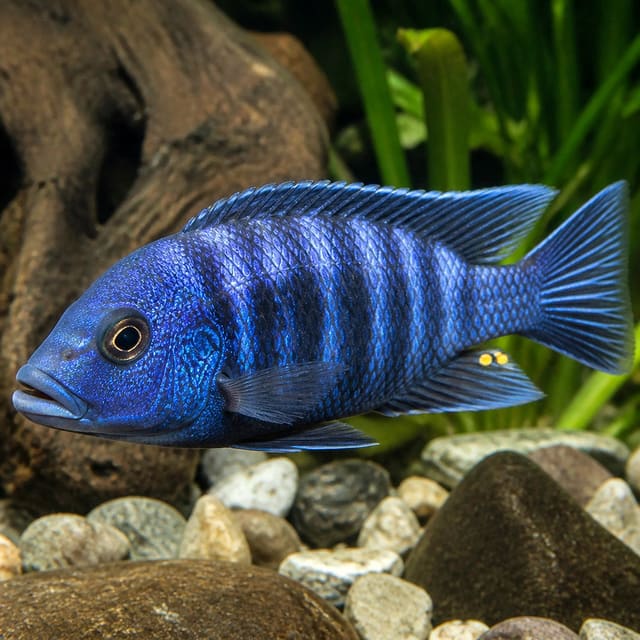
Copadichromis virginalis Fire crest
25–27°C · pH 8–8.5 · 304L
£50.99
Lupingu Copadichromis (Copadichromis trewavasae) is a Lake Malawi cichlid offered in four dispatch sizes. It suits an intermediate keeper who can provide hard alkaline water, mature filtration, open swimming room and carefully managed Malawi companions.
Adult size is the maximum length this species reaches at full maturity (scientific sources). The livestock you receive will be younger and smaller — pick a size above for the actual shipping size. Product-photo provenance and any image-specific limitations are stated on the listing.
Copadichromis trewavasae
Save when buying multiple fish. Each quantity is one fish; sex and pair formation are not guaranteed unless the selected variant explicitly states them.
Lupingu Copadichromis (Copadichromis trewavasae) is a Lake Malawi cichlid offered in four dispatch sizes. It suits an intermediate keeper who can provide hard alkaline water, mature filtration, open swimming room and carefully managed Malawi companions.
Adult size is the maximum length this species reaches at full maturity (scientific sources). The livestock you receive will be younger and smaller — pick a size above for the actual shipping size. Product-photo provenance and any image-specific limitations are stated on the listing.
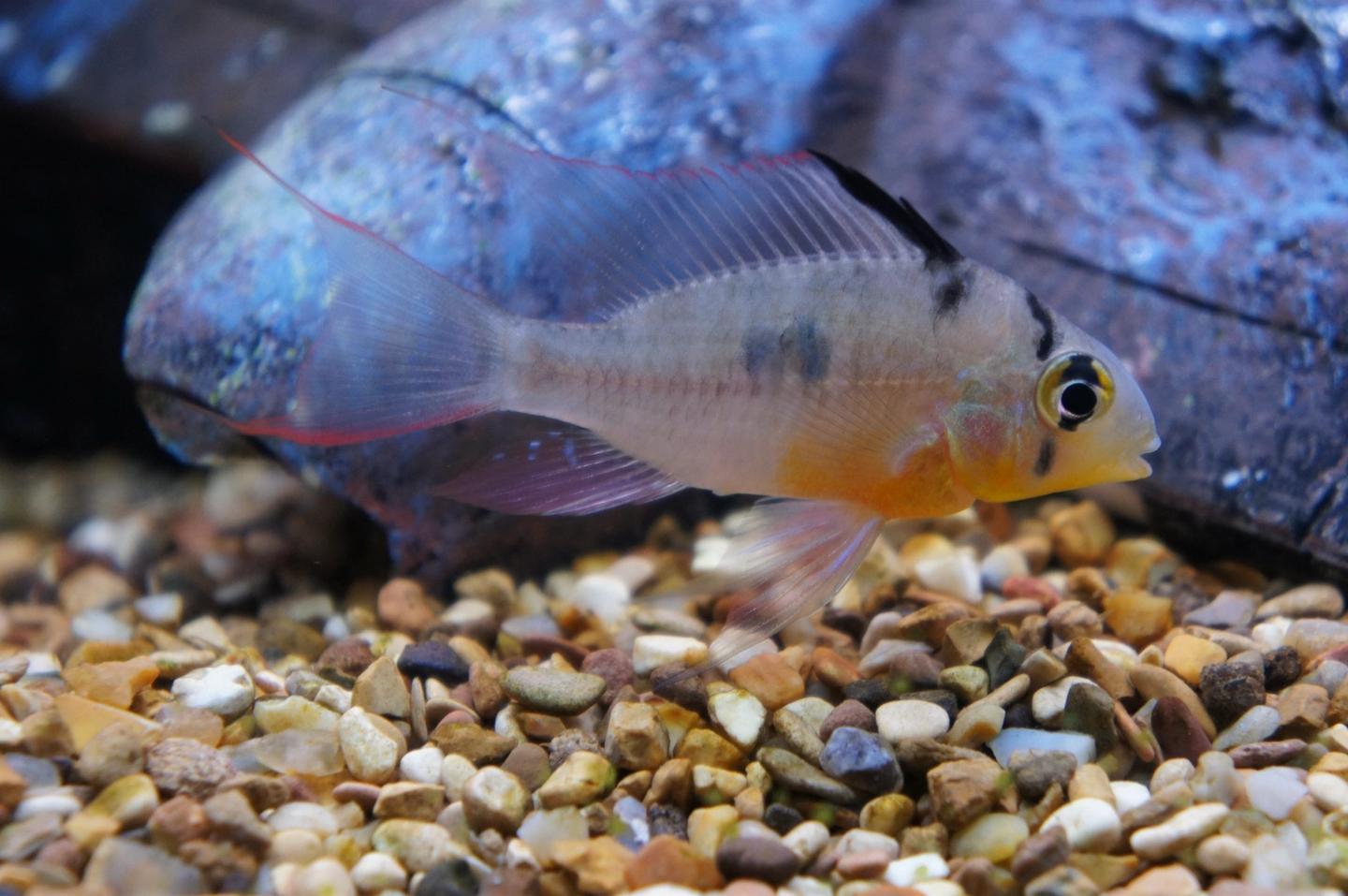
Cichlids are a family of roughly 1,800 accepted species, not one care type. Before buying, identify the exact species and source, then compare adult measurement, usable tank dimensions, social system, territory, tested water, diet and an exit plan. No family-wide minimum tank, water range or tank-mate list is safe.
Maintain these water conditions for optimal health and vibrant colors
Lupingu Copadichromis (Copadichromis trewavasae) is a Lake Malawi haplochromine cichlid sold under the trade locality label “Lupingu”. FishBase recognises the species and records it from Lake Malawi, while the exact offer record preserves the Lupingu name and its recurring dispatch grades. Keeping the locality word outside the scientific parentheses makes the distinction clear: Copadichromis trewavasae is the supported binomial, and Lupingu describes the offered form rather than becoming part of the Latin name.
One purchase supplies one live fish in the size you choose. The recurring dispatch sizes are 4–5 cm, 5–6 cm, 6–7 cm and 7–9 cm. The size you select is the size supplied, not the adult size. FishBase’s adult record is a maximum of 10.5 cm standard length for male/unsexed fish. Standard length excludes the tail fin, so that figure must not be repeated as total length or expanded into an unfounded 12–15 cm range.
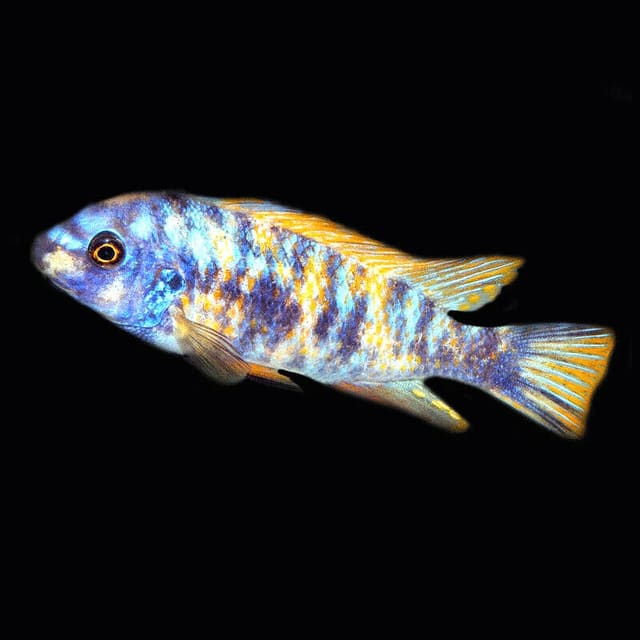
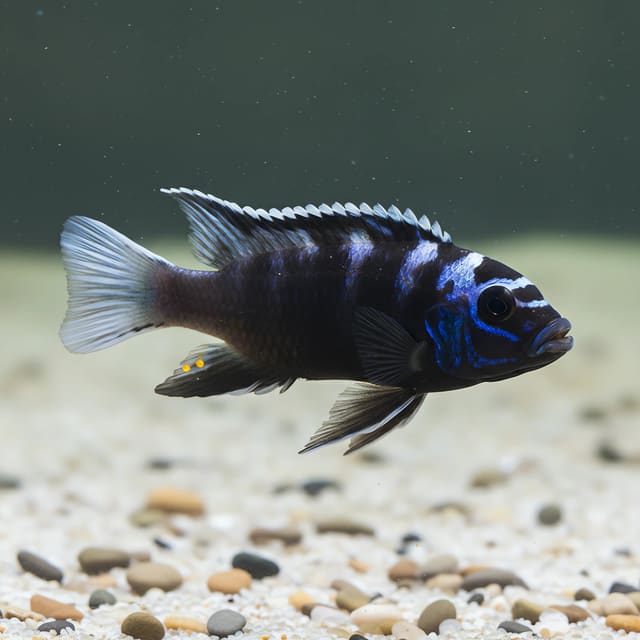
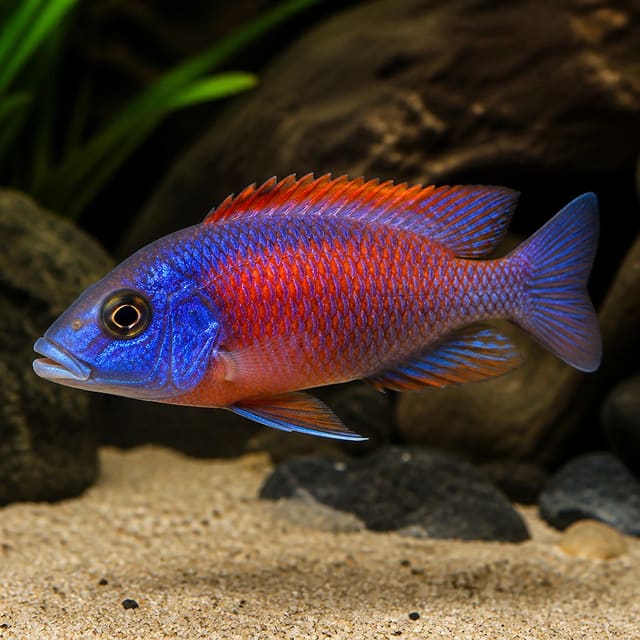
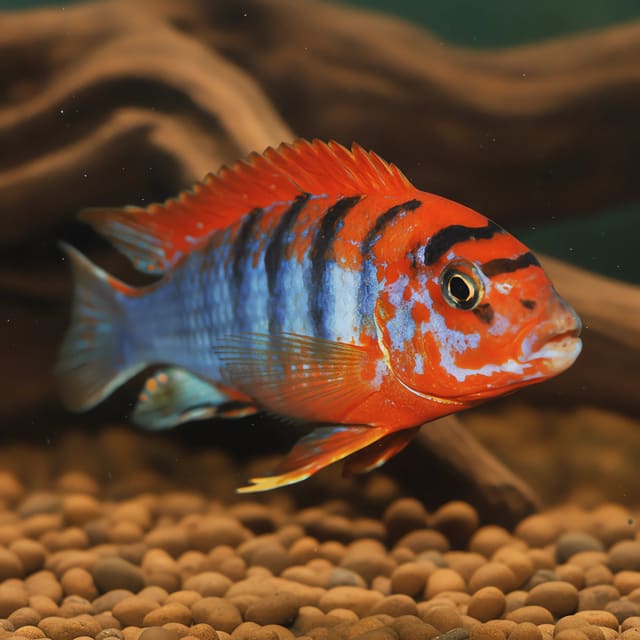
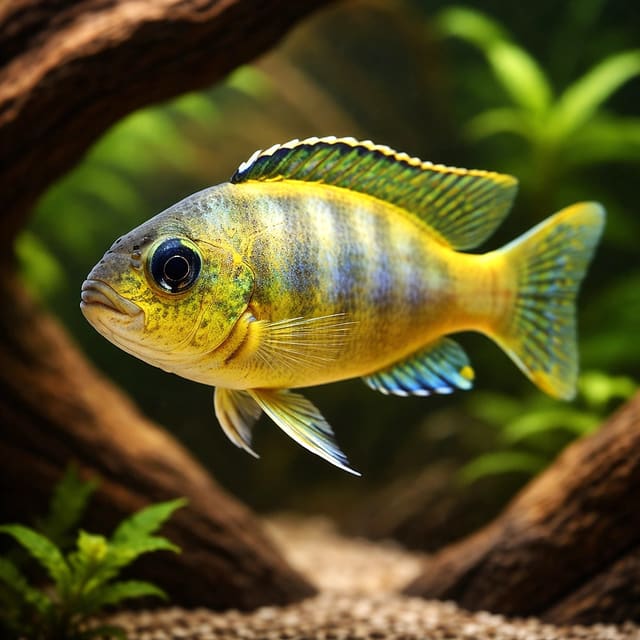
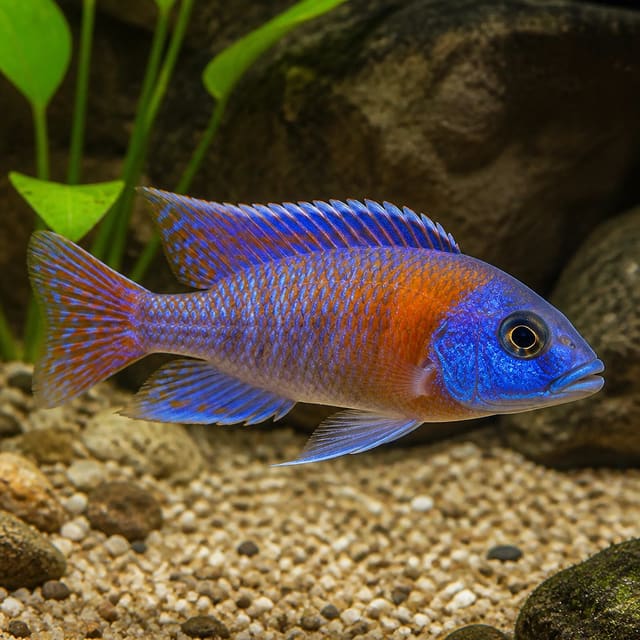
No size choice guarantees male or female. Juvenile colour and fin development cannot be used to promise sex, future colour or a breeding role. A photograph showing a blue-silver fish is useful for seeing shape and colour in the gallery, but it does not prove that every fish will look identical or that the pictured animal is the exact specimen supplied.
| What one purchase supplies | One live fish in the chosen dispatch size |
|---|---|
| Dispatch sizes | 4–5 cm, 5–6 cm, 6–7 cm or 7–9 cm |
| Adult record | 10.5 cm standard length, male/unsexed |
| Sex | No male or female guarantee |
| Care approach | Intermediate Lake Malawi planning |
Sex is guaranteed only when the selected option explicitly states male or female. This Lupingu Copadichromis listing has no sex-guaranteed option.
A good home for this fish begins with measured hard, alkaline water and a layout that balances open swimming room with secure rock boundaries. The keeper should be ready to watch feeding and social behaviour daily, because juvenile size and colour do not predict exactly how a particular mix will behave as the fish mature. Planning a separation route before it is needed is part of responsible cichlid keeping.
In the wild, FishBase places this species around the sand-and-rock interface at 10–30 metres, usually 15–25 metres. It records both males and females feeding on plankton in the water column near the bottom and on benthic invertebrates. Territorial males construct a bower next to a rock, while females are normally seen in small groups rarely exceeding ten. These observations guide habitat and behaviour discussions, but a wild female-group record is not an aquarium stocking instruction.
For routine aquarium planning, OATA’s broad Malawi-cichlid guide gives 23–27°C, pH 8.0–8.6, 12–18°dGH and 10–15°dKH. Those are group-level values rather than a measured species-specific optimum. The practical aim is stable, hard, alkaline water in a mature, well-filtered aquarium with strong oxygenation, open swimming room, a sand-and-rock layout and a stocking plan designed around Malawi cichlid behaviour.
This is an intermediate fish because the chemistry, social management and feeding plan need deliberate attention. It is not a general tropical-community cichlid and should not be put into soft acidic water with delicate fish merely because its juvenile size looks manageable. If your aquarium is new, unstable or already tense, solve that problem before adding another cichlid.
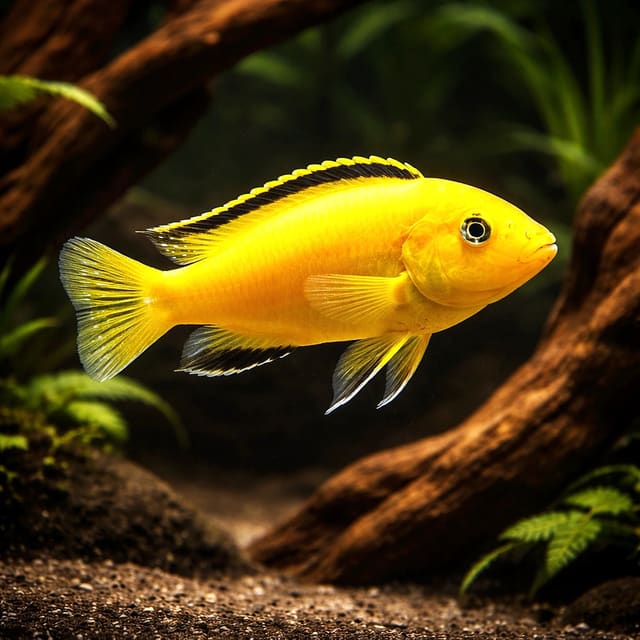
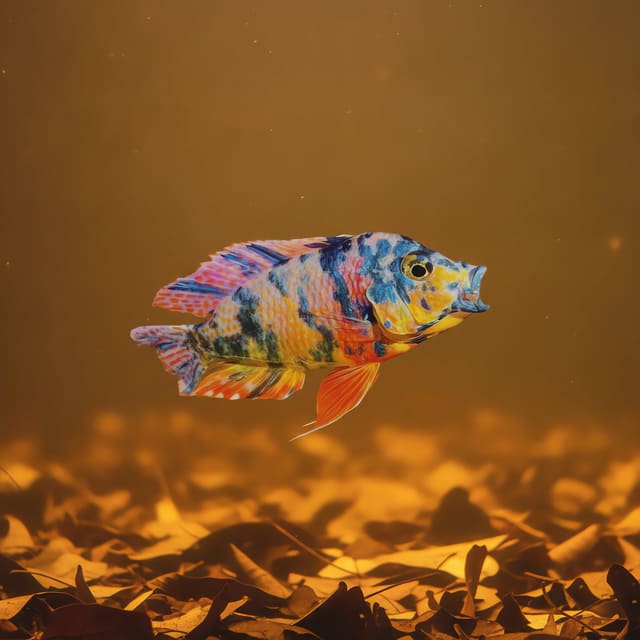
Gallery images have been digitally enhanced to improve image quality. Natural colour, pattern, size and maturity can vary between live animals.
For a view of the wider range, browse the African cichlid collection. The related-products field remains empty because an Acei, Yellow Lab, peacock or Blue Dolphin is not automatically an equivalent substitute or compatible companion; each requires its own adult-size, water and aggression assessment.
FishBase records a maximum length of 10.5 cm SL for male/unsexed Copadichromis trewavasae. The SL label is essential: standard length is measured without the tail fin. It is not interchangeable with total length, and there is no honest conversion in the species record. Treat 10.5 cm SL as a scoped biological record, not a guarantee that every fish will reach exactly that measurement.
The four sale sizes are dispatch grades. A 4–5 cm fish is not a miniature adult, and a 7–9 cm fish may still change in body depth, colour and social behaviour. Plan the aquarium around adult swimming space, filtration load and cichlid interactions from the start. Do not place a juvenile in a temporary small tank on the assumption that an upgrade will happen before it matters.
OATA recommends at least 200 litres for a reasonable Malawi-cichlid community, while noting that individual needs vary. That is broad community guidance, not a species-specific minimum for C. trewavasae. Aquarium shape, usable swimming length, rock placement, number and character of companions, oxygenation and filtration capacity all affect whether a particular setup works. A long, spacious footprint is more informative than a volume number viewed alone.
FishBase describes this species at the meeting point of sand and rocks, where both are present in roughly equal proportions. Recreate the useful structure rather than copying a decorative photograph exactly. Leave open sand and water for swimming and foraging, then use securely placed rocks to provide visual breaks and territory edges. Set heavy rocks directly and safely so digging cannot undermine them.
Avoid tall unstable piles, narrow crevices that can trap a fish and sharp edges at turning height. Create several routes through the aquarium so one territorial individual cannot control the only passage. Keep enough open foreground and mid-water space for the keeper to observe breathing, feeding and interactions. Plants are optional in a Malawi plan and may be disturbed; if used, choose robust placements that do not crowd the swimming area or compromise the rock structure.
Use a fitted lid and protect gaps around cables and pipework. Active cichlids can jump when startled or chased. The cover should still allow safe gas exchange, feeding and maintenance. Avoid placing the aquarium where passing traffic, loud vibration or sudden light changes repeatedly startle the fish.
OATA’s Malawi-cichlid group guide is 23–27°C, pH 8.0–8.6, general hardness 12–18°dGH and carbonate hardness 10–15°dKH. Keep those numbers together with their scope. They describe broad routine guidance for Malawi cichlids, not a species-specific optimum measured for the Lupingu offer.
Test the aquarium’s actual water before purchase. The water-parameters guide explains the main readings, and the water matcher helps compare your results with stated guidance. Measure temperature with a thermometer rather than trusting the heater dial, and check both general and carbonate hardness where the mineral content is important to the plan.
A stable value within the suitable broad range is safer than repeated rapid adjustment. Do not chase pH with sudden doses while ignoring hardness and buffering. If tap water is much softer or more acidic than a Malawi aquarium requires, plan a consistent remineralisation method before the fish arrives and verify every prepared batch. Rocks and substrate marketed for Malawi aquariums can influence chemistry, but their effect should be measured rather than assumed.
Keep a log of temperature, pH, hardness, ammonia, nitrite and nitrate. Patterns are more useful than isolated results. If pH or temperature moves noticeably between morning and evening, identify the cause before adding fish. The aquarium should also be protected from direct sun, radiator heat and cold draughts that create avoidable swings.
Ammonia and nitrite must be zero. The RSPCA explains that biological filtration supports bacteria which process toxic ammonia and nitrite into the less harmful nitrate. A new aquarium with clear water may still lack enough biological capacity. Follow the first tropical tank setup guide, confirm the cycle with tests and add livestock gradually.
Malawi cichlids can create a substantial waste load, particularly in a managed community. OATA recommends an oversized filter and strong aeration for the group. Choose equipment with enough biological media and flow while ensuring that fish can still use the whole tank without being pinned by a jet. Surface movement, clean filter paths and sensible stocking all contribute to oxygen availability.
OATA recommends weekly partial water changes of about 25% and regular testing. Treat replacement tap water for chlorine or chloramine, match temperature carefully and avoid a sudden chemistry shift. Siphon waste from the sand surface and accessible rock edges. Clean biological filter media gently in removed aquarium water when flow declines; do not rinse it under the tap or replace every mature medium at once.
Nitrate management depends on stocking, feeding, source water and maintenance. Do not use the absence of visible dirt as proof of clean water. If nitrate rises faster than the routine can control, reduce feeding waste, improve maintenance access or revise the stocking plan rather than relying on an occasional very large corrective change.
FishBase records C. trewavasae taking plankton in the water column near the bottom and benthic invertebrates. In the aquarium, that supports small suitable foods delivered where the fish can intercept them, but it does not justify a narrow single-food menu. OATA notes that Malawi-cichlid diets vary and that larger utaka may need pellets with more animal content alongside suitable frozen foods.
Use a good-quality Malawi or appropriate omnivorous cichlid staple and select particle size for the fish being supplied. Offer modest portions that are consumed promptly. OATA’s broad advice is to feed Malawi cichlids only what they can eat within a few minutes, twice daily. Treat that as a starting framework and adjust to body condition, growth, waste and competition rather than feeding by habit.
Suitable frozen foods may add variety, but avoid uncontrolled rich feeding and remove anything left uneaten. Do not use mammal meat as a shortcut to protein. If one fish consistently hangs back, spread small portions through the water column or use two feeding points so a dominant fish cannot take everything. Observe which fish actually swallows food.
Juveniles need reliable nutrition, but “growth feeding” should not become chronic overfeeding. Check the abdomen and overall body condition from both sides, and keep notes if the fish is newly arrived. A sudden loss of appetite, abnormal swelling, stringy waste or laboured breathing calls for a water test and qualified advice, not a guessed medicine or an unfounded home treatment.
FishBase records territorial males constructing a bower beside a rock and females usually occurring in small groups rarely above ten. Mouthbrooding females remain closer to the bottom than foraging females and may form small groups. These are useful descriptions of wild behaviour. They do not prove that a home aquarium should contain one male with a fixed number of females, especially when this listing does not guarantee sex.
OATA’s broader Malawi guidance says these cichlids can be aggressive and suggests groups of at least fifteen in a reasonable Malawi community to spread aggression, with more females than males where possible. That refers to community management across Malawi cichlids, not fifteen Copadichromis trewavasae. It also does not override the need for suitable volume, filtration, identification and an exit plan.
Build the social plan around the aquarium you can manage. Additions should not overload filtration or remove every retreat. Introduce fish with close observation, use visual barriers and be ready with a mature alternative space or safe divider. Rearranging some rockwork can interrupt established territories, but it cannot make an incompatible tank large enough or turn a highly aggressive individual into a suitable companion.
Record the aquarium’s normal pattern before adding this fish: where each resident feeds, which rock boundaries are defended, how long food remains visible and what the usual nitrate rise looks like between water changes. After introduction, compare the same points rather than relying on a vague impression that the tank seems calm. A dated note or short video can reveal repeated pressure that is easy to miss during a quick glance.
Growth changes the balance. Reassess swimming room, rock routes and filter load each month while juveniles develop. A route that works for 4–5 cm fish may become narrow, and a previously quiet individual may begin holding territory. Move rocks only when they can be made fully stable, preserve open water, and make one planned change at a time so the result can be judged.
Prepare a backup plan before mixing cichlids. A mature alternative aquarium or properly installed divider is far more useful than an empty emergency container with no biological filtration. Keep spare dechlorinator, test reagents and basic equipment available, and know which fish could be moved without creating a second incompatible mix. Early separation after persistent cornering or missed meals is kinder than waiting for major injury.
For routine review, note temperature, pH, hardness, ammonia, nitrite, nitrate, appetite, fin condition and any fish repeatedly excluded from shelter. Pair those observations with feeding and maintenance notes. If behaviour shifts immediately after a large layout or stocking change, address that context while also testing water, rather than assuming every problem is disease.
Before a holiday or busy period, confirm that the filter, heater and aeration are reliable, test the water and portion food conservatively. Show the carer the normal feeding amount and the signs that require contact: power loss, leaking equipment, surface gasping, a fish pinned in a corner or repeated refusal of food. Avoid adding new fish, changing the rock layout or performing an unfamiliar deep clean immediately before leaving. Label essential plugs so filtration and heat are not switched off accidentally, and leave test results and an emergency contact beside the aquarium.
Prepare the aquarium and testing equipment before delivery. Record the sealed parcel opening before other handling, then float the unopened bag for 20–30 minutes as set out in the delivery guidance. Avoid pouring transport water into the display. Once released, give the fish time to orient without repeatedly chasing it for photographs.
During the first days, check breathing, balance, skin, fins, feeding and where the fish spends time. A newly introduced cichlid may explore or hold back, but persistent surface gasping, uncontrolled chasing, refusal of every food or visible injury needs action. Test water immediately and separate fish safely if aggression prevents feeding or rest.
Quarantine is valuable only when the quarantine aquarium itself has mature filtration, heat, oxygen, cover and suitable water. A tiny uncycled container creates a new hazard. Use separate equipment, avoid cross-contamination and seek aquatic-veterinary or experienced specialist advice for disease concerns.
OATA advises keeping Malawi cichlids with other Malawi cichlids or some species of Synodontis catfish that also occur in Lake Malawi. That is a group-level starting point, not a guarantee for every combination. Each proposed companion still needs compatible adult size, water chemistry, feeding style and temperament.
Do not mix this fish into a soft-water community of tetras, rasboras or delicate dwarf cichlids. Even if no chasing occurs on the first day, incompatible mineral and pH requirements make the plan unsuitable. Avoid very small fish that could be intimidated, displaced or treated as prey, and avoid large, highly territorial cichlids able to dominate the whole aquarium.
FishBase’s record of bower-building territorial males means the layout should include more than one visual zone. Open water is needed for swimming and feeding, while rock boundaries can interrupt direct sight lines. Do not place the only food route or resting area inside a single defendable corner.
Observe feeding as closely as chasing. A calmer fish can lose condition without showing obvious fin damage if faster or more assertive cichlids take every portion. Spread food, use more than one entry point and watch the Lupingu fish consume it. If a fish remains excluded, change the stocking arrangement rather than simply increasing food and water pollution.
OATA’s group-of-at-least-fifteen guidance is intended to spread aggression in a reasonably sized Malawi community. It is not an instruction to buy fifteen of this product, and it is not safe when applied to an undersized or under-filtered aquarium. Stocking density must remain within the tank’s real swimming space, oxygenation, filtration and maintenance capacity.
The listing has no sexed option, so a male-to-female ratio cannot be ordered with certainty. Juvenile colour and the gallery photograph must not be used to assign sex. If a mature male becomes territorial, the keeper may need to revise rock boundaries, remove a competing individual or provide separate accommodation. Breeding is not promised and no fixed harem recipe is offered.
Add more peaceful residents before more aggressive ones where practical, and avoid introducing a single new fish into an established group without a plan. OATA recommends adding Malawi cichlids in groups to reduce focused aggression and notes that rearranging décor can disrupt old territories. These measures reduce risk but do not guarantee acceptance.
Review the aquarium at several times of day. Look for repeated chasing, cornering, blocked shelter, torn fins, loss of colour, rapid breathing and missed meals. A fish that survives but remains hidden and unfed is not compatible. Keep a secure separation option ready and do not wait for serious injury.
The supplied alternatives—Acei, Yellow Lab, a peacock and Blue Dolphin—are not automatically compatible or interchangeable with this species. Their appearance in the same retail category is not a social recommendation. Assess each exact product independently before combining it with C. trewavasae.
FishBase records a maximum of 10.5 cm standard length for male/unsexed Copadichromis trewavasae. Standard length excludes the tail, so it must not be presented as total length. The 4–9 cm figures on this listing are dispatch sizes, not an adult-size range.
OATA recommends at least 200 litres for a reasonable Malawi-cichlid community. Treat that as a broad starting point and increase space where stocking, swimming length, aggression or filtration demand it. Plan around adult space, not juvenile fit.
Aquarium social planning must keep the wild female-group record separate from the broader Malawi-community strategy; neither sets a fixed count of this species. Wild females occur in small groups rarely above ten, while OATA suggests at least fifteen fish for some Malawi communities to spread aggression; neither statement means buying that number of this species.
It is best treated as an intermediate fish. The keeper needs a mature aquarium, stable hard alkaline water, strong filtration and oxygenation, careful Malawi stocking and a way to respond if aggression or feeding competition develops.
FishBase records plankton taken near the bottom and benthic invertebrates in the wild. In the aquarium, offer appropriately sized quality Malawi-cichlid foods in modest portions, add suitable variety and make sure this fish eats before removing leftovers.
OATA’s broad Malawi-cichlid guide is 23–27°C, pH 8.0–8.6, 12–18°dGH and 10–15°dKH. These are group-level aquarium values rather than a species-specific optimum. Keep the chosen conditions stable and test them regularly.
Malawi cichlids can be aggressive, and FishBase records territorial males building bowers by rocks. Provide open swimming room, visual barriers and several feeding routes, then watch for repeated chasing, cornering or blocked meals rather than assuming a fixed temperament.
Start with suitably sized Malawi cichlids sharing hard alkaline water; some Lake Malawi Synodontis may also be considered. Every combination needs its own adult-size and behaviour check. Avoid delicate community fish, incompatible water requirements and highly aggressive companions.
Tropical Fish Co hand-packs live fish in oxygenated bags inside an insulated box and uses a licensed live-animal courier on the confirmed delivery date. Read the current delivery and Live Arrival Guarantee terms, and record the sealed parcel being opened if you need to make a claim.
The Lupingu trade offer establishes the Lupingu trade/locality label and four dispatch grades. FishBase’s Copadichromis trewavasae record supports the accepted binomial, Cichlidae family, Lake Malawi distribution, sand-and-rock habitat, feeding observations, territorial-male behaviour and 10.5 cm SL male/unsexed maximum. Standard length and sample scope remain attached to the number wherever it appears.
The OATA Malawi-cichlid care sheet supplies broad aquarium ranges and community-management advice. It does not establish a species-specific optimum, minimum tank or group number for this fish. The RSPCA aquarium environment guidance supports the need for established biological filtration.
Keep the scopes straight: dispatch size describes the fish supplied, 10.5 cm SL is a FishBase adult record, and OATA’s figures guide a broad Malawi community. Combining those distinct records without their labels would make the advice less accurate, not more convenient.
No reviews for this item yet. Bought one? Honest reviews only, good or bad.
What customers say about ordering from us
Easy website plenty of info on fish your buying great to pick a time slot
TRACEY DURRANT · 7 Oct 2026
Got some lovely fish thank you
Kevin Mackie · 7 Oct 2026
Reviews of our shop, collected by Judge.me, an independent third-party review collector. Newest first.