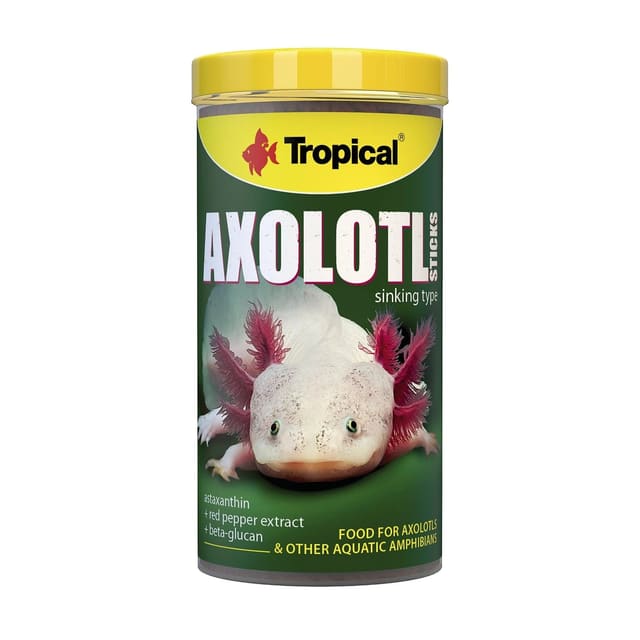
Tropical Axolotl Sticks 250ml/135g – 2mm Sinking Amphibian Food
£9.49
One 100 ml / 36 g can of Tropical Biorept Supreme Young: soft complete food with probiotic for young aquatic and semi-aquatic turtles from 4 cm carapace length.
One 100 ml / 36 g can of Tropical Biorept Supreme Young: soft complete food with probiotic for young aquatic and semi-aquatic turtles from 4 cm carapace length.
Tropical Biorept Supreme Young 100ml/36g is a soft complete food with probiotic for young and growing aquatic and semi-aquatic turtles. Tropical recommends it from a carapace length of 4 cm. The formula combines fish, krill, shrimp, squid and black soldier fly larvae with vitamins, minerals and a declared 2:1 calcium-to-phosphorus ratio.
This listing supplies one 100 ml can containing 36 g. It is the Supreme Young soft formula, not Biorept W Young and not the adult recipe. Feed once daily, include at least one fasting day each week and remove uneaten food from the water. The exact amount depends on the turtle's species, size, condition, temperature and appetite, so begin with a restrained portion and watch what is actually eaten.
| Listing detail | What is supplied |
|---|---|
| Quantity | One sealed retail can |
| Volume | 100 ml |
| Net weight | 36 g |
| Recipe | Biorept Supreme Young soft formula |
| Life stage | Young and growing turtles |
The product photograph shows the correct Biorept Supreme Young range and is a packaging reference. Label artwork can be refreshed by the manufacturer, so use the product name, 100 ml volume and 36 g net weight on this page as the dispatch specification.
Tropical developed this food for young aquatic and semi-aquatic turtles with a carapace length of at least 4 cm. The manufacturer's examples include turtles from genera such as Mauremys, Trachemys, Malaclemys, Clemmys, Kinosternon, Sternotherus, Apalone, Pelodiscus, Chelydra and Macrochelys. That list describes intended use; it is not a substitute for checking the diet of the exact species you keep.
The manufacturer also classifies the recipe as a complete feed for turtles and ornamental fish and says it can be offered to large predatory fish. On this store, its primary use is young aquatic and semi-aquatic turtle food. Do not assume that the word "reptile" makes it suitable for lizards, snakes or terrestrial tortoises.
| Animal or situation | Fit | Important note |
|---|---|---|
| Young aquatic turtle, 4 cm+ carapace | Intended use | Check species-specific feeding needs |
| Young semi-aquatic turtle, 4 cm+ carapace | Intended use | Feed in water and remove leftovers |
| Large predatory ornamental fish | Manufacturer-permitted secondary use | Only where the formula and piece size suit the species |
| Hatchling below 4 cm | Not the stated size range | Choose an age- and size-appropriate diet |
| Terrestrial tortoise | Not appropriate | Use a herbivorous tortoise diet matched to the species |
| Snake or insectivorous lizard | Not appropriate | Use the animal's established species-specific diet |
"Young" identifies the growth stage, while "Supreme" distinguishes this soft probiotic recipe from Tropical's other Biorept foods. It is designed around the higher protein and mineral demands of growing aquatic and semi-aquatic turtles. The soft structure is intended to resemble the softer animal foods these turtles take naturally and to be manageable for young animals within the stated size range.
This does not mean faster growth should be forced. Appropriate food works alongside correct temperature, clean water, suitable basking access and species-appropriate ultraviolet lighting. Growth should be steady and body condition should be monitored rather than judged only by appetite.
| Declared component | Amount or role |
|---|---|
| Krill meal | 10% of the recipe |
| Shrimp meal | 10% of the recipe |
| Squid meal | 6% of the recipe |
| Black soldier fly larvae meal | 3.2% of the recipe |
| Probiotic | Bacillus subtilis C-3102 (DSM 15544) |
| Calcium to phosphorus | 2:1 based on declared 2% calcium and 1% phosphorus |
| Astaxanthin | 100 mg/kg colour additive |
The manufacturer lists: molluscs and crustaceans, including krill meal 10%, shrimp meal 10% and squid meal 6%; fish and fish derivatives; vegetable protein extracts; cereals; insects, including Hermetia illucens larvae meal 3.2%; derivatives of vegetable origin, including aloe vera extract; oils and fats; and mineral feed materials.
Ingredient order and the named percentages are more useful than broad claims such as "premium" or "natural" because they show what the recipe actually contains. If your turtle has a known dietary sensitivity, check the current can label before feeding and ask a reptile-qualified vet for individual advice.
This is a mixed complete feed containing crustaceans, molluscs, fish, insects, cereals and plant-derived materials. It is not a single-protein food and is not suitable where any of those ingredients must be excluded.
| Constituent | Declared amount | How to read it |
|---|---|---|
| Crude protein | 42.0% | High-protein growth-stage formula |
| Crude fat | 10.0% | Concentrated dietary energy |
| Crude fibre | 3.5% | Declared fibre fraction |
| Moisture | 16.0% | Consistent with the soft-food format |
| Calcium | 2.0% | Part of the declared mineral balance |
| Phosphorus | 1.0% | Produces the stated 2:1 Ca:P ratio |
These figures describe the food, not a guaranteed outcome for an individual animal. Shell and skeletal development also depend on species, age, health, ultraviolet exposure, thermal gradient, husbandry and total dietary intake.
Calcium and phosphorus are both required for normal mineralisation, and their relationship matters as well as their absolute amounts. Tropical declares 2% calcium and 1% phosphorus in this food, giving a 2:1 ratio. The manufacturer positions that balance, together with the protein level, for the nutritional requirements of growing turtles and normal shell development.
A balanced prepared food does not correct unsuitable UVB, poor basking temperatures or an underlying health problem. If a shell is soft, misshapen, damaged or changing unexpectedly, seek veterinary guidance instead of adding supplements without diagnosis.
The recipe contains viable endospores of Bacillus subtilis C-3102 (DSM 15544) at a declared minimum of 1 x 10¹⁰ colony-forming units per kilogram. Tropical states that this probiotic stabilises intestinal microflora, supports better use of the food and can help reduce unpleasant waste odour and water contamination.
Those are manufacturer feeding benefits, not a claim that the food treats digestive disease. Persistent appetite loss, abnormal faeces, buoyancy changes, lethargy or weight loss need husbandry review and veterinary assessment.
| Additive per kg | Declared amount |
|---|---|
| Vitamin A | 33,400 IU |
| Vitamin D3 | 2,000 IU |
| Vitamin E | 130 mg |
| Vitamin C | 485 mg |
| Astaxanthin | 100 mg |
Astaxanthin is included to support the animals' natural colour. Added vitamins make this a formulated complete feed, so do not automatically combine it with extra vitamin or mineral powders. Over-supplementation can be harmful; use additional products only when the overall diet and veterinary advice justify them.
| Declared additive per kg | Amount |
|---|---|
| Iron | 40.5 mg |
| Zinc | 11.2 mg |
| Manganese | 8.4 mg |
| Copper | 2.0 mg |
| Iodine | 0.24 mg |
| Bacillus subtilis C-3102 | Minimum 1 x 10¹⁰ CFU |
The declaration also includes antioxidants. Formulations and legal label wording can change, so the label on the can remains the final reference for the batch you receive.
Tropical's direction is simple: feed once daily, include at least one fasting day per week, and remove uneaten food from the water. Offer a small initial amount. If it is consumed promptly, a little more can be offered; if pieces remain, reduce the next portion.
There is no honest universal number of pieces per turtle. A 4 cm juvenile and a much larger growing individual do not need the same amount, and appetite changes with species, temperature, activity and health. The turtle should remain well proportioned, with steady growth rather than rapid weight gain.
| Step | Practical action | Reason |
|---|---|---|
| 1. Check suitability | Confirm aquatic or semi-aquatic species and at least 4 cm carapace | Matches the manufacturer's stated use |
| 2. Start small | Offer a restrained portion once that day | Prevents immediate excess |
| 3. Observe | Watch acceptance and the amount consumed | Appetite is more useful than a fixed piece count |
| 4. Remove leftovers | Take uneaten food out of the water | Limits decay and avoidable pollution |
| 5. Include a fasting day | Skip feeding on at least one day each week | Follows Tropical's feeding direction |
| 6. Review condition | Adjust future portions to growth, body condition and waste | Keeps the routine individual and controlled |
Some keepers feed aquatic turtles in a separate water-filled container to make leftover removal easier. That can reduce food waste in the main enclosure, but it is not suitable for every turtle: handling and movement can cause stress, and the feeding water still needs an appropriate temperature. If the animal feeds calmly in its normal enclosure, careful portioning and prompt removal may be simpler.
Whichever method you use, do not feed dry food on land to an aquatic turtle that needs water to swallow. Follow the natural feeding behaviour and husbandry requirements of the species.
Offer a small amount alongside the established suitable diet rather than replacing everything at once. Some turtles recognise a new texture immediately; others need repeated calm exposure. Remove refused pieces and try again at the next normal feeding opportunity. Do not leave food soaking for long periods in the hope that a reluctant animal will eventually eat it.
If a normally keen juvenile refuses all food, check water and basking temperatures, stress, enclosure conditions and health. A prolonged loss of appetite should not be treated as a brand preference alone.
"Complete feed" means the formula is designed to supply a complete nutrient profile when used as directed. It does not mean every turtle species should eat exactly the same diet throughout life. Species differ in how their diet changes with age, and some benefit from correctly selected plant or animal foods as part of a wider husbandry plan.
Use this product as the dependable prepared-food component for an animal within its stated range. If adding variety, choose foods that genuinely fit the species rather than copying a generic percentage from the internet. Our frozen turtle-food option may provide occasional variety for appropriate species, but it is not automatically suitable for every turtle and does not replace the complete-food role of this formula.
| Food type | Purpose | Key decision |
|---|---|---|
| Biorept Supreme Young | Soft complete food for growing aquatic and semi-aquatic turtles from 4 cm | Choose for the stated young/growing life stage |
| Adult turtle formula | Maintenance needs of mature animals | Change only when species and growth stage justify it |
| Single-ingredient dried treat | Occasional variety | Not a nutritionally complete replacement |
| Fresh, live or frozen food | Species-dependent variety or enrichment | Check nutrition, hygiene and suitability first |
The correct comparison is not which product sounds most premium. It is whether the food matches the animal's species, life stage, size and total husbandry plan.
Even a well-formulated turtle food can pollute water when too much is offered. Remove visible leftovers, maintain appropriate mechanical and biological filtration, and base water changes on tested water quality and enclosure load. Food should not be left to break down in corners or beneath decor.
Tropical says the probiotic can support better feed use and reduce unpleasant waste odour and water contamination. It cannot compensate for an undersized enclosure, inadequate filtration or overfeeding. Strong odour is a prompt to inspect the whole system, not simply to add more products.
Measure the first portion away from the enclosure, close the can immediately, feed once, and remove leftovers before they fragment. Keeping a short note of portion and waste for the first week makes adjustment much easier.
A growing turtle also needs an enclosure sized for its species, clean heated water where required, a dry basking area, a correct thermal gradient and appropriately selected UVB. The exact UV Index and lamp distance depend on species and enclosure design. Our reptile basking and UV lamp listing is one equipment option, but it must be assessed against the individual animal rather than treated as a universal match.
For broader setup information, start with our aquatic care guides and seek a reptile specialist where a species-specific guide is not available. Feeding copy on a product page cannot replace a complete care plan.
There is no single age that fits every turtle. Consider species, expected adult size, growth rate and body condition. A turtle that is still growing rapidly may remain on a young formula longer than a smaller, earlier-maturing species. Review the manufacturer's life-stage guidance for the intended adult food and transition gradually rather than changing abruptly.
If you are unsure whether the animal is juvenile or adult, identify the species and measure the carapace correctly. Our team can help with the product specification, while an experienced reptile keeper or vet is better placed to assess the individual animal.
Keep the can tightly closed in a cool, dry place away from direct sunlight, heaters, basking lamps and humidity. Use clean, dry hands or a dry feeding tool so moisture is not introduced. Do not mix a new can into old food, because that hides the age and condition of both batches.
Check the best-before and batch information printed on the pack. Discard food if it becomes damp, mouldy, contaminated, unusually odorous or visibly altered. The 100 ml can is useful for keepers who want a smaller pack that can be used while fresh.
The gallery image shows Tropical Biorept Supreme Young in its branded can. It is a product photograph, not a picture of the individual turtle that will eat it. Packaging colour and minor label design can change while the formula name remains the same. On arrival, confirm that the can says Biorept Supreme Young and that the volume and net weight match 100 ml / 36 g.
Because recipes can be revised, the physical label supplied with the current batch takes precedence if its ingredient or additive declaration differs from an older image or online source.
| Order question | Where to check |
|---|---|
| Dispatch and delivery | See current delivery information before ordering |
| Returns | Read the returns policy, especially before opening food |
| First order | Eligible first orders can use WELCOME5 for 5% off; terms apply |
| Suitability question | Contact us with the turtle species and carapace length |
| More prepared foods | Browse the prepared-food category |
The live product page shows current price and availability. We do not place a fixed price in this description because stock costs and promotions can change independently of the formula.
Pack, suitability, composition, additives, analysis and feeding directions on this page were checked against Tropical's official Biorept Supreme Young product specification and the supplied pack record. Manufacturer statements about microflora, feed use, odour, water contamination, shell development and colour are presented as formulation benefits, not treatment claims.
Yes. Tropical classifies it as a complete feed for turtles and ornamental fish. Its primary intended use here is young and growing aquatic and semi-aquatic turtles from 4 cm carapace length.
One 100 ml can containing 36 g. It is not the 250 ml/90 g pack.
No. This is Biorept Supreme Young from Tropical's soft-food range, with the specific probiotic formula and analysis shown on this page.
Feed once daily and include at least one fasting day per week, following Tropical's direction. Remove any uneaten food from the water.
Begin with a restrained amount and observe consumption. Adjust to species, size, condition, temperature and appetite rather than relying on a universal number of pieces.
The manufacturer's stated range begins at a 4 cm carapace length. Choose a food specifically suited to smaller hatchlings and the species concerned.
No. It is intended for aquatic and semi-aquatic turtles, not terrestrial herbivorous tortoises.
It is not a general reptile food. Snakes and lizards need species-specific diets, so this turtle formula should not be used as their routine food.
Yes. It contains fish and fish derivatives plus krill meal, shrimp meal and squid meal. It also contains insect, cereal and plant-derived ingredients.
The declared crude protein is 42%, with 10% crude fat, 3.5% crude fibre and 16% moisture.
The food contains 2% calcium and 1% phosphorus, producing the manufacturer's stated 2:1 ratio.
It contains Bacillus subtilis C-3102 (DSM 15544), declared at a minimum of 1 x 10¹⁰ CFU per kilogram.
Do not add supplements automatically. This is a fortified complete food; extra supplementation should reflect the whole diet, husbandry and professional advice.
Tropical says the food can be offered to large predatory fish. Use it only where the formula and piece size suit the exact fish species; its primary retail purpose remains young turtle food.
Keep it sealed, cool and dry, away from sunlight, heat and humidity. Use a dry feeding tool and follow the best-before information on the pack.
No reviews for this item yet. Bought one? Honest reviews only, good or bad.
What customers say about ordering from us
Easy website plenty of info on fish your buying great to pick a time slot
TRACEY DURRANT · 7 Oct 2026
Got some lovely fish thank you
Kevin Mackie · 7 Oct 2026
Reviews of our shop, collected by Judge.me, an independent third-party review collector. Newest first.