−11%
Moderate
Maleri Peacock Cichlid (Aulonocara maleri)
24–26°C · pH 7.5–8.5
£14.23£15.99
Maleri Gold Peacock Cichlid (Aulonocara sp. "stuartgranti maleri") for mature, hard-water Malawi aquariums. Territorial males; sex and adult colour vary.
Adult size is the maximum length this species reaches at full maturity (scientific sources). The livestock you receive will be younger and smaller — pick a size above for the actual shipping size. Product-photo provenance and any image-specific limitations are stated on the listing.
Aulonocara sp. "stuartgranti maleri"
Save when buying multiple fish. Each quantity is one fish; sex and pair formation are not guaranteed unless the selected variant explicitly states them.
Confirm your email, then we’ll send an availability message for this exact item if it returns within 180 days.
This request is only for this product—no newsletter or other promotions. A mail-provider retry may very rarely duplicate the same availability message. Unconfirmed addresses are removed after 48 hours. See our privacy policy.
Maleri Gold Peacock Cichlid (Aulonocara sp. "stuartgranti maleri") for mature, hard-water Malawi aquariums. Territorial males; sex and adult colour vary.
Adult size is the maximum length this species reaches at full maturity (scientific sources). The livestock you receive will be younger and smaller — pick a size above for the actual shipping size. Product-photo provenance and any image-specific limitations are stated on the listing.
Cichlids are a family of roughly 1,800 accepted species, not one care type. Before buying, identify the exact species and source, then compare adult measurement, usable tank dimensions, social system, territory, tested water, diet and an exit plan. No family-wide minimum tank, water range or tank-mate list is safe.
Maintain these water conditions for optimal health and vibrant colors
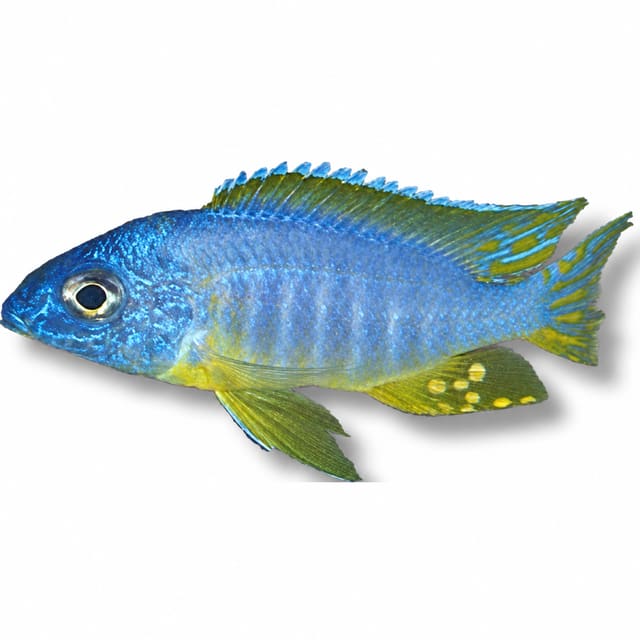
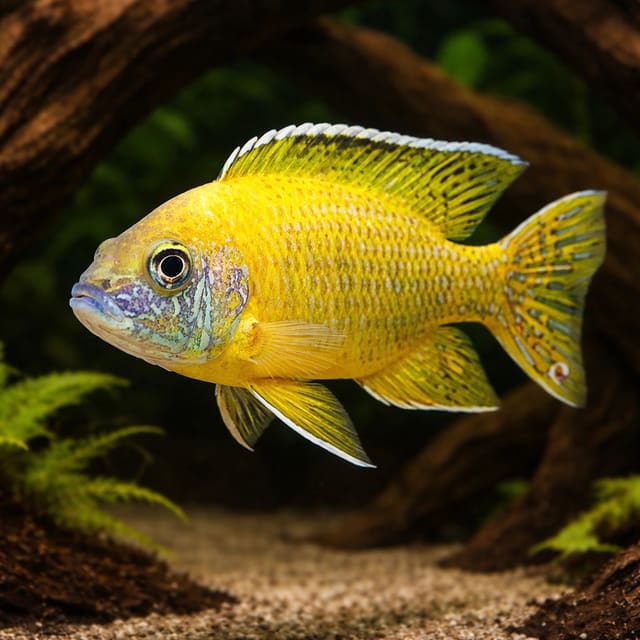
The Maleri Gold Peacock Cichlid is a yellow-gold Lake Malawi peacock sold in the aquarium trade under names including Maleri Peacock, Yellow Peacock and Sunshine Peacock. The most careful working identity for this form is Aulonocara sp. "stuartgranti maleri"; the supplier name Aulonocara maleri gold is a trade label rather than a formally settled scientific binomial.
One quantity buys one fish in the size grade selected above. Sex, adult colour and pair formation are not guaranteed unless a variant explicitly says otherwise. Young fish and females are naturally much less yellow than a mature displaying male, so choose this cichlid for its adult care needs rather than expecting every juvenile to arrive in full gold colour.
| Trade name | Maleri Gold Peacock Cichlid |
|---|---|
| Working identity | Aulonocara sp. "stuartgranti maleri" (provisional hobby name) |
| Family | Cichlidae |
| Geographic origin of the form | Rock-sand transition habitat around the Maleri Islands group and nearby south-western Lake Malawi localities; shop fish are not claimed as wild-collected or locality-pure |
| What one quantity buys | One fish in the selected size grade; sex and pair formation are not guaranteed |
| Approximate adult size | About 13 cm; females are generally smaller |
| Temperament | Comparatively mild for a Malawi cichlid, but territorial around its own kind and breeding sites |
| Practical minimum aquarium | At least 120 cm long and about 200 litres for a carefully planned group; substantially more space for multiple males or a mixed Malawi community |
| Recommended temperature | 24-26°C |
| Recommended pH | 7.5-8.5, kept stable in hard, mineral-rich water |
| Diet type | Carnivorous micropredator and sand-sifter; feed appropriate sinking cichlid foods with small aquatic invertebrate foods in rotation |
| Breeding | Maternal mouthbrooder |
The Maleri form belongs to the Aulonocara peacock group. Specialist cichlid references continue to use the provisional label Aulonocara sp. "stuartgranti maleri", while shops may shorten that to Aulonocara maleri, Maleri Gold or Sunshine Peacock. Keeping both names on this page makes the trade identity searchable without pretending the taxonomic question is settled.
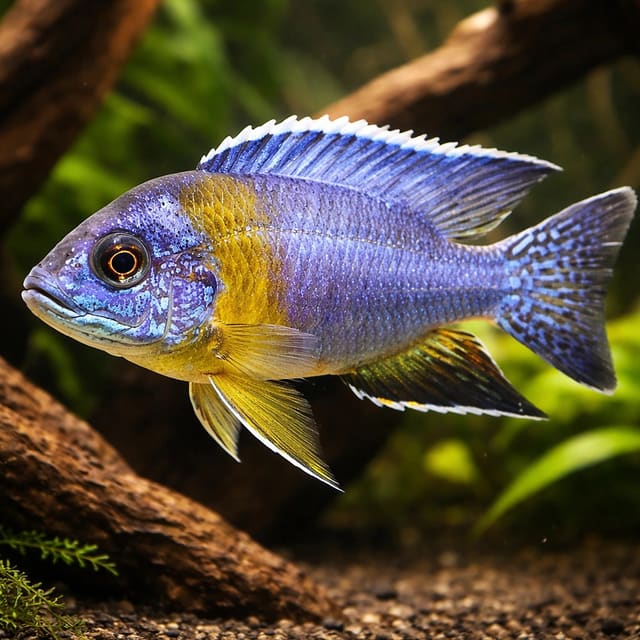
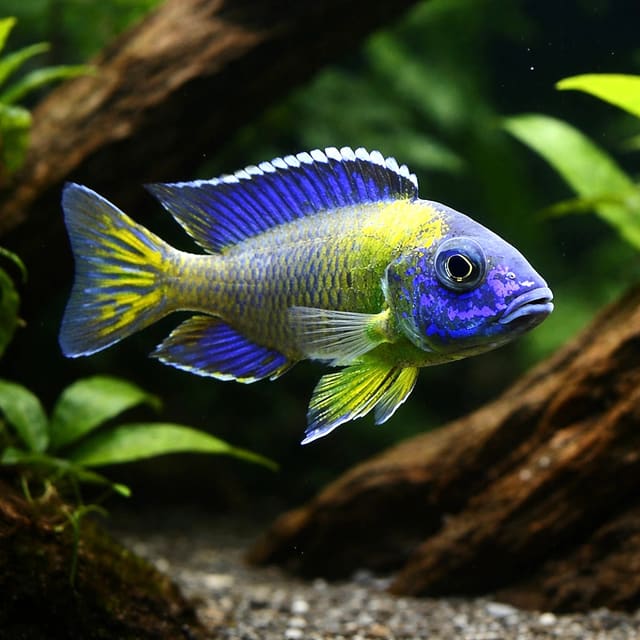
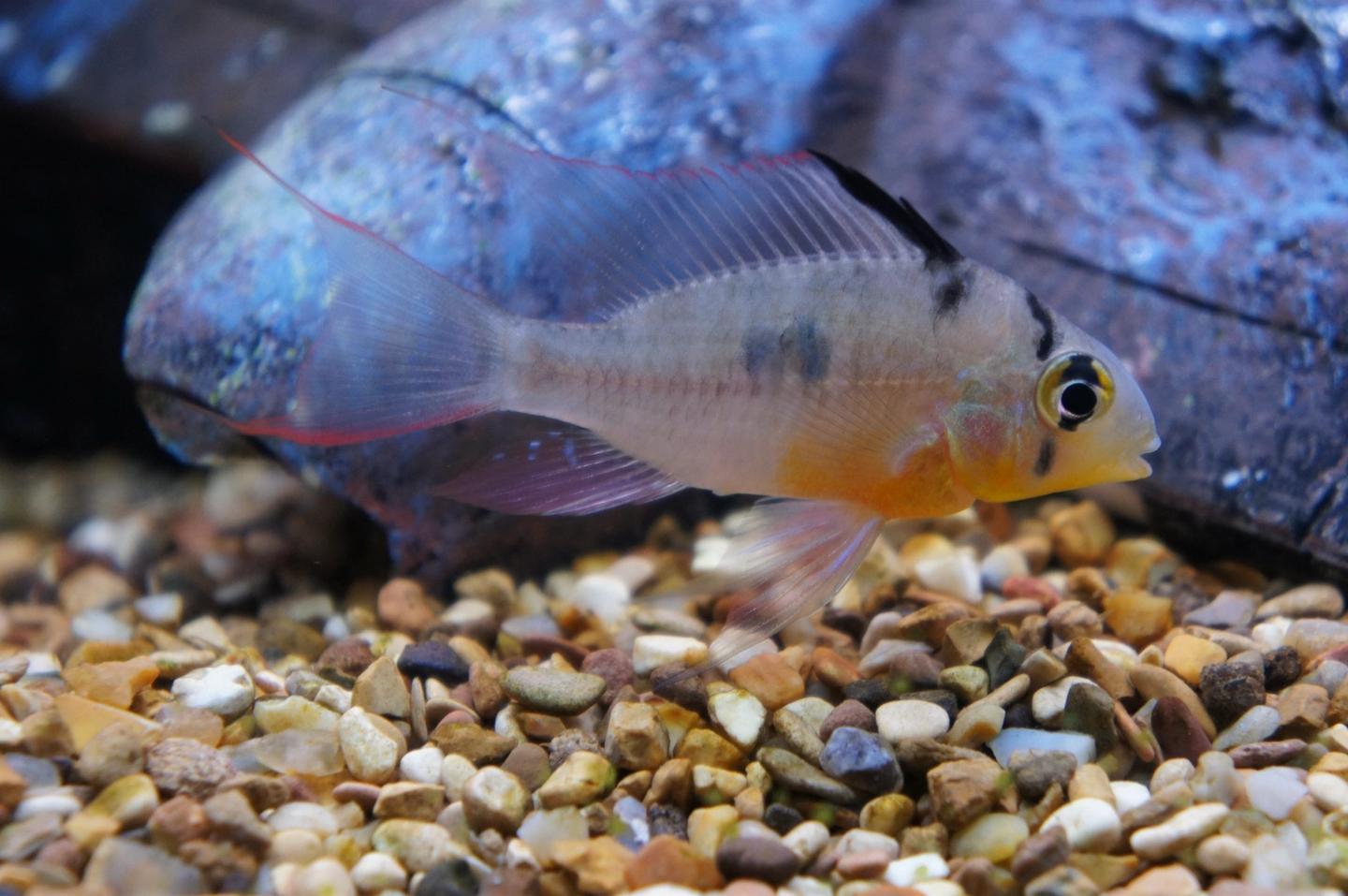
A mature dominant male can develop a yellow to gold body, darker vertical bars and blue iridescent detail around the face and fin edges. Females, subdominant males and juveniles are usually grey-brown or beige with darker barring. Colour develops at different rates and is affected by age, sex, social status, lighting and settling-in time. The current gallery picture is a representative juvenile image, not a photograph of the exact fish that will be dispatched.
Plan around the adult fish, not the dispatch size. A 120 cm aquarium of roughly 200 litres is a practical lower starting point for a carefully managed Maleri group with one adult male territory. A longer 140 cm aquarium and roughly 300-400 litres gives a safer margin when keeping more than one male or building a mixed peacock and hap community. Footprint, sightline breaks and territory space matter more than volume alone.
Recreate the rock-sand transition zone rather than filling the whole tank with rock. Use fine, smooth sand for natural sifting, open patches for feeding and swimming, and stable rock groups that form shaded retreats and visual barriers. Make rockwork secure so digging cannot undermine it. Efficient biological filtration, good surface movement and regular maintenance are important because Malawi cichlids are active feeders and do poorly when water quality or chemistry swings.
Keep this fish in stable, alkaline, mineral-rich water at about 24-26°C and pH 7.5-8.5. Stability is more important than forcing a particular number with sudden chemical adjustments. Test the source water before purchase, establish the aquarium fully, and make changes gradually. This is not a suitable match for soft, acidic community fish simply because those species share a similar temperature range.
Wild Maleri-type peacocks locate small invertebrates in sandy areas using the enlarged sensory pores typical of Aulonocara. In the aquarium, use a quality sinking pellet or granule formulated for peacock and hap cichlids as the staple. Rotate modest portions of mysis, daphnia or brine shrimp for variety. Food should be small enough for the selected fish and reach the lower-middle part of the tank without encouraging frantic surface competition.
Feed controlled portions rather than one large meal, remove obvious leftovers, and do not use colour-enhancing food as a substitute for correct water, space and social conditions. Juvenile colour is not a reliable guide to appetite or health; judge new arrivals by steady breathing, balance, alertness and a gradually returning feeding response.
This is often one of the less combative Malawi choices, but "peaceful" is misleading without context. Mature males defend display and spawning areas, and similar-looking males may be treated as rivals. A typical long-term social plan is one male with several females after sex can be identified. Because the smaller size grades may be unsexed, allow for future separation or rehoming if the group develops too many males.
| Usually more suitable | Use caution or avoid |
|---|---|
| Comparatively calm Malawi haps and peacocks of a similar adult size | Highly aggressive mbuna that can dominate feeding and territory |
| Robust fish sharing hard, alkaline Lake Malawi conditions | Small fish that may be intimidated or eaten |
| Appropriately sized bottom fish proven suitable for the same water and layout | Soft-water community fish, timid feeders and persistent fin-nippers |
| A carefully sexed Maleri group with adequate retreats and open sand | Multiple similar Aulonocara forms in a breeding setup, because hybridisation can make fry identity unreliable |
Every aquarium has its own territory pattern. Watch feeding access, torn fins, hiding, rapid breathing and repeated chasing after introduction, and be ready to separate a fish rather than waiting for persistent aggression to resolve itself. Browse the wider Malawi cichlid collection by adult size, temperament and water requirements rather than colour alone.
Mature males usually show the strongest yellow-gold and blue colour, while females remain smaller and more muted. Juveniles cannot always be sexed reliably from colour, and a stressed or subordinate male can also remain pale. This listing therefore does not promise a male, female or breeding pair.
Maleri peacocks are maternal mouthbrooders. A receptive female collects the fertilised eggs and carries the developing brood in her mouth for roughly three weeks, during which she may eat very little. Breeding males become more territorial. If fry are raised, keep accurate parent records and do not distribute hybrids under a locality or species name. The general cichlid care guide explains the wider family behaviour and setup principles.
Have the mature aquarium, selected size-appropriate retreats and compatible residents ready before delivery. On arrival, keep the lights low, match temperature and follow the acclimation instructions supplied with the order. Avoid a large first feed. During the first week, check breathing, posture, fins, colour, appetite and whether the fish can reach food without being pinned behind rockwork.
Livestock orders are covered by the current terms of our Live Arrival Guarantee. Read the policy before dispatch so you know the delivery-day checks and contact steps. The guarantee supports a safe arrival; long-term success still depends on mature filtration, compatible stocking and stable Lake Malawi water.
This care note distinguishes the trade name from the provisional Maleri identity. It was checked against the FishBase Aulonocara stuartgranti record, M. K. Oliver's account of Aulonocara sp. "stuartgranti maleri", the Nordic Cichlid Society species register and Ad Konings' Maleri Islands field sheet. Where specialist sources use different aquarium minima, this page gives the lower practical threshold and clearly recommends more space for more complex stocking.
No reviews for this item yet. Bought one? Honest reviews only, good or bad.
What customers say about ordering from us
Easy website plenty of info on fish your buying great to pick a time slot
TRACEY DURRANT · 7 Oct 2026
Got some lovely fish thank you
Kevin Mackie · 7 Oct 2026
Reviews of our shop, collected by Judge.me, an independent third-party review collector. Newest first.