−14%
Moderate
Betta rubra (Betta rubra)
22–27°C · pH 4.5–6.5 · 40L
£61.91£71.99

One unsexed Jambi Scarlet Betta (Betta coccina) per quantity in the XL trade grade. This small wild-type labyrinth fish needs a mature, covered blackwater aquarium with very soft acidic water, shaded cover, gentle flow and small carnivorous foods; XL is not a guaranteed centimetre size, sex or pair.
Betta coccina
Confirm your email, then we’ll send an availability message for this exact item if it returns within 180 days.
This request is only for this product—no newsletter or other promotions. A mail-provider retry may very rarely duplicate the same availability message. Unconfirmed addresses are removed after 48 hours. See our privacy policy.
One unsexed Jambi Scarlet Betta (Betta coccina) per quantity in the XL trade grade. This small wild-type labyrinth fish needs a mature, covered blackwater aquarium with very soft acidic water, shaded cover, gentle flow and small carnivorous foods; XL is not a guaranteed centimetre size, sex or pair.
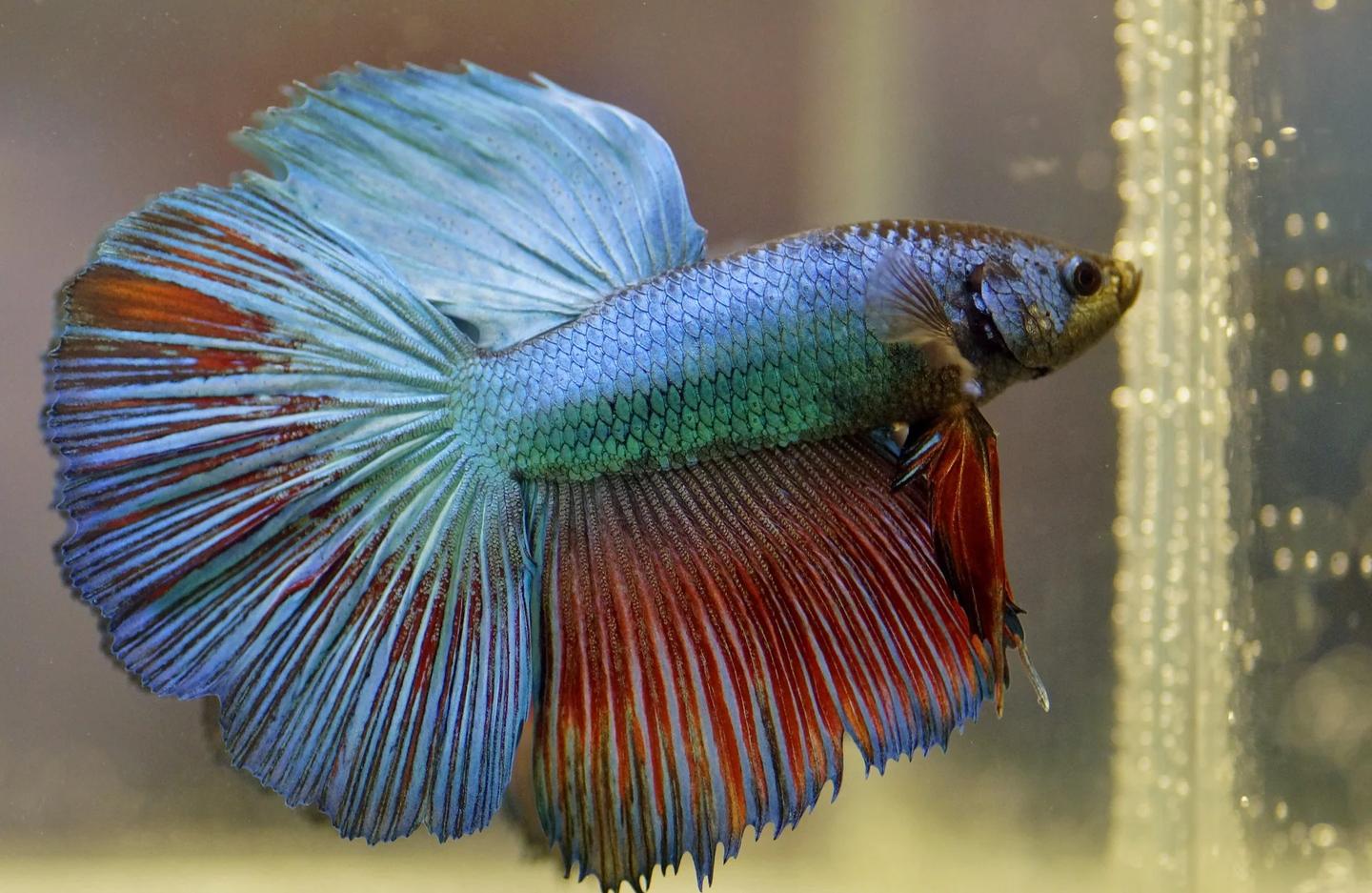
For one typical domestic Betta splendens, start with at least 20 litres, a mature filter, thermostatic heater, separate thermometer, gentle flow, a secure lid with surface access, and plants or refuges. Keep one male per aquarium.
Maintain these water conditions for optimal health and vibrant colors
Jambi Scarlet Betta is the trade name used for this small wild-type Betta coccina, also known as the scarlet betta or wine-red betta. It is a short-finned, naturally shaped labyrinth fish for a mature blackwater aquarium, not a long-finned domestic Betta splendens colour morph. Its best qualities are subtle red colour, iridescent detail and quiet behaviour among leaf litter, roots and shaded plants.
This is a specialist choice for an aquarist who can prepare soft, acidic water and keep it stable. A bright hard-water community, an uncycled aquarium or a small decorative bowl is not suitable. If you are comparing wild and domestic bettas, start with our Betta fish guide and range, then use the evidence and planning tables below to decide whether this species matches your water and experience.
Sale-unit clarity: each selected quantity is one unsexed live fish in the XL trade grade. XL is a supplier size band rather than a guaranteed ruler measurement, sex, adult stage or breeding condition. The fish is not sold as a pair, and selecting two does not guarantee one male and one female or that two individuals will be compatible.
| Listing detail | What it means |
|---|---|
| Sale unit | One unsexed live fish per selected quantity |
| Supplier grade | XL trade grade; no exact dispatch length is promised |
| Sex | Not selected or guaranteed |
| Pair status | Not paired, bonded or sold as a male-and-female set |
| Batch origin | The supplier has not provided collection locality, breeder or wild/captive provenance |
| Current availability | Use the live variant selector on this page rather than evergreen description wording |
Living fish vary. Colour intensity, iridescent markings, body condition and fin development can change with sex, maturity, mood, lighting, water chemistry and transport. Judge the product by the identity and sale-unit information above, not by an expectation that every individual will match one photograph.
| Care point | Evidence-led planning range |
|---|---|
| Accepted name | Betta coccina Vierke, 1979 |
| Family | Osphronemidae |
| Adult size | FishBase records up to 5.6 cm total length; supplier data rounds this to 6 cm |
| Temperature | 24-27°C is the source-backed core range; avoid rapid change |
| pH | About 5.0-6.5 for aquarium planning; FishBase records 4.0-6.0 in its ecological data |
| Hardness | Very soft; FishBase records 0-4 dH, while the supplier gives a broader 0-10 dGH range |
| Tank planning | A mature 60 x 30 cm footprint is a practical starting point for one; use at least a 75 cm-long, heavily structured aquarium for more than one |
| Temperament | Relatively reserved for a betta, but individuals and nesting fish can defend space |
| Diet | Small carnivorous foods, with varied frozen or cultured live prey important |
| Breeding mode | Bubble nester; FishBase records male nest care |
| Care level | Specialist because very soft acidic water has little buffering capacity |
These figures are planning ranges, not targets to chase with abrupt chemical dosing. The safest aquarium is one that is fully cycled, tested and already stable before the fish arrives. Read our Betta temperature guide for heater and measurement basics, while remembering that this peat-swamp species needs softer and more acidic water than a typical domestic betta.
| A good match when... | Choose another fish when... |
|---|---|
| You can make and test very soft, acidic water consistently | Your aquarium uses hard alkaline tap water and you do not plan to change the water source |
| The aquarium is mature, covered, shaded and gently filtered | The tank is new, open-topped, brightly lit or has strong current |
| You can offer small frozen or cultured live foods | You need every fish to accept large flakes or pellets immediately |
| You are comfortable observing behaviour and separating incompatible fish | You expect two unsexed fish automatically to become a pair |
| You value natural form and subtle behaviour | You want the long fins and predictable colour of a domestic show betta |
The specialist label is mainly about chemistry and preparation, not about a complicated daily routine. Once a suitable aquarium is mature, maintenance should be calm and consistent: small measured water changes, low disturbance, careful feeding and regular testing. The difficult route is trying to convert unsuitable tap water with quick-fix pH products after the fish has arrived.
Betta coccina remains an accepted species. The Catalog of Fishes records Vierke's 1979 description, a type locality in Jambi, central Sumatra, and a broader distribution in Malaysia and Sumatra. The red body and an iridescent lateral blotch in males are useful published characters, but colour alone is not a safe way to identify every member of the coccina complex.
The word Jambi needs care. It is part of this product's established trade name, but the supplier has not supplied collection records for the current batch. We therefore do not claim that the dispatch fish was collected in Jambi, belongs to a documented Jambi population or has verified locality lineage.
This distinction became even more important after a 2025 peer-reviewed study of the Betta coccina complex described Betta iaspis from a particular Jambi peat-swamp population. That study does not justify relabelling this supplier fish; there is no specimen-level evidence for doing so. It shows why a locality word, image colour or retailer title cannot replace morphology, genetics and provenance. This listing retains the supplier's B. coccina identity while stating the uncertainty honestly.
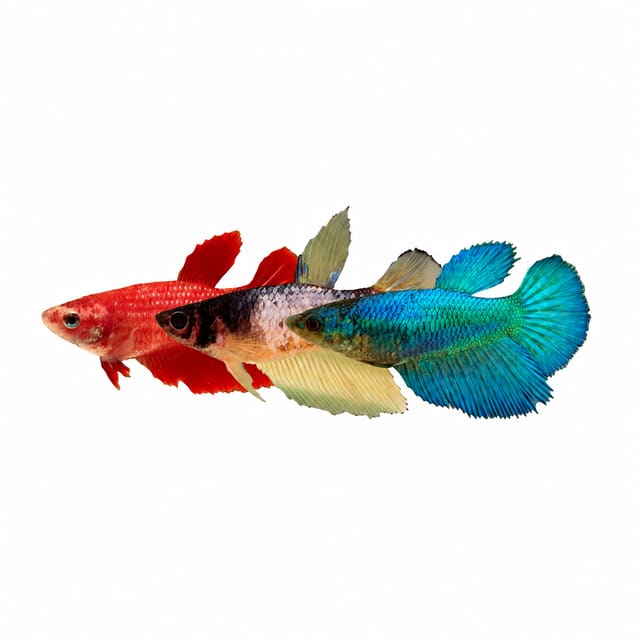
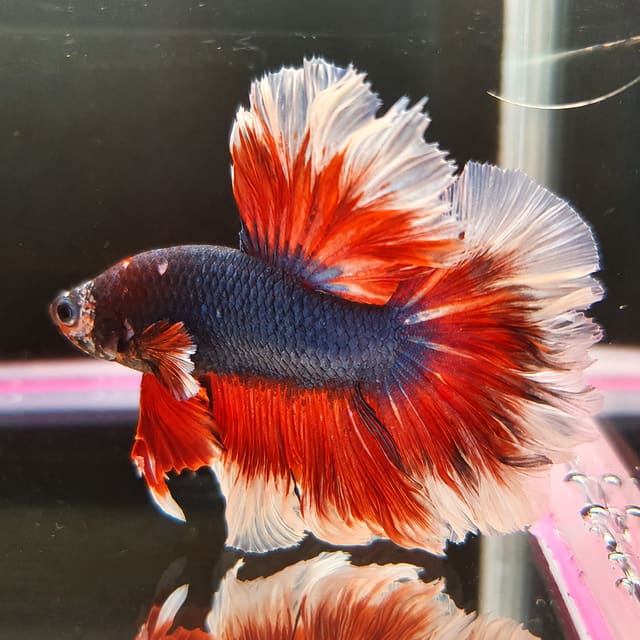
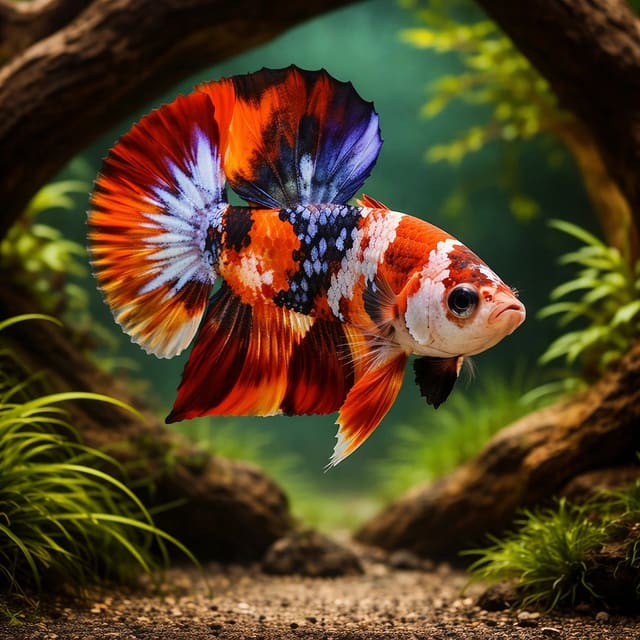
The existing gallery image is a representative illustration created from text when no supplier photograph was available. It was not generated from a photograph of the current fish, and its exact turquoise pattern should not be used for species diagnosis or as a promise of dispatch colour.
The fish you receive may be paler after transport and can develop stronger red and iridescent colour as it settles. Sex, age, water, lighting, background and social context all affect appearance. For this reason, the scientific identity, supplier trade grade and care information are more dependable than any single representative render.
Published sources place scarlet bettas in Southeast Asian forest peat-swamp and associated blackwater habitats. Decaying leaves and wood tint the water, shade is heavy, current is weak, and dissolved minerals and carbonate buffering can be extremely low. These environments are structurally complex even when the water body looks small: leaf litter, roots, branches and marginal plants create many feeding and retreat zones.
| Natural feature | Aquarium translation |
|---|---|
| Leaf litter and submerged wood | Use clean aquarium-safe leaves, fine branches and root-like wood to create broken sight lines |
| Low light under forest cover | Use floating plants, shaded areas and a gentle photoperiod |
| Slow or still margins | Choose low-flow filtration with calm surface zones |
| Very soft acidic water | Prepare suitable water before purchase and verify pH, GH and KH with reliable tests |
| Small terrestrial and aquatic prey | Offer appropriately sized cultured live and frozen foods |
| Dense cover | Provide multiple retreats rather than one ornament that becomes a contested resource |
Botanicals can provide tannins and cover, but they do not automatically turn hard tap water into safe peat-swamp water. Their effect depends on the source water's buffering capacity. Measure the actual chemistry and replace leaves in stages so that decay, colour and hiding structure change gradually.
Small adult length does not make this a bowl fish. A larger footprint gives more stable chemistry, a gentler temperature gradient, better cover and room to avoid conflict. For one fish, a mature aquarium with a base around 60 x 30 cm, commonly about 54 litres before displacement, is a sensible practical starting point. Smaller specialist setups can work in expert hands, but they leave less margin for a low-buffer chemistry error.
| Plan | Conservative recommendation | Why |
|---|---|---|
| One unsexed fish | About 60 x 30 cm footprint or larger | Stability, feeding observation and several retreat zones |
| Two unsexed fish | At least 75 cm length, dense structure and a spare cycled aquarium | Sex and compatibility are unknown; two fish are not a guaranteed pair |
| Small group | Use a substantially larger, mature species aquarium; TFH cites a 30-inch tank for six to eight coccina-group fish | Multiple territories, visual barriers and feeding access are needed |
| Community attempt | Larger than the species-only plan | Other fish consume space, food and quiet surface access |
Use dark fine substrate, scattered leaves, branchy wood, broad-leaved and floating plants, and several shaded surface-adjacent retreats. Leave open pockets where you can see the fish eat. A secure lid is essential because bettas can jump; retain a warm, humid air space above the water and unobstructed access to the surface for labyrinth breathing. Do not seal the aquarium airtight.
FishBase records pH 4.0-6.0, hardness 0-4 dH and 24-27°C. Our stock records are broader at pH 5.0-6.5, 0-10 dGH and 24-28°C. For most prepared aquaria, pH around 5.0-6.5 and 24-27°C is the practical overlap, with genuinely soft water and minimal day-to-day movement.
| Measurement | Planning guidance | Important caution |
|---|---|---|
| Temperature | 24-27°C | Use a guarded thermostat heater and independent thermometer |
| pH | About 5.0-6.5 | Do not force pH down rapidly with acid products |
| GH | Very soft; preferably near the narrower 0-4 dGH ecological range | Confirm the source water and acclimate gradually from holding conditions |
| KH | Low | Low KH means weak buffering and a greater risk of sudden pH movement |
| Ammonia / nitrite | 0 mg/l | Any detectable reading needs immediate investigation |
| Nitrate | Keep low and stable | Control with light feeding, plants and regular measured water changes |
If local tap water is hard, reverse-osmosis water can be the basis of a controlled recipe, but pure RO water should not be used casually. Remineralise to a repeatable target, aerate and heat new water, and record the recipe. Make small changes with water that closely matches the aquarium. The goal is repeatability, not the lowest possible pH.
Use mature biological filtration with a gentle output. An air-driven sponge filter is often suitable because it provides biological surface area without turning the aquarium into a fast stream. Position the outlet so one part of the surface remains calm, while still maintaining adequate gas exchange. A labyrinth organ allows air breathing; it does not remove the need for clean, oxygenated water.
Clean filter media in removed aquarium water rather than untreated tap water, and do not replace all media at once. Siphon visible waste without stripping every leaf and surface of biofilm. In low-mineral water, test more often after maintenance, a feeding change, a filter interruption or a large botanical replacement.
The species is a micropredator. The TFH coccina-group account emphasises small insects, worms and crustaceans, and warns that some individuals do not accept dry food readily. Plan a varied diet before the fish arrives instead of assuming flakes will become the staple.
| Food type | Use | Caution |
|---|---|---|
| Frozen cyclops, daphnia and small Artemia | Useful varied staples at an appropriate size | Thaw a small portion and avoid adding packing liquid |
| Small mosquito larvae or bloodworm | Rotation food for condition and feeding response | Match prey size and avoid heavy daily portions |
| Cultured live foods | Excellent for newly settled, shy or breeding-conditioned fish | Use clean cultures; never collect from polluted or pesticide-exposed water |
| Quality micro pellets | Can add convenience if the individual accepts them | Introduce gradually; do not let refusal become prolonged underfeeding |
Feed small portions once or twice daily and watch the fish swallow them. A rounded abdomen after a modest meal is enough; persistent bloating is not a sign to feed more. Remove leftovers because a low-buffer aquarium can be unforgiving of excess organic waste. If tank mates are present, make sure the betta actually receives food rather than merely approaching the feeding area.
This wild betta is generally less combative than a domestic male B. splendens, but peaceful does not mean conflict-free. Space use changes with sex, maturity, individual temperament and breeding condition. Males may defend a bubble-nest area, and a subordinate fish can be stressed without obvious torn fins.
Sex is not guaranteed at the supplier XL grade. Mature males are often more intensely coloured and can show a lateral iridescent blotch, but temporary colour, condition and the complexity of related species make photograph-based sexing unreliable. Do not use the representative gallery image to infer the sex of the fish supplied.
If keeping more than one, provide duplicate resources: several surface refuges, several dense cover zones and more than one feeding location. Watch for repeated exclusion, a fish pinned to one corner, faded colour, clamped fins or missed meals. A spare mature aquarium or divider must be ready before a multi-fish trial; separation is a normal management decision, not a failure.
A species-focused aquarium is the clearest recommendation. Very calm, tiny soft-water fish may be possible in a larger setup, but they can compete for food or disturb nesting areas. Review our broader Betta tank-mate guide, then apply the stricter chemistry and feeding needs on this page.
| Companion type | Assessment | Reason |
|---|---|---|
| Another unsexed Jambi Scarlet Betta | Case by case only | Sex, compatibility and bonding are not guaranteed |
| Tiny calm blackwater shoaling fish | Possible in a larger aquarium | Needs exact chemistry overlap, quiet behaviour and protected feeding access |
| Small peaceful snails | Often the lowest-risk companion | Still monitor and avoid species that need harder mineral-rich water |
| Dwarf shrimp or shrimplets | Not dependable | Small crustaceans may be treated as food |
| Domestic male bettas, gouramis or fin nippers | Avoid | Territorial conflict, stress or physical damage |
| Hard-water community fish | Avoid | The chemistry requirements do not align |
For other wild-betta projects, compare the care and sale unit of Betta persephone, Betta rubra, Betta imbellis and the larger mouthbrooding Betta pugnax. These links are comparisons, not automatic tank-mate recommendations; each species has different chemistry, social and breeding requirements.
FishBase records male care of a bubble nest. In suitable aquaria, the nest may be hidden under a leaf, among roots or near other surface cover rather than displayed in an open corner. Calm flow and floating structure are useful, but a bubble nest is not proof that two fish are compatible or that the aquarium is perfect.
This product is not sold as sexed, paired, mature or breeding-ready. Breeding should be attempted only by keepers who can maintain the required chemistry, identify aggression, prepare first foods and house adults or juveniles separately if needed. Keep lineage records where known, and never mix superficially similar coccina-complex species in a breeding project.
Prepare the aquarium before dispatch: cycle complete, lid fitted, temperature stable, hiding places present and test results recorded. Use the fish acclimation timer as a practical companion to the instructions supplied with the delivery. Avoid leaving a transported fish in opened shipping water for a prolonged period; follow the current retailer method and match temperature and chemistry without unnecessary delay.
Keep lighting subdued on arrival day. Give the fish access to cover and the surface, then observe breathing, posture and balance from a distance. Offer a very small familiar frozen or live food after it has settled rather than repeatedly disturbing it. Colour can be muted after transport and should not be judged immediately.
During the first week, record temperature and test ammonia, nitrite and pH. Check that the fish emerges to feed, is not trapped by current and is not being excluded by a companion. Use separate equipment for quarantine where possible. Do not medicate preventively without a diagnosis, because unnecessary treatment can add stress and interfere with biological filtration.
| Observation | Check first | Response |
|---|---|---|
| Refuses food | Food size, competition, brightness, temperature and recent transport | Reduce disturbance and offer a small cultured live or frozen food |
| Repeated surface dashing | Water quality, oxygen, temperature and access to calm surface air | Test immediately; correct the cause gradually and improve gas exchange if needed |
| Faded colour and hiding | Aggression, lack of cover, hard water, bright light or strong flow | Add visual cover, verify chemistry and separate persistent aggressors |
| Clamped fins or rapid breathing | Ammonia, nitrite, pH movement, temperature and disease signs | Quarantine when appropriate and seek an aquatic-veterinary diagnosis for persistent symptoms |
| Sudden pH movement | KH, water-change recipe, decaying material and dosing history | Stop chasing numbers, stabilise safely and review the repeatable water recipe |
Many apparent disease problems begin with environment or social stress. Test before treating. If a fish shows persistent laboured breathing, loss of balance, ulcers, severe swelling or progressive wasting, isolate it in suitable water and seek professional aquatic-veterinary advice.
| Feature | Jambi Scarlet Betta | Typical domestic show betta |
|---|---|---|
| Identity | Wild-type Betta coccina trade listing | Line-bred forms of Betta splendens |
| Shape | Slender body and functional short fins | May have highly enlarged or specialised fins |
| Water emphasis | Very soft, acidic, stable blackwater | Often maintained closer to neutral in conditioned tap water |
| Feeding | Small live/frozen prey is important; dry acceptance varies | Quality prepared diets are often accepted readily |
| Social plan | Can be less combative, but groups require structure and observation | Adult males are commonly housed separately |
| Best buyer | Prepared specialist or experienced soft-water keeper | Suitable for a wider range of properly equipped keepers |
The comparison is not a quality ranking. Both can be excellent aquarium fish when their needs are met. It prevents a common buying error: applying generic domestic-betta advice to a peat-swamp species simply because both share the genus name.
FishBase reports B. coccina as Vulnerable under the global IUCN assessment dated 2018. Peat-swamp drainage, conversion and habitat degradation are serious concerns across the species complex. Never release aquarium fish or water outdoors, and do not present an undocumented trade name as a conservation locality.
The current supplier has not stated whether this batch is captive-bred or wild-caught. We therefore leave that status as unknown. Keepers who breed the fish should retain purchase dates, supplier identity, photographs and any later provenance information, and should avoid crossing it with another coccina-complex fish of uncertain identity.
Eligible livestock purchases are covered by our Live Arrival Guarantee when the current delivery, timing and evidence terms are followed. Read those terms before choosing a delivery date, especially during extreme weather. WELCOME10 gives eligible new customers 10% off their first purchase.
The live page controls are the source for current availability, price and checkout options. The care guide remains evergreen so it does not make a stale availability or dispatch-date promise.
Each selected quantity is one unsexed live fish in the XL trade grade. It is not a pair and no exact length, sex, adult colour or breeding condition is promised.
No. XL is the trade grade. Living size varies and the supplier has not attached a fixed dispatch-length range to this variant.
No. It is sold as the wild-type species Betta coccina, with a natural short-finned body and specialist blackwater requirements. It should not be treated as a domestic B. splendens morph.
FishBase records a maximum of 5.6 cm total length. The supplier data rounds the species maximum to 6 cm; individual adult size varies.
For one, a mature aquarium around a 60 x 30 cm footprint is a conservative practical start. Use at least a 75 cm-long, densely structured aquarium plus separation capacity for more than one.
Plan around 24-27°C, measured with a reliable thermometer. Stability matters more than repeatedly adjusting within that range.
About pH 5.0-6.5 with very soft water is the practical overlap between supplier and published data. FishBase records pH 4.0-6.0 and 0-4 dH; do not pursue extreme acidity without the experience and testing to keep it stable.
It is not a good default choice for hard alkaline water. Test GH, KH and pH first. Where necessary, use a controlled RO-based recipe rather than sudden chemical pH reduction.
Offer small carnivorous foods such as frozen cyclops, daphnia, Artemia and suitably sized insect larvae. Clean cultured live foods are valuable, while dry-food acceptance varies by individual.
They sometimes can in a sufficiently large, structured aquarium, but two unsexed fish are not automatically a pair. Provide duplicate retreats, watch feeding and have a mature separation option ready.
No. Sex is not guaranteed for this listing, and the representative image cannot be used to select or infer the fish supplied.
Yes. Published species data records male care of a bubble nest, often built under leaves or among sheltered surface structure.
No. Jambi is retained as the established trade name, but the supplier has not supplied collection or lineage records for this batch.
No. It is a representative illustration created without a specimen photograph. It is not a promise of exact pattern, colour, sex or individual appearance.
A 2025 scientific paper described another coccina-complex species from a particular Jambi peat swamp. It does not prove this product is that species; it explains why trade locality names are not enough for a specimen-level identification.
Eligible livestock purchases receive Live Arrival Guarantee cover when the current terms are followed. WELCOME10 gives eligible new customers 10% off their first purchase.
No reviews for this item yet. Bought one? Honest reviews only, good or bad.
What customers say about ordering from us
I have a small group of long finned mountain minnows. So was delighted to be able to order ten of this variety to increase the genetics in my tank . The ones I recieved are healthy but it’s to early to give a verdict on wether they are of a long finned type since they are small currently.
Gordon Walker · 23 Sept 2026
100% success travel and "installation". Pleased with quality of purchase. The Siamese fighter a bit "shy" so have not yet seen him at his best yet but looking good. Happy customer. GG
George E Garratt · 21 Sept 2026
Reviews of our shop, collected by Judge.me, an independent third-party review collector. Newest first.