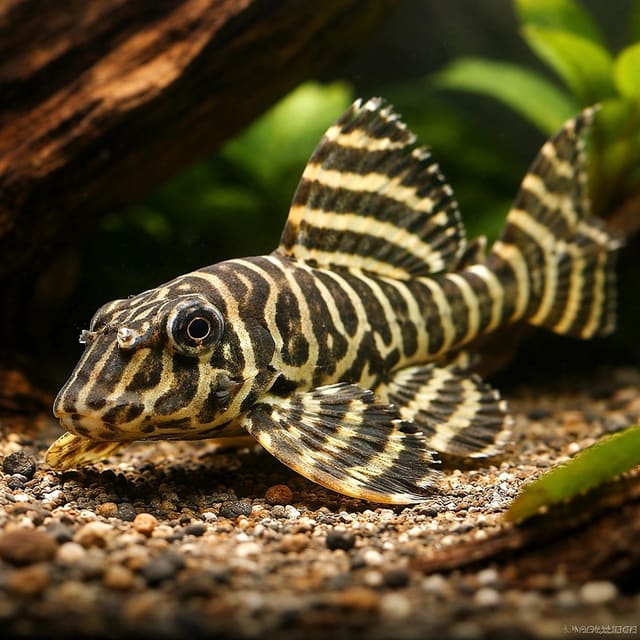
L333 Maze Zebra Pleco (Hypancistrus sp.) – CB Porto de Mos
22–27°C · pH 6–8
£48.99

Graceful Pimelodella, also sold as Slender Pimelodella, is a dusk-active South American catfish for mature shaded aquariums with soft substrate, hiding places and suitably sized peaceful tank mates.
Adult size is the maximum length this species reaches at full maturity (scientific sources). The livestock you receive will be younger and smaller — pick a size above for the actual shipping size. Product-photo provenance and any image-specific limitations are stated on the listing.
Pimelodella gracilis
Confirm your email, then we’ll send an availability message for this exact item if it returns within 180 days.
This request is only for this product—no newsletter or other promotions. A mail-provider retry may very rarely duplicate the same availability message. Unconfirmed addresses are removed after 48 hours. See our privacy policy.
Graceful Pimelodella, also sold as Slender Pimelodella, is a dusk-active South American catfish for mature shaded aquariums with soft substrate, hiding places and suitably sized peaceful tank mates.
Adult size is the maximum length this species reaches at full maturity (scientific sources). The livestock you receive will be younger and smaller — pick a size above for the actual shipping size. Product-photo provenance and any image-specific limitations are stated on the listing.
Maintain these water conditions for optimal health and vibrant colors
Graceful Pimelodella, also sold in the trade as Slender Pimelodella, is Pimelodella gracilis, a long-whiskered South American catfish from the Heptapteridae family. It is a peaceful dusk-active species for mature aquariums, but it is not a tiny nano catfish. FishBase records it from the Orinoco, Amazon and La Plata basins and gives an adult size up to about 18 cm SL, so this listing is best planned as a medium catfish for a settled community with room, cover and tank mates too large to be treated as food after dark.
The appeal is subtle rather than loud: a slim body, long sensory barbels, a dark lateral line, a forked tail and a smooth gliding movement over sand, wood and shaded planting. It suits aquarists who want a natural South American bottom-dweller that becomes more visible at feeding time and in lower light, not a bright centrepiece that patrols under full aquarium lighting all day.
| Common names | Graceful Pimelodella, Slender Pimelodella |
|---|---|
| Scientific name | Pimelodella gracilis |
| Family | Heptapteridae, the three-barbeled catfishes |
| Natural range | Orinoco, Amazon and La Plata basins, South America |
| Adult size guide | Up to about 18 cm SL |
| Supplied sizes on this product | 5-6 cm, 7-8 cm and > 10 cm variants when available |
| Temperature guide | 20-24°C |
| pH guide | 6.5-7.8 |
| Hardness guide | 5-20 dGH |
| Best aquarium | Mature, shaded, well-covered community aquarium with soft substrate |
This product had become too thin for the amount of care judgement the fish deserves.
The species name also matters. FishBase uses the common name Graceful Pimelodella, while supplier and hobby trade wording often uses Slender Pimelodella. Both names are kept here naturally so customers can recognise the fish whether they search by the scientific name, the FishBase common name or the trade name.
Pimelodella gracilis is mainly active at dusk. In the aquarium, expect a fish that rests under cover during brighter parts of the day, then moves with more confidence when the room quietens, lights dim or food reaches the lower water. The long barbels are part of the visual effect: they constantly read the substrate, wood and open water ahead of the fish, giving it a deliberate, searching movement.
Against dark wood, leaf-litter tones or a planted background, the body stripe becomes much easier to see. Bright open aquariums can make this species look nervous and washed out; shaded edges, floating cover and broken sight lines usually make it look better and behave more naturally.
Plan a mature aquarium from around 160 litres for a small group, with more length and volume if it will share space with active mid-water fish. Use soft sand or very smooth fine gravel so the belly and barbels are not rubbed. Add driftwood, smooth stone caves, robust plants, shaded corners and open lanes along the front or back of the aquarium for evening movement.
Water quality matters more than chasing a perfect number. Keep ammonia and nitrite at zero, nitrate controlled, and temperature stable inside the cooler tropical range. FishBase lists 20-24°C, pH 6.5-7.8 and 5-20 dGH; that makes this fish a better match for many South American community aquariums than for very hot discus-style systems.
| Care level | Moderate, because it needs a mature aquarium, shaded cover and calm feeding conditions |
|---|---|
| Tank size | About 160 litres or larger for a small group; choose more space for busy communities |
| Substrate | Soft sand or smooth fine gravel |
| Lighting | Subdued to moderate, with shaded retreats |
| Flow | Gentle to moderate, with quiet resting areas |
| Maintenance | Stable filtration, regular water changes and careful feeding at dusk |
FishBase notes that captive Pimelodella gracilis feed on worms and insects. In a home aquarium, use small sinking carnivore pellets, catfish tablets, chopped earthworm, bloodworm, blackworm, daphnia, brine shrimp and similar meaty foods. Feed after lights dim or just before the evening low-light period so food reaches the fish before faster tank mates take everything.
Do not rely on leftovers. This species is peaceful, but it is still a small predator and a dusk feeder, so it can be outcompeted by bold barbs, cichlids or large plecos during normal daytime feeding. A target-fed sinking meal several times per week is better than hoping enough food lands near its shelter.
The best tank mates are calm fish of similar size that enjoy comparable water: medium tetras, pencilfish, peaceful rasboras, suitable Corydoras, smaller Geophagus-style earth-eaters only where space allows, and gentle South American cichlids that will not bully it. ScotCat warns that companions should be large enough not to be seen as potential prey during night-time activity, which is the key compatibility rule for this fish.
Avoid very small fry, tiny shrimp, delicate nano fish, fin nippers, boisterous cichlids, large predatory catfish and aggressive bottom dwellers. It is often better kept as a small group rather than a single fish, provided there are enough shelters and feeding points to reduce competition.
| Good choices | Peaceful medium tetras, pencilfish, robust rasboras, Corydoras, calm South American community fish |
|---|---|
| Use caution | Dwarf cichlids, smaller plecos and other bottom dwellers, because shelter and feeding competition must be managed |
| Avoid | Tiny fry, very small shrimp, fin nippers, aggressive cichlids, large predatory catfish and frantic feeding competitors |
| Group note | A small group is usually preferable when the aquarium has enough cover and feeding points |
This product covers the Graceful or Slender Pimelodella size variants shown above. Stock can change quickly, so use the live availability on the page as the final guide. When available, orders are packed for livestock transport with oxygenated bags and insulated packaging, then sent by licensed live-animal courier. Eligible livestock orders are covered by our Live Arrival Guarantee when the delivery and acclimation steps are followed.
First-time customers can also use the current 10% first-order discount where the checkout offer is active. The important care point is to have the aquarium ready before ordering: mature filter, shaded cover, soft substrate and a feeding plan for the first evening.
Care notes were checked against FishBase for distribution, water range, adult size, dusk activity and diet, with ScotCat used as the hobby cross-check for identification notes, hiding places, group keeping and the warning about small tank mates.
Yes, this listing uses Graceful Pimelodella for the FishBase common name and Slender Pimelodella for the supplier and hobby trade name. Both refer here to Pimelodella gracilis.
It is peaceful with suitably sized fish, but it can eat tiny fry or very small shrimp after dark. Choose calm tank mates that are too large to fit in its mouth.
Plan for a cooler tropical aquarium around 20-24°C. Avoid very warm setups unless every tank mate also suits the same conditions.
A small group is usually better than a lone specimen when the aquarium is large enough and has several shelters. Provide multiple feeding spots so one fish does not dominate the best hiding area.
Feed sinking foods at dusk or after the lights dim. This matches its natural activity pattern and helps prevent faster daytime fish from taking all the food.
No reviews for this item yet. Bought one? Honest reviews only, good or bad.
What customers say about ordering from us
I have a small group of long finned mountain minnows. So was delighted to be able to order ten of this variety to increase the genetics in my tank . The ones I recieved are healthy but it’s to early to give a verdict on wether they are of a long finned type since they are small currently.
Gordon Walker · 23 Sept 2026
100% success travel and "installation". Pleased with quality of purchase. The Siamese fighter a bit "shy" so have not yet seen him at his best yet but looking good. Happy customer. GG
George E Garratt · 21 Sept 2026
Reviews of our shop, collected by Judge.me, an independent third-party review collector. Newest first.