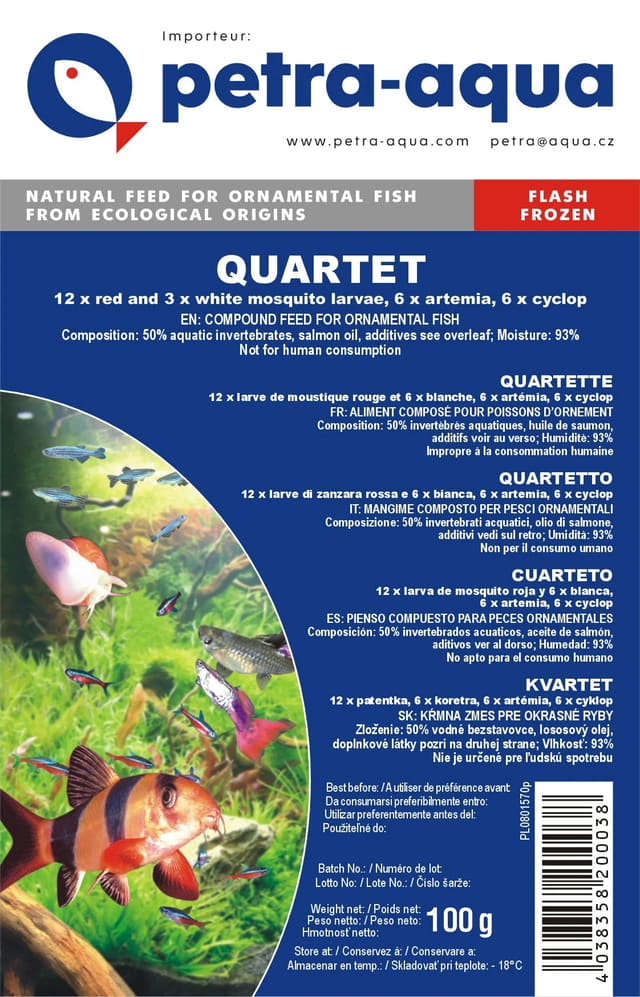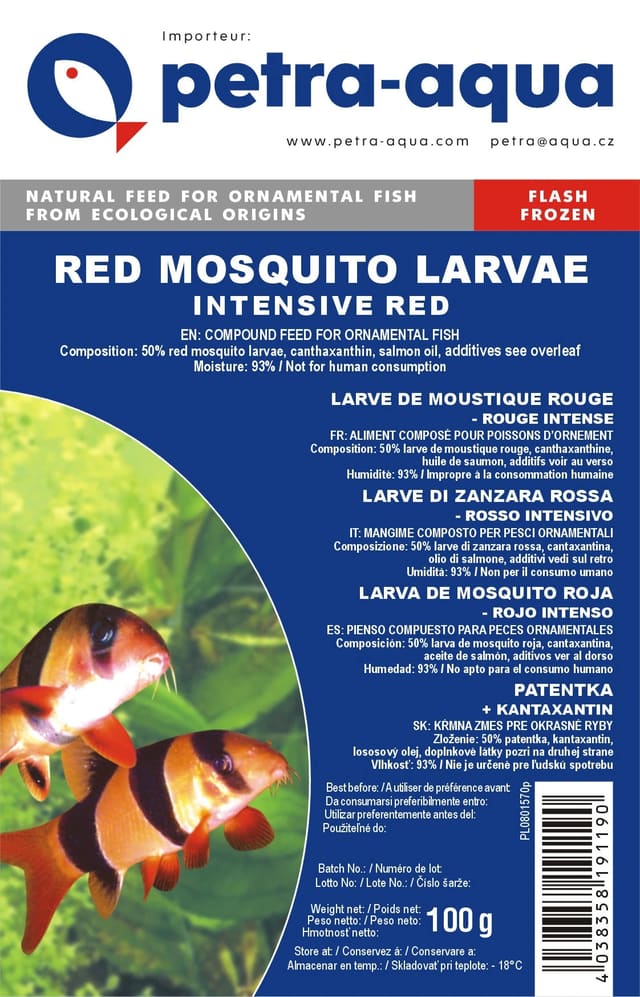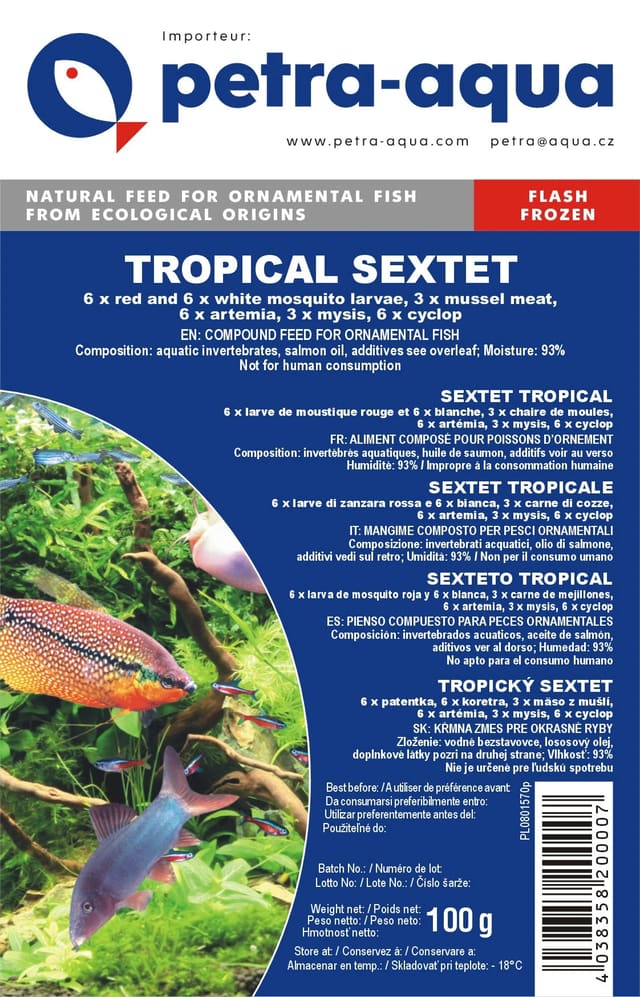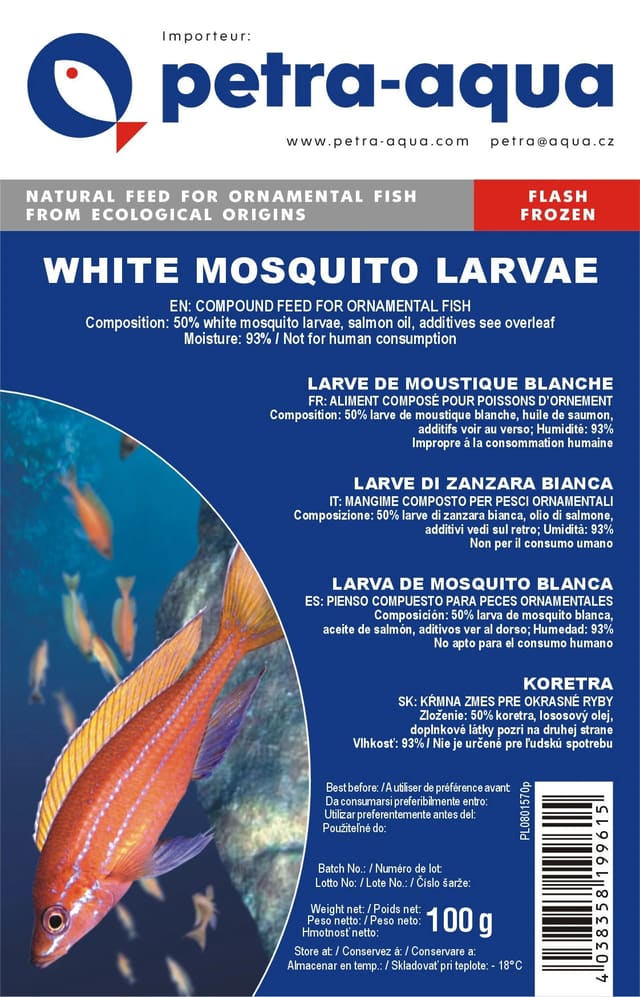
Green Plankton Frozen Fish Food 6 x 100g
£19.99
Six 100g blisters of frozen compound food for aquatic invertebrates. Declared with 50% marine zoo- and phytoplankton plus salmon oil; intended for suitable corals and other compatible filter feeders.
Six 100g blisters of frozen compound food for aquatic invertebrates. Declared with 50% marine zoo- and phytoplankton plus salmon oil; intended for suitable corals and other compatible filter feeders.
Frozen Invertebrate Food is a compound aquarium feed made for aquatic invertebrates. One order supplies six 100g frozen blisters, giving a total pack weight of 600g. The declared composition is 50% marine zoo- and phytoplankton with salmon oil; the front label also declares 92% moisture and directs the keeper to the reverse label for the additives statement.
This food is positioned for suitable corals and other filter-feeding animals, but that does not mean it is appropriate for every coral or every invertebrate. Coral feeding modes, particle capture and nutritional needs vary substantially. Use it only after matching the food to the animals in your aquarium, then begin with a small observable portion and adjust from their response and the system's nutrient trend.
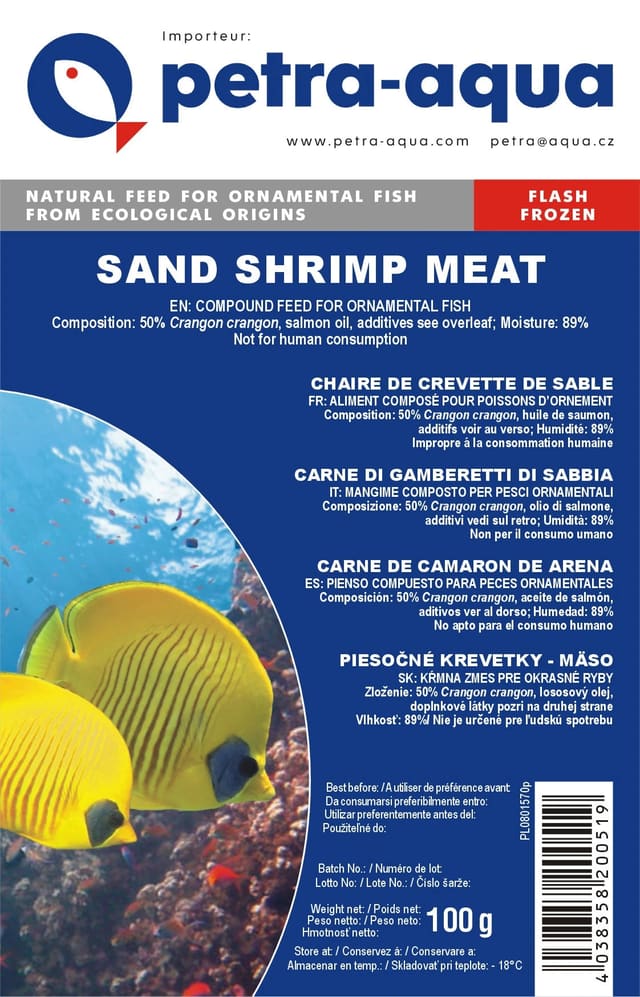
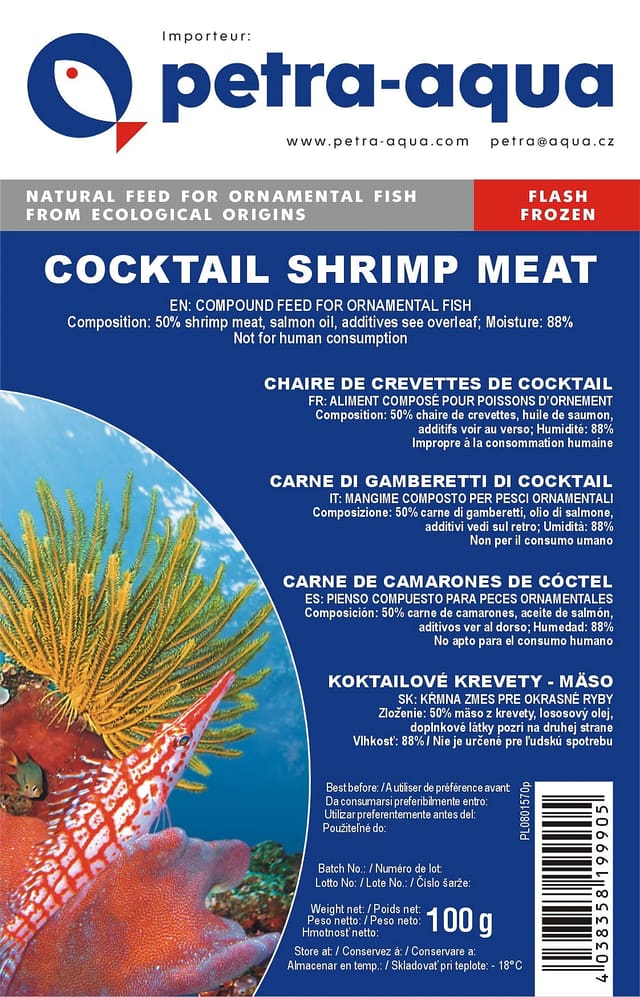
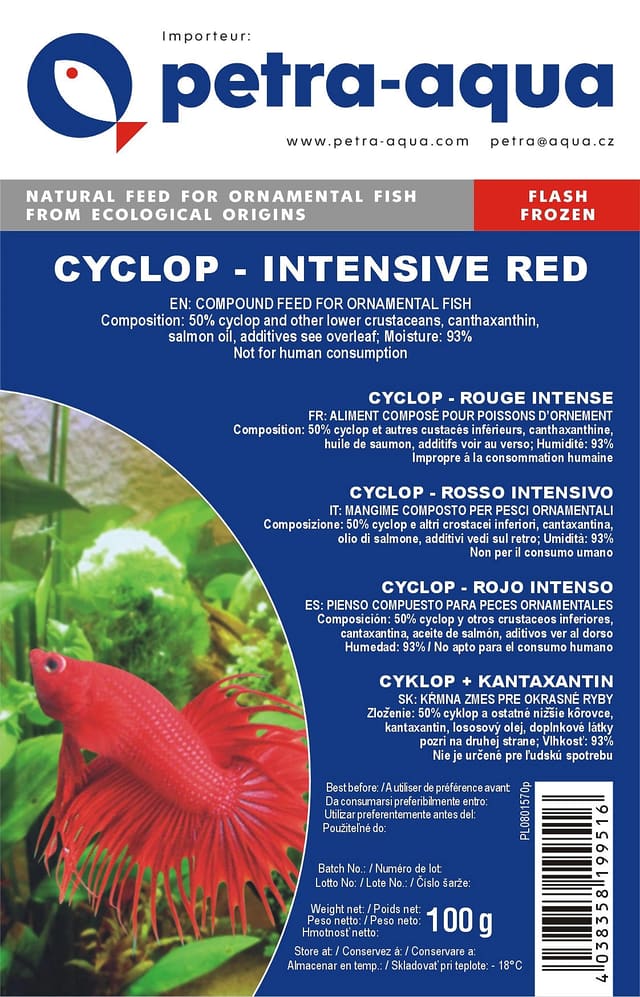
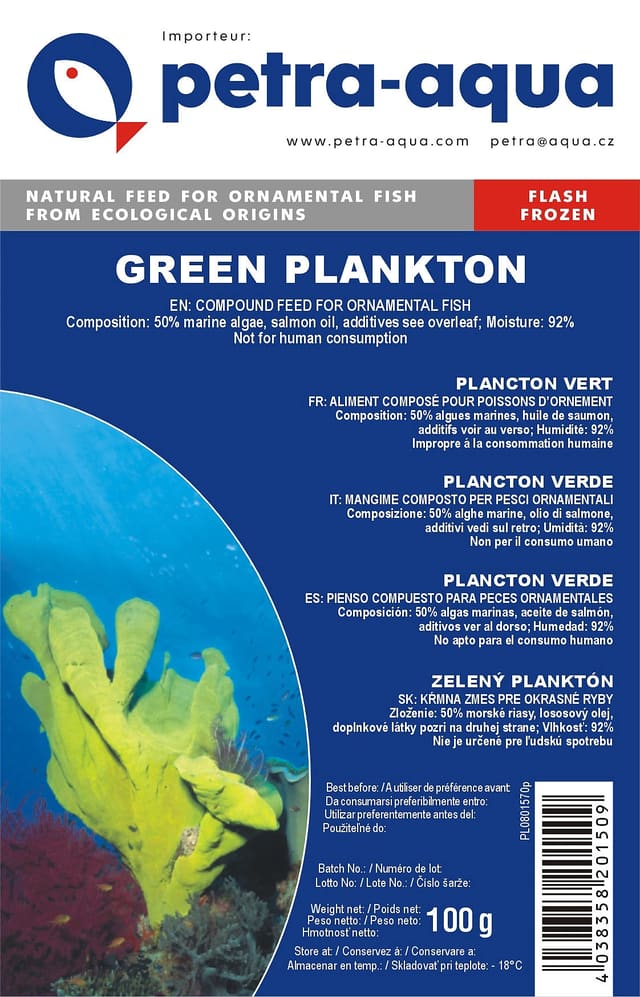
The retail unit is a multi-pack of six individual 100g frozen blisters. The package front shown in the gallery is the label for one 100g unit, while the product sold on this page is the full six-blister pack. This distinction matters when planning freezer space, comparing pack prices and estimating how quickly a small reef aquarium will use the food.
| Pack detail | What you receive |
|---|---|
| Number of blisters | Six |
| Weight per blister | 100g |
| Total supplied weight | 600g |
| Format | Frozen invertebrate food in blister portions |
| Gallery package view | Front label of a 100g unit |
Blister packaging allows only the required portion to be removed while the rest remains frozen. It does not create a standard dose: aquarium volume alone cannot tell you how much to feed because livestock biomass, species, coral polyp size, filtration, current nitrate and phosphate, and the amount of other food entering the system all matter.
This is a frozen plankton-based compound feed for aquatic invertebrates. The exact product record and supplied package identify it as invertebrate food, with corals and other filter-feeding animals shown as the intended use context. It is primarily relevant to appropriately stocked marine and reef aquariums rather than ordinary freshwater community-fish feeding.
The words compound feed mean that the product contains more than one declared component. They do not prove that it is nutritionally complete for every animal. Some corals obtain much of their energy from photosymbiotic partners while also capturing particles; others depend more heavily on heterotrophic feeding. Sponges, tube worms, bivalves and other filter feeders also differ in the particle sizes and food sources they can retain. The keeper still has to make a species-level decision.
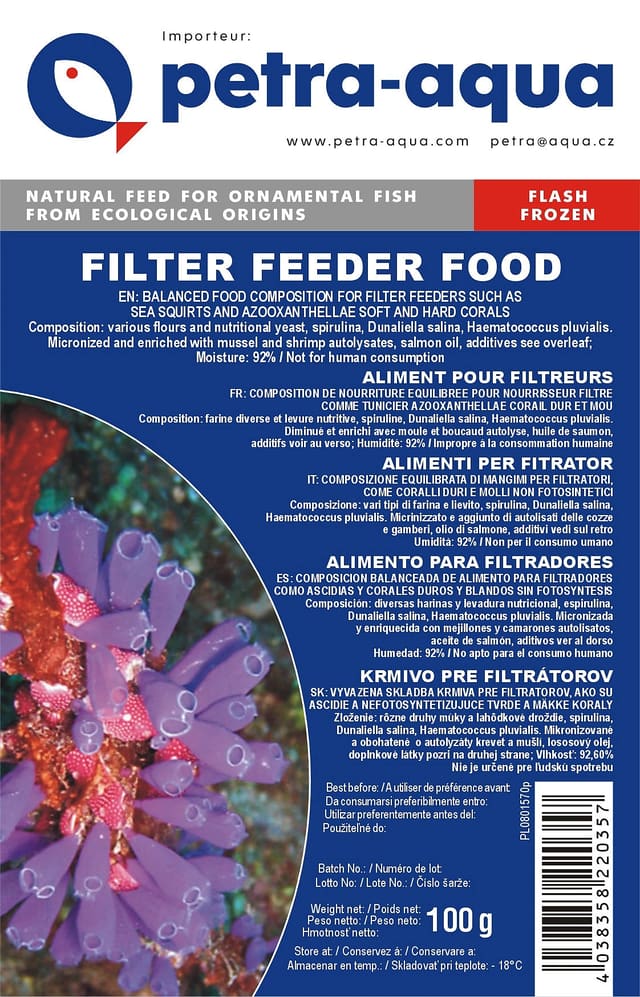
The supplied front label is the primary product evidence. It states that the feed contains 50% marine zoo- and phytoplankton with salmon oil. Moisture is declared at 92%. The front also states that additives are listed overleaf, so the reverse label on the physical pack remains the authority for the current additives declaration, batch information, best-before information and any manufacturer feeding directions.
| Declared item | Available information | What is not supplied on the front |
|---|---|---|
| Plankton | 50% marine zoo- and phytoplankton | Species list and particle-size distribution |
| Oil | Salmon oil | Exact inclusion percentage |
| Moisture | 92% | No additional front-label analysis |
| Additives | Front directs the reader to the reverse | The reverse declaration is not visible in the gallery |
| Storage | -18°C | No permission to use a thawed pack later |
Because the front label does not publish the plankton species, particle distribution or a guaranteed analysis beyond moisture, this page does not invent those details. Read the complete supplied pack before first use, especially if you need to exclude a specific ingredient or additive.
Frozen Invertebrate Food is a plankton-based compound feed. It is not a single-prey Artemia product and should not be chosen as though it were frozen brine shrimp for tropical community fish. If you specifically need brine shrimp, use the separate Frozen Artemia 6 x 100g blister listing.
| Question | Frozen Invertebrate Food | Frozen Artemia |
|---|---|---|
| Primary identity | Compound feed for aquatic invertebrates | Artemia / brine shrimp food |
| Declared basis | Marine zoo- and phytoplankton with salmon oil | Use the Artemia product label for its declaration |
| Main shopping intent | Suitable corals and other compatible filter feeders | Fish and other animals whose diet includes Artemia |
| Interchangeable? | No. Select by the documented diet and feeding behaviour of the animal. | |
This clear separation also helps prevent accidental repeat feeding of the same prey type. A keeper building a varied marine-food rotation should compare actual ingredients and particle form, not just the fact that both products are frozen and supplied in blisters.
The product is positioned for corals and other filter-feeding aquatic invertebrates. That may include selected photosymbiotic and non-photosymbiotic corals, sponges, feather duster worms and other suspension feeders when their established husbandry shows that they capture food in the available particle range. Suitability must be checked for the exact animal, not inferred from the broad word invertebrate.
Even within corals, feeding differs. Some capture larger zooplankton with tentacles. Others take smaller plankton, suspended particles or dissolved material through different mechanisms. Polyp size, feeding time, flow and colony condition can influence whether food is captured. A food that produces an obvious response from one coral may pass another without being retained.
This product name does not establish suitability for every coral, anemone, sponge, bivalve, crustacean, snail or freshwater shrimp. It also does not replace the normal species-specific diet of animals that need larger prey, direct meaty foods, algae grazing or specialist dissolved feeds.
Corals are not one feeding category. Scientific reviews describe a range of nutritional strategies: photosymbiotic carbon transfer, capture of zooplankton and smaller plankton, uptake of particulate organic matter, and other routes whose importance varies across coral groups and environmental conditions. This is why a statement such as "all corals need the same coral food" would be misleading.
For aquarium use, begin with three questions. First, what does the species normally capture? Second, does the product's available particle form reach and remain near the feeding structures long enough to be retained? Third, can the aquarium process the unconsumed fraction without an unwanted rise in nutrients or bacterial load? A positive answer to one question does not automatically answer the others.
The declared mix of marine zooplankton and phytoplankton gives this frozen coral-food option a broader composition than a single-prey blister. That breadth can be useful in a mixed reef, but it is not proof that every particle is available to every animal or that the mixture covers every nutritional requirement.
List the animals you intend to feed and check reliable care information for each one. Look for documented feeding mode, normal prey or particle type, polyp extension pattern, time of feeding and sensitivity to elevated nutrients. If a retailer or care sheet merely says "filter feeder" without explaining the animal's requirements, seek more specific evidence before ordering a six-pack.
| Check | Ready to trial | Pause and investigate |
|---|---|---|
| Animal identity | Species or reliable trade identity is known | Animal is unidentified |
| Feeding evidence | Plankton or suspended particles are documented | Diet is assumed from appearance |
| Observation | Polyps or feeding structures can be watched | Capture cannot be assessed |
| Water testing | Nitrate and phosphate trends are recorded | Nutrients are not monitored |
| Storage | -18°C freezer space is ready | The pack cannot remain frozen |
If you are unsure about suitability, use the contact page and include the animal names, aquarium volume, current nitrate and phosphate, filtration and other foods already used. That information is more useful than asking whether the product is "good for a reef tank" in general.
Keep the pack frozen while deciding how much to use. Remove only the required portion with clean tools and return the remaining blister to the freezer immediately. Place the portion in a clean aquarium-only container and allow it to loosen using a small amount of aquarium water. Do not use hot water, household utensils that may carry detergent, or water from an unverified source.
Once loosened, mix gently so that the suspended fraction can be delivered in a controlled way. The front label available to us does not publish a universal thaw time or state that the liquid should be discarded, so this page does not prescribe either. Follow any current instructions on the reverse of the supplied pack.
Record the starting portion, target animals, time, pump setting and nutrient readings. Feed where you can watch capture. A simple log turns the next portion into an informed adjustment instead of another guess.
Target feeding uses a pipette or similar aquarium-safe tool to place a diluted suspension near selected polyps or feeding structures. It can reduce the amount released across the whole aquarium, but a strong jet can make a coral retract or damage delicate tissue. Hold the tool at a sensible distance and deliver gently rather than pressing food directly onto the animal.
Broadcast feeding distributes a diluted portion into the water column. This may reach many filter feeders, including animals that are difficult to target, but it also exposes the whole system to the food. Mechanical filtration, skimming and non-target organisms may remove a substantial share. Start smaller than you think the aquarium can accept, observe, and adjust only after seeing both animal response and water-quality results.
Neither method is automatically superior. In a small aquarium with a few target corals, controlled target feeding may be easier to evaluate. In a mature mixed reef containing numerous compatible filter feeders, a carefully measured broadcast portion may be more practical. Some systems use a combination: a small targeted share first, followed by a limited water-column distribution.
Flow has two opposing roles. It carries particles to feeding animals, but excessive velocity can move food past them before capture. Mechanical filtration and protein skimming can remove suspended material, while stopping all circulation can reduce oxygen exchange and allow food to settle in unwanted areas.
If your established feeding routine temporarily pauses mechanical export, keep adequate water movement and oxygenation for the livestock, and restore normal equipment promptly after the observation period. Do not use a fixed universal off-time from an unrelated aquarium. The appropriate setting depends on system design, animal placement, temperature, biomass and the way the food disperses.
Watch what happens in your own aquarium. Useful signs include visible polyp capture, particles remaining suspended long enough to reach the target, and minimal accumulation on rock or substrate. If food immediately disappears into a filter sock, or instead settles in dead spots, change delivery technique before increasing quantity.
There is no evidence-based universal cube-per-litre or grams-per-coral dose on the available front label. A safe trial begins with a small quantity that can be observed. The goal is not to create a visibly dense cloud; it is to place available particles where suitable animals can capture them without leaving the filtration system to process a large unconsumed load.
Adjust from evidence. If target animals show a feeding response and nutrient readings remain controlled, the same portion may be repeated according to their husbandry. If the water remains cloudy, the skimmer reacts strongly, film develops, nuisance algae increases, or nitrate and phosphate rise faster than intended, reduce the portion or frequency and review export.
Do not calculate the dose from aquarium volume alone. Two 300-litre reefs can contain completely different numbers and types of corals, fish-food input, filter-feeding biomass and nutrient-export capacity. The smallest practical test is more informative than a generic chart.
Frequency is also species- and system-specific. Some animals are fed small amounts frequently; others take occasional larger particles; some photosymbiotic corals may not require routine direct feeding in a particular established system. The label evidence available here does not support a fixed daily or weekly schedule for all users.
Base frequency on the documented husbandry of the target animals, their observed condition, the amount of other planktonic or particulate food entering the aquarium and the nutrient trend between water changes. When introducing the product, change only one part of the feeding routine at a time. That makes it easier to identify whether the new food affects polyp response, water clarity, skimming, nitrate or phosphate.
More feeding is not automatically better feeding. A missed capture still becomes organic input. Consistency, observation and restraint are more useful than pursuing a feeding-response claim that was measured in a different species or aquarium.
During delivery, look for extension, adhesion or transfer of particles toward the mouth or feeding structures where that behaviour is normal for the animal. Retraction is not always rejection, but repeated closure when food is applied directly may indicate that flow, concentration or delivery pressure should be changed.
After feeding, check whether material has settled on tissue, rockwork or substrate. Restore normal circulation and filtration according to your established procedure. Over the following hours and days, note water clarity, surface film, odour, skimmer behaviour and any change in animal condition. Test nitrate and phosphate on a consistent schedule rather than reacting to one isolated number.
Yes. Any food that is not captured or exported becomes organic input. Bacteria and other organisms process it, and the resulting nutrient load can contribute to elevated nitrate, phosphate, clouding, oxygen demand, nuisance algae or deposits in low-flow areas. The risk depends on quantity, system maturity, filtration and the existing feeding load.
Frozen format does not make the food inherently clean or dirty. Control comes from matching the food to animals that can use it, delivering it effectively, limiting the trial portion, maintaining circulation and export, and measuring the result. A visibly enthusiastic response from one coral does not mean the rest of the broadcast portion was consumed.
If your aquarium already has an upward nutrient trend, identify the cause before adding another routine food. Consider whether current fish feeding, detritus accumulation, filter maintenance or stocking has already reached the system's export capacity.
The supplied label states store at -18°C. Put the pack into a suitable freezer promptly and keep it consistently frozen. Remove only the portion needed for the current feed, minimise time at room temperature and return the rest to the freezer without delay.
This page does not endorse repeated thawing and refreezing. If a blister has thawed, the seal is damaged, the pack has leaked, or you cannot establish how long it was above the labelled storage temperature, do not rely on appearance alone. Check the current package instructions and contact us before use. The batch and best-before information on the physical product governs.
Keep at -18°C, keep separate from human food where practical, use clean aquarium-only tools, and do not use the product for human consumption. The physical pack is the final authority for batch, date, additives and handling statements.
Choose by target animal and particle type rather than by a general idea that all frozen marine foods are interchangeable. Frozen Microplankton 6 x 100g is a related option where a finer plankton-focused food is required. Sextet Marin 6 x 100g and Unimix Marin 6 x 100g are mixed marine-food alternatives for keepers building a broader rotation.
Frozen Mysis 6 x 100g offers a more recognisable larger prey item for animals whose diets and mouth size suit it. The actual Frozen Artemia blister is the relevant choice for keepers specifically seeking brine shrimp. Review each product's own declaration instead of assuming that one can replace another gram for gram.
Compare this when the target animals are documented to take a finer plankton-style frozen food.
A mixed marine frozen-food option for a varied feeding rotation.
Another marine mixture to compare by declared ingredients and the animals being fed.
Check the current delivery information before ordering because dispatch methods, service areas and schedules can change. Make sure someone can receive the parcel and transfer the food to a -18°C freezer promptly. The live buy box is the authority for price and stock.
Review the returns information for the current procedure if packaging or temperature condition causes concern on arrival. Photograph the parcel and product before discarding packaging, keep the batch information, and contact us promptly. Do not use a pack whose condition you believe may be unsafe.
You can browse the full frozen food in blisters range or the broader frozen aquarium food category to compare formats. Choose a food because its declaration matches the livestock, not because a long list of unrelated search terms has been attached to it.
Product identity, pack size, composition, moisture, storage and human-consumption warning come from the supplier record and the supplied package. An exact product reference for Invertebrate Food Frozen independently identifies the same food and its coral/filter-feeder positioning. General feeding context was checked against Goldberg's scientific review of coral food, feeding and nutrition.
Those sources support cautious explanation, not promises. This page does not claim that the product grows coral faster, improves colour, strengthens immunity, cures disease or suits every invertebrate. It does not invent a dose, shelf life, thaw time or guaranteed feeding response. The animal's reliable care requirements and the complete label on the delivered pack remain decisive.
No. It is a compound food for aquatic invertebrates made with 50% marine zoo- and phytoplankton plus salmon oil. Frozen Artemia is available as a separate product.
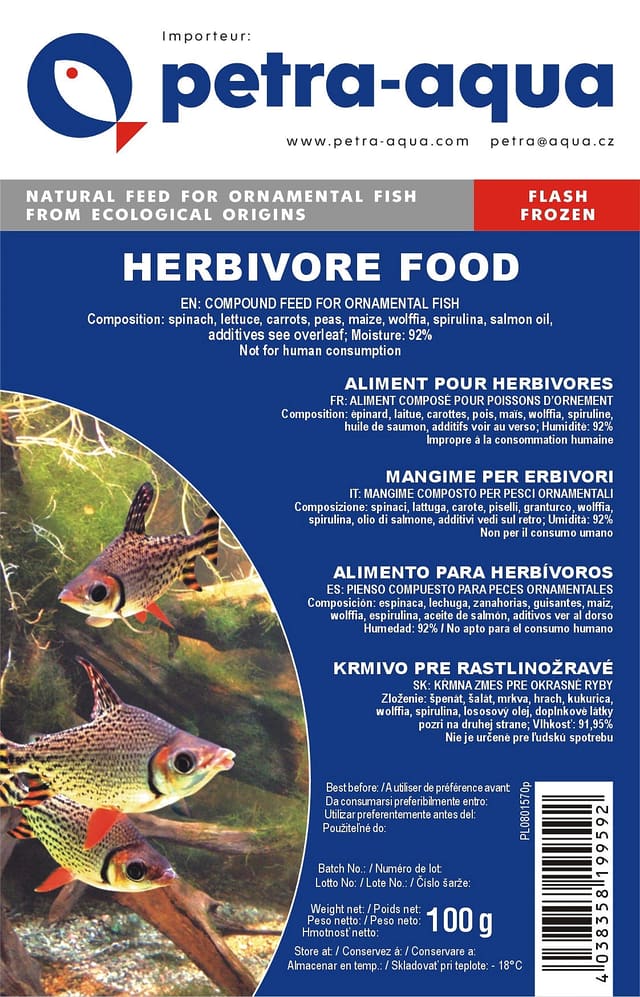
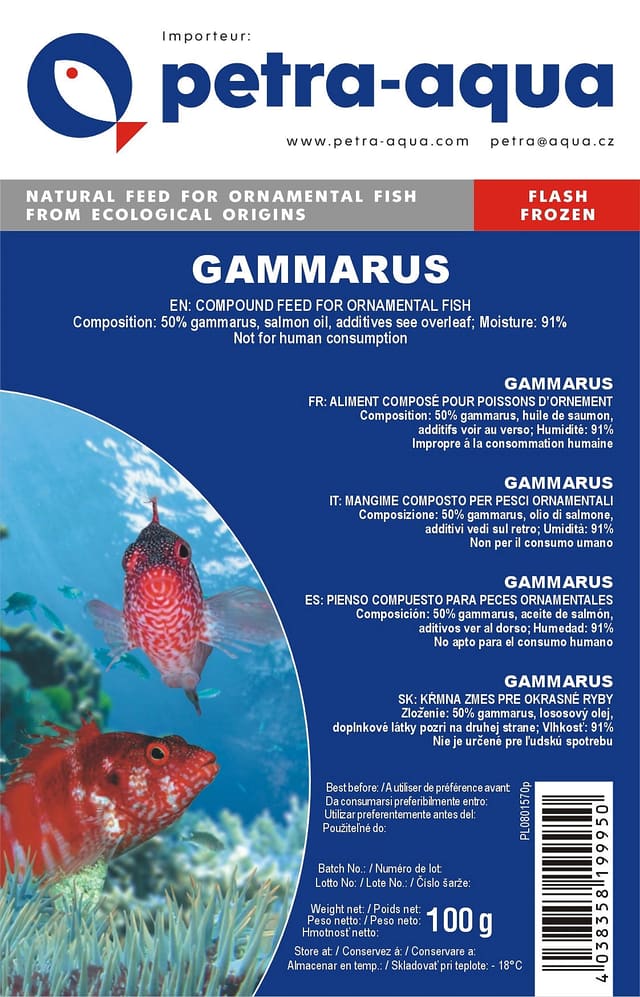
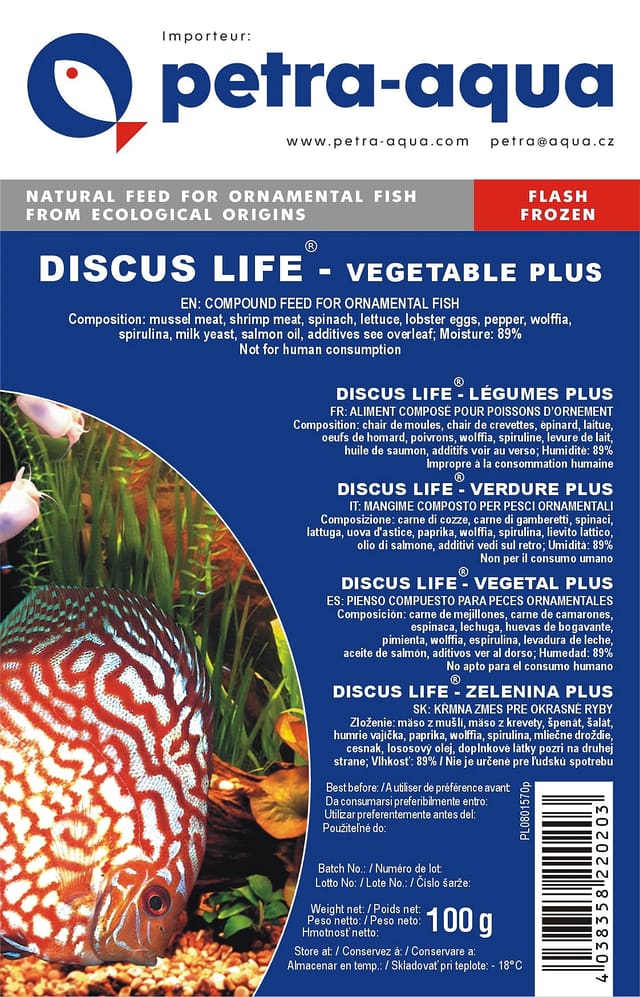
One order supplies six 100g frozen blisters, 600g total. The front package image represents a 100g unit.
No. Coral feeding modes and particle capture differ. Check the documented diet and feeding behaviour of each coral before use.
Only where reliable species guidance supports plankton or suspended-particle feeding in the food's available range. The broad term filter feeder is not enough to guarantee suitability.
Do not assume so. This product is positioned for aquatic invertebrates in a marine coral/filter-feeder context. Use a food documented for the freshwater shrimp species you keep.
The front declares 50% marine zoo- and phytoplankton plus salmon oil. It directs the user to the reverse for additives; read the physical pack for the complete current declaration.
The label declares 92% moisture. That is a product fact, not a dose or a guarantee of suitability.
No universal dose is published on the available front label. Begin with a small observable portion based on the target animals and adjust from capture, leftovers and nutrient trends.
Target feeding can help control placement for selected animals. Deliver a diluted portion gently and avoid a strong jet against coral tissue. Broadcast feeding may suit some mixed systems but creates a larger system-wide nutrient input.
Use the established routine for your system. Maintain adequate circulation and oxygenation, pause mechanical export only where appropriate, and restore normal equipment promptly. There is no universal off-time.
Keep the product frozen at -18°C. Remove only the required portion and return the rest to the freezer immediately. Do not assume a thawed pack can be safely refrozen.
No. The package states that it is not for human consumption.
No reviews for this item yet. Bought one? Honest reviews only, good or bad.
What customers say about ordering from us
Easy website plenty of info on fish your buying great to pick a time slot
TRACEY DURRANT · 7 Oct 2026
Got some lovely fish thank you
Kevin Mackie · 7 Oct 2026
Reviews of our shop, collected by Judge.me, an independent third-party review collector. Newest first.