Green Plankton Frozen Fish Food 6 x 100g
£19.99

Six 100 g frozen blisters (600 g total) for sea squirts and azooxanthellate soft and hard corals. Micronised blend; store at -18 C.
Six 100 g frozen blisters (600 g total) for sea squirts and azooxanthellate soft and hard corals. Micronised blend; store at -18 C.
Frozen Filter Feeder Food is a micronised frozen blend for suspension-feeding marine animals. The product label specifically names sea squirts and azooxanthellate soft and hard corals. Each retail unit contains six 100 g blisters, giving 600 g in total. It is not six cubes inside one 100 g pack.
The label lists flours, nutritional yeast, spirulina, Dunaliella salina, Haematococcus pluvialis, mussel and shrimp autolysates, and salmon oil. It does not list zooplankton, so this page does not use the old "microalgae and zooplankton cubes" description. It also does not extend the product to freshwater fish, fry or nano fish without manufacturer evidence.
One basket unit is the supplier's 6 x 100 g grade: six frozen 100 g blisters, 600 g total. The photographed front label belongs to a 100 g blister, while the product information defines the six-pack retail quantity. Ordering quantity two therefore means two six-packs, or twelve 100 g blisters in total.
| One retail unit | Six 100 g blisters |
|---|---|
| Total net weight | 600 g |
| Not implied | Six small cubes within one 100 g blister |
| Product state | Frozen; store at -18 C |
| Current image | Readable 100 g front label; not a photograph of all six packs together |
Check the quantity shown in the basket before checkout. The live price applies to the complete six-pack, and the buy box controls current stock and price. Pack artwork, batch placement and minor label layout can change, but the product identity and 6 x 100 g supply contract should match the order.
The front label describes a balanced food composition for filter feeders such as sea squirts and azooxanthellate soft and hard corals. Azooxanthellate means the coral does not rely on symbiotic photosynthetic algae in the same way as many familiar reef corals. These animals depend heavily on suitable captured food, but their feeding structures and particle preferences still differ.
"Filter feeder" is a feeding strategy, not a promise that every suspension-feeding animal can use the same product in the same quantity. Before buying, identify the animal, confirm that it accepts a fine frozen blend, and check the keeper or manufacturer guidance for that species. The label supports the named marine groups; it does not create universal suitability for every coral, sponge, worm, clam or fish.
This product is not presented here as fry food, freshwater food, nano-fish food or a complete diet for marine fish. Choose a food whose own label names those uses when they are your goal.
The photographed label gives the following composition: various flours and nutritional yeast; spirulina; Dunaliella salina; Haematococcus pluvialis; and a micronised blend enriched with mussel and shrimp autolysates and salmon oil. It refers the reader to the reverse for additives. The reverse label is not present in the current gallery, so no additive list is invented here.
| Label component | What the label establishes | What it does not establish |
|---|---|---|
| Various flours | Flours are part of the blend | Source, percentage or allergen declaration |
| Nutritional yeast | Yeast is listed | Strain, percentage or vitamin analysis |
| Spirulina | A cyanobacteria-based ingredient is present | Its proportion or a health outcome |
| Dunaliella salina | A named microalga is present | Cell count or inclusion percentage |
| Haematococcus pluvialis | A named microalga is present | Astaxanthin concentration |
| Mussel and shrimp autolysates | Marine animal-derived ingredients are present | Species, ratio or protein percentage |
| Salmon oil | Fish oil is present | Fatty-acid profile or percentage |
| Additives | The label says to see the reverse | The unseen additive names or amounts |
Spirulina, Dunaliella salina and Haematococcus pluvialis support a natural description of the blend as containing microalgae-derived ingredients. The old product name also claimed zooplankton cubes, but no zooplankton appears in the visible composition. Mussel and shrimp autolysates are animal-derived ingredients, not evidence that whole zooplankton is present.
This distinction matters for shoppers comparing frozen coral food within the wider frozen fish food category. Microplankton, rotifers, Artemia and blended filter-feeder food are separate product types. A nearby word such as plankton should never be used to merge them into one identity. For a product explicitly sold as microplankton, compare the Microplankton Frozen Blister on its own label and intended use.
The front label says the food is micronised. In practical terms, this means the blend has been reduced to fine material rather than supplied as large whole prey. That format is relevant to animals that capture suspended particles. The label does not state a particle-size range in microns, however, so it cannot prove that every particle fits every coral's capture mechanism.
Particle capture depends on the animal, polyp extension, current, placement, competing filtration and the way the portion is introduced. Watch whether the intended animal actually receives the food. Clouding the whole aquarium is not proof of successful feeding, and a food disappearing into mechanical filtration is not the same as capture.
The photographed label states 92% moisture. That is useful for identifying this as a water-rich frozen blend, but it is not a complete nutritional analysis. The current evidence does not provide crude protein, crude fat, fibre, ash, phosphorus or energy values. This page therefore does not invent them or compare the food nutritionally with a pellet or another frozen line.
"Balanced composition" is manufacturer label wording for the intended filter-feeder use. It should not be read as a universal complete-diet claim for every animal. A specialist coral or sea squirt may require more than one food type, and the correct feeding plan depends on the exact animal and aquarium.
A 100 g blister is a storage unit, not a universal single serving. Aquariums differ enormously in water volume, animal biomass, capture efficiency and nutrient export. The evidence available for this listing does not give one safe spoon, cube or millilitre amount. Begin with a small system-appropriate portion and adjust only after observing capture and subsequent water quality.
Use a clean tool so the remaining frozen food is not contaminated. Remove only what you intend to prepare, keep the rest at -18 C, and follow the complete pack instructions for preparation. Do not use hot water, household food utensils that will return to human use, or an unmeasured whole blister simply because it is convenient.
Target feeding can place a fine suspension nearer a particular coral or sea squirt. Broadcast feeding distributes it more widely through the system. Neither method is automatically better: target feeding can still miss the animal, and broadcast feeding can send much of the food into filters or low-flow deposits.
If your established method involves dispersing a small amount in aquarium water, use a clean container and water from the aquarium rather than untreated tap water. Introduce the portion gently where the intended animal can encounter it. Avoid blasting tissue with a concentrated jet. Observe extension, capture and release rather than assuming contact means ingestion.
Filter feeders need moving water to bring particles within reach, while aquarium equipment can remove the same particles before capture. This creates a system-specific balance. The current label does not tell keepers to stop return pumps, circulation pumps, skimmers or mechanical filters for a fixed time.
Follow the aquarium's established feeding plan. If any equipment is adjusted, use a timer and restore normal operation promptly. Never leave oxygenation, circulation or filtration off because a generic page supplied an arbitrary number of minutes. Systems with animals that depend on high oxygen or continuous flow need especially careful planning.
There is no defensible universal schedule in the available product evidence. Frequency depends on the animal's biology, other foods, recent feeding response, nutrient readings and export capacity. A non-photosynthetic coral may require deliberate regular feeding, but that does not make one fixed schedule correct for every species or aquarium.
Record the date, amount, method, animal response and later nitrate/phosphate readings. Change one variable at a time. If tissue condition, polyp extension or water quality worsens, review the entire husbandry plan rather than automatically increasing food.
Any uneaten frozen food adds organic material. Excess can contribute to bacterial films, detritus, oxygen demand, nitrate and phosphate. A strong filter does not make overfeeding harmless. The goal is efficient capture with the smallest effective input, followed by normal export and maintenance.
| Observation | Possible meaning | Practical review |
|---|---|---|
| Food is removed immediately by floss | Delivery path may be inefficient | Review placement, flow and equipment timing |
| Persistent clouding | Portion may exceed capture/export | Reduce the next amount and inspect deposits |
| Rising nitrate or phosphate | Total nutrient input exceeds export | Review all foods, stock and maintenance |
| No visible capture | Animal, particle or timing mismatch | Confirm species needs before adding more |
| Stable readings and consistent capture | Current method may be proportionate | Keep records and avoid unnecessary increases |
The label gives two useful examples: sea squirts and azooxanthellate soft and hard corals. It does not name a particular genus or species. Confirm the requirements of the animal in your care, because some sea squirts and non-photosynthetic corals have specialised particle, flow and feeding-frequency needs that a general product label cannot resolve.
Other filter feeders may accept fine food, but acceptance must come from that animal's care evidence rather than from the broad phrase "filter feeder". This page does not promise suitability for sponges, feather-duster worms, clams, anemones, photosynthetic corals or fish unless their own guidance supports the blend.
Neither the product information nor the photographed label supports those uses. The label's examples are marine filter feeders and non-photosynthetic corals. There are dedicated frozen feeds for small fish and freshwater species, and those should be selected by their own labels.
For a broad frozen prey product, compare the Frozen Artemia 6 x 100 g. For a different fine marine product, compare Red Rotifer Frozen Blister. These links are comparisons, not claims that the foods are interchangeable.
The product label states storage at -18 C. Make freezer space before ordering and transfer the packs to suitable frozen storage immediately after receipt. Keep them away from household food, protect the seals from damage and avoid repeated temperature changes.
Do not rely on appearance alone to judge cold-chain history. If the packs are not frozen as expected, a seal is open, liquid has leaked, or batch/best-before information is missing, photograph the parcel and product and contact Tropical Fish Co before use. This page does not declare partly thawed food universally safe to refreeze.
The label explicitly says this product is not for human consumption. Use dedicated aquarium-food tools, wash hands after handling and keep it away from children and pets.
Frozen goods need more preparation than dry fish food. Check the current delivery information, postcode availability, dispatch schedule and checkout service before ordering. Make sure someone can receive the parcel and that freezer space is ready. Do not place an order on the assumption that every postcode or delivery day uses the same service.
On arrival, inspect the outer parcel, the six blisters, seals, label, batch and condition before putting the product away. If there is a problem, retain the packaging and provide clear photographs promptly. The current returns and problem-reporting policy controls evidence and eligibility.
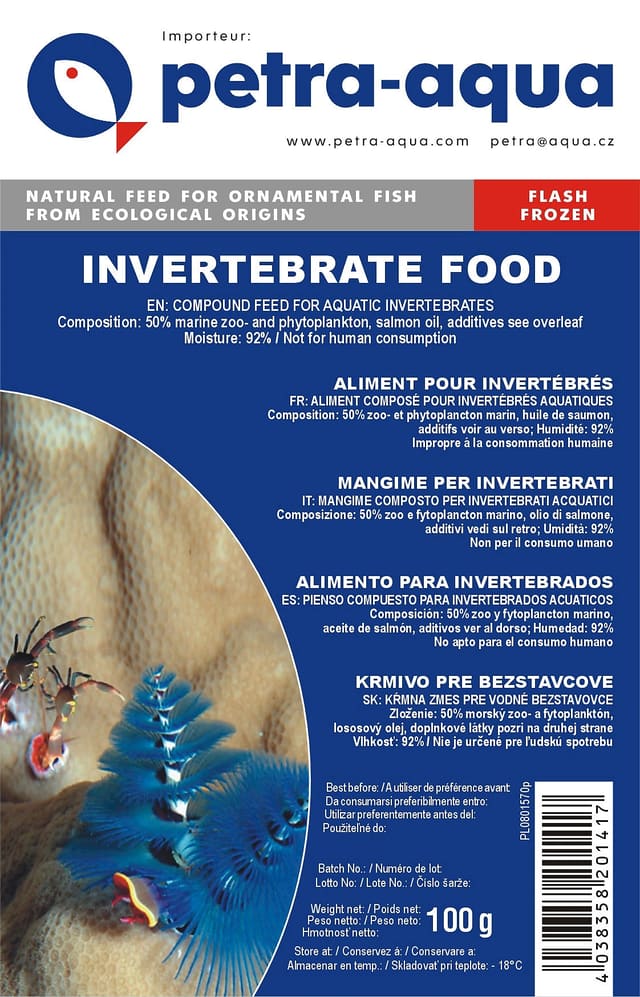
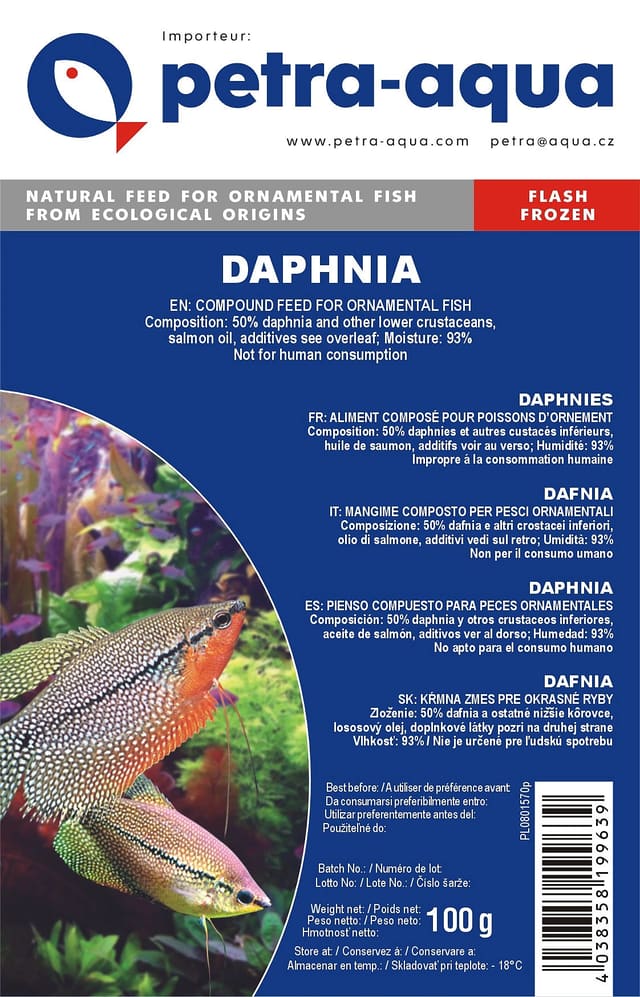
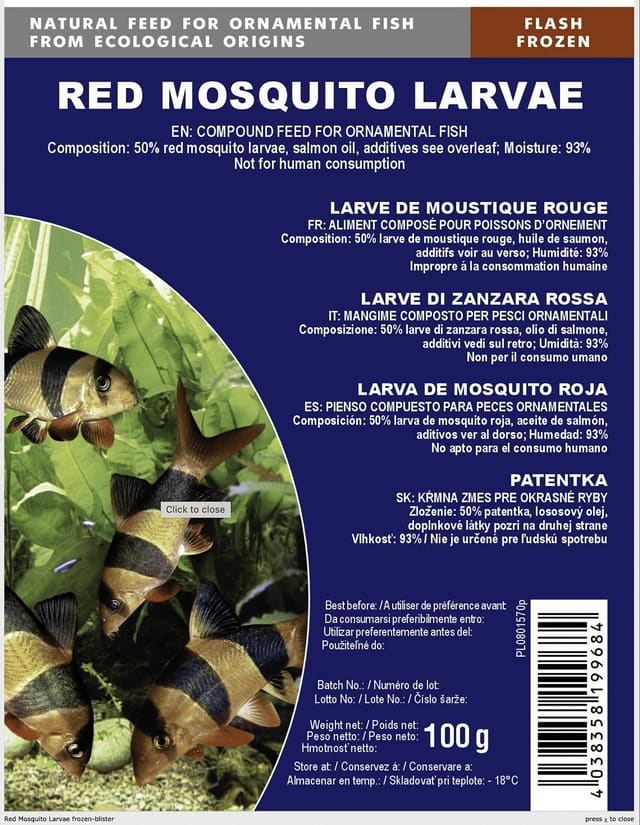
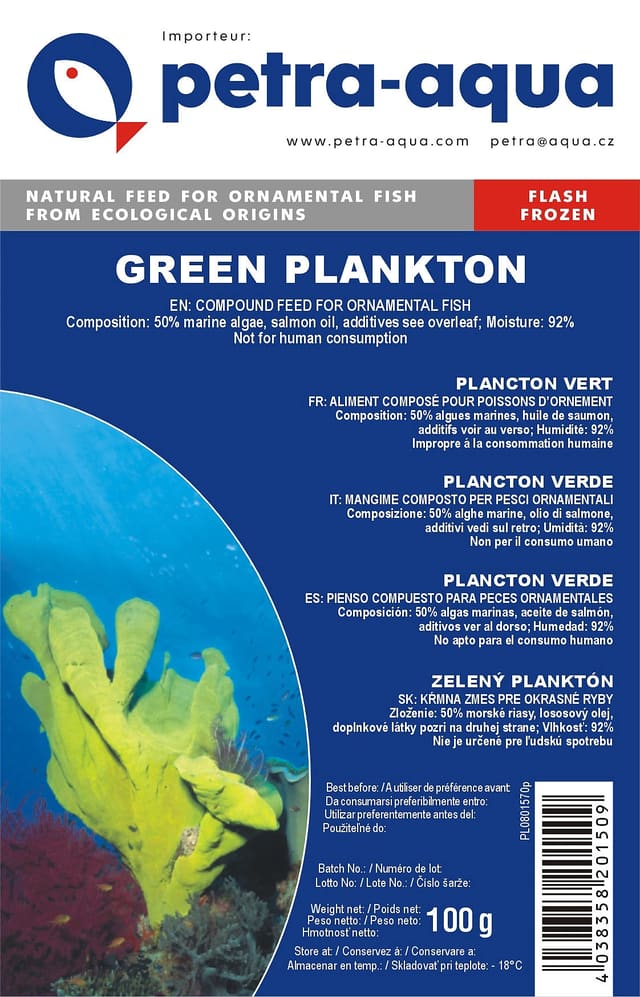
The sole gallery image is useful because it shows the real front label at readable resolution. It displays the Filter Feeder Food name, target groups, composition, moisture, 100 g net weight, barcode and -18 C storage line. It does not show the reverse, the full additive declaration, all six packs together or the exact batch that will be dispatched.
The image remains in its existing position. Its role is label evidence, not decoration. Packaging can be updated by the manufacturer, so compare the delivered label with this page and follow the current physical pack when details differ.
| Product | Identity | Choose it when |
|---|---|---|
| Filter Feeder Food | Micronised blend labelled for sea squirts and azooxanthellate corals | The intended animal's care supports this fine blend |
| Microplankton | Separate frozen product | You need the product named Microplankton and its label fits the animal |
| Red Rotifer | Separate rotifer product | You need a rotifer-based frozen food |
| Sextet Marin | Separate mixed marine frozen-food product | You want the variety stated on that pack |
| Mussel Meat | Larger animal-tissue food | The animal requires a meat food of that format |
| Artemia | Whole brine-shrimp frozen food | The target fish or invertebrate accepts Artemia |
Do not choose by search volume or a similar photograph. Choose by product identity, particle format, ingredient list and the animal's feeding biology. The frozen blister food category lets you compare the available packs without pretending they share one use.
The label includes mussel, shrimp and salmon-derived ingredients. This matters for keepers who avoid particular inputs or have handling allergies. The current front label does not provide a complete allergen or cross-contamination statement. Handle cautiously, use dedicated tools and consult the complete physical packaging if this information affects your household.
Never taste aquarium food. Clean spills promptly and disinfect preparation surfaces used for aquarium equipment. Do not pour unused prepared food into household sinks where it can create odour or hygiene problems; contain and dispose of it appropriately.
The buy box shows the current live price and stock for one six-pack. The established product route is retained for continuity, while the title now identifies the filter-feeder use and the exact 6 x 100 g quantity without a supplier code or unsupported ingredient claim.
Frozen-delivery eligibility, dispatch timing and any evidence deadline are controlled by the current checkout and policy pages. Check those details before payment, especially for remote or restricted postcodes. Product availability does not by itself guarantee that every delivery service can carry frozen food to every address.
Pack quantity and category come from the current product information. Product identity, target groups, composition, moisture, net weight, storage temperature and human-consumption warning come directly from the preserved high-resolution front label. The current image does not show the reverse label, so additive details and any reverse-side feeding directions remain outside this page.
The page deliberately removes unsupported claims rather than replacing them with new guesses. If supplies an updated technical sheet or a complete rear-label photograph, ingredient, analysis and feeding details can be expanded after reconciliation. Until then, the delivered packaging is the final instruction source.
One retail unit contains six 100 g frozen blisters, 600 g total. Quantity two gives twelve 100 g blisters.
No. The supplier grade is 6 x 100 g: six 100 g blisters. The 100 g front label in the gallery belongs to one blister.
The label names filter feeders such as sea squirts and azooxanthellate soft and hard corals. Confirm the exact animal's needs before feeding.
Zooplankton is not listed on the visible label. The old zooplankton-cube wording has therefore been removed.
The label lists spirulina, Dunaliella salina and Haematococcus pluvialis. It does not give their percentages.
Yes. Mussel and shrimp autolysates and salmon oil are listed. The front label does not provide their proportions.
The label calls it a balanced composition for the named filter feeders, but the evidence does not support a universal complete-diet claim. Plan feeding for the exact animal.
That use is not supported by the product information or visible label. Choose a product whose own instructions name freshwater fish or fry.
No universal amount is supplied in the available evidence. Start with a small system-appropriate portion, observe capture and monitor nutrients.
Frequency depends on the animal, other foods and aquarium nutrient control. Follow the complete pack and species guidance rather than a generic fixed schedule.
The front label gives no fixed equipment timing. Follow the aquarium's established feeding plan, use a timer for any adjustment and restore normal operation promptly.
Store at -18 C as stated on the label. Keep the packs sealed, separate from household food and protected from temperature changes.
Photograph the parcel, packs, seals and labels and contact Tropical Fish Co before use. Do not assume questionable food is safe to refreeze.
No. The label states not for human consumption. Use dedicated aquarium-food tools and wash hands after handling.
No. The preserved image shows a readable 100 g front label. The retail quantity is established by the supplier's 6 x 100 g row.
Use the frozen blister food category and compare each product's own label, format and intended animals.
No reviews for this item yet. Bought one? Honest reviews only, good or bad.
What customers say about ordering from us
I have a small group of long finned mountain minnows. So was delighted to be able to order ten of this variety to increase the genetics in my tank . The ones I recieved are healthy but it’s to early to give a verdict on wether they are of a long finned type since they are small currently.
Gordon Walker · 23 Sept 2026
100% success travel and "installation". Pleased with quality of purchase. The Siamese fighter a bit "shy" so have not yet seen him at his best yet but looking good. Happy customer. GG
George E Garratt · 21 Sept 2026
Reviews of our shop, collected by Judge.me, an independent third-party review collector. Newest first.