Advanced
Tropheus moorii — Caramba
23–27°C · pH 8–9.5
£51.99

Buy the Chipimbi Blunthead Cichlid for sale in the UK. A bold, moderate-care cichlid with real personality, ideal for experienced aquarists.
Adult size is the maximum length this species reaches at full maturity (scientific sources). The livestock you receive will be younger and smaller. Product-photo provenance and any image-specific limitations are stated on the listing.
Tropheus moorii
Save when buying multiple fish. Each quantity is one fish; sex and pair formation are not guaranteed unless the selected variant explicitly states them.
Confirm your email, then we’ll send an availability message for this exact item if it returns within 180 days.
This request is only for this product—no newsletter or other promotions. A mail-provider retry may very rarely duplicate the same availability message. Unconfirmed addresses are removed after 48 hours. See our privacy policy.
Buy the Chipimbi Blunthead Cichlid for sale in the UK. A bold, moderate-care cichlid with real personality, ideal for experienced aquarists.
Adult size is the maximum length this species reaches at full maturity (scientific sources). The livestock you receive will be younger and smaller. Product-photo provenance and any image-specific limitations are stated on the listing.

Cichlids are a family of roughly 1,800 accepted species, not one care type. Before buying, identify the exact species and source, then compare adult measurement, usable tank dimensions, social system, territory, tested water, diet and an exit plan. No family-wide minimum tank, water range or tank-mate list is safe.
Maintain these water conditions for optimal health and vibrant colors
The Chipimbi Blunthead Cichlid, a striking locality form of Tropheus moorii, is one of the most rewarding Lake Tanganyika species for experienced keepers who want real behaviour, real personality, and a tank full of movement. If you are searching for tropical fish for sale UK and want something beyond standard community species, this is a standout choice. Native to the rocky shallows of Lake Tanganyika, this Lake Tanganyika cichlid reaches around 14 cm, can live up to 10 years, and develops best in a large social colony rather than as a single specimen or pair. That social structure is the key to success with this African cichlid.
The Chipimbi morph is admired for its bold body shape, active grazing behaviour, and the intense contrast it brings to a well-designed hard-water aquarium. It is not a fish for beginners, but aquarists who understand hard, alkaline water and colony-based cichlid care often consider it one of the most fascinating freshwater cichlid options available. For hobbyists looking to buy fish online or buy tropical fish UK from a specialist tropical fish store rather than generic mixed stock, this species offers something far more distinctive. Kept correctly, the Chipimbi Blunthead Cichlid delivers constant activity, strong hierarchy behaviour, and an authentic Tanganyika display with long-term appeal.
Tropheus moorii is among the best-known rock-dwelling cichlids of Lake Tanganyika. In the hobby, different collection points and local colour forms are highly valued, and the Chipimbi variant is sought after by keepers who enjoy colony dynamics, algae-grazing behaviour, and regional colour morphs. Compared with many mass-market aquarium species, Tropheus demand more planning, but they reward that effort with exceptional activity and social complexity. For broader background on keeping rift-lake cichlids, see our cichlid care guide.
The Chipimbi Blunthead Cichlid comes from Lake Tanganyika in East Africa, one of the oldest and deepest freshwater lakes in the world. In the wild, Tropheus moorii lives along rocky shorelines where wave action keeps the water highly oxygenated and clean. These fish spend much of the day grazing aufwuchs, the natural mix of filamentous algae, microorganisms, and tiny invertebrates that grows on submerged rocks. That feeding style explains why the chipimbi blunthead cichlid diet must stay heavily plant-based in captivity.
Natural chipimbi blunthead cichlid water conditions are very stable. The lake is mineral-rich, alkaline, and hard, which is why chipimbi blunthead cichlid hard alkaline water is not optional but essential. Successful keepers pay close attention to the chipimbi blunthead cichlid pH level, hardness, and dissolved oxygen. If you are used to softer-water community fish, Tanganyika species require a different mindset.
In the wild these cichlids are rarely isolated, so the correct chipimbi blunthead cichlid school size in captivity must mirror that need for group living. Rather than pairing off quietly like some other cichlids, they establish a visible pecking order. This is why many keepers looking for a chipimbi blunthead cichlid care guide are surprised to learn that keeping too few fish often increases aggression instead of reducing it.
This is a true specialist fish. It is better compared with other Tanganyika fish UK lines than with random mixed stock. Aquarists looking for a rare tropical fish for sale UK, an unusual tropical fish for sale UK, or an exotic tropical fish for sale UK option often choose Tropheus because of their locality forms and strong natural behaviours.
Mimicking the natural habitat matters more with Tropheus than with most other cichlids. Strong filtration, brisk circulation, stacked rockwork, and a large colony help reduce stress and bring out the constant grazing behaviour that makes this species so impressive.
A good chipimbi blunthead cichlid Tanganyika setup starts with space, oxygen, and stability. This is not a fish for a small mixed aquarium. The accepted chipimbi blunthead cichlid minimum tank size is 300 litres, but for a full colony many keepers prefer 375 litres or more. When people ask about the chipimbi blunthead cichlid tank size, the honest answer is that bigger is safer, especially for aggression management and water quality.
A 300-litre aquarium is the minimum for a young group, but an adult colony does better in a long tank with a large footprint. Because the recommended chipimbi blunthead cichlid school size is 12 or more, space is needed for line-of-sight breaks and movement. This species is a strong candidate for a chipimbi blunthead cichlid for large tank display with a rocky shoreline theme. Choose width and length over height alone.
Correct chipimbi blunthead cichlid water parameters are critical. The best chipimbi blunthead cichlid ideal temperature is 24-28°C, with many keepers aiming for 25-26°C for day-to-day stability. That chipimbi blunthead cichlid temperature sits firmly within normal tropical ranges; despite the "blunthead" name this is not a coldwater fish, and it must never be kept cool.
Target a pH of 8.0-9.0 and maintain strong mineral content. Chipimbi blunthead cichlid water hardness should sit around 10-25 dGH. In practice, chipimbi blunthead cichlid hard water care means using a buffer if your tap water is soft, testing regularly, and avoiding sudden swings. Stable alkaline conditions matter far more than chasing one exact number and losing it the next day.
Tropheus produce a heavy waste load for their size because they are active, social, and kept in groups. Use oversized filtration with strong biological capacity and good turnover. A robust external canister filter is ideal, and many keepers add a circulation pump for extra oxygenation.
Use sand or fine gravel with plenty of rock piles arranged to create grazing surfaces and territory breaks. Rounded stones and stacked rock walls work well, but always make sure structures are stable before adding fish. Open swimming lanes at the front help the colony move as a group while still allowing subordinate fish to escape dominant individuals.
Keepers often ask whether a chipimbi blunthead cichlid for planted aquarium setup works. The answer is sometimes, but with care. These fish are not an ideal planted-tank cichlid, yet hardy species attached to rock can cope in alkaline water; expect some grazing on softer leaves. Lighting should be moderate to bright, mainly to support a natural algae film on the rocks and to show off colour. A 7-9 hour photoperiod is usually enough. A light grazing film is actually useful for this species.
Always cycle the aquarium for 4-6 weeks before adding Tropheus. Because they are sensitive to unstable water, a mature filter and consistent mineral balance are far more important than rushing to stock the tank.
For aquarists comparing similar species, the Kiriza Yellow Cichlid - Tropheus Moorii and Orange I Blunthead Cichlid - Tropheus suit the same broad Tanganyika approach, while keepers exploring other African setups may also look at Yellow Elongatus Cichlid - Chindongo Elongatus or Aulonocara Sp Neon Red Calico Peacock. You can browse the full range on our Lake Tanganyika cichlids and Tropheus moorii pages.
The correct chipimbi blunthead cichlid feeding plan is the difference between long-term success and the digestive problems Tropheus are known for. In nature they graze algae and associated micro-life all day, so the captive chipimbi blunthead cichlid diet should be based on spirulina flakes, high-fibre herbivore pellets, and vegetable-rich foods. This is not a fish to feed like a general carnivorous cichlid.
Use spirulina flake or a dedicated herbivore cichlid pellet as the staple. Feed small portions two to three times daily rather than one heavy meal. This steady approach better matches natural grazing and reduces the risk of bloat. With Tropheus the first specialist lesson is simple: fibre first, protein low.
Blanched spinach, shelled peas, and high-quality algae wafers can be offered in moderation. Some keepers clip nori sheets to the glass. Variety helps, but every food should support herbivorous digestion. If a product looks more suitable for predators or large meaty cichlids, skip it.
Avoid bloodworm, tubifex, beefheart, and rich high-protein treats. These are common causes of digestive stress in Tropheus. The species has a long intestinal tract adapted to grazing, and heavy meaty foods can trigger the bloat-type syndrome often discussed in cichlid circles, even though this fish is from Tanganyika rather than Malawi.
| Time | Food | Amount |
|---|---|---|
| Morning | Spirulina flake or herbivore pellet | Only what the colony clears in 30-60 seconds |
| Evening | Vegetable-based pellet or algae wafer | Small second feed, no leftovers |
If you plan to buy live fish online UK or buy chipimbi blunthead cichlid UK, make sure you already have the right food on hand before the fish arrive. A good first-week feeding routine helps new arrivals settle faster and reduces stress-related digestive issues.
Overfeeding causes ammonia spikes, excess waste, and digestive stress. With Tropheus, one rich meal can do more harm than a slightly lean feeding schedule. Keep portions small, remove leftovers, and never rely on protein-heavy treats.
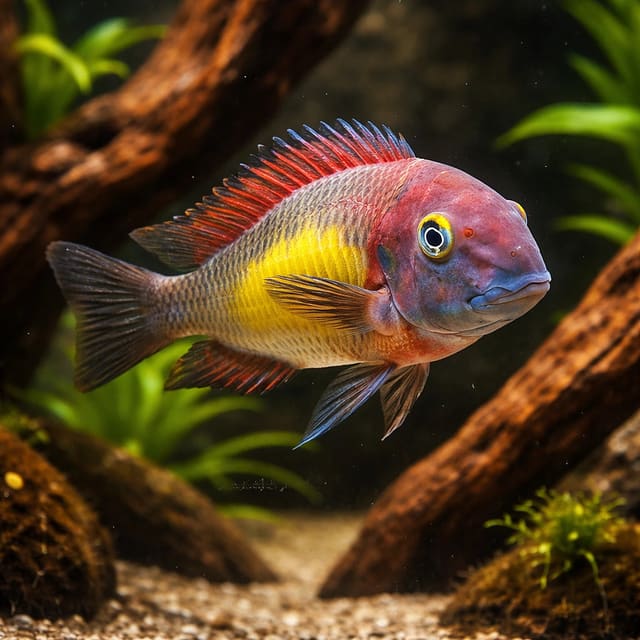
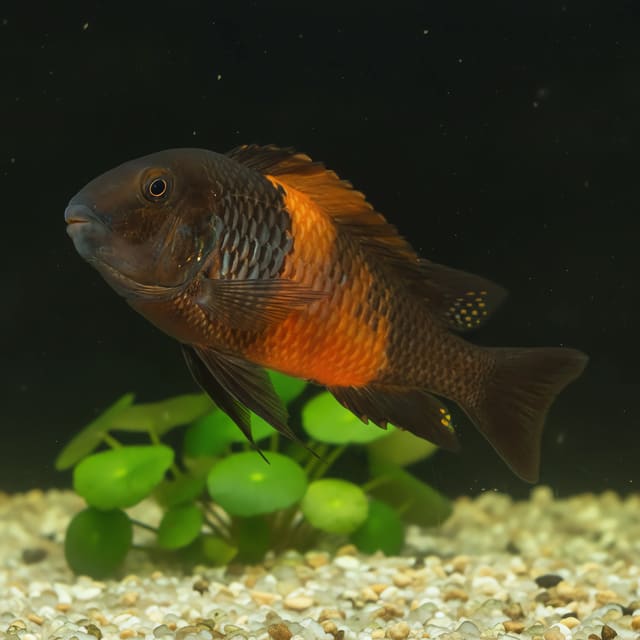
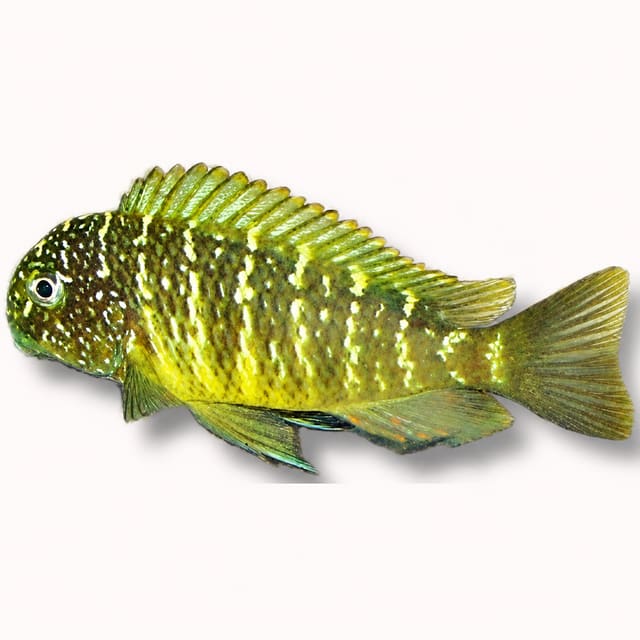
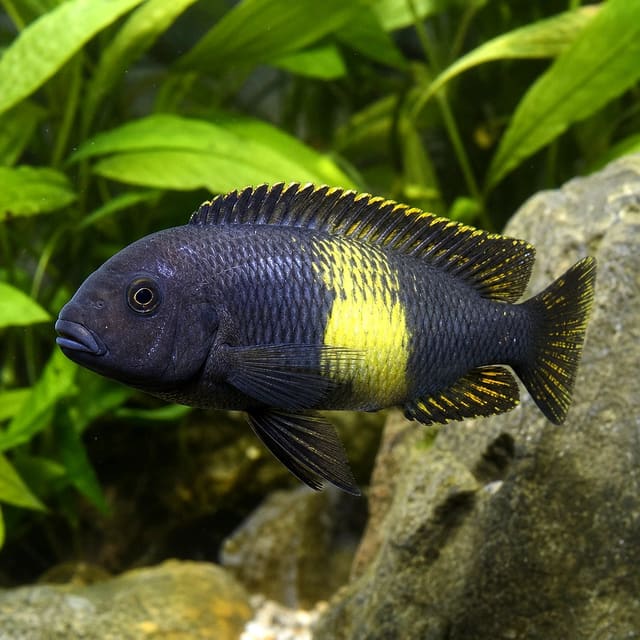
The Chipimbi Blunthead Cichlid has the classic robust Tropheus moorii shape: a deep body, rounded forehead, strong lips for grazing, and a confident midwater-to-rockwork swimming style. Adults reach about 14 cm, making them substantial without being one of the truly large tropical fish for sale UK choices. Their compact power is part of the appeal.
Colour can vary with age, dominance, lighting, and stress level, but healthy specimens show rich body tones with contrasting facial and fin highlights depending on the exact locality line. When comparing chipimbi blunthead cichlid online UK listings, look for clear body depth, intact finnage, and alert grazing behaviour rather than over-edited colour alone.
Sexing is not always easy. Males may show slightly stronger territorial behaviour and sometimes fuller finnage, but females can be equally bold. During breeding a holding female becomes easier to identify because she carries eggs and fry in her mouth. The expected chipimbi blunthead cichlid lifespan of up to 10 years means body quality and condition are worth investing in from the start.
Buyers often weigh the chipimbi blunthead cichlid price UK against other Tropheus morphs. Rarer locality forms can command more, but condition, group quality, and source matter more than choosing the cheapest fish. For a trusted chipimbi blunthead cichlid shop UK listing or a live chipimbi blunthead cichlid UK option, focus on healthy stock with proper colony advice. This remains one of the more sought-after rare cichlid UK choices.
This is where many buyers make mistakes. The chipimbi blunthead cichlid community tank idea only works if "community" means a carefully planned Tanganyika cichlid colony, not a random mix of peaceful fish. The best answer to which are chipimbi blunthead cichlid compatible fish is usually: other Tropheus of the same type, or very carefully chosen Tanganyika companions in large systems. For most keepers, the safest route is a species-focused colony.
The best tank mates for chipimbi blunthead cichlid are usually other members of its own colony. A large group spreads aggression and prevents one fish from taking all the pressure. Some advanced keepers combine Tropheus with robust Tanganyika dither or bottom species, but this needs tank volume, experience, and close observation.
If you want to explore related cichlid options, the Kiriza Yellow Cichlid - Tropheus Moorii and Orange I Blunthead Cichlid - Tropheus are the closest thematic matches. For aquarists comparing other African cichlids rather than direct tank mates, Yellow Elongatus Cichlid - Chindongo Elongatus, Rubin Red Peacock Cichlid - Aulonocara, and Aulonocara kandeense show how varied Malawi species can be in temperament and feeding.
Avoid mixing with delicate shoalers, slow fish, long-finned species, and soft-water community fish. These fish are not suitable with most invertebrates either, and snails may be harassed. They are also a poor fit for novelty "show" combinations. Tropheus do best in a dedicated hard-water cichlid system, not as an add-on to an unrelated community tank.
| Species | Compatible? | Notes |
|---|---|---|
| Kiriza Yellow Cichlid - Tropheus Moorii | Caution | Only for advanced keepers; mixing Tropheus forms can increase aggression and hybridisation risk. |
| Orange I Blunthead Cichlid - Tropheus | Caution | Similar needs, but best kept as a carefully planned colony, not an impulse mix. |
| Tetras, bettas, peaceful community fish | Avoid | Different water chemistry, temperament, and feeding needs. |
So is the chipimbi blunthead cichlid for community tank life realistic? In a broad mixed-species sense, no. In a specialist African cichlid setup, yes, but only with planning. The ideal chipimbi blunthead cichlid tank mates discussion starts with "more Tropheus" rather than "what else can I add?"
Always quarantine new arrivals for 2-4 weeks before adding them to an established Tropheus colony. Introducing a sick or weak fish into a hierarchy-driven tank can lead to rapid bullying and losses.
For hobbyists comparing cichlid styles rather than direct compatibility, you may also want to look at Thorichthys Maculipinnis - Elliot'S Cichlid - or Guianacara Dacrya - South American Cichlid, both of which suit very different water chemistry and community planning.
Chipimbi blunthead cichlid breeding is very achievable once the colony is mature and stable. This species is a maternal mouthbrooder: the female carries fertilised eggs and developing fry in her mouth. If you are trying to form a chipimbi blunthead cichlid breeding pair, it is usually better to start with a group and let natural pairings and hierarchy develop rather than buying two random fish.
Use a mature tank of at least 300 litres, though larger is better. Keep the temperature around 25-27°C, maintain excellent water quality, and feed a clean herbivore diet. Stable water conditions are more important than trying to force spawning with temperature swings.
Males display, circle, and defend a spawning site among rocks. After eggs are laid and fertilised, the female collects them into her mouth and may eat very little during incubation. A holding female often looks slightly fuller in the throat and becomes more withdrawn. This is one of the most fascinating parts of chipimbi blunthead cichlid behaviour.
Incubation typically lasts around 3-4 weeks depending on temperature and individual fish. Some breeders leave the female in the colony if aggression is manageable; others move her to a separate tank to reduce stress. Once released, fry can take finely crushed spirulina flake and powdered herbivore foods, with newly hatched brine shrimp used only sparingly if at all.
Do not strip a holding female unless you have experience and a clear reason. Many Tropheus females are excellent mothers in stable conditions, and unnecessary interference can interrupt future breeding behaviour.
Choosing between Tropheus forms and other African cichlids depends on your water chemistry, feeding discipline, and how much social behaviour you want to observe. The chipimbi blunthead cichlid vs Julidochromis comparison usually comes down to colony grazing fish versus cave-spawning pairs. The chipimbi blunthead cichlid vs Neolamprologus question often comes down to body shape, aggression style, and breeding method. Within the genus, chipimbi blunthead cichlid vs Tropheus comparisons are usually about colour morph and collection point rather than basic care.
| Feature | Chipimbi Blunthead Cichlid | Kiriza Yellow Cichlid |
|---|---|---|
| Max Size | 14 cm | Around 12-14 cm |
| Care Level | Moderate to advanced | Moderate to advanced |
| Temperature | 24-28°C | 24-28°C |
| Best For | Specialist Tanganyika colony | Specialist Tanganyika colony with alternate colour preference |
| Feature | Chipimbi Blunthead Cichlid | Neon Red Calico Peacock |
|---|---|---|
| Water Type | Hard, alkaline Tanganyika | Hard, alkaline Malawi |
| Diet | Strictly herbivore-focused | More omnivorous / insectivore leaning |
| Social Style | Large colony hierarchy | Harem / peacock cichlid structure |
| Temperament | Intra-species aggression common | Assertive but different aggression pattern |
| Best For | Keepers wanting Tropheus behaviour | Keepers wanting showy Malawi colour |
If you want one of the most engaging herbivorous rock-grazers in the hobby, choose the Chipimbi. If you want a more mixed African display, consider Aulonocara Sp Neon Red Calico Peacock, Rubin Red Peacock Cichlid - Aulonocara, or Aulonocara kandeense. If you want a different Tropheus look, the Kiriza Yellow Cichlid - Tropheus Moorii is the most natural comparison. For many aquarists the real decision is not about beauty but about commitment: Tropheus reward consistency more than convenience.
A healthy Chipimbi is alert, grazing often, holding position confidently in the group, and showing full finnage with no clamped posture. Appetite should be strong, though holding females may eat less. Eyes should be clear, the belly should not appear pinched, and breathing should stay steady. When buying a chipimbi blunthead cichlid for sale UK specimen or comparing a chipimbi blunthead cichlid buy online UK listing, these are the signs worth checking.
The biggest risk is digestive trouble caused by poor diet or unstable water. Bloat-like symptoms include swelling, lethargy, stringy waste, and refusal to eat. External parasites, bacterial infections, and stress injuries can also occur, especially if the colony is too small or the hierarchy is unstable. A proper chipimbi blunthead cichlid care guide always treats group size, diet, and water quality together.
Prevention is better than cure. Keep nitrates low with regular water changes, avoid sudden chemistry swings, and feed only suitable herbivore foods. Quarantine all new fish, and remove severely bullied individuals if needed.
Never assume a Tanganyika cichlid can eat the same foods as predatory cichlids. Protein-heavy feeding is one of the fastest ways to create serious digestive trouble in Tropheus.
Chipimbi blunthead cichlid behaviour is active, social, and highly structured. These fish spend much of the day grazing rock surfaces, chasing rivals, and maintaining position in the hierarchy. They are not shy fish that hide all day, which is one reason they remain so popular among keepers who want visible interaction.
The species is often described as aggressive, but that needs context. In a proper colony, aggression is spread across many fish and becomes manageable. In undersized groups, one or two fish may be relentlessly targeted. That is why the correct chipimbi blunthead cichlid school size matters so much, and why this is not a fish for beginners unless the keeper is ready to build the whole setup around it.
To encourage natural behaviour, provide broad rockwork, open swimming space, strong current, and a consistent feeding schedule. A settled colony often becomes bolder over time and will greet the keeper at the glass, especially at feeding time.
When you order a specialist fish like this, the difference is in preparation. Tropheus should not be netted from a mixed holding tank and shipped with generic advice. Our Chipimbi stock is selected for body shape, alert grazing behaviour, and suitability for hard-water cichlid systems, and we focus on fish that are feeding properly on herbivore-based foods before dispatch, which is especially important for this species.
Each fish is observed before sale, and we provide practical guidance on acclimation, colony size, and feeding so you can avoid the common mistakes that lead to losses. For customers searching tropical fish for sale UK delivery or the best place to buy tropical fish online UK, the key question should be not only price but whether the seller understands Tropheus husbandry, including packing for temperature stability with insulated boxes and timing dispatch to reduce transit stress.
Order your Chipimbi Blunthead Cichlid today with confidence if you are ready for a true Tanganyika colony fish. It is a superb choice for the aquarist who wants movement, hierarchy, and authentic algae-grazing behaviour in a large hard-water aquarium.
Building a Tanganyika or African cichlid display? Consider the Kiriza Yellow Cichlid - Tropheus Moorii for another iconic Tropheus colour form, or the Orange I Blunthead Cichlid - Tropheus if you want a related blunthead variant with similar care needs. For a different African look, the Rubin Red Peacock Cichlid - Aulonocara and Aulonocara kandeense offer Malawi colour and contrast. Browse more on our Lake Tanganyika cichlids collection.
No reviews for this item yet. Bought one? Honest reviews only, good or bad.
What customers say about ordering from us
I have a small group of long finned mountain minnows. So was delighted to be able to order ten of this variety to increase the genetics in my tank . The ones I recieved are healthy but it’s to early to give a verdict on wether they are of a long finned type since they are small currently.
Gordon Walker · 23 Sept 2026
100% success travel and "installation". Pleased with quality of purchase. The Siamese fighter a bit "shy" so have not yet seen him at his best yet but looking good. Happy customer. GG
George E Garratt · 21 Sept 2026
Reviews of our shop, collected by Judge.me, an independent third-party review collector. Newest first.