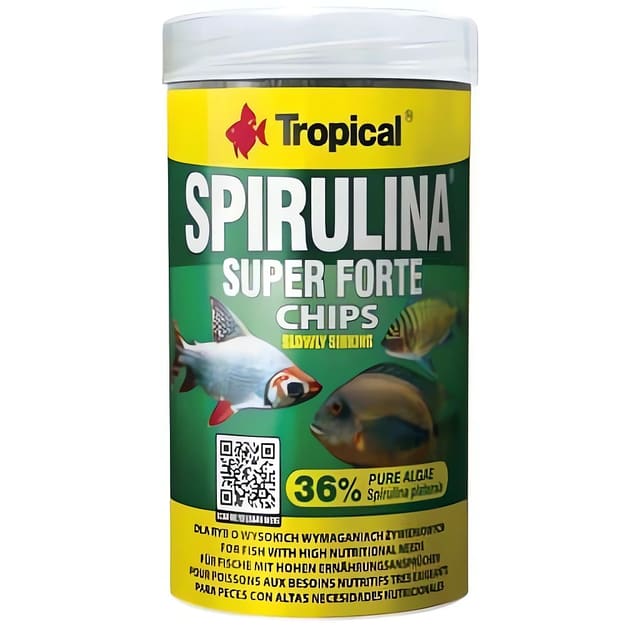
Tropical Super Spirulina Forte Chips 1000ml / 520g
£41.19
Manufacturer-verified 50ml/36g pack of about 80 adhesive 12mm tablets. Contains 12% algae from chlorella, Ascophyllum and Laminaria for suitable herbivorous fish, omnivores as a supplement, and crustaceans.
Manufacturer-verified 50ml/36g pack of about 80 adhesive 12mm tablets. Contains 12% algae from chlorella, Ascophyllum and Laminaria for suitable herbivorous fish, omnivores as a supplement, and crustaceans.
Tropical 3-Algae Tablets A are adhesive aquarium-food tablets made for freshwater and marine herbivorous fish whose diet includes algae. They can also be used as a supplementary food for omnivorous fish and may be fed to freshwater or marine crustaceans. Press a tablet onto the inside of the aquarium glass and the animals can feed in view, making it easier to check who is eating and how quickly the portion is being consumed.
This is the manufacturer-listed 50 ml / 36 g pack, containing approximately 80 tablets. Each tablet is about 12 mm in diameter. The verified recipe contains 12% algae from three named sources: Chlorella vulgaris, Ascophyllum nodosum and Laminaria digitata. It also contains 2% aloe vera. It does not list spirulina, so this page does not present it as a spirulina food.
| Detail | Manufacturer information | What it means in the aquarium |
|---|---|---|
| Food form | Adhesive tablet | Press it onto clean internal glass rather than dropping it loose |
| Pack size | 50 ml / 36 g | The small retail container in this listing |
| Tablet count | Approximately 80 | Count is approximate because the product is sold by pack size and weight |
| Tablet size | Approximately 12 mm | A broad feeding surface that several small fish can pick at |
| Algae | 12% | Three named algae sources, not 12% of each species |
| Protein | 36% | This is not simply compressed vegetable matter |
| Feeding instruction | Small portions several times daily | Only offer what the animals consume within 2-3 minutes |
An adhesive tablet is designed to stay on the aquarium pane after being pressed firmly against it. This changes the feeding position without changing the animals' dietary needs. Fish and crustaceans can approach the exposed face of the tablet, pick away particles and remain visible while feeding. That visibility is useful in a mixed aquarium because the keeper can see whether shy individuals are joining the meal or whether one dominant fish is controlling the feeding point.
The glass-mounted format also gives you control over placement. A front or side pane can bring the food into an open viewing area; a quieter side near cover may suit nervous animals. In a larger aquarium, using more than one appropriately small portion can spread attention between feeding points. The aim is not to cover the glass with food, but to place a measured portion where the intended animals can reach it.
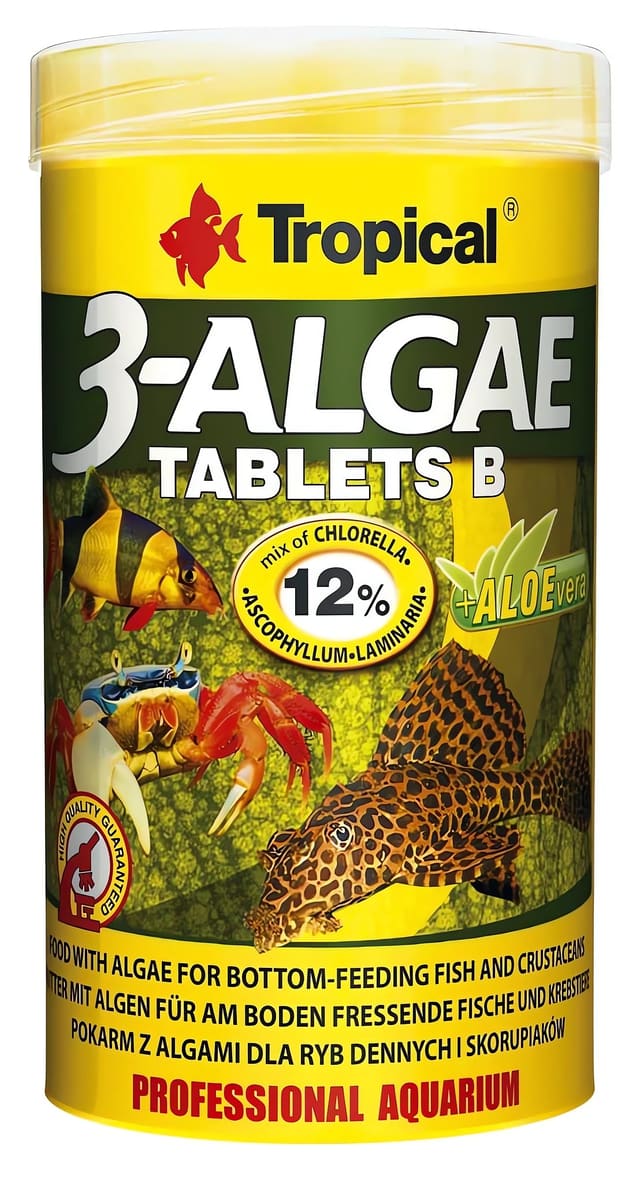
Tablets A should not be described as ordinary sinking algae wafers. Tropical sells a separate 3-Algae Tablets B format for bottom placement. The A format is chosen when glass attachment and feeding observation are useful.
The manufacturer names chlorella (Chlorella vulgaris) and the brown seaweeds Ascophyllum nodosum and Laminaria digitata. The two brown-algae ingredients are commonly described as kelp algae. Together they account for the product's declared 12% algae content.
| Algae | Group | How it is represented here |
|---|---|---|
| Chlorella vulgaris | Green microalga | One of the three named algae in the blend |
| Ascophyllum nodosum | Brown seaweed / kelp algae | One of the two marine macroalgae in the blend |
| Laminaria digitata | Brown seaweed / kelp | The third named algae source |
Spirulina is not named in the current official composition. That matters because many aquarium foods use spirulina and it is easy for generic algae-food copy to add it by assumption. If you specifically want a food whose name and formula are built around spirulina, compare Tropical Super Spirulina Forte Chips instead.
The label lists cereals first, followed by algae at 12%. The remainder includes derivatives of vegetable origin, vegetable protein extracts and several animal-derived ingredients. It is therefore an algae-rich prepared food, but it is neither a pure-algae tablet nor a vegan product.
Cereals; algae 12%; derivatives of vegetable origin, including aloe vera 2%; vegetable protein extracts; fish and fish derivatives; molluscs and crustaceans; milk and milk derivatives; meat and animal derivatives; yeasts; oils and fats; and minerals.
This ingredient list is important for keepers managing sensitivities or strict feeding plans. The product contains fish, mollusc, crustacean, milk and meat derivatives. It should not be represented as an exclusively plant-based feed simply because algae appear prominently on the packaging.
| Constituent | Declared amount | Reading the figure |
|---|---|---|
| Crude protein | 36.0% | Total crude protein in the prepared food |
| Crude oils and fats | 7.0% | Declared lipid fraction |
| Crude fibre | 1.7% | Laboratory crude-fibre measure, not total dietary fibre |
| Moisture | 10.0% | Declared water content of the packaged food |
These values help compare foods, but a high or low number is not automatically better. Suitability depends on the animal's natural diet, life stage, health, the rest of the feeding rotation and how much is offered. Use the product as Tropical specifies: daily for appropriate herbivorous fish, and as a supplementary food for omnivorous fish.
Per kilogram, the declared vitamin additions are vitamin A 20,400 IU, vitamin D3 1,200 IU, vitamin E 80 mg and vitamin C 280 mg. Declared trace compounds provide iron 25.0 mg, zinc 7.0 mg, manganese 5.0 mg, copper 1.1 mg, iodine 0.15 mg, selenium 0.15 mg and molybdenum 0.03 mg per kilogram. Lecithin and antioxidants are also listed.
Those are formulation figures per kilogram, not instructions to dose individual vitamins into an aquarium. Do not add more vitamin products on the basis of this table alone. The tablet is a prepared feed and should be portioned as food.
The manufacturer's scope is broader and more reliable than a list of fashionable aquarium names: freshwater and marine herbivorous fish for which algae are an important part of the diet, omnivorous fish as a supplementary food, and freshwater or marine crustaceans. That includes many grazing aquarium animals, but the keeper still needs to check the exact species.
| Animal or diet | Role of Tablets A | Decision point |
|---|---|---|
| Herbivorous fish that naturally use algae | May be used for daily feeding | Confirm the species can use a 12 mm adhesive tablet |
| Omnivorous fish | Supplementary algae-rich food | Rotate with an appropriate complete diet |
| Freshwater crustaceans | Suitable food option | Observe access and prevent fish monopolising the tablet |
| Marine crustaceans | Suitable food option | Match portion and placement to the species and system |
| Strict carnivores | Not the intended primary food | Choose a species-appropriate carnivorous formula |
| Newly hatched fry | Usually too large as a direct first food | Use a correctly sized fry or micro food |
A pleco, an otocinclus, a marine grazer and a shrimp do not have identical nutritional needs merely because all may pick at algae. Check the species' adult diet and mouth size. Do not use this product as proof that an aquarium has enough natural biofilm, wood, vegetables or other specialist foods where those are required.
Tropical instructs the keeper to feed several times during the day in small portions, using an amount the animals consume within 2-3 minutes. The official information does not prescribe one tablet per a fixed number of fish, a tank-volume formula or a universal once-daily ration. Those numbers would ignore animal size, species, appetite, water temperature, competition and the other foods offered.
For a first use, begin conservatively. A whole 12 mm tablet may be more than a very small group can finish quickly, while a busy larger aquarium may need several separated feeding points. The package count is approximate and is not a ration guide.
Choose a section of glass below the water line and away from a concentrated filter jet. Hold the tablet against the inner pane and press firmly for a moment so its surface contacts the glass. Do not use soap, household cleaner or any chemical to prepare the area. If the pane carries heavy hard-water scale or thick algae, move to a cleaner spot that is still accessible to the animals.
Place it where you can observe feeding without forcing shy fish into an exposed conflict. A side pane near shelter may work better for newly introduced or nocturnal animals. In a mixed tank, two smaller feeding points can reduce crowding more effectively than one oversized portion. Keep each placement away from filter intakes where softened particles could be pulled straight into the media.
The adhesive format lets you see mouths, bellies and social access. Use that advantage. If one animal excludes the rest, change the number or position of feeding points rather than simply adding more food to the same location.
| Format | Where it is offered | Useful when |
|---|---|---|
| 3-Algae Tablets A | Attached to internal aquarium glass | You want visible grazing and control over feeding height |
| 3-Algae Tablets B | Placed on the bottom | The intended animals feed primarily at substrate level |
Both belong to Tropical's 3-Algae family, but format changes access. Do not call the A tablet a sinking wafer or tell customers to place it on the substrate by default. Choose the B product for deliberate bottom placement.
| Food | Format | Typical advantage |
|---|---|---|
| 3-Algae Tablets A | 12 mm adhesive tablet | Visible, fixed feeding point on the glass |
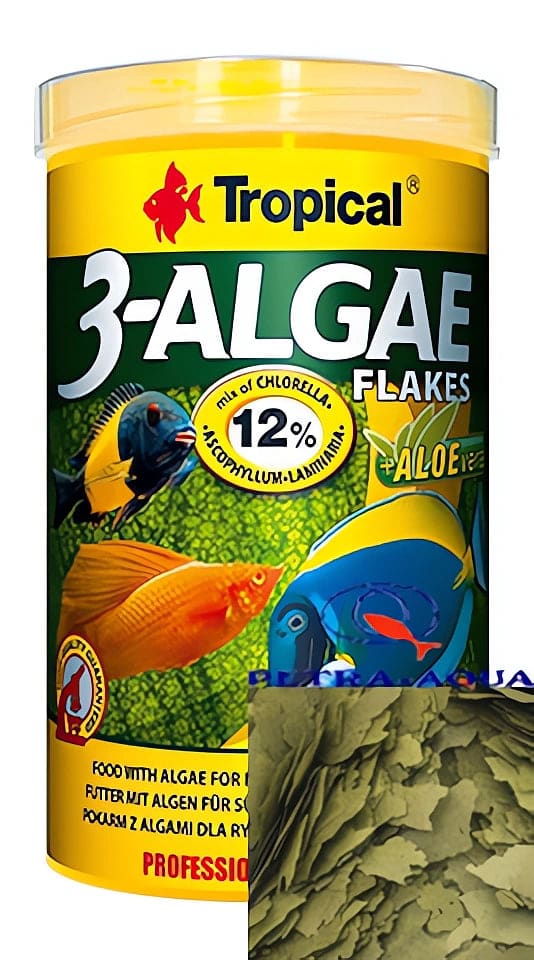
| 3-Algae Flakes | Delicate flake | Disperses across surface and mid-water for a broader group |
| 3-Algae Granulat | Granule | Individual particles can be distributed through the water column |
| Super Spirulina Forte Chips | Chip | A separate spirulina-led formula for keepers seeking that named ingredient |
The best format is the one the intended animals can find and eat without excessive competition or waste. A mixed community may use more than one format in a rotation. That does not mean every animal should eat every food at every meal.
First decide which animals the tablet is meant to feed. Offer their portion while watching faster fish, because omnivorous community species may also gather around the glass. If the target grazer repeatedly misses out, place a second small portion near its usual shelter or feed the faster group separately with a suitable staple.
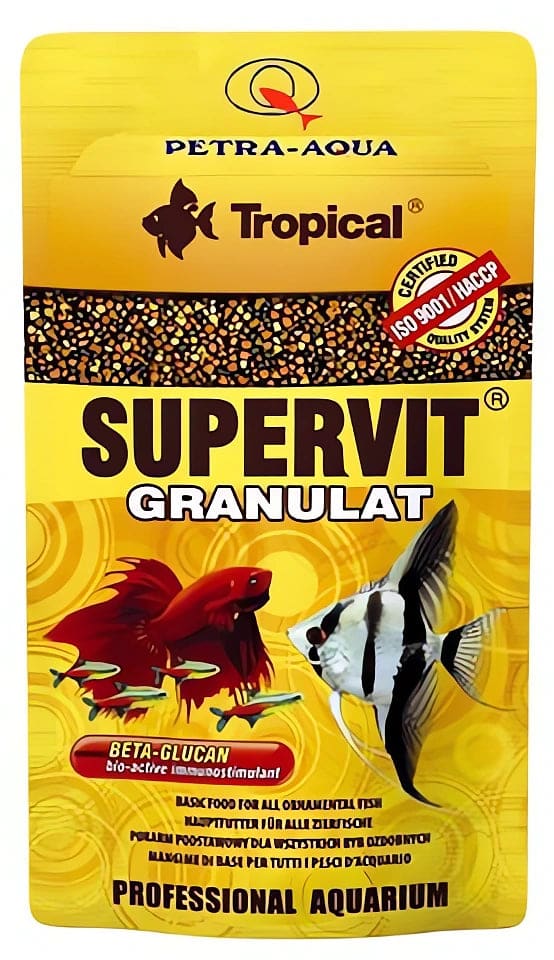
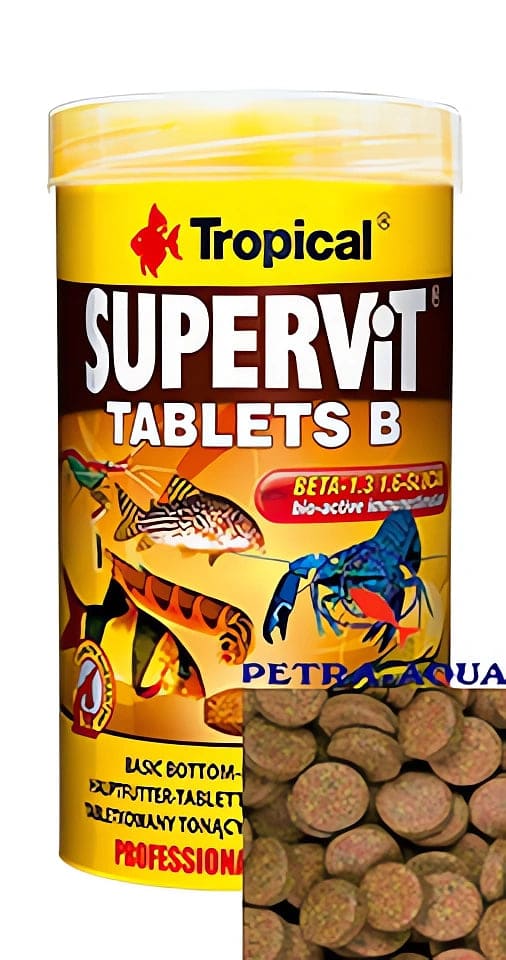
For omnivores, treat the algae tablet as part of a varied rotation. A balanced granule such as Tropical Supervit Granulat can provide a different format for a general community, while the 3-Algae tablet creates a dedicated grazing opportunity. Check every linked product's own directions before combining portions; adding two foods should not double the total meal.
Do not buy algae tablets as a substitute for diagnosing poor grazing, weight loss or damaged plants. Check water quality, social pressure, mouth condition and the species' full diet. A fish that refuses food may be stressed or unwell rather than merely bored with its current brand.
The manufacturer's 2-3 minute consumption target is more useful than an arbitrary rule to leave a tablet for hours. Prepared food begins to soften in water, and uneaten particles add organic load. In a small aquarium or heavily stocked system, repeated overfeeding can raise ammonia or nitrite, increase nitrate and encourage bacterial cloudiness.
A 30-litre aquarium with two small crustaceans does not need the same portion as a 30-litre grow-out tank full of active juveniles. Feed the animals in front of you and use consumption time to adjust.
Test ammonia and nitrite whenever animals breathe rapidly, become lethargic or food repeatedly remains. Both should be zero in a mature aquarium. Remove visible excess, correct the next portion and investigate filtration or stocking if water quality has already deteriorated.
Keep the container closed, dry and away from heat, direct sun and aquarium splashes. Use dry fingers or a clean dry tool so moisture does not enter the pack. Do not store it on a warm light unit or beside an open aquarium where condensation is frequent.
Check the label and best-before information on the pack delivered. Discard food that has become wet, mouldy, unusually odorous or contaminated. Aquarium food is not for human consumption. Wash hands after handling, particularly if you have known sensitivities to fish, crustacean, mollusc or milk ingredients.
This listing is for one 50 ml / 36 g container of Tropical 3-Algae Tablets A, with approximately 80 adhesive tablets. The count is not guaranteed as an exact unit count. The product is sold as a sealed commercial feed by its declared volume and net weight.
The pack should be selected for its format and formulation, not because a page promises a fixed number of aquarium meals. How long it lasts depends on the animals, portion size, feeding frequency and how it fits into the wider diet.
Identity, pack size, tablet count, algae species, composition, analytical constituents, additives and feeding directions were checked against Tropical's current official 3-Algae Tablets A product page. The approximately 12 mm tablet diameter is also shown in Tropical's aquarium feeding guide and product catalogue.
The manufacturer's page contains broad promotional statements about condition, immunity and convalescence. This listing keeps the verifiable formulation and intended-use facts, but does not turn a feed into a medicine or promise prevention or treatment of disease. Seek an aquatic vet for illness, and test water first when several animals change behaviour together.
Order the 50 ml / 36 g pack online for UK delivery. Stock shown on the page is live at the time you visit, and the checkout provides the current delivery options. New customers can use the site's current 10% first-order welcome offer when eligible; use the code shown by the welcome offer and check its current terms at checkout.
This is dry aquarium food, not a live animal, so the live-arrival guarantee does not apply to it. If the delivered container is damaged or incorrect, contact us with the order details and photographs of the parcel and product so the team can investigate.
Yes. They are adhesive tablets intended to be pressed onto the inside aquarium pane, where fish or crustaceans can feed from the exposed surface.
Tropical lists approximately 80 tablets in the 50 ml / 36 g container. It is an approximate count, not an exact-unit guarantee.
The published tablet diameter is approximately 12 mm.
Spirulina is not named in the current official composition. The three declared algae are Chlorella vulgaris, Ascophyllum nodosum and Laminaria digitata.
The declared total is 12% algae. That figure covers the combined three-algae blend, not 12% of each species.
No. The composition also lists fish, mollusc, crustacean, milk, meat and other animal derivatives.
Yes, as a supplementary food. Omnivorous fish still need an appropriately varied overall diet.
Tropical states that the tablets may be fed to freshwater and marine crustaceans. Match the portion and feeding position to the exact species and prevent tank mates from taking all the food.
The manufacturer advises several small portions during the day, with each portion consumed within 2-3 minutes. There is no official universal tablet-per-fish ration.
The official direction is to offer an amount consumed within 2-3 minutes. Do not routinely leave uneaten food to break down overnight.
Use a portion appropriate to the animals present. If a whole tablet is too much to meet the 2-3 minute target, offer a smaller cleanly handled portion and keep the remainder dry.
Tablets A are adhesive and attach to aquarium glass. Tablets B are intended for bottom feeding.
A 12 mm tablet is generally not a direct first food for newly hatched fry. Use a species-appropriate micro or fry food with a suitable particle size.
No. It is aquarium food, not a medicine. The manufacturer promotes it for feeding during demanding periods, but illness needs water-quality checks, correct diagnosis and veterinary advice where necessary.
No reviews for this item yet. Bought one? Honest reviews only, good or bad.
What customers say about ordering from us
Easy website plenty of info on fish your buying great to pick a time slot
TRACEY DURRANT · 7 Oct 2026
Got some lovely fish thank you
Kevin Mackie · 7 Oct 2026
Reviews of our shop, collected by Judge.me, an independent third-party review collector. Newest first.