Tropical Pro Defence Granules S
£17.99

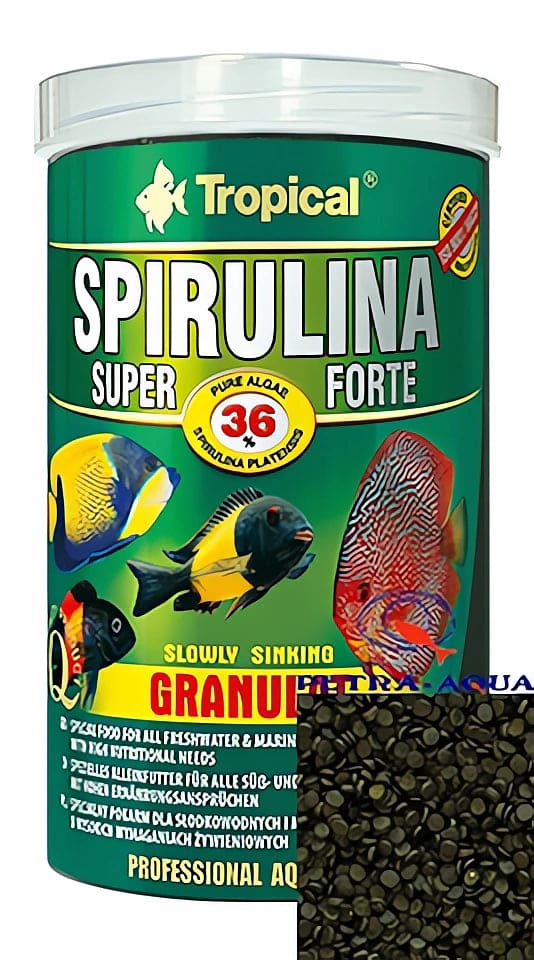
Verified 1000ml / 520g jar of slowly sinking 5.8mm chips with 36% Spirulina platensis. Complete food for larger algae-eating fish and suitable omnivores needing substantial plant material.
Verified 1000ml / 520g jar of slowly sinking 5.8mm chips with 36% Spirulina platensis. Complete food for larger algae-eating fish and suitable omnivores needing substantial plant material.
Tropical Super Spirulina Forte Chips are slowly sinking aquarium-food chips made with 36% Spirulina platensis. This is the verified 1000ml / 520g jar, intended primarily for larger algae-eating fish and for suitable omnivorous fish whose normal diet needs a substantial plant component. The chips descend gradually through the water rather than remaining at the surface, giving mid-water and lower-feeding fish time to locate them.
The useful facts are specific: 36% spirulina, 48% crude protein, a 5.8 x 1.2mm chip, and a complete manufacturer-formulated food rather than a loose algae supplement. Those details matter more than broad claims about a food being "healthy" for every tropical fish. Fish have different mouth sizes, feeding zones and nutritional strategies, so the right question is whether this large, slowly sinking chip suits the species and the role it will have in the feeding plan.
This guide sets out the current manufacturer composition, analytical constituents, declared nutritional additives, suitable feeding profiles, portioning, storage and comparisons with smaller granules, tablets and flakes. Formulations can change, so the label on the supplied jar remains the final authority.
| Product | Tropical Super Spirulina Forte Chips |
|---|---|
| Pack supplied | 1000ml / 520g |
| Food type | Complete food for ornamental aquarium fish |
| Format | Slowly sinking chips |
| Approximate chip size | 5.8 x 1.2mm |
| Spirulina content | 36% Spirulina platensis |
| Crude protein | 48.0% |
| Primary use | Larger algae-eating fish; suitable omnivores requiring substantial plant material |
| Water type | Freshwater or marine, only where the species' diet and mouth size are appropriate |
The defining feature is not simply that spirulina appears somewhere in the ingredient list. It represents 36% of the formula. Spirulina is a photosynthetic microorganism used widely in prepared aquaculture and ornamental-fish feeds as a concentrated ingredient containing protein, pigments and other nutrients. Here it is part of a complete compound food alongside vegetable protein extracts, fish ingredients, cereals, molluscs, crustaceans, yeasts, oils, fats and minerals.
That distinction prevents two common misunderstandings. First, "36% spirulina" does not mean the jar contains 36% of a separate powder coating or that every remaining ingredient is vegetable matter. Second, this is not a vegetarian food: the declared composition includes fish and fish products as well as molluscs and crustaceans. Keepers choosing food for ethical, allergy-handling or species-specific reasons should use the complete composition rather than relying on the green colour or the front-label algae message.
The manufacturer positions the food for larger algae-eating fish and other fish, including suitable marine species, that require a significant plant fraction in their diet. It can also complement an omnivore rotation. That does not make it a universal staple for every pleco, cichlid, loach, catfish or marine fish. Within those broad groups are herbivores, omnivores and specialised carnivores with very different requirements.
The current manufacturer specification declares the following ingredient groups. Ingredients are listed here for transparency, not translated into unsupported medical promises:
| Declared component | What the label tells you |
|---|---|
| Algae, including Spirulina platensis 36% | The named spirulina level is a substantial and measurable part of the formula. |
| Vegetable protein extracts | Concentrated plant-derived protein ingredients contribute to the food's nutritional profile. |
| Products of vegetable origin | Additional plant materials form part of the recipe. |
| Fish and fish products | The food is not vegetarian and includes animal-derived aquatic ingredients. |
| Cereals | Cereal ingredients are part of the finished chip structure and recipe. |
| Molluscs and crustaceans | Further animal-derived aquatic ingredients are present. |
| Yeasts | Yeast ingredients are included in the manufacturer formulation. |
| Oils and fats | These contribute energy and help form the complete diet. |
| Mineral feed materials | Mineral ingredients contribute to the declared nutrient profile. |
This food contains fish, mollusc and crustacean materials. Wash hands after handling fish food, keep it away from human food-preparation areas, and check the jar label if anyone in the household has relevant sensitivities. Manufacturers may update recipes or declarations; the physical label supplied with the product takes priority over any online transcription.
Analytical constituents describe measured nutrient categories in the completed food. They are more useful for comparing feeds than vague phrases such as "high quality" or "superfood", but they still need to be interpreted in the context of the species, life stage and the rest of the diet.
| Analytical constituent | Declared amount | Practical interpretation |
|---|---|---|
| Crude protein | 48.0% | A protein-rich complete formulation; do not assume an algae-focused food is automatically low in protein. |
| Crude fat | 6.0% | Part of the food's energy and nutrient profile. |
| Crude fibre | 3.8% | A measured fibre fraction within the complete recipe. |
| Moisture | 10.0% | A dry stored food that must be protected from humidity after opening. |
The 48% crude-protein figure is especially important when planning diets for algae-grazing cichlids or other fish sometimes described casually as herbivores. Feeding ecology is more nuanced than a single label: many grazers consume microorganisms and small invertebrates along with algae in nature. Use the manufacturer's species guidance and an informed care source for the exact fish rather than building a diet around one nutrient percentage.
The manufacturer lists nutritional additives per kilogram of food. These are part of the formulated diet, not medicines and not a promise to prevent or cure disease.
| Additive | Declared amount per kg |
|---|---|
| Vitamin A | 38,000 IU |
| Vitamin D3 | 2,000 IU |
| Vitamin E | 200mg |
| Vitamin C | 540mg |
| Iron | 42.0mg |
| Zinc | 11.5mg |
| Manganese | 9.0mg |
| Copper | 2.1mg |
| Iodine | 0.26mg |
The declaration also lists colours and antioxidants. The copper figure is a declared trace-element additive in fish food; it is not equivalent to dosing an aquarium with a copper medication. Even so, keepers of sensitive invertebrates should choose and portion food for the inhabitants they actually keep, observe feeding, and follow the current package label rather than assuming that any food is universally suitable.
Each chip is approximately 5.8mm across and 1.2mm thick. That makes it a relatively substantial food piece compared with fine granules or crushed flakes. The chip is designed to sink slowly, extending access beyond fast surface feeders and creating opportunities for fish that feed through the middle and lower areas of the aquarium.
"Slowly sinking" is more accurate than saying the food drops instantly to the substrate. The route of a chip depends on water movement, where it is introduced, and how quickly fish take it. In a strongly circulated tank it may travel before settling. In a calm tank it can be intercepted in mid-water. Place portions deliberately rather than assuming every chip will land beside a particular fish.
Large or robust fish may take a whole chip. Smaller fish may peck at an edge after it softens, but that does not make the format ideal for them. If several fish struggle to take the food cleanly, use a smaller granule rather than routinely crushing a large jar into irregular particles. The Tropical Super Spirulina Forte Mini Granulat is the more direct same-range option for smaller mouths and a finer distribution through the tank.
This product makes most sense where three conditions align: the fish eats a meaningful amount of algae or plant material, the 5.8mm chip suits its mouth and feeding behaviour, and a slowly sinking food reaches its preferred feeding zone. Examples can include larger algae-grazing freshwater fish, appropriate African cichlids, robust omnivorous community fish, and selected marine herbivores or omnivores. Suitability must still be checked at species level.
| Feeding profile | Likely role | What to check first |
|---|---|---|
| Larger algae-grazing freshwater fish | Potential complete food or important rotation food | Adult mouth size, natural diet and ability to reach a chip before tank mates |
| Plant-leaning omnivores | Useful plant-rich part of a varied diet | Whether other foods provide the variety appropriate to the species |
| Algae-grazing African cichlids | Potential staple where the species profile supports it | Exact species, social feeding pressure, portion size and total protein/energy intake |
| Marine herbivores and omnivores | Possible prepared-food component | Manufacturer guidance, mouth size and the species' need for marine algae or other foods |
| Small community fish | Usually not the most efficient format | Choose mini granules or flakes that can be swallowed safely |
| Specialised carnivores | Not an appropriate sole diet | Use food designed around the species' actual feeding ecology |
"Pleco" is not a single diet category. Some loricariid catfish consume much more algae and plant material than others; some need wood, biofilm, invertebrate material or a more omnivorous diet. A large spirulina chip can be useful for an appropriate adult grazer, but the family name alone is not enough evidence. Check the species and provide the hardscape, natural grazing opportunities and dietary variety it requires.
Many rock-grazing African cichlids are offered spirulina foods, but different species and populations do not have identical diets. The analytical profile here includes 48% crude protein. Feed small portions, avoid uncontrolled heavy meals, and base the wider diet on reliable species guidance. A product's green colour should never replace species-level husbandry.
Many loaches are omnivorous rather than primarily algae-eating. They may accept a slowly sinking chip, but acceptance is not proof that it is a complete long-term diet for them. Use it as one component where appropriate and include foods that cover the animal-derived part of the species' natural feeding strategy.
Do not use one jar as a universal solution for a mixed community containing surface-feeding micro-predators, small rasboras, specialised catfish, carnivorous cichlids and algae grazers. A complete food is complete for the fish and use described by its manufacturer, not automatically for every aquarium inhabitant.
For a broader algae-based rotation, Tropical 3-Algae Granulat offers a granule format, while Tropical 3-Algae Tablets A can be attached to the glass so feeding behaviour and intake are easier to observe.
The manufacturer advises several small portions each day, with each portion consumed within a few minutes. That is a better starting principle than a fixed number of chips per tank because fish size, species, temperature, activity, stocking density and competition all alter intake.
Large jars can make overfeeding feel inexpensive, but the biological cost is the same. Uneaten protein-rich food becomes organic waste. That can raise ammonia in an immature or overloaded system, increase nitrate and phosphate over time, encourage nuisance growth, consume oxygen during decomposition and place unnecessary demand on filtration.
Use the first week to establish the smallest repeatable portion that reaches every intended feeder and disappears within a few minutes. Record it for anyone else who feeds the tank. Increase only when fish growth, group size or observed body condition justifies a change.
A mixed tank often needs more than one food texture at the same meal. Surface fish can take a small flake or granule portion while the spirulina chips are introduced at the opposite end or near a lower-feeding territory. This spreads attention and reduces the chance that one bold group captures everything.
Do not scatter a large handful merely to make sure one shy fish receives something. Targeting is cleaner. A feeding tube, tongs, a consistent drop point or temporarily slowing circulation can improve placement, provided equipment is restored promptly. Feeding after the main lights dim can help some nocturnal catfish, but observe enough early sessions to confirm the intended fish actually eat the chips and that uneaten food is not hidden overnight.
| Problem observed | Better response | Avoid |
|---|---|---|
| Fast fish intercept every chip | Distract them with an appropriate food elsewhere and target the lower feeder | Adding several times more food to the whole aquarium |
| Chip is too large for intended fish | Change to mini granules or a smaller format | Assuming repeated pecking always provides an adequate meal |
| Food disappears under rockwork | Use a visible feeding area or dish and reduce the portion | Leaving hidden remains to decompose |
| One territorial fish guards the food | Use several separated feeding points and review stocking/social structure | Concentrating all food in one defensible spot |
| Fish show little interest | Check species suitability, freshness, stress and water conditions | Continuing to add chips in the hope they will be eaten later |
Food quality cannot compensate for unstable water. If fish stop feeding suddenly, first check temperature, oxygenation, ammonia and nitrite rather than trying several larger meals. Reduced appetite can accompany stress, disease, aggression or unsuitable conditions. Remove uneaten chips and correct the cause.
Because the chips soften in water, fragments may lodge in coarse substrate, under wood or behind filters. Inspect these areas during the first few feeds. A feeding dish can help in tanks where food routinely disappears into inaccessible spaces. Maintain normal water changes and substrate cleaning appropriate to the aquarium; no low-waste claim should be treated as permission to overfeed.
A rotation should cover the fish's nutritional needs and feeding behaviour, not add products for their own sake. This spirulina-rich chip can provide the plant-heavy element for an appropriate larger fish. The other foods should solve a defined gap: smaller particle size, a different feeding zone, more animal-derived ingredients for an omnivore, or a presentation that lets you monitor a shy grazer.
| Alternative or companion | Format | When it may be the better choice |
|---|---|---|
| Super Spirulina Forte Mini Granulat | Small sinking granules | Smaller mouths or a group that needs food distributed more widely |
| 3-Algae Granulat | Algae-based granules | A different algae blend or granule presentation |
| 3-Algae Tablets A | Adhesive tablet | Watching grazers feed on the glass and controlling placement |
| Krill Gran XXL | Large sinking granules | Appropriate larger omnivores needing an animal-rich rotation food |
| Vitality & Color Flakes | Flakes | Surface and mid-water community fish that do not feed effectively from large chips |
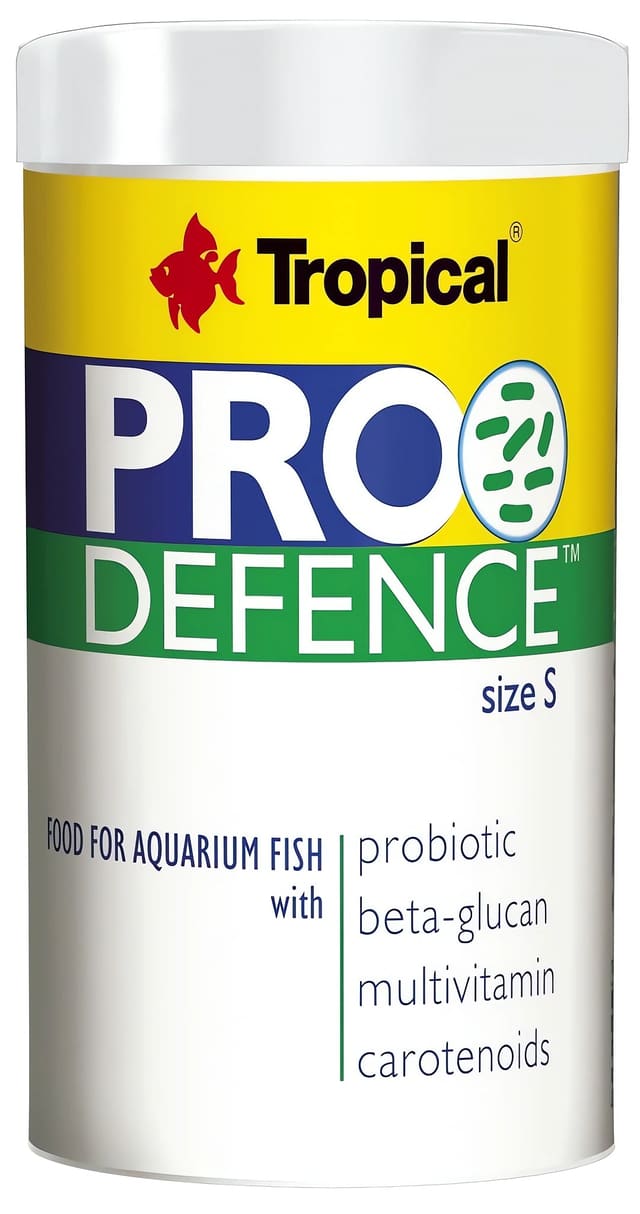
| Pro Defence Granules S | Small granules | Suitable smaller omnivores where a compact granule matches the mouth size |
Introduce a new food gradually and observe acceptance. Variety is valuable when every item has a nutritional purpose; random daily switching can make it harder to see which food is being rejected or causing waste.
Format changes who gets the food. A chip remains a distinct piece and descends slowly. A wafer is usually designed for bottom placement and prolonged grazing. Granules vary greatly in size and sinking speed, allowing more fish to take individual particles. Flakes spread across the surface and upper water, which can be ideal for small community fish but poor for a shy bottom feeder.
| Format | Main advantage | Main limitation |
|---|---|---|
| Slowly sinking chip | Visible, portionable piece available through several water levels | May be too large for small fish and can be monopolised |
| Bottom wafer/tablet | Predictable placement and extended grazing | Territorial fish may guard a single piece |
| Mini granule | Good distribution among smaller fish | Tiny particles are harder to recover if overfed |
| Flake | Easy access for surface and mid-water feeders | Fast surface fish may consume it before lower feeders benefit |
Choose the format that reaches the intended fish in a controlled amount. There is no single best fish-food shape for every tank.
Keep the lid tightly closed and store the jar in a cool, dry place away from direct sunlight, condensation and aquarium splashes. Do not keep it on a warm light hood or beside an open-topped tank. Moist fingers, wet spoons and humid air can introduce water to the food, causing clumping and reducing storage quality.
A 1000ml jar is economical only when the household can use it while it remains fresh. For a lightly stocked aquarium, consider whether a smaller pack would be consumed more promptly.
The claim means that Spirulina platensis accounts for 36% of the declared formula. It does not mean 36% "purity", 36% protein, or that spirulina is the only algae or only protein source. It also does not establish that the food will cure digestive disease, prevent infection, force brighter colour or improve breeding in every fish.
The manufacturer describes nutritional benefits associated with the formula, but aquarium outcomes also depend on genetics, species, total diet, water quality, stress, social conditions and correct portioning. We therefore present the measurable composition and intended use without turning nutritional language into a medical guarantee.
The pack size was verified against the current catalogue record for the supplied item. Composition, analytical constituents, additives, feeding direction and chip dimensions were checked against Tropical's current manufacturer specification. The jar label remains authoritative if a later production batch differs.
This transparent source trail helps shoppers compare like with like and gives search systems clear facts: product identity, 1000ml / 520g pack size, 36% spirulina content, slowly sinking 5.8mm chips, declared composition and intended feeding profile. It is more useful than repeating generic buying phrases throughout the page.
This listing is for the 1000ml / 520g jar. The manufacturer also produces other pack sizes, so compare the exact volume and net weight rather than relying only on the product photograph.
The declared formula contains 36% Spirulina platensis. That is the proportion of this named ingredient in the complete food, not a purity or protein percentage.
They are slowly sinking chips. Water flow and fish activity affect their path, so observe the first feeds and place them where the intended fish can intercept them.
The manufacturer lists an approximate chip size of 5.8 x 1.2mm. The format is aimed at larger fish; choose mini granules for mouths that cannot take or graze the chips effectively.
No. Although it contains 36% spirulina and other vegetable ingredients, the composition also declares fish and fish products, molluscs and crustaceans.
No blanket rule is safe. Loricariid catfish have varied diets. It can suit an appropriate larger algae grazer, but check the exact species' need for plant matter, wood, biofilm and animal-derived foods.
It may suit species whose feeding ecology and mouth size match the product, but these groups are not nutritionally identical. Feed controlled portions and use reliable species guidance for the complete diet.
The manufacturer recommends several small portions daily, each consumed within a few minutes. Adjust the amount to fish number and size, and remove uneaten food.
The manufacturer includes suitable marine fish among the intended users. Confirm that the individual species needs substantial plant material and can handle this chip size; many marine fish still require other marine-algae or animal-based foods.
The nutritional-additive declaration lists copper at 2.1mg per kg of food. This is a trace element in the prepared feed, not an aquarium copper treatment. Use the current label and species-specific guidance in tanks containing sensitive invertebrates.
Choose this 1000ml / 520g jar when the chip size and feeding profile match your fish and the quantity can be used while fresh. UK delivery options and the current estimated dispatch information are shown at checkout. New customers can use WELCOME10 for 10% off their first eligible order. This is a dry aquarium product, so the live-arrival guarantee used for livestock does not apply.
Before ordering, check the product facts once more: slowly sinking 5.8 x 1.2mm chips, 36% Spirulina platensis, 48% crude protein, and a verified 1000ml / 520g pack. Matching those facts to the fish is the best route to a useful purchase and a cleaner feeding routine.
No reviews for this item yet. Bought one? Honest reviews only, good or bad.
What customers say about ordering from us
I have a small group of long finned mountain minnows. So was delighted to be able to order ten of this variety to increase the genetics in my tank . The ones I recieved are healthy but it’s to early to give a verdict on wether they are of a long finned type since they are small currently.
Gordon Walker · 23 Sept 2026
100% success travel and "installation". Pleased with quality of purchase. The Siamese fighter a bit "shy" so have not yet seen him at his best yet but looking good. Happy customer. GG
George E Garratt · 21 Sept 2026
Reviews of our shop, collected by Judge.me, an independent third-party review collector. Newest first.