Moderate
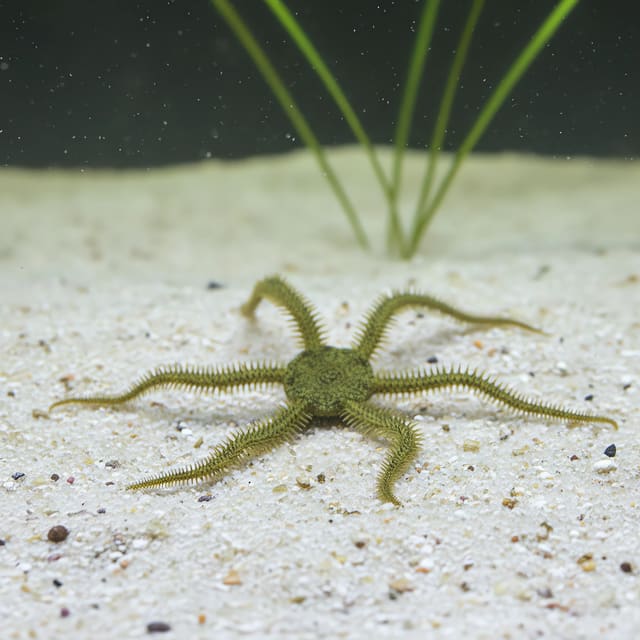
Green brittle star (Ophiarachna incrassata) - Marine Aquarium Livestock UK
22–26°C · pH 8.1–8.4 · 200L
£46.99
The Red Tube Worm (Sabellastarte spectabilis) is a filter-feeding fan worm of the family Sabellidae, native to the tropical Indo-Pacific, that grows up to 8 cm long inside a leathery tube. It suits a mature marine aquarium run to OATA's invertebrate guidance of 24–26°C, pH 8.0–8.2 and 1.024–1.026 SG, with tank mates screened so nothing picks at its feathery crown. Sold as one live worm per purchase.
Adult size is the maximum length this species reaches at full maturity (scientific sources). The livestock you receive will be younger and smaller. Product-photo provenance and any image-specific limitations are stated on the listing.
Sabellastarte spectabilis
The Red Tube Worm (Sabellastarte spectabilis) is a filter-feeding fan worm of the family Sabellidae, native to the tropical Indo-Pacific, that grows up to 8 cm long inside a leathery tube. It suits a mature marine aquarium run to OATA's invertebrate guidance of 24–26°C, pH 8.0–8.2 and 1.024–1.026 SG, with tank mates screened so nothing picks at its feathery crown. Sold as one live worm per purchase.
Adult size is the maximum length this species reaches at full maturity (scientific sources). The livestock you receive will be younger and smaller. Product-photo provenance and any image-specific limitations are stated on the listing.
Maintain these water conditions for optimal health and vibrant colors
The Red Tube Worm (Sabellastarte spectabilis) is a marine fan worm: a segmented polychaete in the family Sabellidae that lives in a tough, leathery tube and spreads a plume of branched, feathery tentacles into the water to feed and breathe. Wikipedia's account of the species also calls it the feather duster worm, feather duster or fan worm, places it in the tropical Indo-Pacific, and records the worm reaching 80 mm (8 cm) in length and 10–12 mm in width.
It suits a keeper who already runs, or is carefully building, a mature marine aquarium set up for invertebrates, and who wants a calm animal to watch rather than a fish that swims to the front of the glass. This worm never chases food. It stays in its tube and catches fine organic particles as they drift past its crown, so three decisions matter more than anything else: stable water, a secure place for the tube, and tank mates that leave the crown alone.
| Suits | Not suited to |
|---|---|
| A mature marine aquarium kept to OATA's marine-and-invertebrate water values | Freshwater aquariums of any kind |
| Keepers who test salinity, ammonia, nitrite and nitrate as a matter of routine | A newly filled aquarium whose filter has not yet matured |
| A reef or invertebrate display with a sheltered crevice in stable rockwork | Tanks holding animals that pick at, bite or dig around sessile invertebrates |
| Anyone who enjoys watching a feeding animal up close | Buyers who need one exact crown colour |
Because it is sessile, the worm cannot walk away from poor water or a troublesome neighbour the way a fish or shrimp might. Everything on this page is organised around that fact: the care tab covers feeding biology, water values, filtration, placement and arrival day, and the compatibility tab turns the same biology into a set of screening questions for any animal you plan to keep alongside it.
Each purchase supplies one live Red Tube Worm in its tube. The soft body stays inside, and the crown of branched tentacles, which biologists call radioles, projects from the open end to form the plume you see in the aquarium. That plume is both the feeding surface and the breathing surface, so the way you handle, place and protect it shapes everything else on this page.
Sex is guaranteed only when the selected option explicitly states male or female. This Red Tube Worm listing has no sex-guaranteed option. Plan for it as one animal that settles into a single spot in the rockwork and stays there, so the choice of that spot is the most important decision you make on arrival day.
You may see this worm sold as Sabellastarte indica. WoRMS, the World Register of Marine Species, records that name as unaccepted and gives the accepted name as Sabellastarte spectabilis (Grube, 1878), in the family Sabellidae within the order Sabellida. The naming has a tangled history: the worm appeared in Hawaii under the name Sabellastarte sanctijosephi, Hartman used S. punctata and S. indica in 1966, and a 2003 revision of the genus by Knight-Jones and Mackie concluded that S. spectabilis is the correct name. If an invoice or care book says Sabellastarte indica, it refers to the worm now accepted as S. spectabilis.
Red Tube Worm is the trade name this animal is sold under rather than a promise about the shade of every crown. The species account describes the tentacles as striped in dark and pale brown bands and the body as buff with purple specks, and the photograph on this page shows a crown banded in tan and cream. Gallery images have been digitally enhanced to improve image quality. Natural colour, pattern, size and maturity can vary between live animals. Plan the display around the worm's needs rather than one exact colour.
If you are building an invertebrate display, the marine invertebrates we keep for reef aquariums are grouped together, so you can plan the rest of the aquarium in one place; run each candidate through the screening questions in the compatibility tab before it joins the worm.
Wikipedia describes S. spectabilis as a filter feeder, and the mechanism explains most of its care. Tiny hair-like cilia on the tentacles set up currents in the water. Organic particles are caught as they float past, then passed along mucus-filled grooves to the mouth. Larger particles that are not food are put to use as building material for the tube, and the same tentacles work as gills for gas exchange.
Three practical points follow from that biology:
It also helps to be clear about what the worm is not. It is not a grazer that scrapes films from rock, a scavenger that tidies leftovers from the sand, or a hunter. Foods made for those feeding styles are of no use to it and simply add to the waste your filter has to process.
Polychaetes are marine bristle worms with long bodies divided into many segments. Some roam, swim or burrow, while others, like this one, live permanently in tubes. The species account describes two long, slender palps and a four-lobed collar below the crown, with a tube covered in fine mud. The tube is the worm's armour and anchor, so a sound, undamaged tube sitting firmly in rock is the first thing to protect after arrival.
OATA's guide to setting up a marine aquarium starts with size: buy an aquarium as large as you reasonably can, because a larger volume of water is more stable and less prone to swings in temperature and pH than a small one. For an animal that cannot leave poor conditions, that stability is worth more than any single piece of equipment.
OATA separates fish-only aquariums from reef aquariums, which hold invertebrates such as corals, and suggests that a newcomer to marine keeping starts with a fish-only tank or a soft coral reef. A fish-only tank can later become a reef tank if the species are compatible, usually with extra equipment. A fan worm is an invertebrate, so it belongs in the invertebrate plan and the water values set out in the next section.
OATA recommends reverse osmosis (RO) water for marine set-ups and calls it essential if you keep invertebrates, corals included, which covers this worm. RO water can be bought already salted or as fresh water to mix at home. Dissolve a specialised aquarium salt, never table salt, following the manufacturer's instructions; once the aquarium is running, mix and heat water for future water changes in a separate vessel so new water matches the aquarium before it goes in.
Rockwork, ideally living rock, gives fish a natural refuge and provides sites to place corals and other sessile invertebrates. OATA also recommends a layer of fine coral sand, washed in RO water before it is added. For this worm, the rock matters most: its tube needs a hole, crack or crevice where it can sit firmly, and planning that spot while you build the aquascape is far easier than forcing one in later.
Keep the aquarium at 24–26°C, pH 8.0–8.2 and a salinity of 1.024–1.026 SG (32–35 ppt). These are OATA's broad guidance figures for home marine aquariums that hold invertebrates rather than a species-specific optimum, and they are the column to follow for a reef-dwelling fan worm.
| Measure | OATA marine and invertebrate guidance |
|---|---|
| Salinity | 1.024–1.026 SG (32–35 ppt) |
| Temperature | 24–26°C |
| pH | 8.0–8.2 |
| Ammonia (NH3) | Zero mg per litre |
| Nitrite (NO2) | Zero mg per litre |
| Nitrate (NO3) | 5–10 mg/l, depending on species |
| Carbonate hardness | 8–12 dKH |
| Phosphate | 0.04–0.1 mg/l, depending on species |
OATA's fish-only column is wider: salinity 1.017–1.023 SG, 24–27°C and nitrate not exceeding 20 mg per litre. Those limits are set for fish. An invertebrate aquarium runs saltier and cleaner, so a system sitting near the bottom of the fish-only salinity range is a long way from where this worm should live. Bring the aquarium into the invertebrate column before the worm arrives, not afterwards.
OATA treats a hydrometer or refractometer for salinity, and test kits for regular water-quality checks, as core equipment. Ammonia and nitrite should both read zero before any livestock goes in and should stay there. Nitrate and phosphate tell you whether feeding and maintenance are in balance, which matters for a particle feeder that tempts you to add food to the open water.
Suppose your refractometer reads 1.022 SG and your nitrate test shows 15 mg per litre. Both would be acceptable in OATA's fish-only column, yet both sit outside the invertebrate column. Raise the salinity steadily with correctly mixed salt water and use water changes to bring nitrate into the 5–10 mg/l band, then re-test before ordering. If your aquarium will also hold hard corals, OATA adds that calcium and magnesium need monitoring too.
The RSPCA's aquarium environment advice explains why filtration comes first. Animals release ammonia, which is toxic. A working biological filter lets beneficial bacteria grow, and those bacteria turn ammonia into nitrite, which is also toxic, and then into nitrate, which is safer. The RSPCA is clear that no fish should be kept without a well set up and maintained filter, and a filter-feeding worm, breathing through its crown in the same water, is no exception.
OATA advises that once a marine aquarium is filled and at the correct salinity and temperature, it should be left for 24 to 48 hours so that any salt fully dissolves, the temperature settles and you can confirm the equipment works. If you run a skimmer, you may not see it remove any waste until livestock is present. That short settling period is only the start: the filter bacteria build up as animals and food are added, which is why a fan worm belongs in a system that is already carrying a steady load.
OATA explains that the beneficial bacteria must increase every time more animals go in and feeding increases. Overstocking, or stocking too quickly, can bring on what keepers call new tank syndrome, when there are not enough nitrifying bacteria to cope with the extra waste. The practical rule is simple:
For this worm, that means it should not be part of the first wave of livestock in a new aquarium. Let the first livestock establish the filter, confirm the invertebrate water values above hold steady, and then add the worm when the system has room for one more feeder.
Wikipedia's habitat notes place this species in holes and cracks and among algae on reefs and rocky shores. It has been found growing in crevices in the coral Pocillopora meandrina, under boulders in still water, in holes in lava, in tidal pools and in channels exposed to heavy surf. Beyond its native range it has also been reported on pilings, floating docks and harbour walls in Hawaii.
Those are wild records rather than aquarium targets, but they point to two useful conclusions. First, the worm anchors its tube in a protected hole, crack or crevice, so give it one. Second, it lives in everything from still water to heavy surf, so there is no single water speed to copy from the wild. In the aquarium, aim for a spot where water keeps carrying fine particles past the crown and the plume can spread without touching rock or other animals.
Move the worm by its tube rather than by the crown, and keep handling to the minimum needed to place it. The tentacles are its gills, so keep the time it spends out of water as short as you can. Settle the tube so it is supported along its length, then leave it alone. Wikipedia notes that the worm can regenerate body parts after damage, but regrowth is a recovery to hope for, not a reason to take risks with the crown.
Its natural food is fine organic matter suspended in the water, caught on the crown as it drifts past. In an aquarium, the aim is to keep a light supply of very fine particles in the water around the worm without letting uneaten food build up and pollute the system.
Choose foods fine enough to stay suspended, sold for filter-feeding marine invertebrates, rather than foods made to sink for fish or bottom feeders. Release a small amount into the water upstream of the crown so the current carries it past, then watch where the food travels and whether any of it settles on rock or sand.
Start with small amounts and let your test results decide whether to increase them. OATA links rising feeding directly to the load on the filter bacteria, and the RSPCA's explanation of the nitrogen cycle shows where excess food ends up: as ammonia, then nitrite, then nitrate. Food that the worm does not catch becomes waste for the whole aquarium.
| If you see | Do this |
|---|---|
| Nitrate drifting above 10 mg/l or phosphate above 0.1 mg/l | Reduce the amount of fine food and review water changes before adding more |
| A film of food settling on rock or sand after feeding | You are adding more than the water column carries; cut the dose |
| Any ammonia or nitrite reading above zero | Stop extra feeding and deal with filtration first |
| Readings steady and plume spread into the flow | Keep the routine unchanged and keep testing |
The last row is the one to aim for. A stable routine, with test results that stay inside the invertebrate column, is better for a filter feeder than frequent changes in food or quantity.
Everything is hand-packed by our team: the worm is bagged in pure oxygen inside an insulated poly box, with a heat pack when the weather calls for it, and carried by a licensed live-animal courier. You receive an email with the tracking number and your confirmed delivery date, so you know when to be in. Someone must be at the address to receive the parcel, because live animals cannot be left unattended. The full terms are on our delivery and Live Arrival Guarantee page.
OATA's advice for any new arrival applies here too. Confirm that the worm suits the animals you already keep and that ammonia and nitrite read zero. OATA also recommends switching off the aquarium lights and taking the bag out of its outer wrappings carefully, avoiding exposure to bright light. OATA notes that fish are easily stressed by bright lights, extreme temperatures, noise and movement, and the same gentle handling costs nothing for an invertebrate.
Once the worm is in place, leave it undisturbed and watch rather than adjust. Each day, note whether the plume is spread into the water, whether the tube is still firmly seated, and whether any tank mate is paying attention to it. Pair those notes with water tests: a change in the worm alongside rising nitrite points to water quality, while a change with clean readings points to placement or neighbours. If the crown is damaged, the worm can regrow body parts, so keep conditions stable and the water clean while it recovers. If you are unsure what you are seeing, contact us with a photograph and your latest test results.
Wikipedia's biology notes describe a worm with more than one way to reproduce. These are natural history rather than a breeding plan for the home aquarium, but they explain some of what you may notice and why the animal copes with damage better than you might expect.
Because fertilisation happens in open water and the larvae drift in the plankton, a single worm in a filtered aquarium is not a breeding project, and nothing about keeping it depends on sex. The ability to regrow damaged parts is the more useful fact day to day: it gives an injured worm a chance, provided the water stays clean and whatever caused the damage is removed. Treat that resilience as a safety margin, and keep crown-damaging tank mates out of the plan from the start.
Add the worm only to a mature marine aquarium kept to invertebrate water standards, and before any fish or invertebrate joins it, confirm that animal will not pick at, bite or dislodge a tube-dwelling filter feeder. That single rule covers most of the risk.
The worm itself is no threat to anything in the aquarium: it feeds by catching organic particles from the water and stays in its tube. The danger runs the other way. Its crown is soft, it cannot retreat to another part of the tank, and it depends on that crown for both feeding and breathing.
| If you see | Check first |
|---|---|
| Torn or missing tentacles while test results stay clean | A tank mate picking at the crown; watch the aquarium closely around feeding |
| The tube tipped, moved or partly buried | Digging or sand-sifting animals, or rockwork that has shifted |
| The plume pressed against rock or coral | Placement; reseat the tube so the crown spreads into open water |
| Crown changes alongside ammonia or nitrite above zero | Water quality rather than a neighbour; fix filtration first |
Once you identify a culprit, separate it from the worm. Repeated damage leaves the crown little chance to regrow, however good the water is.
OATA's wider advice is to check that any new animal is compatible with those you already own before buying, and to ask your retailer about the species you have in mind. If a candidate fails any of the four questions, leave it out of the plan.
OATA describes reef aquariums as holding invertebrates such as corals, and the invertebrate water values in the care tab are written for exactly that kind of system. In the wild, Wikipedia records this worm among algae and in crevices of the coral Pocillopora meandrina. That is a wild association rather than proof that any particular coral makes a good neighbour, so apply the screening questions to corals and other sessile animals as well as to fish.
If you are converting a fish-only aquarium, OATA notes that the change is possible when the species are compatible, usually with additional equipment. Screen the existing fish first: an established fish that fails the questions above rules the worm out of that aquarium.
Say you keep a mature fish-only aquarium at 1.021 SG with nitrate at 18 mg per litre, and one of the fish sifts the sand. That system is within OATA's fish-only column but not ready for the worm. Before ordering, you would decide whether the sand-sifter and the worm can share the aquarium at all, make every batch of new salt water from RO water, bring salinity into 1.024–1.026 SG and nitrate into 5–10 mg/l, and build a crevice high in the rockwork, well away from the sand the fish works. Only when all of that holds steady does the worm join.
Wikipedia records this worm reaching 80 mm (8 cm) in length and 10–12 mm in width. It lives inside a tough, leathery tube, with a plume of banded, feathery tentacles spreading from the open end.
Choose a mature marine aquarium set up for invertebrates and as large as you can reasonably keep, because OATA advises that a larger volume of water stays more stable in temperature and pH. Plan a sheltered crevice in the rockwork with open, moving water in front of the plume.
OATA suggests that newcomers to marine keeping start with a fish-only tank or a soft coral reef and move on as they gain experience. This worm fits once your filter is mature and you can hold OATA's invertebrate guidance of 24–26°C, pH 8.0–8.2 and 1.024–1.026 SG steadily.
It is a filter feeder: cilia on its tentacles draw water past the crown, and organic particles are caught as they float by and carried to the mouth. Offer fine foods that stay suspended, in small amounts, and let your nitrate and phosphate readings guide the quantity.
Keep it at 24–26°C and pH 8.0–8.2, with salinity at 1.024–1.026 SG, ammonia and nitrite at zero and nitrate at 5–10 mg/l. These are OATA's broad guidance for marine aquariums with invertebrates, not a species-specific optimum.
No. It stays in its tube and feeds only on organic particles caught from the water, so it does not chase or nip other animals. Its own soft, feathery crown is the part that needs protecting.
OATA describes reef aquariums as holding invertebrates such as corals, and in the wild this worm has been recorded among algae and in coral crevices. Screen every fish or invertebrate first and leave out any animal that picks at, bites or dislodges sessile invertebrates.
Start a continuous unboxing video while the parcel is still sealed, inspect the worm the same day, then float the bag for 20–30 minutes before releasing; the Live Arrival Guarantee needs that video. It travels hand-bagged in pure oxygen in an insulated poly box, carried by a licensed live-animal courier.
No reviews for this item yet. Bought one? Honest reviews only, good or bad.
What customers say about ordering from us
Easy website plenty of info on fish your buying great to pick a time slot
TRACEY DURRANT · 7 Oct 2026
Got some lovely fish thank you
Kevin Mackie · 7 Oct 2026
Reviews of our shop, collected by Judge.me, an independent third-party review collector. Newest first.