Advanced
Silver Arowana (Osteoglossum bicirrhosum)
24–30°C · pH 5–7.5
£84.99

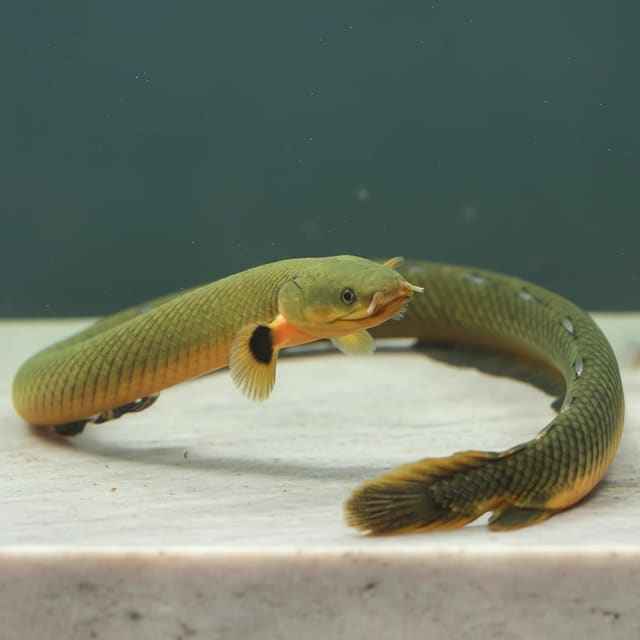
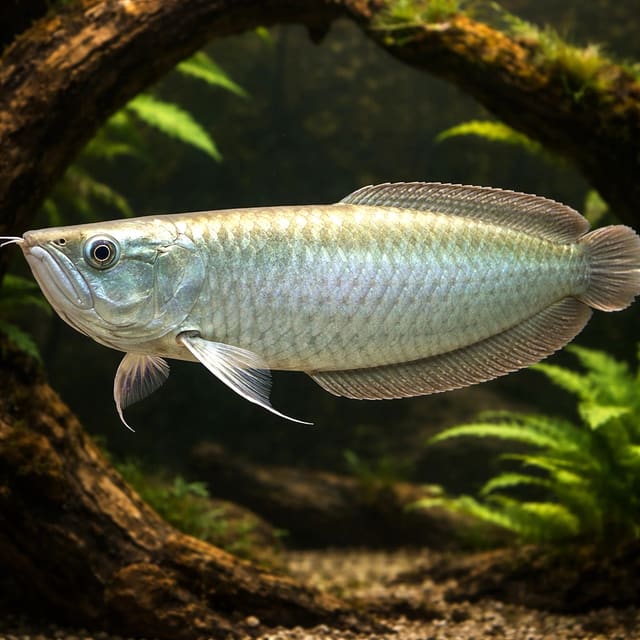
The Silver Albino Arowana (Osteoglossum bicirrhosum) is a freshwater arowana from South America’s Amazon basin, Rupununi and Oyapock rivers that reaches 90 cm. It suits advanced keepers with public installations or the very largest private aquaria; keep it at 24–30°C, the overlap of FishBase and Seriously Fish, with pH 5.0–7.5 and hardness of 2–15 dGH from Seriously Fish. Sold individually in 10–15 cm and 20–25 cm dispatch sizes.
Adult size is the maximum length this species reaches at full maturity (scientific sources). The livestock you receive will be younger and smaller — pick a size above for the actual shipping size. Product-photo provenance and any image-specific limitations are stated on the listing.
Osteoglossum bicirrhosum
The Silver Albino Arowana (Osteoglossum bicirrhosum) is a freshwater arowana from South America’s Amazon basin, Rupununi and Oyapock rivers that reaches 90 cm. It suits advanced keepers with public installations or the very largest private aquaria; keep it at 24–30°C, the overlap of FishBase and Seriously Fish, with pH 5.0–7.5 and hardness of 2–15 dGH from Seriously Fish. Sold individually in 10–15 cm and 20–25 cm dispatch sizes.
Adult size is the maximum length this species reaches at full maturity (scientific sources). The livestock you receive will be younger and smaller — pick a size above for the actual shipping size. Product-photo provenance and any image-specific limitations are stated on the listing.
Maintain these water conditions for optimal health and vibrant colors
The Silver Albino Arowana (Osteoglossum bicirrhosum) is a freshwater member of the arowana family, Osteoglossidae, from South America’s Amazon basin, Rupununi and Oyapock rivers. FishBase records a maximum length of 90 cm. This is an advanced choice for a keeper who can provide a public installation or one of the very largest private aquaria, not an ordinary home community aquarium.
Its upturned mouth lets it capture prey above it while swimming from below. Wild fish are omnivorous generalised predators that eat other fish, terrestrial insects, aquatic invertebrates and fallen plant material. That feeding biology, the adult length and the need for a heavy, tightly fitting cover should shape the aquarium before the fish is selected.
| Suits | Not suited to |
|---|---|
| Advanced keepers able to plan for a 90 cm fish | A first aquarium or a short-term home without adult accommodation |
| Public installations or the very largest private aquaria | Ordinary domestic community aquaria |
| A mature, securely covered aquarium with strong filtration | An uncovered or biologically immature aquarium |
| Carefully screened companions too large to swallow | Small fish or casually assembled mixed communities |
| Stable tropical water and weekly 30–50% water changes | A system where water conditions fluctuate |
Seriously Fish describes this species as suitable only for public installations or the very largest private aquaria. Make that long-term facility the first decision; colour, dispatch size and potential companions come afterwards.
One purchase supplies one fish in the size chosen on the live size selector. The choices are labelled “10 - 15 cm” and “20-25 cm”. The size you select is the size supplied, not the adult size. Neither measurement should be used to infer the fish’s age, sex or life stage; plan both choices around the same 90 cm adult length.
Sex is guaranteed only when the selected option explicitly states male or female. This Silver Albino Arowana listing has no sex-guaranteed option.
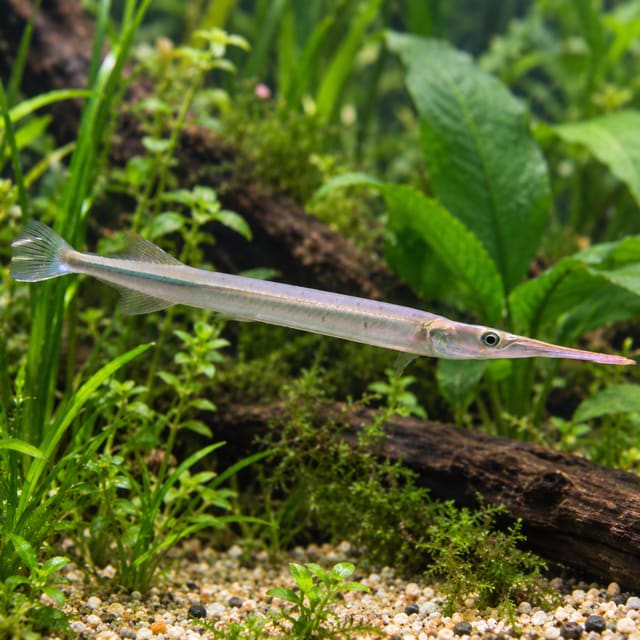
Some gallery images have been digitally enhanced to improve image quality. They show the listed type of animal rather than guaranteeing the exact markings of the individual supplied, so natural colour and pattern can vary.
Keep this fish at 24–30°C, pH 5.0–7.5 and 2–15 dGH. The temperature is the overlap between FishBase’s recorded 24–30°C environment and the 20–30°C aquarium range from Seriously Fish; the pH and hardness ranges come from the latter’s species profile. Stability is obligatory, so choose a target within those ranges that the established system can hold consistently.
Provide a biologically mature, heavily covered installation with a high proportion of dissolved oxygen, moderate water movement and filtration able to manage a very large fish. Seriously Fish calls weekly water changes of 30–50% mandatory. It also describes a heavy, tightly fitting cover as essential because Osteoglossum species are prodigious jumpers.
OATA’s tankbuster guidance says an exceptionally large aquarium is required, often in excess of 500 litres, and that indoor heated ponds can be built to house these fish instead. Treat that figure as broad group planning context rather than the endpoint for this species; the applicable standard here remains a public installation or one of the very largest private aquaria.
If you are comparing the commitment with other specialist freshwater animals, browse the loaches and oddballs collection without treating another species as an automatic substitute.
Fit a heavy, tightly closing cover across the aquarium. Seriously Fish identifies this as essential because Osteoglossum species are prodigious jumpers. Check every section used for feeding, cables, pipework and filter returns so the completed cover remains tightly fitted after the equipment is installed.
Some floating or overhanging vegetation or branches are appreciated. Use those features without compromising the cover or preventing the fish from reaching its surface-feeding area. The layout should support the animal’s normal surface-oriented movement while retaining the cover that contains it.
A high proportion of dissolved oxygen and a moderate degree of water movement support this species. Seriously Fish says external filters, powerheads and airstones should be employed as necessary to provide that oxygen and movement. Select a combination that maintains oxygenation and movement throughout the installation without allowing filtration capacity to become the limiting factor.
Large fish create large quantities of solid waste. OATA notes that several large aquarium filters, or even a pond filter, may be needed for tankbusters. Filter choice therefore has two jobs: maintain the biological process that handles dissolved waste and physically remove the solids produced by feeding and normal activity.
Never add this fish to a biologically immature aquarium. Establish the biological filter, test it and confirm that ammonia and nitrite are both zero before introduction. Our first tropical aquarium guide explains the preparation and maturation process, but the scale of this installation must still match a 90 cm surface fish.
Complete the cover, filtration, aeration, water movement and maintenance access before the animal arrives. A smaller dispatch measurement does not reduce the need for mature filtration or justify postponing the adult plan.
Maintain 24–30°C, pH 5.0–7.5 and hardness of 2–15 dGH. Choose stable values inside all three ranges rather than moving repeatedly between their limits. Seriously Fish says stable water conditions are obligatory for this animal’s well-being, so consistency is part of the care requirement rather than an optional refinement.
The 24–30°C temperature instruction is the overlap between FishBase’s recorded environmental range and Seriously Fish’s aquarium range. Use the water matcher to compare measured aquarium values with those targets, and read the water chemistry guide for the role of each routine test.
Keep ammonia at zero mg per litre and nitrite at zero mg per litre. OATA’s very-large-fish sheet gives those values as group guidance and says nitrate should not exceed 20 mg per litre above the normal tap-water level. Test at least weekly, using the result to judge whether filtration, feeding and the water-change routine are keeping pace with the fish’s waste.
| Reading | Care decision |
|---|---|
| Temperature outside 24–30°C | Restore a stable target within the range and check the heating system. |
| pH outside 5.0–7.5 | Review the aquarium and replacement water before making further changes. |
| Hardness outside 2–15 dGH | Match the planned water source to a stable value inside the range. |
| Ammonia or nitrite above zero | Check filtration, waste and recent feeding, change conditioned water and retest. |
| Nitrate more than 20 mg/l above tap water | Review the frequency and volume of the maintenance routine. |
Maintain good oxygenation alongside the chemical targets. FishBase notes an ability to adapt to low-oxygen environments in nature, but the aquarium instruction from Seriously Fish is to provide a high proportion of dissolved oxygen and moderate movement.
The RSPCA’s aquarium welfare guidance explains that fish release toxic ammonia and that a working biological filter supports bacteria which convert ammonia to nitrite and then to the safer nitrate. This fish must therefore live in a mature system with a well-established filter, not an installation that is still building biological capacity.
Scale filtration to both the animal and its feeding. OATA warns that large fish produce substantial quantities of solid waste and may require several large filters or a pond filter. A nominal filter rating is only one part of the decision: the system must maintain zero ammonia, zero nitrite, controlled nitrate and clear pathways for water movement.
When filter media needs cleaning, rinse it lightly in aquarium water removed during a partial water change, never under the tap. Chlorine or chloramine may kill the established bacterial population. Treat replacement tap water with a suitable conditioner before it enters the aquarium.
Respond to a non-zero ammonia or nitrite result as a filtration and husbandry warning. Check for blocked media, uneaten food, accumulated solids and recent increases in feeding, then complete the conditioned water change and retest. Do not add further livestock while the biological filter is failing to hold both readings at zero.
This is a generalised predator and omnivore. Seriously Fish reports that wild specimens eat other fish, terrestrial insects, aquatic invertebrates and plant material such as fallen nuts and fruits. FishBase also records a tendency to take fish at the surface. Use foods that fit that biology rather than relying on one dried product.
For a smaller specimen, suitable examples include bloodworm, small earthworms and chopped prawn. Adults will accept strips of fish flesh, whole prawns or shrimp, mussels, live river shrimp and larger earthworms. Match each item to the fish’s ability to take it cleanly, and vary the selection rather than turning one food into the entire diet.
Crickets and other suitable insects may also be used. Seriously Fish advises filling their stomachs first with fish flakes or vegetable matter before offering them to the arowana. Floating dried foods can form a limited part of the rotation, but the recorded diet supports a varied mixture of fish, invertebrate and insect foods as the main approach.
Feed once a day and offer only what the fish can consume within a few minutes. That frequency and portion rule comes from OATA’s tankbuster sheet as group guidance. It controls both intake and the uneaten food that would otherwise break down into toxic waste.
Do not feed mammalian or avian meat such as beef heart or chicken. Seriously Fish warns that predatory fish cannot properly metabolise some of the lipids these meats contain. Keep prawns, shrimp, mussels, earthworms, suitable fish flesh, insects and limited floating dried foods as the practical rotation.
Plan for 90 cm, the maximum total length FishBase records for this species. Seriously Fish records 80 cm standard length. Use 90 cm when deciding whether the installation can house the fish for life.
The 10 - 15 cm and 20-25 cm labels describe the fish at dispatch. They do not reduce the eventual space, filtration, cover or maintenance requirement, and they do not identify age or life stage. A smaller selection simply starts the same long-term commitment at a smaller measured size.
| Planning question | Required answer |
|---|---|
| Can the final installation house a 90 cm surface fish? | Yes, as a public installation or one of the very largest private aquaria. |
| Will the cover remain heavy and tightly fitted? | Yes, including every opening around equipment and feeding access. |
| Can filtration handle a very large fish and its food? | Yes, while holding ammonia and nitrite at zero. |
| Can 30–50% be changed every week? | Yes, with conditioned replacement water and stable chemistry. |
| Are companions screened against adult predation risk? | Yes, using adult size, behaviour and swimming zone. |
OATA warns that many tankbusters grow very quickly and that an off-the-shelf aquarium is unlikely to meet their long-term needs. Secure the adult solution before relying on temporary accommodation. A large nominal litre figure alone does not replace the species guidance: Seriously Fish restricts this animal to public installations or the very largest private aquaria.
Review access for water changes, filter servicing and cover checks as part of the space plan. The aquarium is only workable when routine maintenance can be completed without weakening containment, oxygenation or biological filtration.
Arrange for someone to receive the parcel because live fish must not be left unattended. The fish is hand-bagged in pure oxygen and placed in an insulated poly box, with a heat pack when the weather calls for one. A licensed live-animal courier carries the parcel, with tracking and the confirmed arrival date sent by email.
Before adding the fish, follow OATA’s introduction advice by checking that the aquarium is an appropriate size and that ammonia and nitrite are both zero. The aquarium must already be biologically mature, covered and operating within 24–30°C, pH 5.0–7.5 and 2–15 dGH.
Close the heavy cover as soon as the fish is released, because Osteoglossum species are prodigious jumpers.
OATA advises watching swimming behaviour, breathing, colour, temperament, physical appearance, body condition and interest in food. A fish settling into a new installation should be assessed against its own normal behaviour while the water remains stable and the cover remains secure.
Hanging at the surface in a way that differs from its normal surface-feeding movement, sitting on the bottom, erratic swimming, unusually fast or slow gill movement, a marked colour change, damaged fins, lost scales, spots, fluffy growths or refusal of food are reasons to test the water immediately and investigate the husbandry conditions.
Change 30–50% of the aquarium volume every week. Seriously Fish treats that species-level water-change schedule as mandatory because stable conditions are obligatory. OATA’s broad tankbuster advice says to change 25% of the water at least once every week, so the 30–50% instruction is the applicable routine for this fish.
Check swimming behaviour, breathing, colour, temperament, scales, fins, body condition and feeding response, then confirm the cover is still tightly closed. OATA highlights changes in each of these areas as possible early signs of a health or husbandry problem. The normal pattern for the individual fish is the useful baseline.
| Change you see | First action |
|---|---|
| Hanging at the surface unlike its normal movement, or erratic swimming | Test water quality and check oxygenation and flow. |
| Faster or slower gill movement | Test the water and inspect aeration and filtration. |
| Darker or paler colour than normal | Compare behaviour and water readings with the established baseline. |
| More aggression or hiding | Review space, companions and competition. |
| White spots, fluffy growths or damaged tissue | Test the water and document the visible change. |
| Reduced food intake or body condition | Check the diet, waste levels and full set of water readings. |
As soon as you are concerned about a health change, test the water first and contact us with the readings, the observed behaviour and clear details of the physical change. Do not allow a search for treatment to replace correction of ammonia, nitrite, oxygenation, filtration or unstable water conditions.
At each weekly change, compare the latest readings with zero ammonia, zero nitrite and nitrate no more than 20 mg/l above tap water. If waste rises between changes, review food portions, solid-waste removal and filter capacity. The target is a repeatable routine that still works as the fish becomes larger.
Choose companions only when they are too large to swallow and the installation can support every animal at adult size. Seriously Fish describes this arowana as peaceful with animals too large to swallow, but its recorded diet includes fish and aquatic invertebrates. Anything that can be taken as prey should be treated as a predation risk.
Avoid aggressively territorial or very competitive species. They can challenge the arowana for space or food even when they are physically too large to swallow. Other surface-dwelling fish are also best avoided except in the very largest installations because they occupy the same part of the aquarium.
| Candidate | Decision |
|---|---|
| Small fish | Avoid; both Seriously Fish and OATA support the swallowing risk. |
| Aggressively territorial or highly competitive fish | Avoid because the species profile specifically excludes them. |
| Other surface dwellers | Avoid except in the very largest installations. |
| Similarly sized Cichla species | Consider only after checking adult size, behaviour and system capacity. |
| Larger doradid or loricariid catfishes | Consider only in a suitably vast installation with adequate filtration. |
| Aquatic invertebrates | Treat as prey risk because they form part of the natural diet. |
Compatibility depends on the sizes and behaviour of the actual animals and the scale of the installation. Ask us when you have the aquarium dimensions, measured water values and proposed companions, so the stocking assessment can address the whole system rather than one species name.
Plan around one Silver Albino Arowana unless a very large installation has been assessed specifically for multiple adults. Seriously Fish reports that this species can become aggressive towards its own kind when space is limited. Even in larger systems, a group forms a distinct pecking order.
Do not treat two fish of similar dispatch size as an automatically stable pair. The same adult-size test applies to each animal, and apparent tolerance does not remove the need to watch aggression, feeding access and changes in behaviour as the fish develop.
| Observation | Response |
|---|---|
| Rising aggression | Review space and hierarchy immediately rather than waiting for visible damage. |
| One fish hiding more than normal | Check whether another fish controls the surface area or food. |
| Reduced feeding response | Observe each individual during the once-daily feeding period. |
| Lost scales or damaged fins | Separate incompatible fish and test water quality. |
| Changed swimming or breathing | Check water, oxygenation, filtration and social pressure together. |
Keeping a single fish avoids the aggression that limited space can trigger between these arowanas and the pecking order a group forms. It does not make mixed stocking automatic: any other animal must still pass the swallowing, aggression, surface-competition and filtration tests.
It reaches a recorded maximum of 90 cm total length according to FishBase. Plan the permanent installation around that 90 cm figure.
Seriously Fish limits it to public installations or the very largest private aquaria. OATA says tankbusters require an exceptionally large aquarium, often in excess of 500 litres, but plan this 90 cm surface fish around the stricter species requirement, a heavy cover and adult-scale filtration.
Plan for one fish unless a very large installation has been assessed for several adults. It may be aggressive towards its own kind when space is limited, and groups form a pecking order even in larger systems.
No. This is an advanced fish requiring a public installation or one of the very largest private aquaria, a heavy tightly fitting cover, mature filtration, stable water and weekly 30–50% water changes.
Feed varied bloodworm, earthworms, prawn, shrimp, mussels, suitable fish flesh and insects, with floating dried foods used only in limited quantities. OATA’s tankbuster guidance says to feed once daily and only what is eaten within a few minutes.
Keep it at 24–30°C, pH 5.0–7.5 and 2–15 dGH. The temperature is the overlap between FishBase’s recorded environment and Seriously Fish’s aquarium range; the pH and hardness come from Seriously Fish.
It is described as peaceful with fish too large to swallow, but it may attack its own kind when space is limited. Avoid aggressive competitors, watch for fin damage or changed behaviour, and separate fish that become incompatible.
Seriously Fish names similarly sized Cichla species and larger doradid or loricariid catfishes as the best choices, in an installation that already suits a 90 cm arowana. Avoid small fish, aggressive competitors and other surface dwellers except in the very largest systems; treat aquatic invertebrates as prey risk.
For every delivery, start filming a short continuous unboxing video before the parcel is opened, showing it still sealed, the opening and the fish still inside the sealed bag. The fish travels hand-bagged in pure oxygen in an insulated poly box, with a heat pack when the weather calls for one, carried by a licensed live-animal courier to someone present to receive it. After filming, float the bag for 20–30 minutes before releasing the fish, and never pour the bag water into the aquarium.
No reviews for this item yet. Bought one? Honest reviews only, good or bad.
What customers say about ordering from us
I have a small group of long finned mountain minnows. So was delighted to be able to order ten of this variety to increase the genetics in my tank . The ones I recieved are healthy but it’s to early to give a verdict on wether they are of a long finned type since they are small currently.
Gordon Walker · 23 Sept 2026
100% success travel and "installation". Pleased with quality of purchase. The Siamese fighter a bit "shy" so have not yet seen him at his best yet but looking good. Happy customer. GG
George E Garratt · 21 Sept 2026
Reviews of our shop, collected by Judge.me, an independent third-party review collector. Newest first.