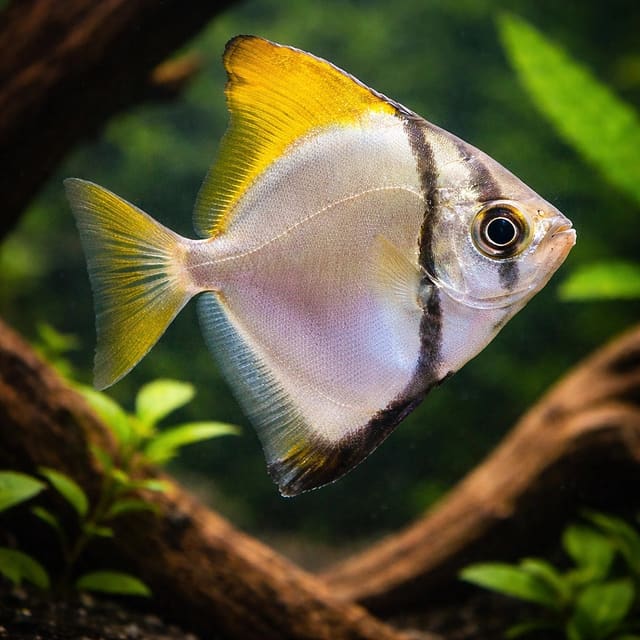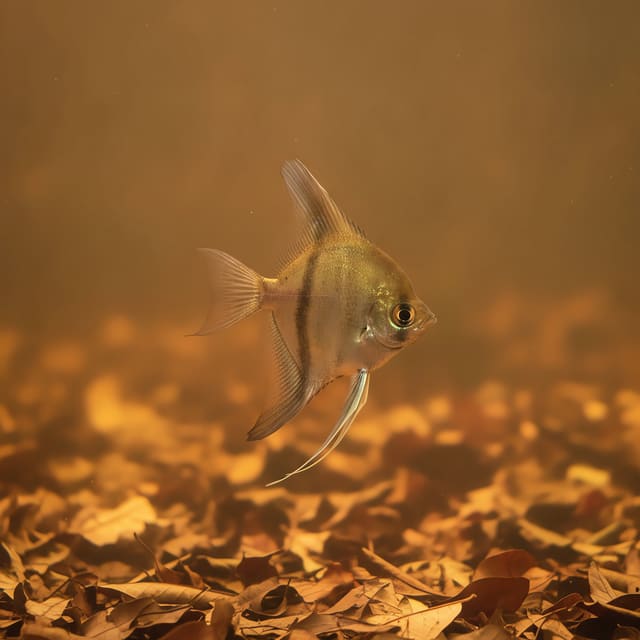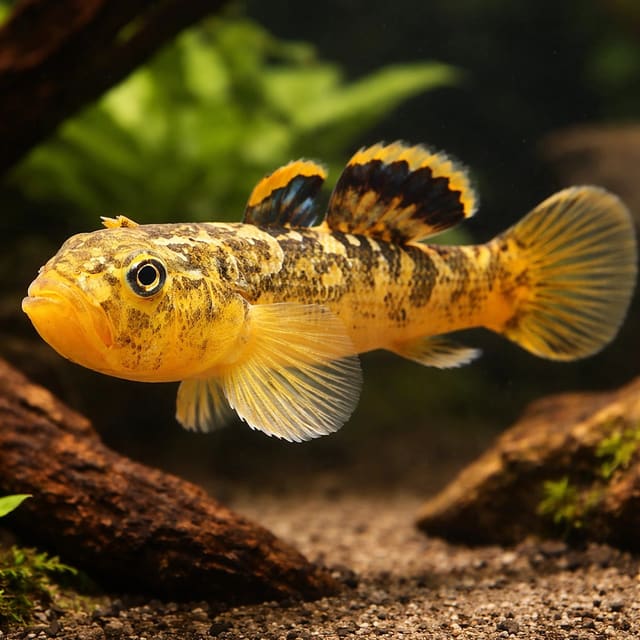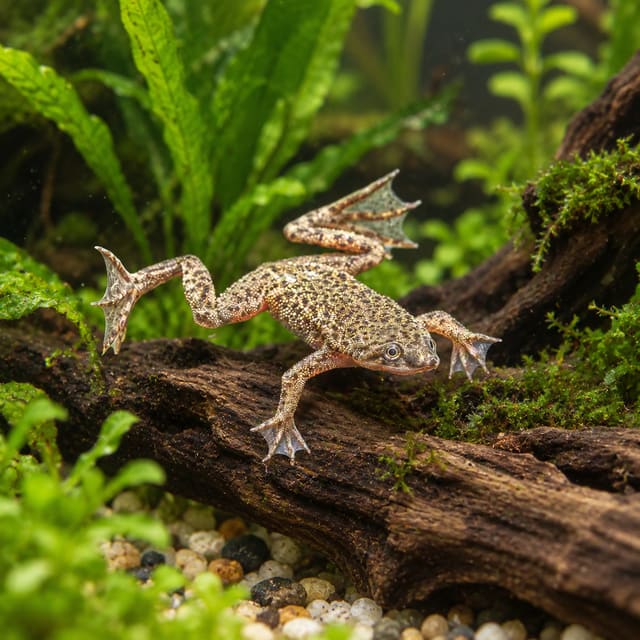
Spotted Scat (Scatophagus argus)
20–28°C
£22.99

The Banded Archerfish (Toxotes jaculatrix) is a surface-feeding fish from Asia and Oceania that reaches 30 cm. It suits advanced brackish keepers: a group of 4 or 5 can mitigate conspecific aggression; FishBase and Seriously Fish overlap at 25–30°C, while Seriously Fish gives pH 7.0–8.0 and 20–30 dGH. Sold individually in 5 cm, 6 - 7 cm and 8 - 9 cm sizes.
Adult size is the maximum length this species reaches at full maturity (scientific sources). The livestock you receive will be younger and smaller — pick a size above for the actual shipping size. Product-photo provenance and any image-specific limitations are stated on the listing.
Toxotes jaculatrix
Save when buying multiple fish. Each quantity is one fish; sex and pair formation are not guaranteed unless the selected variant explicitly states them.
The Banded Archerfish (Toxotes jaculatrix) is a surface-feeding fish from Asia and Oceania that reaches 30 cm. It suits advanced brackish keepers: a group of 4 or 5 can mitigate conspecific aggression; FishBase and Seriously Fish overlap at 25–30°C, while Seriously Fish gives pH 7.0–8.0 and 20–30 dGH. Sold individually in 5 cm, 6 - 7 cm and 8 - 9 cm sizes.
Adult size is the maximum length this species reaches at full maturity (scientific sources). The livestock you receive will be younger and smaller — pick a size above for the actual shipping size. Product-photo provenance and any image-specific limitations are stated on the listing.
Maintain these water conditions for optimal health and vibrant colors
The Banded Archerfish (Toxotes jaculatrix) is a surface-feeding fish from Asia and Oceania that reaches 30 cm. It suits an advanced keeper prepared to run a large brackish aquarium, maintain hard water and plan companions around an adult surface predator. Its specialised feeding behaviour makes it an absorbing display fish, but its size, water requirements and social dynamics rule out a small general community aquarium.
FishBase records a range extending from India eastwards to the Philippines and south through Indonesia to Vanuatu, the Solomon Islands, Papua New Guinea and northern Australia. In nature it occurs primarily in brackish mangrove estuaries, while also entering rivers and small streams. Fish are reported around reefs near overhanging vegetation and usually occur in small aggregations.
This fish is renowned for knocking down insect prey by expelling beads of water from its mouth. FishBase records a shooting range of about 150 cm and describes its ability to compensate for visual refraction when aiming. It feeds at the surface during the day on floating debris containing insects and vegetable matter, so the surface is an important part of both its natural feeding zone and its aquarium layout.
The species is generally peaceful towards suitable companions, although it may eat much smaller fish. Individuals can also be aggressive towards their own kind. Those two points shape the whole plan: provide the adult space first, use brackish water, and choose companions by size, water requirements and behaviour rather than by appearance.
We rate this an advanced fish because an adult needs a 120 × 60 cm base and about 432 litres, with 25–30°C water, pH 7.0–8.0 and hardness of 20–30 dGH. A normal brackish display or a taller planted arrangement can work, but both require mature biological filtration, stable measurements and feeding that reaches the surface. This is a planned specialist aquarium rather than an addition to an ordinary freshwater community.
One purchase supplies one Banded Archerfish. Use the live size selector to choose 5 cm, 6 - 7 cm or 8 - 9 cm. The size you select is the size supplied, not the adult size. Plan the permanent aquarium around the recorded 30 cm adult length rather than using the dispatch measurement as the basis for tank capacity.
Sex is guaranteed only when the selected option explicitly states male or female. This Banded Archerfish listing has no sex-guaranteed option.
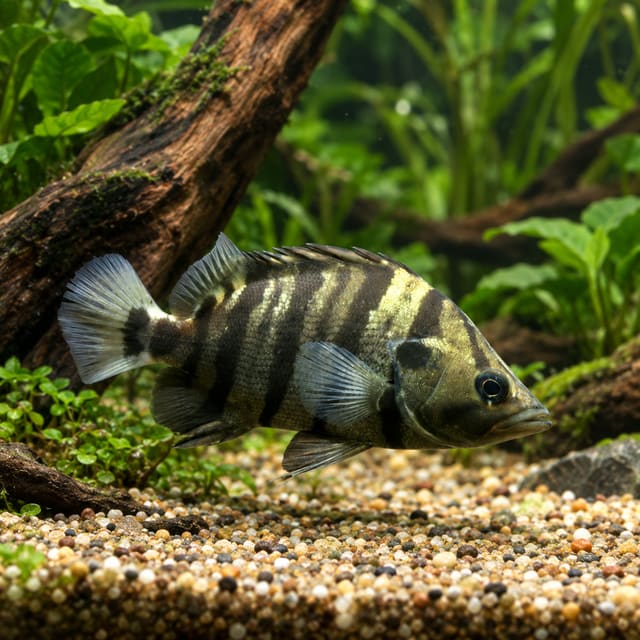
The gallery images are representative, based on reference photographs of this species, so colours can look slightly different from the live animal.
Plan on a 120 × 60 cm base and about 432 litres for an adult. FishBase and Seriously Fish overlap at 25–30°C; Seriously Fish places aquarium pH at 7.0–8.0, with a preference towards the upper end, and hardness at 20–30 dGH. It recommends always keeping the species in a brackish setup, even while the fish are young. If combining members of its own kind, a group of 4 or 5 can mitigate conspecific aggression, but the aquarium still has to be planned around every adult.
| Suits | Not suited to |
|---|---|
| Advanced keepers planning a brackish aquarium | Small general community aquariums |
| A 120 × 60 cm base with about 432 litres for an adult | Aquariums planned around the dispatch size |
| Hard water at 20–30 dGH | Soft-water community plans |
| Groups of 4 or 5 when mitigating conspecific aggression | Casual combinations of a few conspecifics without enough adult space |
| Larger brackish companions after full screening | Plans centred on much smaller fish |
Confirm the aquarium’s internal footprint after allowing for roots, plants and equipment. Decoration adds enrichment but also occupies water and swimming space, so the nominal tank volume alone is not the whole decision. Establish the brackish system, mature its filter and check the measured water before choosing a dispatch size.
Use 30 cm as the adult planning length. Seriously Fish states 30 cm standard length for aquarium planning, while FishBase records a maximum of 30 cm total length. Plan every part of the aquarium around that 30 cm adult.
Provide a base measuring 120 × 60 cm and a volume of about 432 litres for an adult fish. This footprint matters because Banded Archerfish cruise and feed in the upper water. A tall but narrow aquarium does not replace a 120 × 60 cm base, even if its headline volume appears large. Measure the usable base after accounting for internal filter housings, roots and other substantial decor.
For a normal brackish display, combine open upper-water room with mangrove-style roots and brackish-tolerant planting. Seriously Fish also describes a biotope-style alternative: use a tall tank half-filled with water, with dry land and plants above. That design encourages natural feeding behaviour because insects move out over leaves above the water, but the underwater area must still meet the fish’s adult space and water requirements.
Do not use a smaller temporary aquarium as the permanent plan. Larger aquariums are also more stable and less susceptible to changes in temperature and pH than small ones, which is valuable for a fish requiring warm, hard brackish water. Build for the adult at the outset so filtration, decor and companion choices all work together.
Keep Banded Archerfish at 25–30°C, pH 7.0–8.0 and 20–30 dGH in a brackish aquarium. FishBase and Seriously Fish overlap at 25–30°C; the pH and hardness figures come from the Seriously Fish aquarium profile, which notes that the fish prefers the upper end of the stated pH range. Establish those conditions before introducing the fish and measure them rather than judging water by appearance.
| Measurement | Action |
|---|---|
| Temperature | Hold 25–30°C without abrupt movement across the range. |
| pH | Keep 7.0–8.0 and plan towards the upper end. |
| Hardness | Maintain 20–30 dGH. |
| Water type | Run the aquarium as a brackish setup. |
Use the measured source water and the aquarium’s established chemistry to make a repeatable plan. Our water chemistry guide explains the roles of the measurements, while the water matcher helps compare aquarium readings with the target range. A matching temperature does not compensate for unsuitable pH, hardness or water type; check the complete set.
Prepare replacement water before it enters the aquarium. OATA advises treating new tap water to make it safe for fish and matching it to the correct temperature. Make gradual, measured adjustments through the normal maintenance routine instead of repeatedly pushing the aquarium from one end of a range to the other.
A reading inside the target range is useful only when the filtration and maintenance routine can hold it. Record temperature, pH and hardness alongside ammonia and nitrite so a change can be identified early. If a value moves, check equipment, replacement-water preparation and recent stocking or feeding changes before making another adjustment. The goal is warm, hard brackish water that remains predictable between maintenance sessions.
Run a mature biological filter before adding the fish. The RSPCA explains that fish release toxic ammonia, which a working biological filter converts first to nitrite and then to the safer nitrate. Both ammonia and nitrite remain dangerous stages of that process, so equipment movement alone is not proof that the aquarium is ready.
Fill the aquarium, dechlorinate the water and switch on all equipment. OATA’s freshwater aquarium guidance advises allowing 24–48 hours for the setup to settle so the intended temperature is reached and equipment operation can be checked. The biological filter must then mature before fish are introduced. Follow our first aquarium preparation guide to organise that process before the arrival date.
OATA gives 0 mg/L for both ammonia and nitrite as group guidance, not a species-specific optimum. Test both values and pH regularly, with testing at least once a week and more frequent checks while establishing the aquarium or after adding fish. Add livestock gradually because the beneficial bacterial population has to increase as stocking and feeding increase.
For the roughly 432-litre adult aquarium, Seriously Fish recommends turnover of four to five times the aquarium volume per hour. Its worked equipment example uses two filters rated at 865–1080 litres per hour each. Splitting the duty between two units can provide that combined turnover in a 432-litre aquarium, but the final installation must also preserve the slow water movement recommended for the display.
Check filters for blockage and accumulated waste as part of routine maintenance. Do not respond to reduced output merely by increasing flow elsewhere; inspect the equipment and confirm that circulation, biological filtration and oxygen exchange are functioning together. Test the water after a blockage or other filter interruption because clear water can still contain ammonia or nitrite.
Seriously Fish estimates roughly 150–225 W of heating across three heaters for a 432-litre aquarium in a room around 20°C. Use temperature readings from the aquarium to confirm the result, because the care target is the measured 25–30°C range rather than the wattage printed on a heater.
Give the fish a broad, usable surface zone with slow water movement. Seriously Fish describes two suitable styles: a normal brackish aquarium with mangrove roots and brackish-tolerant plants, or a taller biotope-style arrangement that is half-filled with water and has dry land and plants above. Choose between them according to the behaviour you want to observe and the space needed to preserve the 120 × 60 cm underwater footprint.
A tall aquarium that is half-filled with water can provide planted space above the surface. Seriously Fish notes that this arrangement encourages natural feeding behaviour. Crickets or fruit flies introduced into the planted upper area will venture out along the leaves and eventually be shot down and eaten by the fish. Preserve the required underwater footprint and about 432 litres for the adult rather than treating the planted air space as a substitute for water volume.
FishBase places the species around brackish mangrove estuaries, rivers, small streams and areas near overhanging vegetation. That natural context supports the use of roots, plants and a feeding zone beneath foliage. It does not require a crowded recreation of every habitat feature; the practical aim is to combine enrichment with clear swimming room and accessible filtration.
Position the aquarium out of direct sunlight, away from heat sources and draughts, on a flat stand capable of supporting its full weight indefinitely. Keep it away from loud noises, vibration and sudden movement. If you are comparing this fish with other specialist aquarium animals, browse the current loaches and oddballs collection without assuming that animals grouped for browsing share the same water or compatibility requirements.
Use a quality floating dried food as the practical staple, then provide variety with foods that fit the species’ recorded diet. Seriously Fish recommends a quality dried product and freeze-dried bloodworm, and notes that Banded Archerfish accept floating flakes and pellets and will relish frozen bloodworm and brine shrimp. Place food where the fish naturally feeds: at or near the surface.
Wild fish mostly eat terrestrial and aquatic invertebrates, with small fish taken occasionally. FishBase also records surface feeding on floating debris containing insects and vegetable matter. This is therefore not a diet to reduce to a single prey food. Combine a suitable quality dried product with varied invertebrate foods so the feeding plan reflects both the animal component and the broader material taken naturally at the surface.
Frozen bloodworm and brine shrimp add variety alongside the dried staple. Freeze-dried bloodworm adds a further choice. Choose forms that remain accessible in the upper water rather than allowing the entire meal to pass into areas where the fish is not feeding. Remove uneaten material through the normal maintenance routine because leftovers contribute to the ammonia load handled by the biological filter.
In a planted, partially filled biotope, crickets or fruit flies can be introduced into the upper planted area. As the insects venture out along the leaves, the archerfish will eventually shoot them into the water and eat them. This arrangement connects the aquarium layout with the behaviour for which the species is known, but it remains one part of a varied diet rather than the sole food plan.
| Food role | Foods to offer |
|---|---|
| Practical staple | Quality floating dried food, including suitable flakes or pellets |
| Frozen variety | Bloodworm and brine shrimp |
| Freeze-dried variety | Bloodworm |
| Behavioural feeding | Crickets or fruit flies in the planted upper area |
Watch whether food is actually taken at the surface and whether every fish can reach it. A sudden reduction in feeding interest is a health warning: test water quality and compare the fish’s behaviour, breathing, colour and condition with its normal pattern before offering additional food.
Test water quality at least once a week and check the temperature regularly. Keep ammonia and nitrite at 0 mg/L, track pH against the 7.0–8.0 target and monitor hardness against 20–30 dGH. Testing more frequently is useful while establishing the aquarium, after increasing its population or whenever feeding and filter load have changed.
The appropriate water-change size can vary with species, aquarium volume, stocking and other conditions, so use the weekly test results to judge whether the routine is controlling waste. Keep the routine weekly change at up to 25% rather than making larger changes by habit. Consistent preparation and measurement are more useful than reacting to every reading with a major alteration.
| Change observed | First action |
|---|---|
| Hanging at the surface, sitting low or erratic swimming | Test the water and check equipment operation. |
| Darker or paler colour | Compare water readings and recent aquarium changes. |
| Faster or slower gill movement | Check temperature, filtration and water quality promptly. |
| More aggression or hiding | Review stocking, space and interactions. |
| White spots, fluffy growths, or lost fins or scales | Test water quality and seek health guidance. |
| Loss of feeding interest or body condition | Check water first and review what the fish is taking. |
Keep a simple log of readings, maintenance and visible changes. A sequence of measurements shows whether a value is stable or drifting and helps connect a change with filter disruption, heavier feeding or added livestock. If you are concerned about the fish’s health, test the water quality and contact us for further guidance.
Prepare the mature brackish aquarium before the parcel arrives. Check that ammonia and nitrite are 0 mg/L and that temperature, pH and hardness match the established plan. The fish is hand-bagged in pure oxygen, placed in an insulated poly box and packed with a heat pack when the weather calls for it. A licensed live-animal courier carries the parcel.
OATA advises switching off the aquarium lights during introduction and handling the bag carefully away from bright light. It also advises confirming compatibility and suitable aquarium water before release. These preparations reduce the number of changes the fish encounters while moving into its established brackish environment.
The continuous video must begin with the sealed parcel, show it being opened and show the fish inside the sealed bag before anything is disturbed. If there is a Live Arrival Guarantee issue, contact us on the day the fish arrives with the order number and the short unboxing video. Read the current delivery and Live Arrival Guarantee policy before the arrival date.
After release, observe swimming, breathing and colour without adding extra livestock. Continue checking temperature and water quality because the biological filter must adjust whenever the aquarium population and feeding load increase. Keep the normal surface-feeding area clear so the fish can settle into the part of the aquarium it naturally uses.
Banded Archerfish are generally peaceful, but aggression can occur between members of their own species. Seriously Fish states that this can be mitigated by keeping 4 or 5 specimens. Use a group of 4 or 5 when combining conspecifics, and plan the aquarium for the whole group rather than for one adult.
Start with the 30 cm adult length, 120 × 60 cm base and about 432-litre plan for an adult. A group adds multiple adult bodies, feeding demand and biological load. Work out the final aquarium dimensions and filtration for the complete group rather than building around the smallest dispatch fish and postponing the space decision.
The aquarium also needs to hold 25–30°C, pH 7.0–8.0 and 20–30 dGH throughout the usable space. Filter turnover, slow overall flow and an accessible surface-feeding area must work together. A nominally large aquarium is not a suitable group plan if roots, equipment or a narrow footprint leave too little upper-water room.
Observe changes in aggression, hiding, feeding access, body condition, fins and scales. OATA identifies increased aggression, unusual hiding, reduced feeding and fin or scale loss as warning signs that deserve attention. Test the water at the same time because poor water quality can create an additional welfare problem even when an interaction first appears behavioural.
Do not explain persistent aggression by assuming a fish’s sex, rank or life stage. Sex is not guaranteed for this offer, so base every decision on the behaviour you see rather than on guessing which fish are male or female. Base the decision on what is happening in the aquarium: whether fish can use the surface, whether each animal feeds, whether injuries appear and whether the full group has enough adult space.
Before committing to several adult fish, work out the aquarium footprint, usable volume, filtration and proposed stocking together. The useful question is not simply whether four or five can reduce conspecific aggression; it is whether the complete system can support four or five fish reaching 30 cm.
Choose larger brackish companions that share the aquarium’s water conditions and have enough room alongside a 30 cm surface-feeding fish. Seriously Fish names scats, monos and green chromides as larger brackish fish that can be kept with Banded Archerfish. These are potential companion kinds, not universal matches for every aquarium.
| Decision | Animals or rule |
|---|---|
| Potentially suitable | Larger brackish scats, monos and green chromides after matching water and space requirements |
| Caution | Other Banded Archerfish, because conspecific aggression can occur (groups of 4 or 5 can mitigate it); shrimp and other small invertebrates, because they are potential food |
| Avoid | Much smaller fish, and soft-water fish that cannot share hard brackish water |
Decide case by case for any other larger brackish fish. Screen the proposed animal’s adult size, water requirements, use of the aquarium and likely feeding position before combining it with the archerfish. A fish that occupies the same broad water type may still conflict over space or fall outside the 25–30°C, pH 7.0–8.0 and 20–30 dGH plan.
Introduce livestock gradually so the mature filter’s bacterial population can adjust as feeding and waste production increase. Test ammonia and nitrite more frequently after an addition and keep both at 0 mg/L. If behaviour changes, check the water and the interaction rather than assuming one cause.
Keep soft-water fish out of this aquarium, because they do not share its hard brackish water, and treat shrimp and other small invertebrates as potential food for a fish whose wild diet is mostly invertebrates. Keep much smaller fish out of the aquarium altogether, because Banded Archerfish may eat them. For every other proposal, make the compatibility decision from adult size, shared brackish conditions, aquarium capacity and observed behaviour.
It reaches 30 cm. Plan the permanent aquarium around that adult length rather than the 5 cm, 6 - 7 cm or 8 - 9 cm dispatch measurements.
Plan on a 120 × 60 cm base and about 432 litres for an adult. Preserve usable upper-water swimming and feeding space after adding roots, plants and filtration.
A group of 4 or 5 can mitigate aggression between conspecifics. Plan the aquarium and filtration for every 30 cm adult rather than treating the one-fish 432-litre figure as a group capacity.
We rate it advanced because it needs a large mature brackish aquarium, 25–30°C water, pH 7.0–8.0, hardness of 20–30 dGH and careful compatibility planning.
Use a quality floating dried food as the staple, with frozen bloodworm, brine shrimp and freeze-dried bloodworm for variety. In a planted biotope it will also shoot down crickets or fruit flies moving along the leaves above the water.
Keep it at 25–30°C and pH 7.0–8.0, with hardness of 20–30 dGH in a brackish aquarium. FishBase and Seriously Fish overlap at 25–30°C, while the pH and hardness figures come from Seriously Fish.
It is generally peaceful, but it may eat much smaller fish and can be aggressive towards its own kind. A group of 4 or 5 can mitigate conspecific aggression; monitor feeding, hiding, fins, scales and changes in behaviour.
Potential companions include larger brackish fish such as scats, monos and green chromides after matching water, adult space and filtration needs. Avoid much smaller fish because they may be eaten.
Film the sealed parcel before opening or floating the bag, then keep one continuous take through opening and showing the fish in the sealed bag. It is hand-bagged in pure oxygen, insulated and carried by a licensed live-animal courier; float the bag for 20–30 minutes before releasing the fish.
No reviews for this item yet. Bought one? Honest reviews only, good or bad.
What customers say about ordering from us
I have a small group of long finned mountain minnows. So was delighted to be able to order ten of this variety to increase the genetics in my tank . The ones I recieved are healthy but it’s to early to give a verdict on wether they are of a long finned type since they are small currently.
Gordon Walker · 23 Sept 2026
100% success travel and "installation". Pleased with quality of purchase. The Siamese fighter a bit "shy" so have not yet seen him at his best yet but looking good. Happy customer. GG
George E Garratt · 21 Sept 2026
Reviews of our shop, collected by Judge.me, an independent third-party review collector. Newest first.