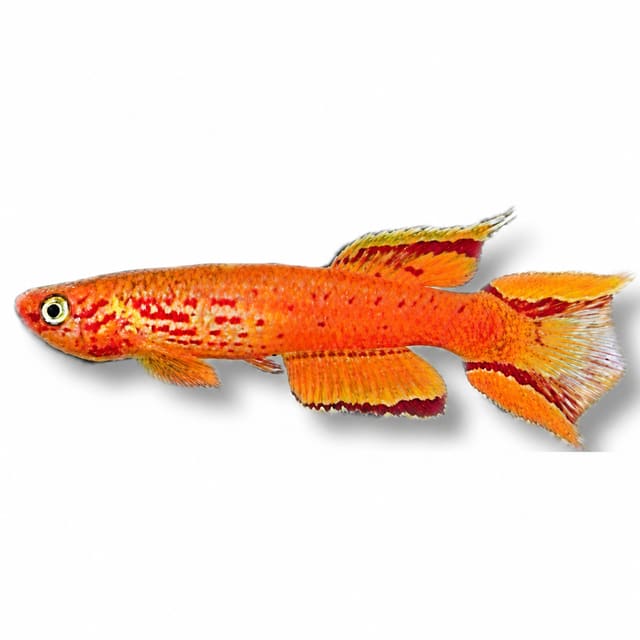
Gold Gardneri Killifish (Fundulopanchax gardneri)
20–26°C · pH 6–7.5
£9.99

A colourful Cameroon killifish supplied around 3-4 cm, best in a covered, dim planted aquarium with calm tank mates and small live or frozen foods.
Adult size is the maximum length this species reaches at full maturity (scientific sources). The livestock you receive will be younger and smaller. Product-photo provenance and any image-specific limitations are stated on the listing.
Fundulopanchax cinnamomeus
Save when buying multiple fish. Each quantity is one fish; sex and pair formation are not guaranteed unless the selected variant explicitly states them.
Confirm your email, then we’ll send an availability message for this exact item if it returns within 180 days.
This request is only for this product—no newsletter or other promotions. A mail-provider retry may very rarely duplicate the same availability message. Unconfirmed addresses are removed after 48 hours. See our privacy policy.
A colourful Cameroon killifish supplied around 3-4 cm, best in a covered, dim planted aquarium with calm tank mates and small live or frozen foods.
Adult size is the maximum length this species reaches at full maturity (scientific sources). The livestock you receive will be younger and smaller. Product-photo provenance and any image-specific limitations are stated on the listing.
Maintain these water conditions for optimal health and vibrant colors
The Cinnamon Killie is the aquarium trade name for Fundulopanchax cinnamomeus, a Cameroon killifish still often sold under its older synonym Aphyosemion cinnamomeum. The fish we supply are around 3-4 cm, so they are still compact, but this is not a tiny 3.5 cm species when fully grown: source records put mature males around 5-6 cm, with large, rounded fins and a deeper body than many small Aphyosemion types. It is a beautiful choice for keepers who enjoy specialist West African killifish, planted aquariums, quiet behaviour and careful observation rather than a busy mixed community display.
Expect a fish with warm cinnamon body colour, blue-dark shading towards the tail, gold to orange fin edging and a shy but rewarding nature when kept in the right surroundings.
Fundulopanchax cinnamomeus is recorded from western Cameroon, especially the upper Mungo drainage and plateau areas around Badouma, Kumba and nearby localities. FishBase describes it from brooks under forest cover, including basement-complex and volcanic soils, while AKA/WAK notes rainforest brooks and streams over volcanic rock with high rainfall. This is why a calm planted aquarium suits it better than a bright, open tank with strong flow.
The old name Aphyosemion cinnamomeum is still useful because suppliers, older books and hobbyists may use it. The accepted modern placement used on FishBase and specialist killifish sources is Fundulopanchax cinnamomeus. Keeping both names in the listing helps buyers recognise the fish without making the older name the main identity.
Males are the show fish. The body can carry a warm cinnamon sheen with darker blue-black shading towards the back and caudal peduncle, and the rounded anal and caudal fins often show gold, yellow, orange or red margins. The pectoral fins can also glow golden orange. Females are smaller and quieter in colour, usually olive to grey-brown with paler fins. The exact pattern depends on population and age, so young fish may look understated at first. Give them cover, good food and time, and the colour develops much more convincingly.
Use a secure lid. This is non-negotiable with killifish because even small gaps can be enough for a jump. A pair or trio can be kept in a well-planted aquarium from around 45 litres, while a group needs more space and more visual breaks. Dark sand or fine gravel, Java moss, Microsorum, Cryptocoryne, floating plants and spawning mops all help the fish feel settled. A few dried leaves or pieces of wood can add cover and tannins, but keep the water clean and oxygenated.
Filtration should be gentle. Strong current makes these fish work too hard and keeps them out of display. Keep lighting subdued or filtered through floating plants; Aquarium Glaser specifically notes that overly bright tanks can leave the fish shy and duller in colour. Stable maintenance is more important than heavy-handed adjustment. Weekly partial water changes, careful feeding and low waste levels will do far more for this species than dramatic parameter swings.
Cinnamon Killies are carnivorous micro-predators. Offer small live and frozen foods such as daphnia, mosquito larvae, baby brine shrimp, grindal worms, white worms, microworms and finely chopped bloodworm. Some individuals will learn to take quality micro pellets or soft small foods, but live and frozen foods bring out better colour, condition and breeding behaviour. Feed modest portions once or twice daily and remove leftovers. They are not built to compete with fast community fish at feeding time.
This is a specialist fish, not a general community workhorse. The safest display is a species setup or a very calm planted tank with small, peaceful fish that do not rush the food. Avoid fin nippers, larger predators, aggressive dwarf cichlids, boisterous barbs, fast tetras, large livebearers and any fish that needs hard, alkaline water. Males can be territorial, especially with similar killifish, so use plants and mops to break sight lines and watch the group dynamic. Females also benefit from rest periods if breeding pressure is high.
If you want colour and movement in a busy community aquarium, choose a more outgoing species. If you want a quieter planted tank where subtle behaviour matters, Cinnamon Killies can be deeply rewarding.
This species is not an annual killifish. It is better treated as a non-annual or switch-spawning Fundulopanchax that often places eggs low in the tank, in peat fibre, dark mops or dense plant material. BKA and AKA/WAK notes both point to bottom or low-level spawning, adhesive eggs and incubation in the range of several weeks. BKA gives 4-5 weeks for incubation, while AKA/WAK reports water-stored eggs around 3-4 weeks and dry storage as more variable. Killi.co.uk breeder reports include both peat and mop methods, with successful keepers reporting 20-23°C.
For practical home breeding, condition a compatible pair or trio with small live foods, provide dark mops or peat fibre, collect eggs gently, and keep notes on water, temperature and hatch results. Fry can take newly hatched brine shrimp or microworms as first foods once they are ready. Do not expect every early egg to be fertile; specialist sources note that the fish can mature late, and young pairs may need time.
Choose Cinnamon Killies if you want a characterful small predator for a quiet planted tank, especially if you already enjoy feeding live or frozen foods and watching subtle courtship behaviour. They suit keepers who are happy to maintain clean water, use a lid, and let the aquarium look a little natural with plants, mops, wood and leaf litter. They are less suitable for a first tank full of fast schooling fish, or for anyone who wants one brightly lit display where every fish competes at the glass.
When the fish arrive, keep the lights low and acclimate them patiently into a mature aquarium. Do not add them to a new, unstable tank. For the first few days, offer tiny portions of easy foods such as daphnia, baby brine shrimp or finely chopped frozen foods, then increase variety once they are feeding confidently. Watch the females in pairs or trios; if a male is pressing too hard, add cover, split the group or give females a rest. A calm routine is the best way to see full colour and relaxed behaviour.
Livestock orders are packed for safe live-animal transport and sent on an appropriate overnight courier service when weather and route conditions are suitable. The checkout will show the available service for your order. Our Live Arrival Guarantee applies when the delivery conditions are followed, and first-time customers can use WELCOME10 at checkout. If the weather is unsuitable, we would rather delay dispatch than risk the fish.
Care notes were checked against FishBase for accepted taxonomy, range, pH, temperature, adult size and conservation status; AKA/WAK for synonym history, Cameroon locality detail, habitat and breeding notes; the British Killifish Association for appearance, feeding, maturity and spawning guidance; Killi.co.uk breeder reports for spawning methods and temperatures; and Aquarium Glaser for aquarium temperature, lighting, feeding and non-annual notes.
No reviews for this item yet. Bought one? Honest reviews only, good or bad.
What customers say about ordering from us
I have a small group of long finned mountain minnows. So was delighted to be able to order ten of this variety to increase the genetics in my tank . The ones I recieved are healthy but it’s to early to give a verdict on wether they are of a long finned type since they are small currently.
Gordon Walker · 23 Sept 2026
100% success travel and "installation". Pleased with quality of purchase. The Siamese fighter a bit "shy" so have not yet seen him at his best yet but looking good. Happy customer. GG
George E Garratt · 21 Sept 2026
Reviews of our shop, collected by Judge.me, an independent third-party review collector. Newest first.