By Tropical Fish Co Editorial Team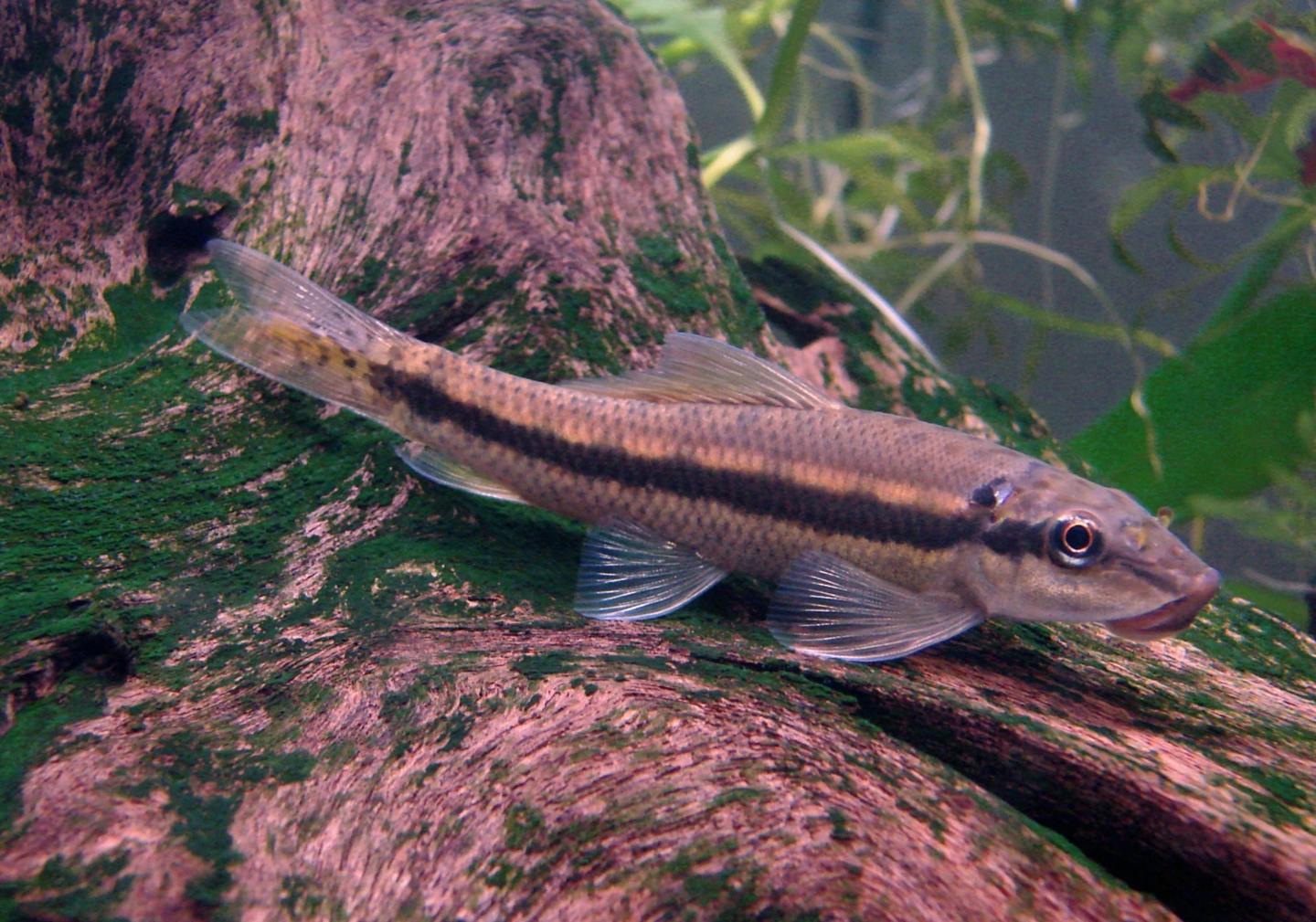
The decision before the algae claim
A Chinese algae eater is a large river fish with a specialised sucker mouth—not an aquarium-cleaning tool. FishBase records 28 cm maximum standard length, which excludes the tail fin, and describes adults as territorial [2]. Those two facts should decide the purchase before the word “algae” does.
The scientific diet record includes algae, periphyton and phytoplankton, but also insect larvae and zooplankton [2][5]. A current UK specialist profile adds a practical warning: adults may become less interested in algae and more troublesome with other fish [6]. That is specialist experience, not proof that every adult stops grazing. The responsible conclusion is simpler: buy this species only because you want to keep this species, never because you expect it to maintain the aquarium for you.
- Identity: the label or seller confirms Gyrinocheilus aymonieri
- Adult space: at least a 120 × 45 cm base and about 240 litres for one fish under our precautionary screen
- Community: no slow, long-finned or similar-looking fish, plus a real separation option
- Environment: mature filtration, stable 25–28°C water and strong oxygenation without pinning fish in excessive flow
- Expectation: supplementary feeding and normal algae maintenance continue; the fish is not the maintenance plan
If every screen above passes, view current algae-eater availability. That collection owns changing stock; this guide cannot promise that a Chinese algae eater is present. Confirm the scientific name, colour form, sale size and price on the exact product page before ordering.
What the name hides
The current Catalog of Fishes accepts Gyrinocheilus aymonieri in the family Gyrinocheilidae. Tirant originally described it as Psilorhynchus aymonieri; the modern combination is not a pleco and the familiar “sucking loach” label does not make it a true loach [1].
Its natural range is Southeast Asian, including river systems in Cambodia, Laos, Thailand, Vietnam, Malaysia and Yunnan in China. FishBase places adults on solid surfaces in flowing water in medium to large rivers and flooded fields [2]. So “Chinese” is a long-established common name, not a complete distribution statement.
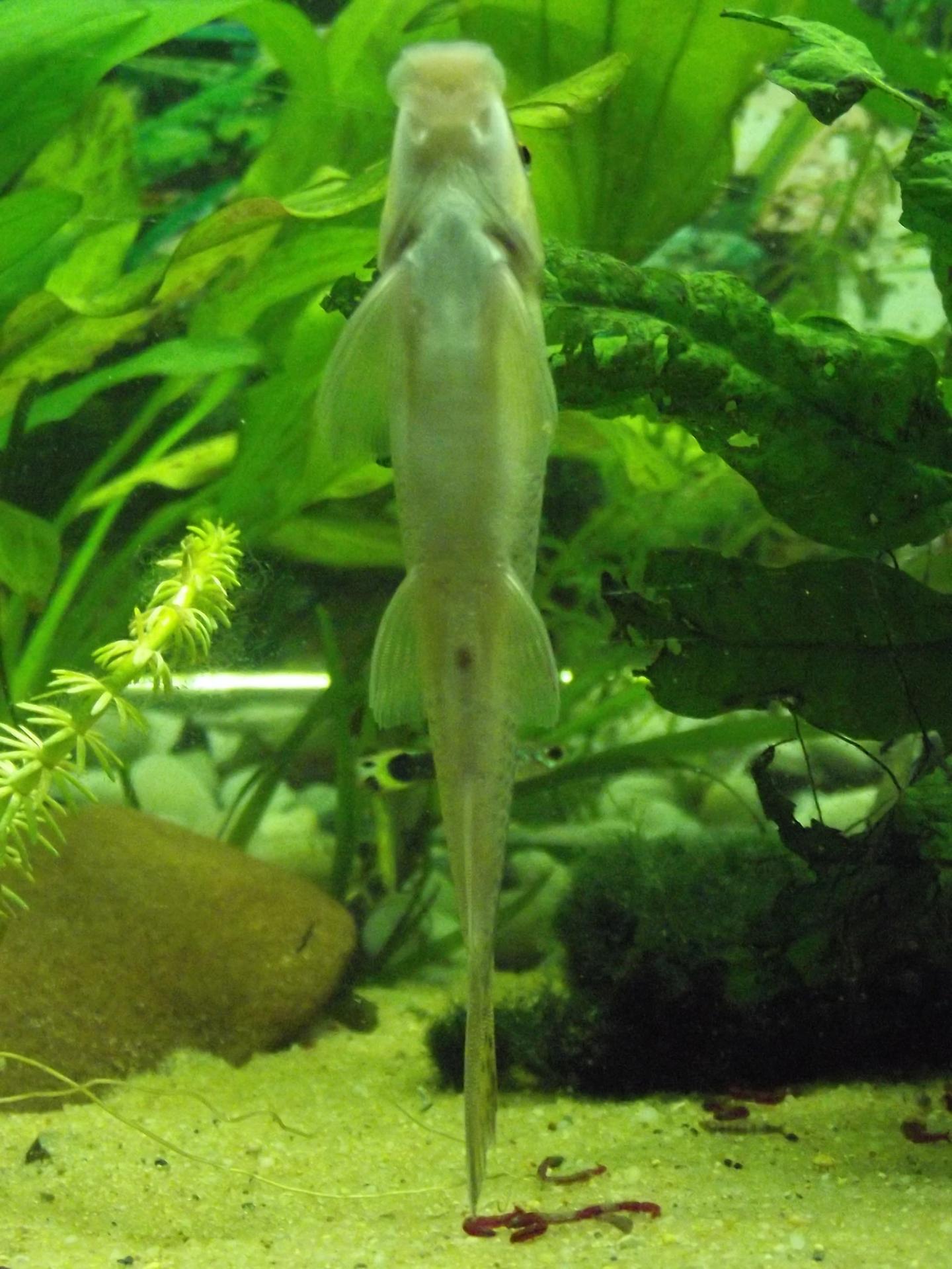
The mouth is the genuinely remarkable part. Anatomical work on young and mature fish found flexible supporting tissue and hooked rasping surfaces that help the fish attach and scrape encrusting algae [4]. The recent genome paper likewise describes the sucker-like oral structure as an adaptation to fast-flowing habitat [3]. FishBase notes that a small opening near the gill cover permits water flow for respiration while the mouth is attached [2].
That adaptation explains what the fish is built to do. It does not prove that an individual photographed on glass is feeding, healthy, fully grown or suitable for a particular aquarium.
Chinese algae eater size and our housing screen
The strongest size answer is 28 cm standard length, not a guessed aquarium average [2]. Standard length stops at the base of the tail. It is therefore different from the tip-to-tip number many shoppers picture when they read “28 cm”.
No selected scientific source tests a universal domestic tank minimum for this species. FishBase carries a much smaller aquarium convention, while the current UK specialist profile says only that housing should be spacious. Repeating one small number as settled science would be misleading for a fish of this length.
Tropical Fish Co therefore uses a precautionary one-fish buying screen of at least a 120 × 45 cm base and roughly 240 litres gross volume. A longer and larger aquarium is preferable when other fish share the space. This is our welfare policy derived from the verified adult size and territorial-risk record; it is not a legal threshold, a guarantee of compatibility, or permission to add an arbitrary number of tank mates.
Before purchase, check the clear internal dimensions rather than the model name, leave open turning space, and plan around the adult—not the 4–7 cm sale size. A large filter does not replace swimming footprint, and an empty volume number does not describe décor, territories or the space displaced by hardscape.
Do Chinese algae eaters stop eating algae?
The old version of this guide said adults stop eating algae. The available evidence does not support that absolute claim.
FishBase's food-item record includes benthic algae and periphyton for juvenile and adult stages, while the Mekong basin guide describes a broader omnivorous diet [2][5]. The UK specialist profile reports that adults can become less interested in grazing and recommends algae wafers, sinking foods, vegetables and animal-based frozen foods [6].
Use those sources together:
- provide a complete, varied diet rather than expecting aquarium growth to feed the fish;
- treat visible grazing as behaviour, not proof that the aquarium is nutritionally complete;
- remove excess algae by correcting light, nutrients and maintenance rather than adding animals indefinitely;
- watch the fish actually obtain food, especially in a busy community.
If algae control is your original goal, start with the cause and then choose an animal only if its full adult care fits. Our aquarium algae guide sets out that maintenance-first approach. The Otocinclus guide, Bristlenose pleco guide and Siamese algae eater guide explain different animals; none is a universal or maintenance-free substitute.
Aggression and tank mates: use a risk screen, not a safe list
FishBase describes adult Chinese algae eaters as territorial. The current UK specialist profile reports harassment of slow-moving or long-finned fish, attachment that can cause damage, and conflict with similar-looking animals [2][6].
That does not mean every juvenile will attack every tank mate. It does mean a peaceful shop-sized fish cannot be sold as a lifetime behaviour guarantee. Compatibility needs five checks:
| Check | Question before purchase | Stop signal |
|---|---|---|
| Adult size | Can every fish turn, feed and retreat at adult size? | The plan only works while the CAE is small |
| Water | Do all species overlap at one stable measured temperature and chemistry? | “Tolerates” is doing all the work |
| Shape and speed | Can a tank mate avoid attachment and reach food? | Slow, long-finned or broad-sided fish |
| Territory | Are there sight breaks without removing swimming space? | One fish can control every feeding area |
| Separation | Is a cycled alternative ready immediately? | Rehoming is the only emergency plan |
Do not use a list of tetras, corydoras, goldfish or cichlids as a safety promise. Robust, fast-swimming fish are the lower-risk direction in the specialist record, but individual behaviour and layout still matter. Similar-looking bottom fish can also become territorial targets. Observe feeding and resting periods, and separate at the first repeated chasing, attachment, injury or loss of feeding access.
FishBase records group housing of five or more, while the UK specialist source advises either one fish or a genuinely large group and specifically warns that two or three can concentrate harassment. These are aquarium conventions, not a controlled group-size trial. A group of fish capable of 28 cm standard length requires specialist-scale space; do not turn conflicting guidance into a small group in a normal community aquarium.
Chinese vs Siamese algae eater
The common names are similar enough to create buying errors. The scientific names are the safer starting point.
| Identification boundary | Chinese algae eater | “Siamese algae eater” |
|---|---|---|
| Name to verify | Gyrinocheilus aymonieri | Often Crossocheilus; exact species must be stated |
| Current family record | Gyrinocheilidae | Crossocheilus oblongus is Cyprinidae |
| Mouth | Specialised ventral attachment disc | Do not identify from this page alone |
| Verified maximum on this page | 28 cm standard length | Check the exact Crossocheilus species source |
| Safe buying rule | Match the exact fish to adult housing | Reject an “algae eater” label without a scientific name |
The Catalog of Fishes treats Crossocheilus oblongus as a valid cyprinid species, separate from Gyrinocheilus aymonieri [7]. However, multiple Crossocheilus names appear in the aquarium trade, so this is not permission to identify any striped shop fish as C. oblongus. Ask the seller for the scientific name and compare the actual animal with a reliable key.
The claim that one named fish is “the only” animal that eats black beard algae has also been removed. Algae consumption varies with species, individual, diet and conditions, and no selected source proves that exclusivity.
Water, flow and feeding
FishBase publishes 25–28°C, pH 6.0–8.0 and 5–19 dH for the species [2]. These are ranges from a compiled species record, not instructions to chase a different number every day.
Set one stable temperature inside the range, confirm it with an independent thermometer, and test the aquarium rather than judging water by clarity. UK source water varies locally; the Drinking Water Inspectorate recommends asking the local water company for an accurate hardness measurement because regional maps hide local variation [10]. Supplier data is useful context, but the aquarium itself still needs testing after substrate, rocks, treatments and biological activity have affected it.
Provide mature biological filtration, oxygenation and water movement. Arrange flow so the fish can choose faster and calmer areas rather than being forced to fight one high-output jet. Use smooth rocks and wood for grazing surfaces while retaining open turning room. Secure equipment and décor against a strong adult.
For food, rotate a plant-rich sinking staple with suitable vegetables and modest animal-based foods consistent with the mixed natural diet. Remove leftovers and adjust the ration from body condition and observed feeding—not from the amount of algae visible on the glass.
Golden Chinese algae eater care is not smaller-fish care
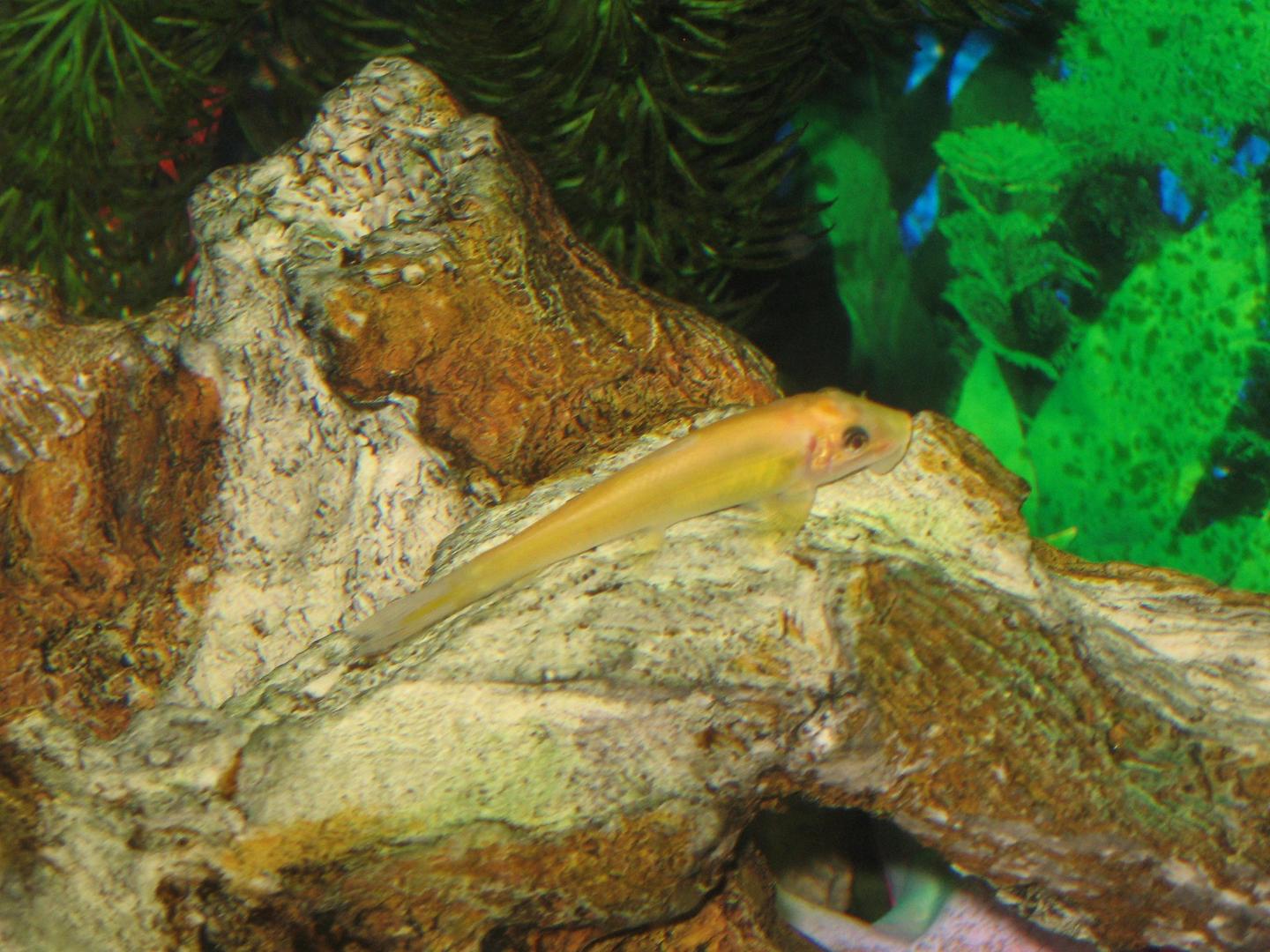
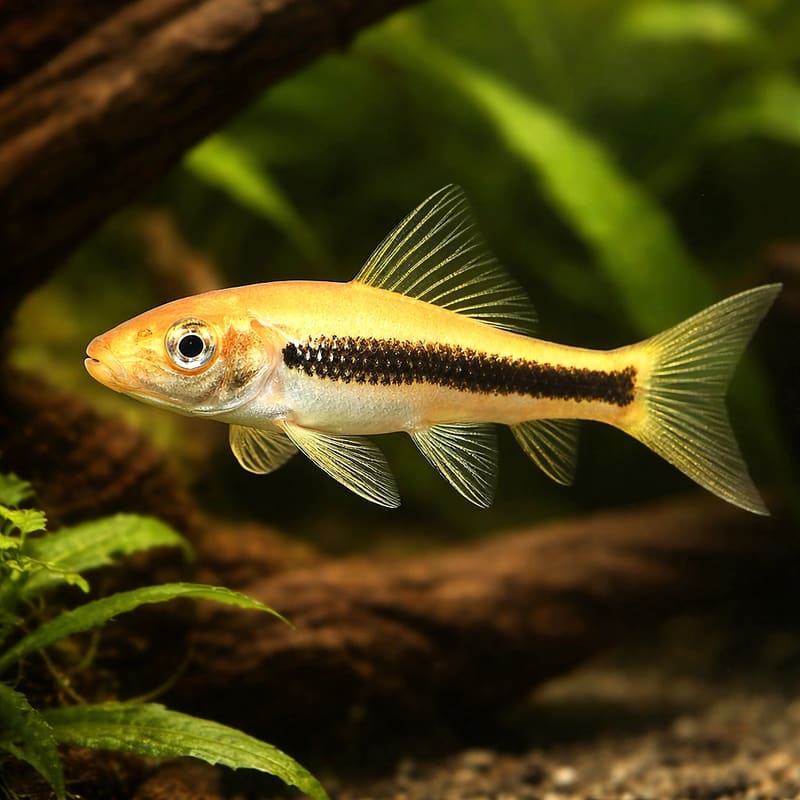
Golden fish are a colour variety of the same species in the selected UK specialist profile [6]. The colour does not make the fish a dwarf, prove that it is albino, or establish sex. The same 28 cm species maximum, territorial-risk screen and housing policy apply.
This matters because a bright 4 cm fish can look like a small permanent feature for a community aquarium. Treat that size as a current sale measurement only. Confirm which colour form the exact product represents and do not infer adult colour from one photograph taken under different lighting.
Current Chinese algae eater listings
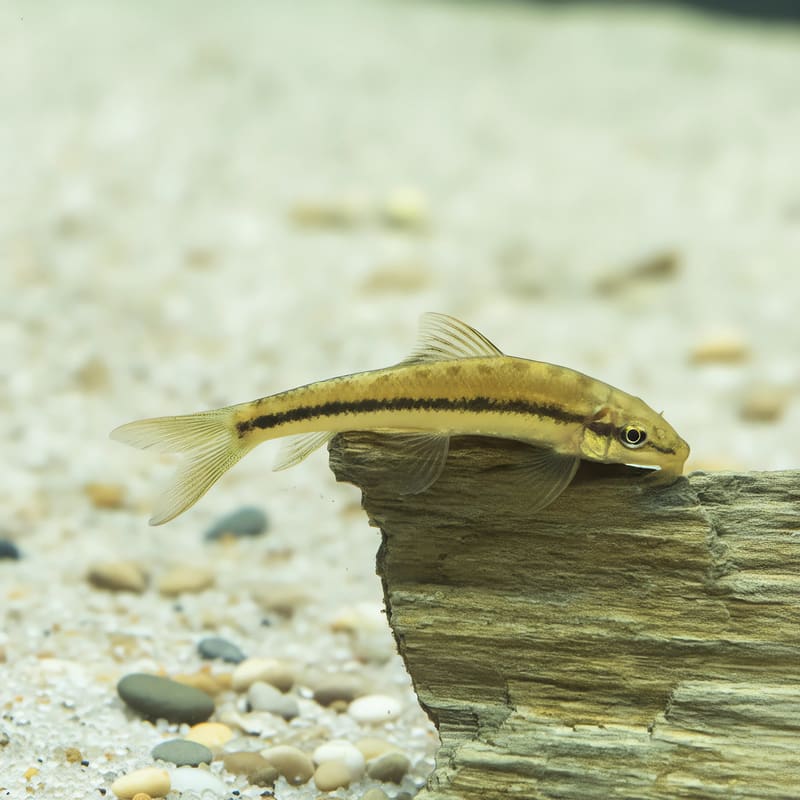
The cards below resolve the current catalogue and only appear when a product has confirmed availability, a positive price and a usable image. They do not override the adult-size, housing or compatibility checks above. Product pages own the live price, sale size, colour description and availability.
Current Chinese algae eater listings
Confirm the exact colour form, sale size, current water and adult housing before ordering. A small sale size does not change the 28 cm species record.
If none appears, browse the current algae-eater collection rather than treating an old article sentence as a stock promise.
Arrival and health: follow the shipment, not a universal timer
Prepare the mature aquarium and separation option before dispatch. RSPCA guidance supports fishless cycling, zero ammonia and nitrite, thermostatic heating and independent temperature checks [8]. OATA similarly stresses a cycled aquarium and regular water testing [9].
On delivery, follow the current instructions supplied for that shipment. Packing method, journey time and source water can change what is appropriate. The RSPCA's general route is to dim the lights, temperature-match the closed bag, net-transfer the fish and discard transport water [8]. This page deliberately does not prescribe one drip rate, a universal 40-minute timer or an automatic 24-hour fast.
For a fish that hides, refuses food, breathes unusually, develops marks or is repeatedly harassed, test water and review the whole system first. Do not diagnose a parasite from one sign or add medicines “just in case”. The MSD Veterinary Manual stresses water-quality review, history, quarantine and diagnosis before targeted treatment [11]. Persistent or severe signs need a fish-experienced veterinary professional.
The accurate buying conclusion
A Chinese algae eater can be kept intentionally in suitable adult housing. It is not a beginner cleaning shortcut, a guaranteed community fish or a species whose adult needs can be read from its sale size.
Verify Gyrinocheilus aymonieri, plan around the 28 cm standard-length record, use the 120 × 45 cm / roughly 240-litre one-fish screen as a minimum store policy rather than a target to crowd, and retain a separation plan. If those conditions are uncomfortable, choose a different fish and address the aquarium's algae at source. That decision is better for the keeper, the community and the fish.