−13%
Moderate
Ocellated Shell-Dweller (Lamprologus ocellatus)
23–27°C · pH 7.5–9 · 40L
£16.52£18.99
Specialist Lake Tanganyika sand cichlid for a mature 300L+, 130-150cm aquarium and a group of eight or more. Size only; sex, bond and exact colour are not guaranteed.
Xenotilapia ochrogenys
Save when buying more.
Confirm your email, then we’ll send an availability message for this exact item if it returns within 180 days.
This request is only for this product—no newsletter or other promotions. A mail-provider retry may very rarely duplicate the same availability message. Unconfirmed addresses are removed after 48 hours. See our privacy policy.
Specialist Lake Tanganyika sand cichlid for a mature 300L+, 130-150cm aquarium and a group of eight or more. Size only; sex, bond and exact colour are not guaranteed.
Maintain these water conditions for optimal health and vibrant colors
Xenotilapia ochrogenys 'Karilani' is a specialist Lake Tanganyika sand cichlid for aquarists who value natural behaviour as much as colour. Adults move in loose schools over open sand, picking and sifting for tiny invertebrates. Mature males can develop a bright ochre face, blue-white flank spots and orange-edged fins, while females and juveniles are usually much quieter in colour. The fish offered here carry the Karilani locality trade label . That identifies the intended form, but the supplier does not document collection generation, sex or the individual fish shown, so none of those details is guaranteed.
This is not a general community fish, a nano cichlid or an easy addition to a mixed Malawi aquarium. It needs a mature, hard and alkaline system with a long bed of fine sand, excellent oxygenation and calm companions that will not occupy the same feeding space. A serious long-term plan starts at about 300 litres and 130-150cm tank length for a group of eight or more. With that space, the group can forage, display and disperse social pressure instead of crowding one another into the corners.
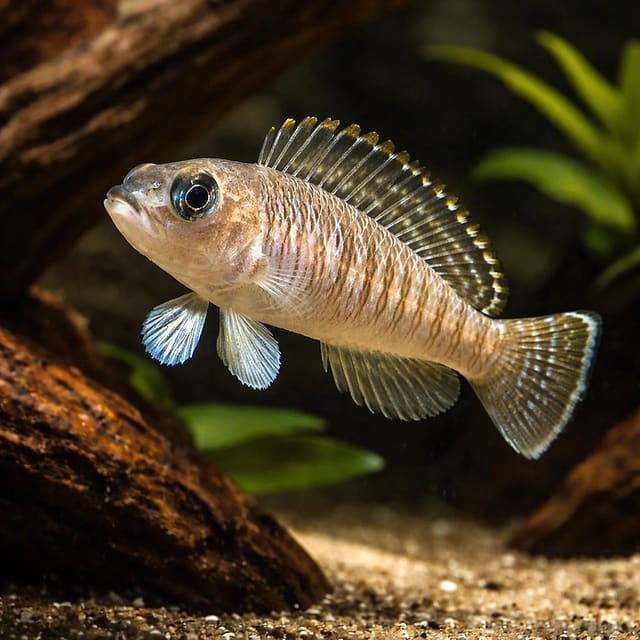
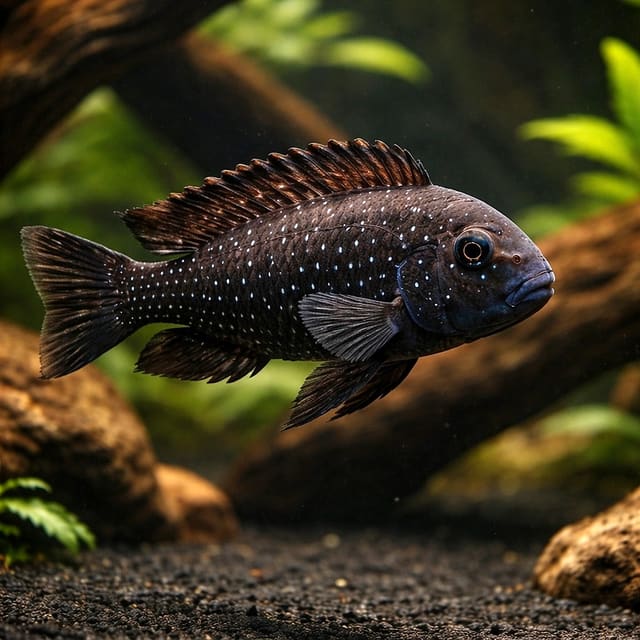
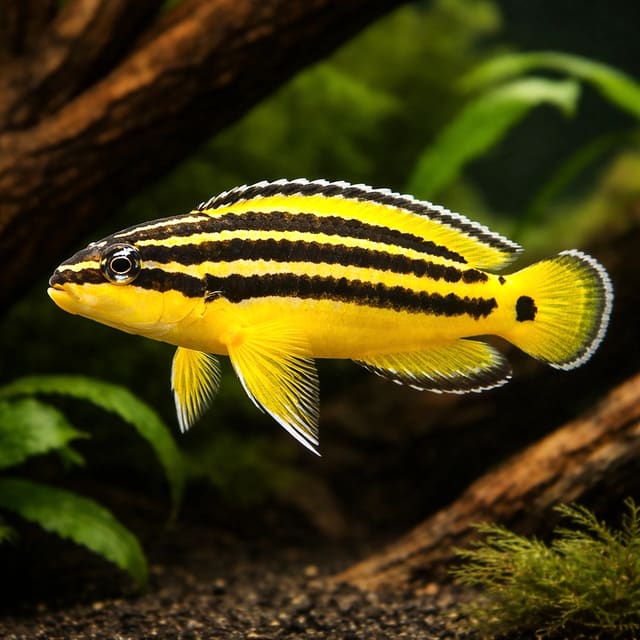
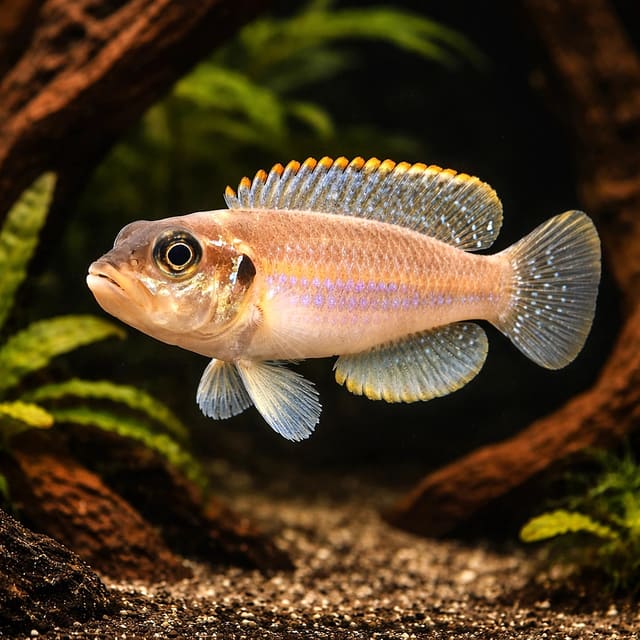
The four gallery images are illustrative derivatives based on one reference photograph, not photographs of the fish currently available for dispatch. They are useful for showing the expected long-bodied sand-cichlid form, but colour, sex, fin shape and markings can differ. The planted and driftwood scenes are visual compositions, not recommended Karilani aquarium layouts.
Xenotilapia ochrogenys is a member of the cichlid tribe Ectodini, a Lake Tanganyika lineage containing highly specialised sand and rock-associated fishes. The species name remains valid in the June 2026 edition of Eschmeyer's Catalog of Fishes and in FishBase. 'Karilani' is not part of the scientific name. It is a locality label used in the aquarium trade for fish associated with Karilani Island on the Tanzanian side of the lake.
Keeping the locality word matters because geographically separated Tanganyika populations can differ in adult male colour and display. It should not, however, be treated as proof that a particular retail fish is wild-caught at Karilani Island. This line is supplied as Xenotilapia ochrogenys Karilani and provides a reference image, but no collection certificate or generation record accompanies these variants. This page therefore preserves the supplier identity without inventing provenance.
The current trade also includes fish once grouped broadly under the ochrogenys name but now discussed as Xenotilapia singularis. The latter is recognised as valid by Catalog of Fishes and is associated with southern populations and prominent dark flank blotches in mature males. Karilani lies within the northern range commonly assigned to X. ochrogenys, so the supplier's species label is plausible and retained. The distinction is worth mentioning because older books, dealer lists and search results can use the names differently.
| Name on this page | What it means | What is guaranteed |
|---|---|---|
| Xenotilapia ochrogenys | Current species identification used by the supplier and major fish databases | The product is sold under this identity |
| 'Karilani' | A locality-form trade label associated with Karilani Island | The supplied trade label, not a collection certificate |
| Sand cichlid | A useful husbandry description of its habitat and feeding style | It needs open, fine sand in the aquarium |
| Pair pricing | A retail quantity format shown by the site | It does not promise one male, one female or a bonded breeding pair |
The species is endemic to Lake Tanganyika. FishBase records adults over sandy bottoms and notes that they form schools. Specialist locality accounts place the Karilani form in northern populations living in sheltered sandy areas, often at relatively shallow to moderate depth, with some sites extending deeper. This open-bottom habitat explains nearly every important aquarium requirement: a long footprint, a fine substrate, low competition near the bottom and stable water chemistry.
Lake Tanganyika is chemically and physically different from a typical planted community aquarium. Its water is alkaline and mineral-rich, and conditions in the lake change far less abruptly than they can in a small glass tank. Karilani fish have evolved in that stability. A keeper does not need to chase an exact lake chemistry number, but must prevent rapid changes in pH, temperature, dissolved waste and oxygen. Stable values inside a sensible hard-water range are more valuable than repeated chemical corrections.
The fish search the sand rather than waiting in a cave. They take small food items at or just above the substrate and reject unwanted particles through the mouth and gills. Sharp gravel, coarse crushed material and a floor buried under rockwork interfere with this behaviour. Open sand is not decorative spare space; it is the fish's feeding ground, social arena and refuge route.
Adult X. ochrogenys are slim, laterally compressed cichlids with a pointed head, large eyes and extended dorsal and anal fins. FishBase gives a maximum of 11cm total length, while locality-focused aquarium accounts describe males at about 12cm and females slightly smaller. Planning around 11-12cm avoids pretending that every fish will stop at one exact number.
Colour is strongly dependent on sex, maturity, social state and location. A displaying Karilani male may show luminous blue-white spots along the body, warm yellow or orange fin margins and the ochre facial colour referenced by the species name. A juvenile at 3-4cm will not look like a dominant adult male. Females can remain silver-beige with restrained markings, and subordinate males may suppress much of their display colour.
The offered size grades are not reliable sexing options. Choosing the largest grade may provide a more developed fish, but it does not confirm sex or future dominance. The safest route to a natural social structure is a group of juveniles or subadults allowed to mature together. If the storefront presents a pair purchase, read that as two fish of the selected grade, not as a proven reproductive pair.
Buy this species for its open-sand behaviour and adult potential, not for a guaranteed copy of one gallery image. A calm group in the correct environment is far more likely to develop good colour than an isolated fish purchased only for appearance.
The gallery has been kept intact. All four 1024px images use the same long-bodied, spotted Karilani-style fish and are derived from the reference photo rather than photographed from current stock. Their consistency makes them helpful for broad recognition, but it also means they should not be read as four independent examples of natural variation.
The image showing two fish does not establish that the supplied pair will be sexed, bonded or visually matched. The isolated blue-background view is an illustrative side profile, not a scientific plate. The planted scenes overstate the role of vegetation, and the driftwood scene is not a chemistry recommendation: large amounts of tannin-releasing wood are unnecessary in a Tanganyika setup.
| Gallery view | Useful for | Do not infer |
|---|---|---|
| Single fish over sand and wood | General body shape and sand-oriented posture | That driftwood is required or the exact fish is in stock |
| Two fish over sand | Illustrating a social presentation | A sexed pair, pair bond or matching colour |
| Clean side profile | Viewing the elongated body and fin outline | A diagnostic specimen photograph |
| Fish beside a plant | Scale and colour contrast | That dense planting replaces open sand |
The former 200-litre recommendation did not give enough attention to footprint or group behaviour. For long-term care, use approximately 300 litres or more and 130-150cm of tank length. Width matters too: a broad front-to-back dimension creates usable sand, lets displays happen without trapping other fish and allows visual breaks around the edges. A tall but narrow 300-litre aquarium is less suitable than a lower, longer tank of similar volume.
Why so much room for an 11-12cm fish? The answer is social geometry. X. ochrogenys forms schools outside breeding activity, while mature males need room to display and establish temporary spawning areas. In a short tank, one confident fish can control the whole floor. In a long tank, subordinates can move away, keep feeding and rejoin the group. Water volume also buffers the chemistry changes that stress Tanganyika specialists.
A 200-litre tank may hold juveniles temporarily, but it should not be presented as the default adult group home. A 125-litre aquarium, 60cm starter tank or general community kit is unsuitable. For a mixed Tanganyika display, especially one containing another territorial bottom species, go larger than the minimum and map every species' adult territory before purchase.
| Setup | Assessment | Reason |
|---|---|---|
| Under 200L or under 100cm long | Avoid | Insufficient adult floor space and no reliable retreat distance |
| 200-250L grow-on aquarium | Temporary only | Can support juveniles with a firm upgrade plan, not a mature group |
| 300L+, 130-150cm long | Practical species minimum | Supports a group, broad sand and social separation |
| 450L+ long Tanganyika display | Preferred for companions | Allows distinct open-sand, rock-edge and upper-water zones |
Plan for at least eight fish rather than an isolated specimen or an arbitrary pair. A group spreads attention and gives the fish enough social information to school, feed and display normally. The group should have more than one male where aquarium dimensions permit, but the exact adult sex ratio cannot be controlled when juveniles are purchased. That uncertainty is another reason to provide more space than a bare volume calculation suggests.
A group is not a promise of perfect peace. Mature males can defend display areas, and a brooding female or weak subordinate may be excluded. Watch feeding distribution, breathing, body condition and time spent hiding. A fish that remains at a top corner or behind a filter is not participating in normal schooling. Rearranging edge markers, increasing sight breaks or removing an aggressor may be necessary.
Do not solve aggression by casually adding more fish to an already inadequate aquarium. Stocking density can sometimes change cichlid interactions, but it also increases waste, competition and disease risk. The welfare-led sequence is adequate footprint, a suitable group, clean water, observable feeding and a spare separation tank.
Use a smooth, fine aquarium sand that can pass through the mouth and gills without cutting tissue. Rinse it appropriately before filling the tank and keep most of the floor open. A depth of roughly 2-4cm is enough for natural sifting without creating an unnecessarily deep bed. Avoid sharp gravel, coral rubble with jagged edges and coarse chips that trap food.
Place limited stable rockwork around the back or sides to provide landmarks and visual barriers. Every rock must be supported safely so digging cannot undermine it. Leave a wide uninterrupted feeding area across the front and centre. Plants are optional. Species attached to rock can be tried if they tolerate hard alkaline water, but rooted plants in the main sand zone are likely to be disturbed.
Use a tight-fitting cover. A startled sand cichlid can accelerate suddenly, and open-topped tanks create an avoidable escape risk. Keep heaters guarded and intakes positioned so a panicked fish cannot wedge behind equipment. Subdued areas and a predictable lighting transition help the group settle without turning the aquarium permanently dark.
FishBase records 24-26°C for the species and at least 10 dH, while our stock records give 24-27°C, pH 7.5-8.5 and 12-30 dGH. For routine aquarium care, a sensible overlap is 24-26°C, pH 7.8-9.0 and about 10-25 dGH. The upper hardness figure is not a target that every keeper must reach. Use your source water and a reliable mineral plan to establish stable, measurable conditions.
Ammonia and nitrite must remain at zero. Nitrate should be kept low through stocking discipline, plant-free nutrient management and regular water changes. Because alkaline water makes a larger proportion of total ammonia more toxic, a missed cycle or dead organism can become dangerous quickly. Strong oxygenation is essential, particularly in warm water and at night.
Do not make large pH corrections with unmeasured powders. Test the aquarium and the replacement water, learn the carbonate hardness of the source and adjust gradually if adjustment is needed. The best number is one that remains appropriate and steady between water changes. Sudden movement from 7.8 to 8.8 is more stressful than a stable value in the lower part of the accepted range.
| Parameter | Routine target | Management point |
|---|---|---|
| Temperature | 24-26°C | Verify with a separate thermometer and avoid chronic overheating |
| pH | 7.8-9.0 | Stability and adequate buffering are more important than chasing 9.0 |
| General hardness | About 10-25 dGH | Use tested mineralised water; do not guess from pH alone |
| Ammonia / nitrite | 0 / 0 | Any reading requires immediate investigation |
| Nitrate | Low and controlled | Track the trend and size water changes to the actual aquarium |
Choose filtration for biological capacity, fine-particle removal and oxygen exchange rather than for a violent jet. Two intakes or two filters can improve resilience in a long aquarium and reduce dead zones, but direct outlets along the surface so the fish can use the sand without fighting constant current. Prefilter sponges make maintenance easier and protect small or weakened fish.
Sand sifting releases fine particles into the water. Mechanical media should be accessible enough to rinse regularly in removed aquarium water. Do not replace all biological media at once, and do not let a dirty filter become the main source of nitrate and oxygen demand. An air stone or well-positioned spray bar is valuable during hot weather, treatment or unusually high biological load.
The tank must be fully cycled before purchase. A calendar alone does not prove a cycle: verify that the biofilter processes an appropriate ammonia source and that both ammonia and nitrite return to zero. Mature biofilm, stable alkalinity and a consistent maintenance routine are especially important for a fish that reacts poorly to environmental swings.
A more accurate description is a benthic micro-predator or invertivore. Locality accounts describe chironomid larvae, aquatic worms, ostracods and copepods among its natural foods, while FishBase assigns a trophic level consistent with animal prey. The fish gathers those small items while moving over sand; it is not an algae eater or a clean-up animal.
Use a high-quality fine sinking complete food appropriate for small carnivorous or omnivorous cichlids, then rotate suitable frozen foods such as cyclops, daphnia, enriched brine shrimp and finely sized mysis. The goal is variety at a scale the fish can take easily. Large hard pellets, mammal meat and frequent fatty treats are unnecessary. Bloodworm quality and origin vary, so it should not become the foundation of the diet.
Feed small amounts once or twice a day and make sure food reaches the whole group. A faster upper-water species can intercept everything before it reaches the sand. Watch each fish swallow. A fish that approaches food but spits repeatedly may be stressed, outcompeted, dealing with unsuitable particle size or developing a health problem.
| Food | Role | Use |
|---|---|---|
| Fine sinking complete granule | Balanced staple | Small measured portions that reach the sand |
| Frozen cyclops or daphnia | Small invertebrate variety | Rotate several times weekly |
| Enriched brine shrimp or fine mysis | Conditioning and behavioural enrichment | Offer modest portions, matched to fish size |
| Large floating flake or pellet | Poor fit | Often intercepted before the group can feed naturally |
| Mammal or poultry meat | Unsuitable | Do not feed |
A healthy settled group should move towards food, forage over the floor and maintain a smooth body profile. Judge the quietest fish, not just the dominant male. Compare both sides of each individual for abdominal hollowness, watch whether the mouth closes normally and check that faeces, respiration and swimming remain typical.
Uneaten food disappears into sand and can spoil out of sight. Use smaller portions, pause between additions and remove visible remains. If one area accumulates waste, adjust flow or feeding position rather than stirring the entire substrate deeply. A narrow siphon can clean exposed patches while preserving the biofilm in the rest of the aquarium.
Loss of appetite after delivery can reflect transport stress or chemistry mismatch, but persistent refusal is not normal. Test water immediately, assess aggression and contact an aquatic veterinarian or experienced fish-health professional when signs continue or several fish are affected. Medication without a diagnosis can add another stressor to a sensitive hard-water system.
This species is often described as peaceful, but that word needs context. It is peaceful compared with many territorial rock cichlids and generally does not seek fights with unrelated fish. Within its own species, mature males display, claim temporary areas and chase rivals. The group needs enough room for those interactions to end without injury.
Much of the day should be spent close to the substrate in coordinated feeding movement. During breeding activity, a male may intensify colour and prepare a shallow sand display area. At rest or after a disturbance the school may move together. Persistent surface hovering, frantic dashing, clamped fins or refusal to cross the tank are warning signs rather than normal shyness.
Because these fish can startle, approach the aquarium predictably and avoid sudden room-to-tank lighting changes. Provide a dark interval at night and keep children, pets and vibrating equipment from repeatedly striking the glass. A settled group becomes observant and engaging without needing hand-taming or intrusive interaction.
The best companions occupy a different zone, share hard alkaline water and feed without overwhelming the sand group. Calm Cyprichromis or Paracyprichromis can use upper water in a large aquarium. Rock-associated species may be considered only when their territories remain physically separate and the aquarium is larger than the species minimum. Every combination needs an exit plan because individual cichlid behaviour varies.
Avoid aggressive mbuna, large predatory Tanganyika cichlids, highly territorial bottom dwellers and any fish that repeatedly drives the group away from food. Do not combine Lake Malawi and Lake Tanganyika species merely because both prefer alkaline water. Their diets, social systems and aggression can be very different. Small community fish, shrimp and soft-water species are also inappropriate.
For a possible upper-water contrast, compare the Karilani Herring Cichlid or Kasai Smallscale Cyprichromis, then research their group size and adult needs independently. A matching locality word does not automatically make two products compatible.
| Companion type | Starting assessment | Condition |
|---|---|---|
| Calm upper-water Cyprichromis | Potentially suitable | Large tank, correct group sizes and food reaching both zones |
| Paracyprichromis | Potentially suitable | Provide their preferred rock faces without taking the sand floor |
| Small shell dwellers | Caution | Only in a much larger zoned tank; shell territories must not overlap |
| Julidochromis | Caution | Rock territory must remain separate and aggression observed |
| Aggressive mbuna or large predators | Avoid | Different behaviour and unacceptable intimidation or predation risk |
The genus name does not make its members interchangeable. Xenotilapia flavipinnis and the Nyanza Lac form provide useful comparisons, but each product needs its own identity, social and breeding review. Some Xenotilapia are paired biparental mouthbrooders, while X. ochrogenys is commonly treated as a schooling maternal mouthbrooder. Copying one care sheet across the genus creates exactly the kind of hidden error this listing is designed to avoid.
The store also lists an ochrogenys 'Ndole' trade form. Southern ochrogenys-like fish are involved in the modern recognition of X. singularis, so that name should not be used as proof that Karilani and Ndole fish are the same population. Keep locality forms separate, avoid casual cross-breeding and record the supplier label when sharing or selling offspring.
| Fish | Useful comparison | Important caution |
|---|---|---|
| X. ochrogenys 'Karilani' | Schooling open-sand forager; strong adult male display | Needs a large group and broad footprint |
| X. flavipinnis | Another elegant sand-associated Tanganyika cichlid | Do not copy breeding or social rules without species research |
| ochrogenys 'Ndole' trade fish | Shows why locality labels matter | May intersect with the X. singularis naming question |
| Cyprichromis | Possible upper-water contrast | Not a substitute for the Karilani group's social space |
X. ochrogenys is a mouthbrooder. Modern comparative work on parental-care evolution classifies it as a maternal mouthbrooder, and Karilani husbandry accounts describe males forming shallow sand display sites while females carry the developing brood. FishBase also contains an older reproduction note mentioning care by both parents, so the literature visible to aquarists is not perfectly consistent. This page does not turn that discrepancy into a guarantee.
Breeding begins with social stability, not with forcing a purchased pair. Mature males display over prepared sand and females choose whether to approach. A female carrying eggs or fry may stop feeding and needs room to avoid courtship pressure. Do not strip eggs routinely or isolate a brooding fish without understanding the stress and water-matching risks.
Any offspring should be labelled with the known parental trade form and uncertainty retained. Do not cross Karilani fish with another locality merely to produce fry. Once released, fry need very small suitable foods, excellent water quality and protection from filtration intakes. A separate mature grow-on system is safer than assuming young will survive in a busy display.
A retail pair quantity is not a sexed pair, a bonded pair or a breeding guarantee. Juveniles need to mature within a proper group before adult sex and social compatibility become clear.
The main avoidable risks are environmental instability, chronic intimidation, poor oxygen, damaged mouths from coarse substrate and digestive trouble from unsuitable food. Transported Tanganyika fish can be especially vulnerable when moved quickly between different pH and mineral levels. Good care therefore begins before the delivery date with a cycled, tested and correctly heated aquarium.
Warning signs include rapid breathing, clamped fins, repeated flashing, isolation from the school, a hollow abdomen, swelling, white or abnormal faeces, loss of balance and refusal of several meals. A scraped snout or gill irritation may point towards rough substrate or frantic contact with decor. One dominant fish growing while others become thin usually signals unequal feeding or aggression, not a need to feed the whole tank more heavily.
Test ammonia, nitrite, nitrate, pH and temperature before reaching for medication. Record the results and recent changes. Quarantine gives time to observe new fish, but the quarantine system must itself match Tanganyika chemistry and provide a smooth floor and cover. Seek diagnosis when disease is suspected; broad medication can damage filtration or mask the actual cause.
| Observation | First checks | Response |
|---|---|---|
| Rapid breathing | Oxygen, ammonia, nitrite, temperature and gill irritation | Increase aeration and correct the confirmed cause |
| Fish hiding above the sand | Aggression, group size, layout and recent disturbance | Identify the aggressor and provide safe separation |
| Hollow body or food refusal | Food access, stress, faeces and water quality | Do not simply increase feeding; investigate promptly |
| Damaged mouth | Substrate texture, rock edges and panic routes | Remove the hazard and monitor for infection |
Base water-change volume on nitrate trend, stocking and feeding rather than an inflexible slogan. Many well-managed systems use weekly partial changes, but a heavily stocked group may need more. Match replacement water for temperature and mineral character, add conditioner for chlorine or chloramine and avoid exposing the fish to abrupt pH shifts.
Clean accessible sand lightly where waste collects. Do not churn the entire floor at every service. Rinse mechanical filter media as needed and alternate deeper filter work so biological capacity is not stripped all at once. Check heaters, covers, intake guards and air flow while equipment is visible.
Keep a simple log of temperature, pH, nitrate, water-change volume, feeding changes and unusual behaviour. This turns a vague sense that the fish are 'not quite right' into useful evidence. The log is also valuable when several keepers share maintenance or when a veterinarian needs a history.
Complete the aquarium before ordering. Confirm that the filter is cycled, the lid closes, the sand is smooth, the water is stable and the planned group can be housed without adding incompatible fish at the same time. Have a separate heated container or quarantine aquarium ready in case one individual needs observation.
On delivery, follow the current Tropical Fish Co unpacking, evidence and acclimation instructions supplied with the order. Do not leave a sealed transport bag floating for an extended period or improvise a long acclimation without considering ammonia chemistry. Dim the aquarium, minimise chasing and let the fish settle before offering a small meal.
Check every fish during the published live-arrival evidence window. The live-arrival guarantee applies under the current delivery and evidence terms rather than as an unconditional promise. Keep packaging and clear photographs until the fish have been checked. The first eligible order may also qualify for the site's advertised 10% introductory discount under the current promotion terms; the checkout is the final source for eligibility.
Choose Karilani when you already understand cycling and hard-water maintenance, can provide a long 300L+ aquarium, want a proper group and are prepared to monitor subtle social stress. It is an excellent choice for a dedicated Tanganyika keeper who enjoys watching foraging, schooling and courtship rather than expecting constant confrontation.
Do not choose it for a small starter aquarium, as a single show fish, as an algae cleaner or as a guaranteed colourful pair. It is also a poor impulse purchase for a mixed cichlid collection assembled only around pH. The aquarium must be designed around open sand and the group's use of the bottom.
| You are ready when... | Wait when... |
|---|---|
| The aquarium is 300L+, 130-150cm long and fully cycled | The planned tank is 200L or smaller |
| You can keep at least eight and observe every fish feeding | You only want one specimen or a guaranteed sexed pair |
| Water is stably hard, alkaline and well oxygenated | You rely on sudden chemical pH corrections |
| Companions are calm, zone-separated Tanganyika species | The tank contains aggressive mbuna or territorial bottom fish |
| You accept natural variation from the illustrative images | You require an exact colour or marking match |
Xenotilapia ochrogenys is the valid species name used by Catalog of Fishes and FishBase. 'Karilani' is a locality-form trade label, not part of the formal scientific name.
FishBase records 11cm total length. Locality husbandry accounts place mature males around 12cm and females slightly smaller, so 11-12cm is a sensible planning range.
Use approximately 300 litres or more with 130-150cm tank length and a broad sand footprint. Larger is preferable when another species is included.
Plan for at least eight. A group supports normal schooling and disperses attention, but the aquarium still needs enough room and a separation option.
No sex or bond is guaranteed. Pair pricing describes a retail quantity, while the size grades are selection options. Juveniles and subadults may not show reliable adult sex differences.
Use fine sinking complete food plus small frozen invertebrate foods such as cyclops, daphnia, enriched brine shrimp and suitably sized mysis. They are benthic micro-predators, not algae cleaners.
Maintain stable hard alkaline water around 24-26°C, pH 7.8-9.0 and approximately 10-25 dGH, with zero ammonia and nitrite and low controlled nitrate.
Do not treat mbuna as automatic companions. Their territorial aggression and feeding behaviour can intimidate sand cichlids even when the water chemistry overlaps.
No. The four preserved images are illustrative derivatives based on one reference photograph. Exact colour, sex, markings and fin development vary.
It is better for an intermediate or experienced aquarist who can maintain stable Tanganyika water, a mature biofilter and a socially appropriate group.
It is a mouthbrooder and is commonly classified as maternal. Males display over sand and females carry the brood, although older summaries contain inconsistent parental-care wording.
Yes, when the current published delivery, evidence and acclimation conditions are followed. Review those terms before dispatch and inspect the fish within the stated evidence window.
This listing separates database facts, supplier facts and practical aquarium recommendations so that none is presented as more certain than the evidence allows. The species identity, 11cm maximum, sandy habitat, schooling behaviour, temperature and mouthbrooding notes were checked against FishBase. Current names and the recognition of Xenotilapia singularis were checked against the June 2026 Catalog of Fishes. The maternal-care classification was compared with the open-access study Repeated Parallel Evolution of Parental Care Strategies within Xenotilapia. Tank footprint, group size and Karilani field observations are practical husbandry recommendations rather than measurements from those databases.
Specialist fish deserve specialist information. This page does not promise a colour clone, a sexed pair or a universal community fish. It explains the supplied identity, the evidence gap around provenance, the real social commitment and the limits of the existing gallery. That gives you a fair basis for deciding before livestock is reserved.
When available, select the size grade that suits the established group rather than choosing only by price. Confirm that all intended fish can be introduced safely and that a quarantine or separation option is ready. Orders use the site's current tracked live-aquatic delivery service and published live-arrival terms. Eligible new customers can use the current 10% first-order offer where checkout terms allow.
Keep Xenotilapia ochrogenys 'Karilani' as a group of at least eight in a mature 300L+, 130-150cm hard-water aquarium. Provide broad fine sand, strong oxygenation, calm zone-separated companions and small sinking invertebrate-based foods. Expect natural variation, monitor every fish and never interpret pair quantity or illustrative media as a sex, bond or colour guarantee.
No reviews for this item yet. Bought one? Honest reviews only, good or bad.
What customers say about ordering from us
Easy website plenty of info on fish your buying great to pick a time slot
TRACEY DURRANT · 7 Oct 2026
Got some lovely fish thank you
Kevin Mackie · 7 Oct 2026
Reviews of our shop, collected by Judge.me, an independent third-party review collector. Newest first.