Advanced
Gunther's Zanzibar Gold Nothobranch (Nothobranchius guentheri)
22–25°C · pH 6–7
£10.99

A larger non-seasonal rivulus for covered planted aquariums, supplied at about 3-4 cm with exact source photo, secure-lid care notes and meaty feeding guidance.
Adult size is the maximum length this species reaches at full maturity (scientific sources). The livestock you receive will be younger and smaller. Product-photo provenance and any image-specific limitations are stated on the listing.
Anablepsoides hartii
Save when buying multiple fish. Each quantity is one fish; sex and pair formation are not guaranteed unless the selected variant explicitly states them.
Confirm your email, then we’ll send an availability message for this exact item if it returns within 180 days.
This request is only for this product—no newsletter or other promotions. A mail-provider retry may very rarely duplicate the same availability message. Unconfirmed addresses are removed after 48 hours. See our privacy policy.
A larger non-seasonal rivulus for covered planted aquariums, supplied at about 3-4 cm with exact source photo, secure-lid care notes and meaty feeding guidance.
Adult size is the maximum length this species reaches at full maturity (scientific sources). The livestock you receive will be younger and smaller. Product-photo provenance and any image-specific limitations are stated on the listing.
Maintain these water conditions for optimal health and vibrant colors
The Giant/Hart's Rivulus (Anablepsoides hartii) is a larger non-seasonal rivulid killifish, still widely known in the aquarium trade as Rivulus hartii. That older name matters for search and hobbyist recognition, but FishBase and Shorefishes of the Greater Caribbean both place the species under Anablepsoides hartii. This SKU is supplied at about 3-4 cm, with reliable references recording adults around 10 cm total length, so it should not be treated like a tiny nano species.
This is a character fish for a covered, mature aquarium. It is usually calm rather than aggressive, but it is a strong jumper and an opportunistic feeder that will take insects, small fish and small invertebrates if it can. The right buyer is someone who wants a hardy, unusual rivulus-style species and is happy to give it a tight lid, floating cover, clean water and a sensible tank-mate plan.
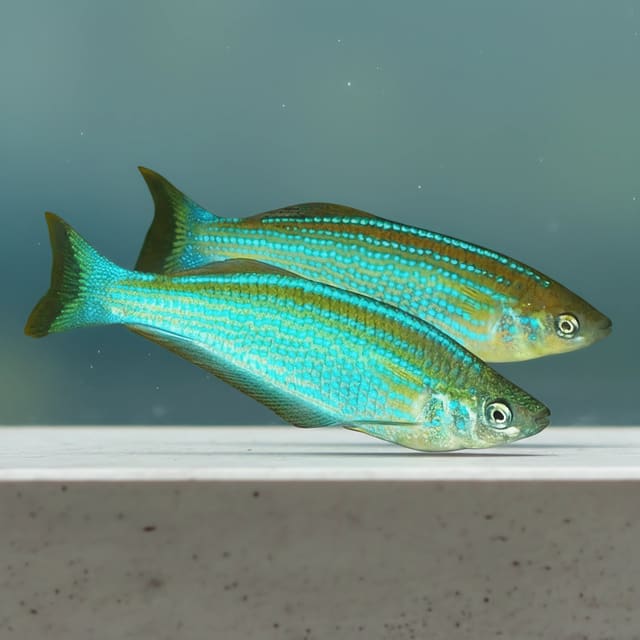
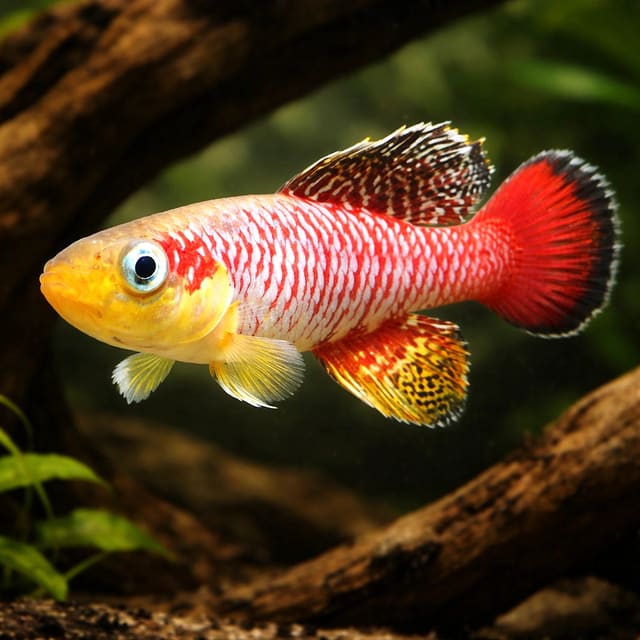
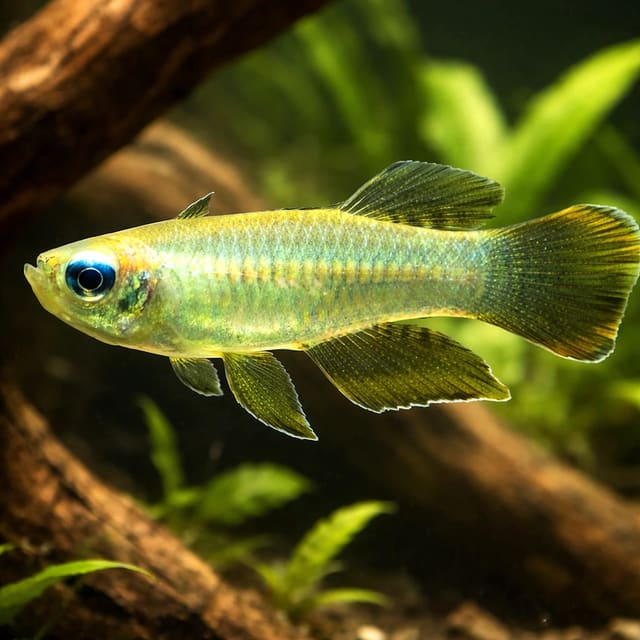
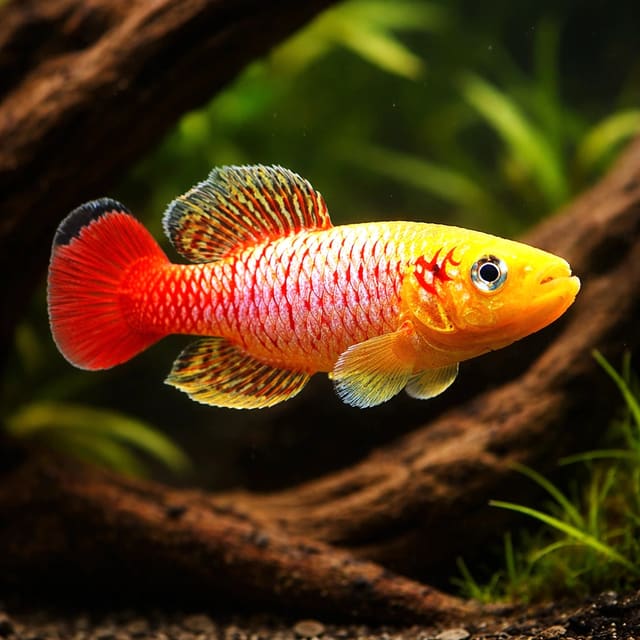
The original reference photo for SKU 3175 shows a long, powerful fish rather than a tiny nano species. The body is pale blue to violet-blue with a fine pearly scale pattern, the lower fins show yellow and orange tones, the dorsal and anal fins carry warm orange spotting, and the caudal fin is dark blue with bright yellow edging. Shorefishes describes the species with red-brown spotting in rows along the body and yellow to orange margins on the male tail, which fits the visual direction of the source image.
Settled males are the display animals. They can show blue-green body colour, warm spotted fins and a bold tail edge when kept under floating plants with a darker background. Females are plainer and may show a caudal spot, but both sexes have the alert rivulus posture: hovering near cover, watching movement above the water and dashing quickly when food appears.
FishBase records Anablepsoides hartii from Caribbean coastal river basins and lists freshwater and brackish habitats. USGS describes native waters along the Caribbean slope of Venezuela and the islands of Trinidad, Tobago, Grenada and Margarita, with the fish using small pools, ponds, streams and tributaries. FishBase also notes adults at the foot of waterfalls, in swamps, streams and ponds.
This species is famous for behaviour that matters in the aquarium. FishBase and USGS both report jumping behaviour to catch insects from overhanging vegetation, and USGS notes movement over moist ground into isolated waters. In a tank, that translates into one hard rule: keep the aquarium tightly covered. Gaps around filters, cables and feeding holes need attention because this fish is built to exploit them.
Use at least 60 litres for a pair or carefully planned small group, and choose more room if combining them with other fish. A longer tank with dense side and rear planting works better than a bare show tank. Use floating plants, Java moss, fine-leaved stems, driftwood and leaf litter to break up sight lines. Gentle filtration is enough; the fish does not need hard current, but it does need clean, oxygenated, stable water.
A routine range of 22-26 C suits this species well. Keep pH close to neutral or mildly acidic where possible, roughly 6.5-7.5, and avoid sudden swings. FishBase lists the fish as freshwater/brackish, but for normal home care a clean freshwater planted aquarium is the better default unless you are deliberately recreating coastal conditions with proper experience.
Anablepsoides hartii is not difficult because it is fragile; it is difficult because it is larger than many killifish, jumps strongly, feeds assertively and can treat very small tank mates as food. Give it a secure lid, steady maintenance and thoughtful company, and it becomes a fascinating, robust display fish.
Feed like you would feed a larger predatory-leaning killifish. Frozen bloodworm, mosquito larvae, daphnia, brine shrimp, mysis and chopped meaty foods are useful staples. Good floating or slow-sinking pellets can be accepted once the fish is settled, but live and frozen foods bring out better condition and colour. Because it naturally takes insects from above the water, surface foods and occasional live foods are especially useful enrichment.
Do not keep it with tiny fry, very small shrimp or timid fish that cannot compete. USGS records a diet including insects and juvenile guppies in the wild, so the compatibility advice should be honest. Feed measured portions and remove leftovers, especially in quieter planted tanks where food can hide under leaves.
The safest option is a pair, trio or species-first setup in a covered planted aquarium. If tank mates are used, choose calm fish too large to be swallowed and too peaceful to bully a rivulus. Avoid fin nippers, large cichlids, fast barbs, predatory catfish, crayfish, tiny fry and expensive dwarf shrimp colonies. A peaceful label should not be read as harmless to everything small enough to fit in the mouth.
Because this fish often uses the upper and middle areas and can jump during feeding, avoid open-top aquascapes. A beautiful rimless planted aquarium is not the right home unless it has a fitted lid. Check the cover after maintenance, and keep water changes steady rather than dramatic.
This is a non-seasonal rivulus, not an annual peat-spawning killifish. Hobby breeding reports use covered tanks with plants or spawning mops. Eggs are laid over time rather than in one annual burst, and practical reports describe incubation around ten days to two weeks in suitable conditions. A planted breeding tank around 60 litres, stable warm water and heavy feeding with live/frozen foods are the sensible route.
If you are not breeding, the same details still matter because they explain the fish's needs: cover above, cover below, good food and stable water. A mop or dense fine-leaved plant mass can reduce stress even in a display tank.
Your fish is packed for live-animal courier delivery with oxygen, heat support when required and species-aware packing. Use the exact source photo and gallery as a visual guide, but remember that colour can shift with sex, age, stress level and lighting. Newly arrived rivulus often look paler until they settle into cover and begin feeding confidently.
First-time customers can use WELCOME10 for 10% off their first order when the code is available at checkout. Livestock orders are supported by our Live Arrival Guarantee; follow the delivery and acclimation instructions, keep the aquarium covered, and contact us quickly if anything does not look right on arrival.
| Care point | Best approach for this SKU |
|---|---|
| Tank style | Mature planted aquarium with a tight lid, floating cover, roots and quiet shaded edges. |
| Adult planning size | Plan around a fish that can reach about 10 cm, not a tiny nano killifish. |
| Water routine | Stable freshwater around 22-26 C, gentle filtration and regular maintenance. |
| Behaviour note | Confident jumper and opportunistic feeder; secure every gap around lids, cables and filters. |
For broader setup planning, compare this listing with our killifish care and shopping guide before choosing tank mates.
| Before adding Giant/Hart's Rivulus | Why it matters |
|---|---|
| Use a tight, weighted or well-fitted lid | This species is known for jumping and exploring gaps above the waterline. |
| Add floating plants and surface shade | Shade helps the fish settle, reduces sudden flight behaviour and improves display colour. |
| Leave open feeding lanes | It feeds assertively near cover, so make sure food reaches it without creating frantic competition. |
| Keep maintenance steady | Stable, clean water matters more than chasing a narrow number every week. |
If you are matching an existing aquarium, our water matcher can help compare your current temperature and pH routine with this species' preferred range.
| Food type | How to use it |
|---|---|
| Frozen bloodworm or mosquito larvae | Useful staple-style foods for conditioning and natural feeding response. |
| Brine shrimp, daphnia and similar foods | Good variety, especially while the fish is settling after delivery. |
| Quality carnivore or community pellets | Offer after the fish is feeding confidently; remove uneaten food promptly. |
| Very small tank mates or fry | Avoid using them as companions because this rivulus may treat them as food. |
| Tank mate choice | Recommendation |
|---|---|
| Same species pair or trio | Often the cleanest plan if the tank has cover and line-of-sight breaks. |
| Calm similar-sized fish | Possible in larger covered aquariums if they are not tiny, frantic or fin-nippy. |
| Shrimplets, fry and tiny nano fish | Not recommended; they can be viewed as prey. |
| Open-top display tanks | Not suitable, even if the water conditions look perfect. |
For arrival day, use the acclimation timer and keep the lid closed whenever you step away from the aquarium.
| What you see on this page | What it means |
|---|---|
| Exact source photo in the gallery | The listing includes the SKU-owned source image alongside supporting visual references. |
| 3-4 cm supplied size | A young fish that still needs adult-size planning and secure-lid care. |
| WELCOME10 | First-time customers can use the discount code when it is active at checkout. |
| Live Arrival Guarantee | Covered by our livestock arrival process when the delivery guidance is followed. |
Check the current livestock delivery information before ordering, especially during hot, cold or disrupted courier periods.
Choose Giant/Hart's Rivulus if you want an unusual, source-backed killifish with real behaviour: surface hunting, bold feeding, strong jumping instincts and a larger adult size than many rivulus relatives. Skip it if you need an open-top display fish, a tiny shrimp-safe nano fish or a carefree mixed-community filler. In the right covered planted aquarium, it is a memorable species with far more personality than a generic keyword page can show.
No reviews for this item yet. Bought one? Honest reviews only, good or bad.
What customers say about ordering from us
I have a small group of long finned mountain minnows. So was delighted to be able to order ten of this variety to increase the genetics in my tank . The ones I recieved are healthy but it’s to early to give a verdict on wether they are of a long finned type since they are small currently.
Gordon Walker · 23 Sept 2026
100% success travel and "installation". Pleased with quality of purchase. The Siamese fighter a bit "shy" so have not yet seen him at his best yet but looking good. Happy customer. GG
George E Garratt · 21 Sept 2026
Reviews of our shop, collected by Judge.me, an independent third-party review collector. Newest first.