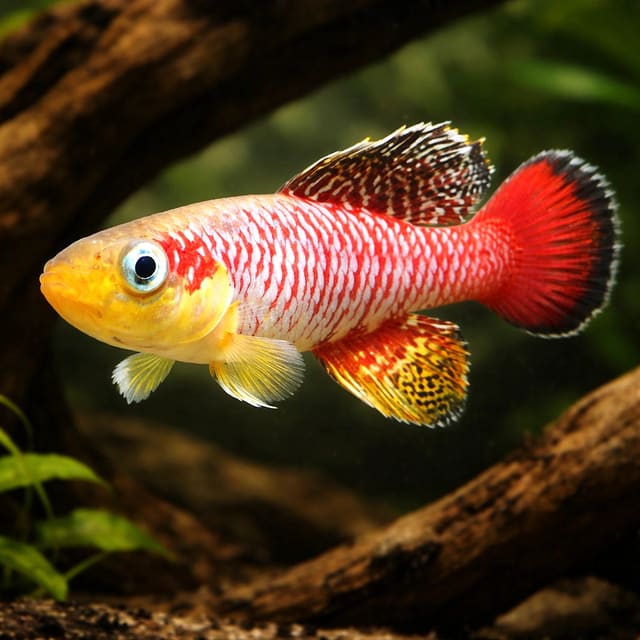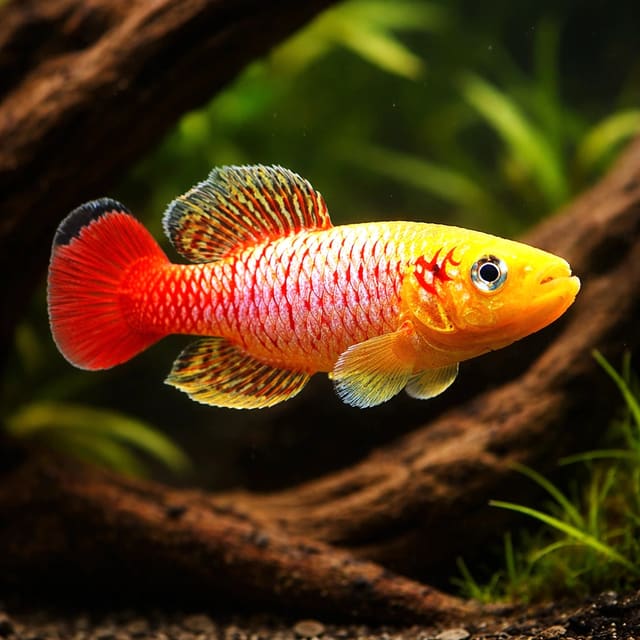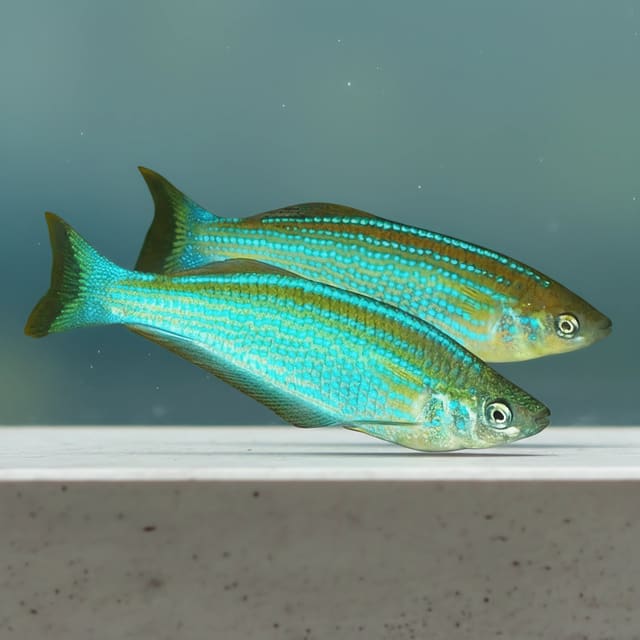
Tanganyika Pearl Killifish (Lamprichthys tanganicanus)
23–25°C · pH 8–8.5
From £19.77Some sizes on sale

Warm-water Peruvian annual killifish for covered species-first aquariums, live/frozen foods, soft spawning substrate and specialist keeper planning.
Adult size is the maximum length this species reaches at full maturity (scientific sources). The livestock you receive will be younger and smaller. Product-photo provenance and any image-specific limitations are stated on the listing.
Aphyolebias peruensis
Save when buying multiple fish. Each quantity is one fish; sex and pair formation are not guaranteed unless the selected variant explicitly states them.
Confirm your email, then we’ll send an availability message for this exact item if it returns within 180 days.
This request is only for this product—no newsletter or other promotions. A mail-provider retry may very rarely duplicate the same availability message. Unconfirmed addresses are removed after 48 hours. See our privacy policy.
Warm-water Peruvian annual killifish for covered species-first aquariums, live/frozen foods, soft spawning substrate and specialist keeper planning.
Adult size is the maximum length this species reaches at full maturity (scientific sources). The livestock you receive will be younger and smaller. Product-photo provenance and any image-specific limitations are stated on the listing.
Maintain these water conditions for optimal health and vibrant colors
Peruvian Longfin (Aphyolebias peruensis) is a South American annual killifish still often seen under its older synonym Pterolebias peruensis. The name matters because older supplier data, image filenames and hobby notes may use the synonym, while FishBase lists Aphyolebias peruensis as the accepted name. This product is supplied around 4-6 cm and should be treated as a specialist fish, not as a casual mixed-community addition.
The attraction is behaviour and life history as much as colour. Annual killifish are adapted to temporary waters, fast maturation and egg survival through a dry period. In aquarium terms, that means a covered tank, warm stable water, excellent food, low stress and a spawning medium if breeding is part of the plan. It also means the fish can have a shorter natural lifespan than many common community species.
| Care point | Guidance |
|---|---|
| Accepted name | Aphyolebias peruensis |
| Common/supplier name | Peruvian Longfin; older synonym Pterolebias peruensis |
| Supplied size | Approx. 4-6 cm for SKU 3151 |
| Adult planning size | Plan up to about 10 cm depending on sex and condition |
| Care level | Moderate specialist |
| Best setup | Covered species-first aquarium with soft spawning substrate |
FishBase lists Pterolebias peruensis as a synonym of Aphyolebias peruensis. Aquarium Glaser also notes that the species was known in the hobby for a long time under the older Pterolebias name. This is why a keeper may see both names when researching the same fish. The product title uses the accepted name and the body keeps the synonym as a helpful cross-reference.
Do not use the synonym confusion as a reason to mix care advice from unrelated killifish. This is a seasonal annual type from Peru, and care should be based around annual-killifish needs: secure cover, quality foods, stable warm water and a substrate or container suitable for bottom-spawning behaviour.
| Label | Use on this page |
|---|---|
| Aphyolebias peruensis | Accepted scientific name used in the title and care fields |
| Pterolebias peruensis | Older synonym retained for keeper recognition |
| Peruvian Longfin | Common product name |
| Annual killifish | Care category and breeding context |
Use a covered aquarium. Killifish can jump, especially when startled, competing or newly introduced. Keep gaps around cables and filter pipes sealed. The layout should include plant cover, floating plants, fine-leaved plants, leaf litter-style shade and a quiet area away from aggressive tankmates.
A species-first setup is safest. It does not have to be huge, but it should be stable, mature and easy to observe. If the aim is breeding, include a spawning container or soft peat/fibre-style medium according to the keeper's preferred annual-killifish method. If breeding is not planned, the fish still benefits from cover and a calm bottom zone.
| Setup item | Best choice | Reason |
|---|---|---|
| Lid | Tight-fitting cover | Reduces jumping risk |
| Plants | Floating and fine-leaved cover | Creates security and breaks sight lines |
| Spawning area | Soft fibre/peat-style container if breeding | Supports bottom-spawning behaviour |
| Flow | Gentle to moderate | Avoids exhausting a specialist fish |
| Substrate | Simple, clean and easy to maintain | Prevents waste build-up in a small specialist setup |
Local records for this product use a warm range around 25-29 C and a flexible pH range around 6.0-8.0. The key is stability. Annual killifish do not reward neglected water, and newly arrived fish should not be put through repeated parameter swings. Keep the aquarium mature, clean and well observed.
| Parameter | Working range | Keeper note |
|---|---|---|
| Temperature | 25-29 C | Warm and stable; avoid cold dips during changes |
| pH | Approx. 6.0-8.0 | Stable matters more than constant chemical adjustment |
| Hardness | Soft to moderate | Avoid extreme swings |
| Filtration | Gentle mature filtration | Clean water without excessive current |
| Maintenance | Small regular water changes | Keeps waste low while protecting stability |
Peruvian Longfin is best approached as a quality-food specialist. Offer live and frozen foods such as brine shrimp, daphnia, mosquito larvae, bloodworm, cyclops and similar small invertebrate foods. Some individuals may accept prepared foods, but the feeding plan should not depend on dry food only.
Feed measured portions and watch body condition. Annual killifish can mature quickly, and good feeding supports colour, condition and breeding readiness. Uneaten food in a small covered setup can spoil water quickly, so remove excess and keep filtration steady.
| Food | Use |
|---|---|
| Frozen/live brine shrimp | Regular conditioning food |
| Daphnia or cyclops | Small foods that encourage natural feeding |
| Bloodworm or mosquito larvae | Useful richer foods in rotation |
| Soft prepared foods | Only if accepted; do not rely on them alone |
This fish is best kept species-first, especially if breeding or careful observation is the goal. Calm, similar-sized warm-water companions may work in a larger specialist aquarium, but avoid fin nippers, aggressive cichlids, very fast feeders, tiny fry or shrimp that may be eaten, and cool-water species.
Male display is part of the appeal, but close quarters can increase pressure. Provide cover and keep a close eye on chasing. If one fish is pinned in a corner or blocked from food, the layout or group plan needs changing.
FishBase notes bottom-spawning behaviour and a long egg incubation period for Aphyolebias peruensis. Aquarium Glaser describes the species as a typical seasonal fish. For keepers, that means breeding is a project, not an accidental side effect. Eggs are usually collected from a spawning medium and incubated away from the adults according to annual-killifish methods.
If you are not already comfortable with annual killifish, research breeding and egg storage before relying on it. Fry and eggs need clean conditions, appropriate foods and stable handling. For display-only care, the same biology still explains why warm water, good food and a secure specialist setup matter.
| Breeding point | Practical meaning |
|---|---|
| Bottom spawner | Provide a soft spawning medium if breeding |
| Annual life strategy | Expect faster maturation and shorter natural lifespan |
| Egg incubation | Plan before purchase if breeding is the goal |
| Fry care | Needs small foods and very clean water |
A healthy Peruvian Longfin should hold balance easily, respond to food and show normal awareness of cover and tankmates. Newly moved fish may be shy, but they should not remain pinned at the surface, breathe heavily or sit with clamped fins. Because this is a specialist annual killifish, early husbandry mistakes can show quickly.
Check the lid every time you work on the tank. Many losses in killifish are not disease problems but jumping incidents. Also check that food is being eaten promptly, that the spawning medium is not fouling the water, and that any filter intake is safe for a slender fish. If breeding containers are used, clean or replace them before they become waste traps.
| Watchpoint | Why it matters | Useful response |
|---|---|---|
| Jumping risk | Killifish can leave even small gaps | Seal lid gaps around pipes and cables |
| Heavy breathing | May indicate water or oxygen stress | Test water and improve aeration gently |
| Refusing food | May be settling stress or wrong food type | Try small live/frozen foods and keep lights low |
| Dominance pressure | Displays can become chasing in tight tanks | Add cover or separate if one fish is excluded |
| Dirty spawning medium | Can spoil water in small setups | Maintain or replace it before waste builds up |
The biggest mistake is treating Peruvian Longfin like a simple community fish because it is small. It has specialist annual-killifish needs and is best with a keeper who understands live/frozen foods, secure covered tanks and, if breeding is wanted, egg incubation planning. The second mistake is mixing it with fish that are too fast at feeding time or too rough during displays.
The third mistake is buying it without thinking about lifespan. Seasonal killifish can be intensely rewarding, but they are not always long-lived display fish. Enjoy them for their behaviour, colour and breeding project potential, and plan the aquarium around their natural strategy rather than expecting them to behave like tetras or rasboras.
Keep lights low at first, use a covered aquarium and allow the fish to settle before heavy feeding. Check breathing, balance and appetite. Do not move it between tanks unnecessarily. Offer a small live or frozen food once it is alert, and avoid bright busy surroundings during the first evening.
Tropical Fish Co supports eligible livestock orders with a Live Arrival Guarantee, and first-time customers can use WELCOME10 where eligible.
If you are comparing unusual killifish and small specialist species, consider whether your aquarium is built for lifespan, feeding and breeding style. The Threadfin Rainbowfish is more of a delicate display shoaler, while the Paska's Blue-Eye Rainbowfish is a small active species with different group needs. For a broader comparison, browse the killifish collection and compare care level before choosing.
No reviews for this item yet. Bought one? Honest reviews only, good or bad.
What customers say about ordering from us
I have a small group of long finned mountain minnows. So was delighted to be able to order ten of this variety to increase the genetics in my tank . The ones I recieved are healthy but it’s to early to give a verdict on wether they are of a long finned type since they are small currently.
Gordon Walker · 23 Sept 2026
100% success travel and "installation". Pleased with quality of purchase. The Siamese fighter a bit "shy" so have not yet seen him at his best yet but looking good. Happy customer. GG
George E Garratt · 21 Sept 2026
Reviews of our shop, collected by Judge.me, an independent third-party review collector. Newest first.