Mahecola Barb (Barbus mahecola trade name)
20–27°C · pH 6–7.5
£6.99

Active, peaceful Filament Barb with a bold black tail spot and high-oxygen shoaling behaviour. Best for a spacious, well-filtered community aquarium.
Adult size is the maximum length this species reaches at full maturity (scientific sources). The livestock you receive will be younger and smaller — pick a size above for the actual shipping size. Product-photo provenance and any image-specific limitations are stated on the listing.
Dawkinsia filamentosa
Shoaling fish: kept in a group they feel safer, stay calmer and show their best colour.
Confirm your email, then we’ll send an availability message for this exact item if it returns within 180 days.
This request is only for this product—no newsletter or other promotions. A mail-provider retry may very rarely duplicate the same availability message. Unconfirmed addresses are removed after 48 hours. See our privacy policy.
Active, peaceful Filament Barb with a bold black tail spot and high-oxygen shoaling behaviour. Best for a spacious, well-filtered community aquarium.
Adult size is the maximum length this species reaches at full maturity (scientific sources). The livestock you receive will be younger and smaller — pick a size above for the actual shipping size. Product-photo provenance and any image-specific limitations are stated on the listing.
Maintain these water conditions for optimal health and vibrant colors
The Filament Barb, also called the Black-Spot Barb, is best listed under its current accepted name Dawkinsia filamentosa. Older aquarium and supplier names such as Puntius filamentosus and Barbus filamentosus are still useful search and trade-name bridges, but the public listing should not force them into the title as a combined taxon. This is an active South Indian barb with a clean silver body, a bold dark caudal spot and, in mature males, the trailing dorsal-fin filaments that give the species its name.
This is not a tiny nano barb. Young fish at 3.5-4.5 cm settle well when kept properly, but adults become powerful open-water swimmers. A good Filament Barb listing should set the right expectation from the start: buy them as a shoal, give them oxygen-rich water, and plan a long aquarium with room for fast group movement. In the right setup they are lively, confident and generally peaceful with similar-sized tank mates.
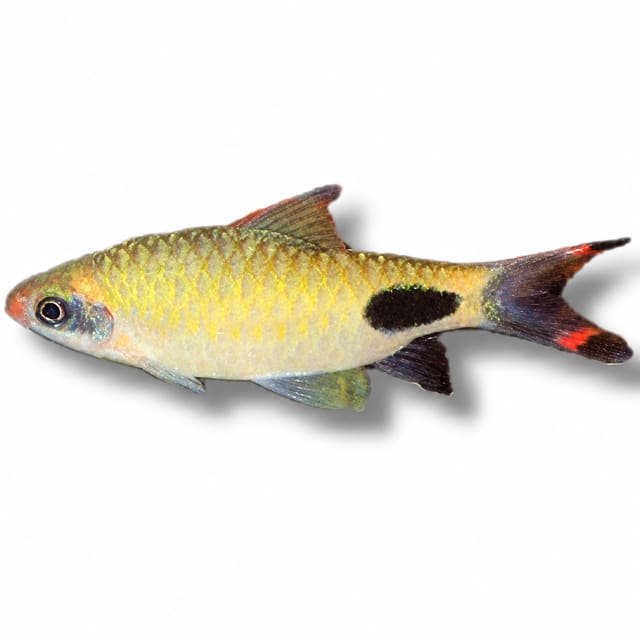
The exact source photo shows the classic Filament Barb shape: a streamlined body, olive-silver back, pale lower body, greenish fins and a strong black blotch toward the rear of the fish. Mature males become more dramatic than juveniles, developing longer dorsal-fin filaments and stronger colour through the fins, especially when displaying. Females are normally deeper-bodied and less extended in the fins. Juveniles can look plainer, so the buyer should expect this species to improve with age and condition rather than arrive as a fully mature show male.
Dawkinsia filamentosa is associated with India, including southern and Western Ghats-linked waters. FishBase records the species from freshwater and brackish environments, including clear streams, lowland rivers, lakes, reservoirs, marshes and estuarine habitats. In aquarium terms, that translates into clean water, strong biological filtration, good oxygenation and enough current to keep the fish working naturally.
Use a long aquarium with open swimming room across the front and middle of the tank. Smooth stones, wood and robust plants can make the layout natural without blocking the swimming lane. Java fern, Anubias, Vallisneria and other tougher plants are better choices than delicate soft plants, because Filament Barbs are curious omnivores and may browse greenery. Keep the lid secure, as fast barbs can jump when startled.
Filtration matters more than decorative complexity. Aim for steady flow, high oxygen and low nitrate through sensible stocking and regular partial water changes. A group of six is the minimum; eight or more gives better confidence and spreads male display behaviour. Because adults can become large, strong swimmers, a 240L+ long aquarium is a more responsible long-term target than an 80L community setup.
Filament Barbs are unfussy omnivores when settled. Offer a quality flake, granule or pellet as the staple, then rotate in frozen foods such as brine shrimp, daphnia, mosquito larvae, mysis or chopped prawn. Include vegetable matter too: spirulina foods, green flake, algae wafers, blanched spinach, cucumber or similar plant-based feeds help match their natural grazing behaviour. Feed small portions that are eaten quickly, because this species is energetic and will easily outcompete slower fish at feeding time.
This is a robust, active shoaling barb, not a shy centrepiece fish. In a proper group it is normally peaceful, but it is too fast and boisterous for very small fish, delicate fancy guppies, slow long-finned species or timid feeders. Better companions include similarly active barbs, danios, larger peaceful rasboras, rainbowfish, robust tetras and many loaches. Avoid predatory fish, aggressive cichlids and any community where the Filament Barb group would dominate every feeding.
Like many barbs, Dawkinsia filamentosa is an egg scatterer. A breeding attempt needs a separate, well-oxygenated aquarium with fine-leaved plants, spawning mops or a marble layer to protect eggs from the adults. Condition the group with varied live and frozen foods, then remove adults after spawning because they will eat eggs and fry. This is specialist behaviour to observe rather than a promise that every home aquarium group will breed.
This listing uses the original reference photo as an added reference image and keeps the existing gallery images for visual continuity. Choose the size option that suits your current shoal and aquarium space, then quarantine and acclimate carefully as with any live fish. Tropical Fish Co dispatches livestock with a Live Arrival Guarantee, and first-time customers can use WELCOME10 where the offer is available at checkout. The best result comes from treating this as a long-term shoaling barb: space, flow, oxygen and a proper group first.
Care and naming were checked against FishBase, GBIF, India Biodiversity Portal, Seriously Fish, Fishkeeper/Maidenhead and our stock records/photo. These sources support the accepted Dawkinsia filamentosa name, older Puntius/Barbus synonym context, active shoaling behaviour, high oxygen requirement, robust-plant warning and larger long-term aquarium guidance.
No reviews for this item yet. Bought one? Honest reviews only, good or bad.
What customers say about ordering from us
I have a small group of long finned mountain minnows. So was delighted to be able to order ten of this variety to increase the genetics in my tank . The ones I recieved are healthy but it’s to early to give a verdict on wether they are of a long finned type since they are small currently.
Gordon Walker · 23 Sept 2026
100% success travel and "installation". Pleased with quality of purchase. The Siamese fighter a bit "shy" so have not yet seen him at his best yet but looking good. Happy customer. GG
George E Garratt · 21 Sept 2026
Reviews of our shop, collected by Judge.me, an independent third-party review collector. Newest first.