Tanganyika Pearl Killifish (Lamprichthys tanganicanus)
23–25°C · pH 8–8.5
From £19.77Some sizes on sale

Brazilian annual killifish supplied at 3-4 cm. Best in a covered species setup around 24-27 C with live/frozen foods and peat or coco-coir spawning media.
Adult size is the maximum length this species reaches at full maturity (scientific sources). The livestock you receive will be younger and smaller. Product-photo provenance and any image-specific limitations are stated on the listing.
Hypsolebias antenori
Save when buying multiple fish. Each quantity is one fish; sex and pair formation are not guaranteed unless the selected variant explicitly states them.
Confirm your email, then we’ll send an availability message for this exact item if it returns within 180 days.
This request is only for this product—no newsletter or other promotions. A mail-provider retry may very rarely duplicate the same availability message. Unconfirmed addresses are removed after 48 hours. See our privacy policy.
Brazilian annual killifish supplied at 3-4 cm. Best in a covered species setup around 24-27 C with live/frozen foods and peat or coco-coir spawning media.
Adult size is the maximum length this species reaches at full maturity (scientific sources). The livestock you receive will be younger and smaller. Product-photo provenance and any image-specific limitations are stated on the listing.
Maintain these water conditions for optimal health and vibrant colors
Current taxonomic sources place that name as a synonym of Hypsolebias antenori, so the main scientific name on this listing is Hypsolebias antenori while the supplier name stays visible for label matching.
This is a seasonal South American annual killifish for a planned species setup, not a general community fish. It is supplied at 3-4 cm and can reach about 7 cm total length as a mature male. The appeal is the pearly body, red-orange fin colour and unusual life cycle: adults live in temporary pools, spawn into the bottom substrate, and the eggs rest in damp peat-like material until the next wet phase.
FishBase lists Hypsolebias antenori as a freshwater, benthopelagic rivuline from the Jaguaribe and Mossoro River basins plus adjacent coastal plains in Brazil. It gives a maximum length of 7 cm total length and notes a bottom-spawning life cycle with around four months of egg incubation.
Eschmeyer's Catalog of Fishes records Cynolebias heloplites from a lagoon near the Fortaleza-Russas route in Ceara, Brazil, and gives the current status as a synonym of Hypsolebias antenori. GBIF/Catalogue of Life also treats Hypsolebias antenori as accepted and lists Cynolebias heloplites among its synonyms. This matters for buyers because the supplier label, old hobby articles and current taxonomy may not all use the same name.
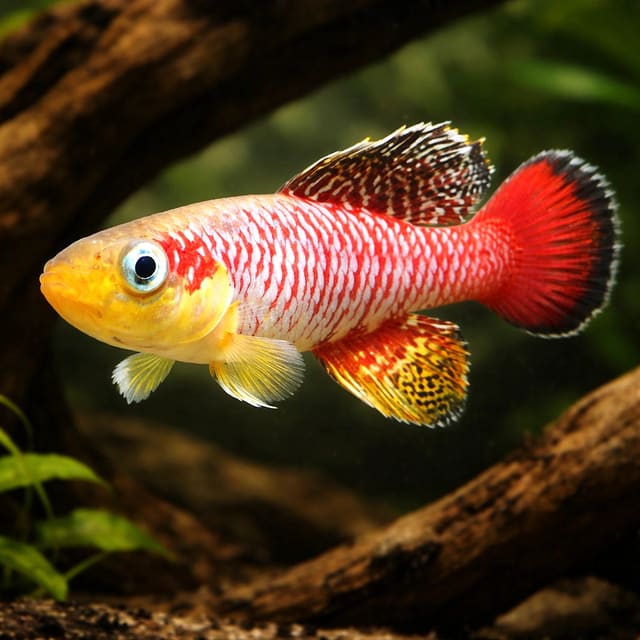
The original reference photo for SKU 3078 shows a deep-bodied male with a pale steel-blue to lavender body, pearl-like light spotting, a darker greenish dorsal area and warm red-orange colour through the lower fins. The photo is small and supplier-watermarked, but it is still valuable because it anchors the listing to the actual supplier fish rather than only to generic aquarium art.
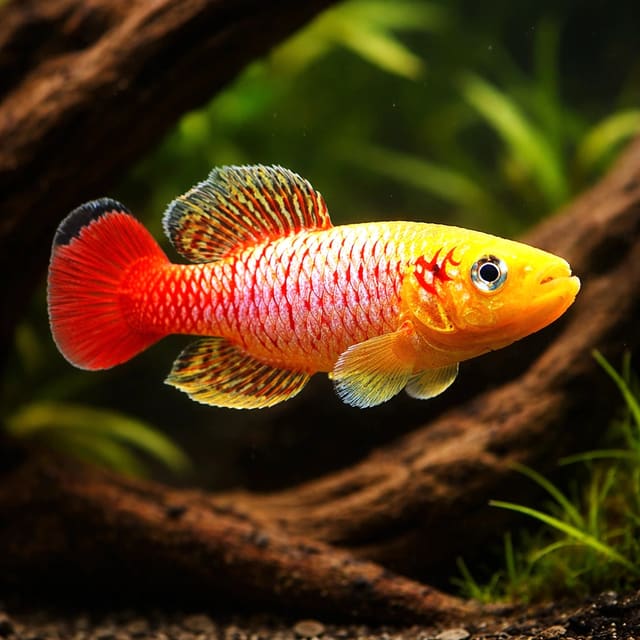
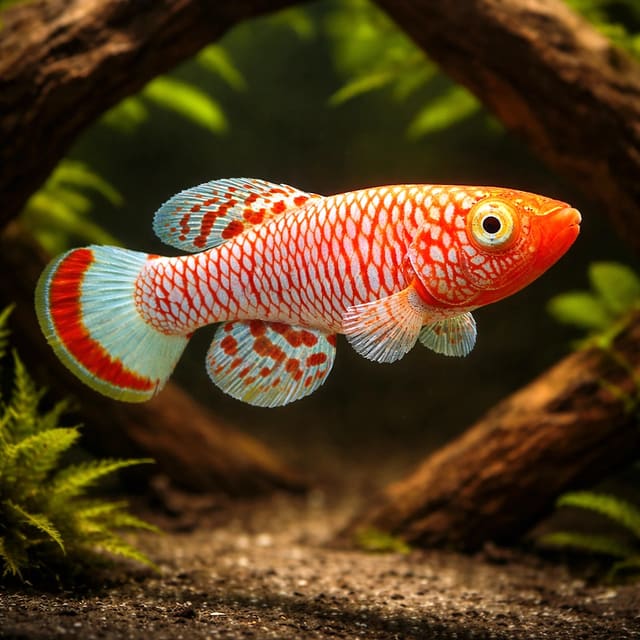
The supporting images are being kept as additional scene views, but the source photo is the primary factual image for identity.
Hypsolebias antenori belongs to the annual killifish fauna of semi-arid northeastern Brazil. These fish use temporary pools and shallow seasonal waters that fill during rains and dry later in the year. Adults grow quickly, display, spawn into the bottom and then naturally disappear as the habitat dries. The next generation waits as eggs in damp substrate.
That life history should shape the aquarium. Think quiet, covered, warm, clean and species-focused. This fish should not be dropped into a busy mixed display where faster fish take the food and males have nowhere to retreat. It does much better when the tank is designed around annual-killifish behaviour from the start.
A dedicated 30-40 litre aquarium is a sensible starting point for a pair or trio. The American Killifish Association notes that a pair or trio can be kept in very small specialist tanks, but for a retail home setup a little extra water volume gives better stability and more space for female cover. If keeping more than one male, use a larger aquarium with strong visual breaks.
Use a tight lid, gentle filtration and subdued lighting. Add Java moss, floating plants, fine-leaved cover and a removable container of peat, coco coir or similar soft spawning medium. The spawning container should be deep enough for diving or bottom-spawning behaviour, but easy to remove for egg checks. Keep the aquarium simple enough that uneaten food and waste can be controlled.
The previous 20-24 C wording was too cool as a general recommendation for this fish. The safer customer-facing advice is to keep it warm, stable and clean, then adjust only if deliberately managing a breeding cycle.
This species is a carnivorous annual killifish. Offer small live and frozen foods such as brine shrimp, daphnia, mosquito larvae, grindal worm, white worm in moderation and small bloodworm. Some adults may take flake or micro-pellets, but live and frozen foods are the reliable foundation for condition, colour and breeding.
Feed small portions and watch the fish eat. Do not let food sink and rot in a small annual-killifish tank. Clean feeding is especially important because peat or coco-coir breeding media can trap debris if the tank is overfed.
This fish is best kept species-only. The supplier and older copy described it as peaceful, but specialist sources add a more useful detail: males may fight, both sexes can form dominance hierarchies and females need places to hide. That does not make it a rough community fish; it means it needs a thoughtful layout and the right group management.
Avoid fin nippers, cichlids, fast-feeding tetras, barbs, larger fish, hard-water species and anything that will crowd the food. If you try companions at all, choose only tiny, calm fish that share warm, soft, clean water and do not compete strongly. Most keepers will get better colour, feeding and breeding behaviour from a dedicated setup.
Hypsolebias antenori is a bottom-spawning annual killifish. FishBase notes bottom spawning and around four months incubation; the American Killifish Association describes it as a substrate-diving species that can be spawned over peat moss or walnut shells, with dry-peat incubation often taking at least five months and sometimes longer.
Condition adults with live and frozen foods, give females cover, provide a removable spawning medium and store eggs damp rather than wet. Fry usually need very small first foods, then newly hatched brine shrimp as soon as they can take it. This is one of the most rewarding parts of the species, but it needs planning and record keeping.
We pack live fish for specialist live-animal courier delivery, using oxygen, insulation and temperature support according to the weather. Dispatch timing is chosen around fish welfare, not around forcing a parcel out in poor conditions. Your order is covered by our Live Arrival Guarantee when the delivery and acclimation steps are followed.
Choose Red-Finned Pearl Killifish if you want a rare annual killifish for a proper species aquarium and you are ready to manage warm, clean water, live or frozen foods and substrate-spawning behaviour. It is small, colourful and fascinating, but it deserves a keeper who enjoys the specialist side of the hobby.
No reviews for this item yet. Bought one? Honest reviews only, good or bad.
What customers say about ordering from us
I have a small group of long finned mountain minnows. So was delighted to be able to order ten of this variety to increase the genetics in my tank . The ones I recieved are healthy but it’s to early to give a verdict on wether they are of a long finned type since they are small currently.
Gordon Walker · 23 Sept 2026
100% success travel and "installation". Pleased with quality of purchase. The Siamese fighter a bit "shy" so have not yet seen him at his best yet but looking good. Happy customer. GG
George E Garratt · 21 Sept 2026
Reviews of our shop, collected by Judge.me, an independent third-party review collector. Newest first.