−15%
Easy
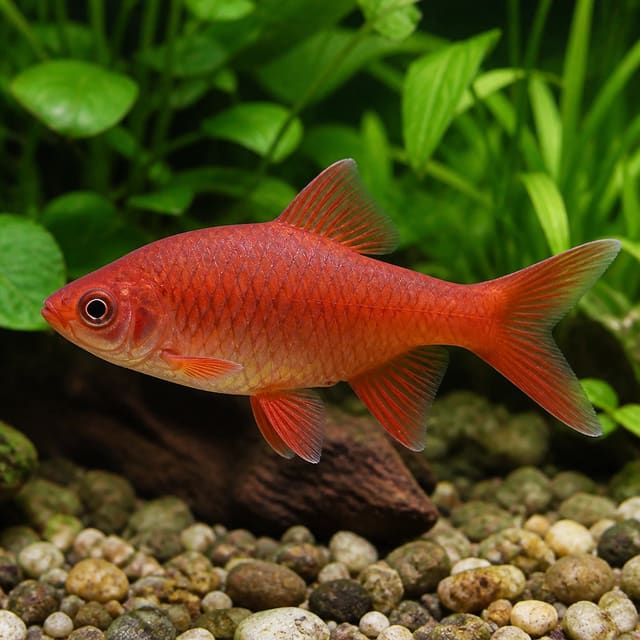
Red Rosy Barb (Pethia conchonius)
18–24°C · pH 6–8 · 90L
£5.09£5.99
Photo coming soon
The size, price and care details on this page are for this listing.
Waanders's Hard-Lipped Barb (Osteochilus waandersii) is a large Southeast Asian river cyprinid for a mature 500L+ long aquarium. Each quantity is one unsexed 5-7 cm fish; the stock image is not the exact individual supplied.
Osteochilus waandersii
Shoaling fish: kept in a group they feel safer, stay calmer and show their best colour.
Confirm your email, then we’ll send an availability message for this exact item if it returns within 180 days.
This request is only for this product—no newsletter or other promotions. A mail-provider retry may very rarely duplicate the same availability message. Unconfirmed addresses are removed after 48 hours. See our privacy policy.
Waanders's Hard-Lipped Barb (Osteochilus waandersii) is a large Southeast Asian river cyprinid for a mature 500L+ long aquarium. Each quantity is one unsexed 5-7 cm fish; the stock image is not the exact individual supplied.
Maintain these water conditions for optimal health and vibrant colors
Waanders's Hard-Lipped Barb (Osteochilus waandersii) is a substantial Southeast Asian river cyprinid for an experienced fishkeeper with a genuinely large, mature aquarium. The young fish offered under this listing is approximately 5-7 cm, but that is a sale grade rather than an adult limit. Published records reach 27.6 cm total length, so this is not a small community barb and it should never be bought as a temporary solution for a short aquarium.
The species is recognised by its elongated body, defined dark stripe running from the gill region towards the middle of the tail, specialised lips and fins that can develop orange or red colour. Wild records associate it with warm freshwater rivers, clear to moderately clear flow, gravel or stony ground and seasonally flooded margins. Its natural history points towards a long aquarium with high oxygen availability, reliable biological filtration, open swimming lanes and surfaces on which natural grazing films can develop.
This page separates published evidence from practical aquarium judgement. Field studies support the identity, maximum size, habitat and predominantly plant- and phytoplankton-based feeding ecology. No scientific paper provides a universal home-aquarium minimum, exact hardness tolerance or guaranteed temperament. The aquarium recommendations below are deliberately conservative because a mobile river fish approaching 28 cm needs more room than the old 200-litre guidance allowed.
| Accepted scientific name | Osteochilus waandersii (Bleeker, 1853) |
|---|---|
| Common name | Waanders's Hard-Lipped Barb; also encountered as Waandersii's Bony-Lipped Barb |
| Family | Cyprinidae, subfamily Labeoninae |
| Sale size | Approximately 5-7 cm; one unsexed fish per quantity |
| Maximum published size | 27.6 cm total length; do not plan around the juvenile sale size |
| Long-term aquarium | 500 litres or more for a carefully planned small group; at least 150 cm long, with 180 cm preferred |
| Practical temperature | 24-28°C; a stable 25-27°C is a sensible central target |
| Practical pH | About 6.0-7.0, kept stable; no exact species-wide hardness tolerance was found |
| Feeding emphasis | Predominantly herbivorous grazing and phytoplankton feeding, supported with a varied prepared diet |
| Experience level | Intermediate to advanced, mainly because of adult size, group planning, flow and oxygen requirements |
| Image note | The retained gallery image is a stock reference, not a photograph of the exact individual supplied |
Osteochilus waandersii is a freshwater member of the carp and minnow family. It belongs to Labeoninae, a group that includes many bottom- or surface-grazing river fishes with specialised mouth structures. The name Osteochilus refers to the bony-lipped character of the genus. This is useful context: the lips are not a novelty added to a trade name, but part of a feeding system suited to taking small food and biological growth from natural surfaces.
Eschmeyer's Catalog of Fishes treats Osteochilus waandersii as the valid scientific name. our stock records use Osteochilus wandersii, with one "a", but that spelling is not accepted. The corrected double-a form is therefore used in the product title, care information and metadata. Older sources also sometimes use waandersi. Those spellings can help explain historical records, but repeating them as if they were separate species would create confusion rather than useful search coverage.
The common name is written here as Waanders's Hard-Lipped Barb. "Waandersii's Bony-Lipped Barb" is another English rendering seen in reference material. Neither wording changes the biological identity. For a buyer, the scientific name is the most dependable anchor because common names for uncommon cyprinids are not consistently standardised across exporters and retailers.
The live gallery image shows an elongated brown-gold cyprinid with a strong lateral stripe and visible barbels, which is visually plausible for this species. No reference photograph or diagnostic measurements were supplied, however, and the image is not a voucher specimen. We therefore use the supplier identity while being open about the evidence limit. The listing does not promise a particular locality, sex, bloodline or exact adult fin colour.
That caution matters because several Osteochilus species enter fisheries and ornamental channels in Southeast Asia. A confident name should come from morphology and provenance, not simply from a similar photograph. If the exact identity would determine a specialist breeding, conservation or display project, contact us before purchase and ask what current stock evidence is available.
Published summaries place the species across parts of mainland and island Southeast Asia. FishBase records the Mekong and Chao Phraya basins, the Malay Peninsula, Sumatra and Borneo, with an additional report from the Maeklong basin. Eschmeyer's catalogue gives a broadly similar range and records the original type locality at Bangka, Indonesia. This is a river fish with a wide regional footprint, not a narrow blackwater species tied to one tiny locality.
Habitat descriptions repeatedly point to flowing freshwater. FishBase describes clear, relatively fast water over gravel or stone. A reproductive study from the Landak River also refers to strong current and clear water. A Rokan Kiri River survey measured 25-28°C, pH 6 and current velocity of 0.327-0.625 m/s where the fish was sampled. A food-habit study in the upstream Lenggang River recorded 27-28°C, pH 6 and a slower measured current of about 0.13-0.17 m/s. These are snapshots from particular places and seasons, but together they support warm, oxygenated freshwater with meaningful water movement.
Juveniles have been recorded around overhanging bank vegetation and softer marginal substrates, while the species can move into flooded forest during high water. That mixture is important when interpreting the habitat. The aquarium should not be a bare high-velocity channel from end to end. It needs open flow and oxygen, but it should also offer quieter edges, cover and a varied surface structure so smaller fish are not forced to swim against the strongest output continuously.
The approximate 5-7 cm size on this product is the current trade grade. FishBase lists a maximum published length of 27.6 cm total length, and field studies include mature animals at much smaller sizes. Reproductive work in the Landak River estimated first maturity around 13.8 cm for males and 14.0 cm for females in that sampled population. Maturity size is not the same as final adult size, and neither figure is a promise that every aquarium fish will reach an identical measurement.
The practical lesson is simple: this species can become four or five times longer than the juvenile offered. Body mass rises much faster than length, so filtration demand, turning room and competition at feeding time increase substantially as it grows. A juvenile can look comfortable in a modest aquarium while the permanent plan is already inadequate. Buying first and planning an upgrade later transfers all of the risk to the fish.
Use the tank-volume calculator to confirm the real internal capacity after substrate and decor, but do not let litres hide a short footprint. A deep cube can hold hundreds of litres and still provide poor cruising distance. For this species, length and width are as important as nominal volume.
For a carefully planned small group, begin at about 500 litres with at least 150 cm of aquarium length; 180 cm or more is preferable. Larger groups, mixed communities or especially active adults justify substantially more. This is a conservative welfare recommendation derived from maximum size, river movement and group uncertainty. It is not presented as a number measured by a scientific aquarium trial.
Surviving in a volume is not the same as having adequate turning space, exercise opportunity, feeding access and stable water quality throughout adulthood.
| Area | Recommended approach | Reason |
|---|---|---|
| Footprint | Long, wide aquarium; 150 cm minimum length and 180 cm preferred | Supports cruising, turning and group spacing |
| Flow | Moderate to strong through the open lane, with quieter refuges | Reflects river use without forcing constant effort |
| Oxygen | Strong surface movement and reliable circulation | Warm water carries less dissolved oxygen |
| Substrate | Rounded gravel, smooth stones or a mixed sand-and-gravel bed | Creates natural grazing surfaces without sharp edges |
| Decor | Stable wood and rounded rock placed around edges | Provides structure while preserving an open swimming lane |
| Plants | Robust, well-rooted or attached species; expect some browsing | Offers cover, but soft growth may be sampled |
| Cover | Secure lid or tightly managed open-top perimeter | Active river fish can jump when startled |
Choose filtration for the expected adult biomass, not the fish's current size. A large external canister, sump or equivalent high-capacity system should turn over and oxygenate the water without creating one narrow jet that pins fish against the opposite glass. Direct returns along the length of the aquarium, then use wood or stone to break the current into zones. A spray bar can spread movement; an air stone provides useful extra gas exchange during hot weather, treatment or a temporary rise in biological demand.
Flow does not compensate for poor maintenance. Mechanical media still needs cleaning before trapped waste decomposes, while biological media should be handled gently in removed aquarium water. Keep intakes guarded and position them so leaves or grazing foods cannot block circulation unnoticed.
Use inert, smooth materials unless the water source needs a deliberately chosen buffering substrate. Rounded river stones are useful because they create broad surfaces for natural films. Wood adds shade and a more complex boundary, but every piece must be secure and leave sufficient turning space. Avoid narrow caves that a growing fish could enter and later struggle to reverse out of.
A perfect photographic stream reconstruction is less important than functional space. Keep the centre or front-centre open, move heavy structure towards the back and ends, and check the route from one end of the aquarium to the other at adult body length. The fish should not have to weave through a decorative obstacle course on every pass.
Attach Anubias, Java fern or similar robust epiphytes to protected wood and stone, or use established rooted plants around calmer edges. No plant is guaranteed to be ignored by a predominantly herbivorous grazer. Treat browsing as a possible natural behaviour rather than a fault in the fish. Fast-growing marginal or floating cover can soften the light, but it must not seal the surface or obstruct gas exchange.
Moderate lighting supports viewing and controlled biofilm growth. Very bright light over an exposed aquarium may make fish hesitant, while excessive nutrients can turn useful surface growth into unstable nuisance algae. Balance light, plant mass, feeding and water changes instead of buying the fish as an algae-control tool.
The most defensible aquarium range is 24-28°C with a stable 25-27°C central target, and roughly pH 6.0-7.0. Multiple field studies found the species at pH 6, while temperatures ranged from the mid-20s to the high 20s. Another recent river survey detected the species in water around 23.8-24.7°C and pH 5.75-6.65. These values show habitat use; they do not prove that every population tolerates the full combined range indefinitely.
No robust species-specific dGH tolerance was found in the reviewed sources, so this listing does not repeat the old 2-12 dGH claim as if it were established. Start with stable, clean freshwater that is not at a chemical extreme. Measure the source water, compare it with the aquarium, and avoid forcing hardness or pH to a number with repeated rapid dosing. The water-matching tool can help compare candidate species, but your own test results remain the deciding evidence.
| Parameter | Practical target | How to interpret it |
|---|---|---|
| Temperature | 24-28°C | Keep stable; 25-27°C is a sensible centre for most homes |
| pH | About 6.0-7.0 | Field records support mildly acidic water; avoid sudden correction |
| Hardness | No exact species-wide range established | Test the source and aquarium; avoid abrupt mineral change |
| Ammonia | 0 mg/L | Any measurable result requires immediate investigation |
| Nitrite | 0 mg/L | Any measurable result indicates an unsafe biological-filter problem |
| Nitrate | Keep controlled by stocking, plants and water changes | Trend matters; do not use nitrate as the only measure of cleanliness |
| Flow | Moderate to strong with calmer margins | Combine circulation with open space and oxygenation |
Do not add this fish to a newly filled aquarium. A mature system must process the expected ammonia load into nitrite and then nitrate without either toxic intermediate becoming measurable. Test before purchase, test after arrival and keep records while the fish settles. "Clear" water can still contain dangerous dissolved waste, so sight and smell are not substitutes for a liquid test.
If the aquarium is being enlarged specifically for this species, move proven mature media with the livestock plan rather than assuming a larger new filter is instantly cycled. Continue testing because moving media, changing stocking and disturbing substrate can alter performance.
A sensible starting routine is a 25-40% weekly water change, adjusted from actual nitrate, waste and feeding data. Match replacement temperature closely, use dechlorinator for treated tap water and avoid exposing biological media to untreated chlorine. Siphon trapped debris without sterilising every surface; useful microbial communities live throughout a mature aquarium.
Observe the fish during maintenance. Repeated gasping, loss of balance, sudden darkening, frantic dashing or tight clustering near one return are warnings. Check oxygen, temperature, ammonia, nitrite and equipment before reaching for medication.
A 2021 food-habit study examined 146 wild fish from the upstream Lenggang River. The gut contents were dominated by phytoplankton, particularly Synedra and Anabaena, with several other algal groups represented. Relative gut length supported a predominantly herbivorous classification for that sampled population. FishBase also assigns a low estimated trophic level based on food items. This is stronger evidence than a generic claim that the fish is an all-purpose community omnivore.
In an aquarium, "herbivorous" should not mean one wafer every evening. The fish naturally encounters varied microscopic growth, suspended material and plant-origin food. Offer more than one format and give it time to browse between meals. Avoid using the species as a cleaning service: the keeper remains responsible for algae control, glass cleaning and nutrient management.
| Food role | Examples | Use |
|---|---|---|
| Daily staple | Quality spirulina or algae-based flakes and sinking herbivore granules | Rotate formats so food reaches different levels and individuals |
| Grazing food | Vegetable-rich wafers, gel food spread thinly on a stone, established biofilm | Supports prolonged natural picking rather than one feeding rush |
| Fresh plant matter | Blanched courgette, spinach or other safe aquarium vegetables | Offer small controlled portions and remove uneaten pieces |
| Supplement | Daphnia, Artemia or a balanced mixed formula in modest amounts | Add variety without turning animal protein into the whole diet |
| Avoid | Mammal meat, greasy kitchen food, large decaying vegetables | Unsuitable nutrition and unnecessary water pollution |
Begin with two small feeds daily and adjust from body condition, growth, competition and waste. A useful portion disappears while the fish are actively feeding and does not form piles under decor. Large vegetables can remain longer only when they are still fresh and every fish is using them; remove them before they soften and foul the water.
Watch individuals rather than the group as a blur. A dominant or faster fish may take most prepared food while a smaller animal appears to join the feeding but receives little. Spread food across the current, provide more than one grazing station and look at abdominal profile over time. Equally, a constantly swollen abdomen and heavy waste can signal overfeeding or an unsuitable diet.
Do not scrub every stone to sterile brightness. Rotate cleaning so part of the aquarium retains mature biofilm while another area is refreshed. This does not mean tolerating cyanobacterial mats, rotting debris or uncontrolled algae; it means recognising that a stable surface community is part of a grazer's environment.
The species is an active benthopelagic river fish. Expect movement through the lower and middle parts of the aquarium, regular inspection of surfaces and strong participation at feeding time. Its body and natural history are different from a tiny ornamental barb kept as a colourful group in an 80-litre planted tank.
Available species-specific literature does not establish a home-aquarium group minimum or prove that every individual is "peaceful". It is safer to plan for conspecific company and space to distribute social pressure, while observing the actual stock. A token pair can concentrate conflict; an arbitrary group of six crowded into a short aquarium can be worse. Group number, adult footprint and filtration capacity must be planned together.
Do not wait for severe injury before acting. Recheck aquarium length, layout, feeding distribution and group composition. Have a realistic separation plan; a tiny emergency box is not an acceptable permanent answer for a fish capable of substantial growth.
Choose companions by adult size, water requirements, swimming style and feeding access. Robust river fish that share warm, mildly acidic to neutral water are more plausible than slow long-finned species, tiny nano fish or animals that require hard alkaline conditions. No named combination is guaranteed because individual behaviour, group size and aquarium layout alter the result.
| Candidate | Assessment | Planning note |
|---|---|---|
| Similar-sized, non-predatory river cyprinids | Potentially suitable | Compare adult size, temperature, pH, group needs and feeding speed |
| Robust loaches with compatible water | Potentially suitable | Provide separate resting spaces and make sure food reaches the bottom |
| Small tetras, rasboras and livebearer fry | Avoid as a default | They may be stressed, outcompeted or treated as food when the barb grows |
| Slow fish with long fins | Avoid | Activity and feeding competition can be inappropriate even without direct aggression |
| Territorial cichlids | High caution | Territory, chemistry and feeding style often conflict |
| Ornamental shrimp and tiny snails | Not guaranteed safe | Foraging adults may consume or disturb small invertebrates |
The barb collection contains species with dramatically different adult sizes and social needs. A Black Ruby Barb is much smaller and should not be treated as an interchangeable companion. A Denison Barb shares a river-fish profile but still needs its own group and water assessment. The Filament Barb and Albino Tinfoil Barb are useful adult-size comparisons, not automatic stocking instructions.
Use product links to compare scale and husbandry, then calculate the complete community at adult size. Do not add four different barbs simply because each individual page uses the word "active" or "river".
Reference descriptions identify an elongated body with a well-defined dark stripe extending from the gill opening to the central caudal rays. Orange or red can be present in the caudal, dorsal, anal and pelvic fins. FishBase also records 12-13 branched dorsal-fin rays. Colour intensity changes with age, lighting, background, condition and locality, so the sale fish may not immediately show the strongest reference appearance.
The hard-lipped mouth sits below the front of the head and is suited to feeding from surfaces. Barbels can be visible around the mouth. These details are more informative than a retailer's promise of "vibrant" colour. The species is attractive because of its purposeful river-fish form, dark lateral line and mature fin colour, not because it has been selected into a named ornamental morph.
This listing is sold unsexed. A field reproductive study found differences after dissection and measured maturity in wild fish, but it does not provide a simple, reliable visual method for sexing 5-7 cm retail juveniles. Mature females may become fuller when carrying eggs, yet body fullness alone can also reflect feeding, health or individual shape. No pair or sex ratio is promised.
A settled fish should hold itself level, respond to movement without continuous panic, breathe evenly and investigate food or surfaces. The body should be symmetrical, the abdomen neither sharply pinched nor persistently bloated, and the lateral line should not be interrupted by ulcers or scale loss. Fins should open normally and show no rapidly advancing erosion.
Newly transported fish can be pale and cautious, so colour alone is a poor first-hour health test. More important are balance, breathing, visible injury and progressive recovery. Record a short video if something looks wrong on arrival. It gives a much clearer timeline than trying to remember the details later.
Prepare the aquarium before dispatch, including a verified heater, mature filter, secure cover and tested water. Do not order first and rely on the delivery window to finish cycling. The acclimation timer can structure the process, but the method should respond to the condition of the parcel and the difference between transport and aquarium water.
Very long drip acclimation can become harmful after a bag is opened because rising pH can increase the toxic fraction of accumulated ammonia. Do not follow a timer mechanically when the fish needs faster transfer into matched clean water. If the water difference is large or the fish is compromised, ask for species-appropriate advice rather than improvising.
Test ammonia and nitrite daily at first. Watch every fish eat, but avoid compensating for nervousness with excess food. Check breathing at rest, social access and the route through the aquarium. A newly added juvenile may use cover more than an established adult; gradual exploration is different from continuous isolation, clamped fins or deterioration.
A separate mature quarantine aquarium is strongly preferred, particularly before adding an uncommon fish to a large established community. It should be big enough for the animal, covered, heated and filtered, with simple removable shelter and no sharp decor. Quarantine is observation and controlled care, not automatic exposure to several medications.
First test temperature, ammonia, nitrite, pH and oxygenation. Environmental stress can imitate disease and makes a genuine infection harder to survive. Treat a diagnosed problem with a product suitable for the species and actual water volume. Remove chemical filtration if the medicine requires it, maintain oxygen and never combine treatments without checking active ingredients.
No fixed lifespan is given because the reviewed sources do not establish one for aquarium-kept O. waandersii. Good care should be planned as a long-term commitment rather than against an unsupported number.
A 2020 Landak River study examined 234 wild fish. Estimated length at first maturity was about 137.9 mm for males and 140.3 mm for females in that population. The authors found mature stages across the study period and suspected a spawning peak from March to May, while also noting evidence that spawning could occur more broadly. Fecundity in examined females ranged from 2,130 to 13,640 eggs and increased with fish size.
Those data describe a wild population; they are not a recipe for breeding the species in a home aquarium. Seasonal water level, flow, food, group structure and space may all be involved.
An experienced breeder would need a large, carefully observed group, excellent condition, seasonal environmental control and a safe plan for adults, eggs and potentially numerous growing juveniles. If breeding is the main goal, obtain current specialist evidence and do not assume the single unsexed fish in this listing forms a pair.
Scientific papers answer some questions very well and others not at all. Taxonomic catalogues establish the accepted name. Field studies show where fish were found and what was measured there. Gut-content analysis describes food actually consumed by a sampled population. None of those automatically sets a universal aquarium minimum, a guaranteed temperament or a perfect commercial diet.
For that reason, this page labels judgement as judgement. The 500-litre and 150-180 cm recommendation is conservative planning based on maximum size and movement, not a claim that a fish becomes unhealthy at exactly 499 litres. The 24-28°C and pH 6.0-7.0 guidance is grounded in several wild measurements but still requires stable acclimation to the water in which the stock has been held. The absence of a precise hardness range is more honest than copying one from an unrelated species.
A useful answer should state the source, uncertainty and practical consequence, rather than merely repeating the product name around every aquarium keyword.
| Question | Waanders's Hard-Lipped Barb | Consider another option when... |
|---|---|---|
| Available adult space | Best for a 500 L+ long river-style aquarium | Your permanent aquarium is under 150 cm long |
| Desired fish size | Potentially up to 27.6 cm total length | You want a small community barb |
| Feeding style | Predominantly herbivorous grazer with varied plant-rich diet | You want a tiny micro-predator or a dedicated algae-control animal |
| Water movement | Meaningful flow, oxygen and open swimming room | The aquarium is a still, densely obstructed display |
| Identification certainty | Supplier identity is plausible but not voucher-confirmed | You require locality-certified or breeding-project stock |
| Experience | Intermediate to advanced planning | You need a first fish for a newly cycled small aquarium |
Browse the full Osteochilus category for the closest taxonomic grouping, or the broader freshwater fish collection when building a different stocking plan. The care-guide library is useful for cycling, maintenance and general preparation. If your tank measurements or existing livestock make the choice uncertain, use the contact page before ordering.
| Sale unit | One unsexed live fish |
|---|---|
| Approximate dispatch size | 5-7 cm unless the live option states otherwise |
| Exact individual | Chosen from current stock; not the exact fish in the stock-reference image |
| Sex or pair | Not guaranteed; one quantity is not a pair or group |
| Price and stock | Use the live selector on this page; do not rely on old text or search snippets |
| First-order offer | Eligible new customers can use WELCOME5 for 5% off their first order, once per customer |
If the live selector shows out of stock, do not substitute a similarly named species without rechecking adult size and care. Stock availability changes independently of the care information. Search engines may retain an older price or availability snippet until they recrawl the page; the live page and checkout are the current commerce source.
Livestock delivery requires different handling from ordinary goods. Review the live-fish delivery guide, choose a day when someone can receive the parcel and bring it indoors immediately. Weather, route and service availability can affect dispatch. The page does not promise universal next-day delivery because the safe option depends on the order and destination.
Eligible livestock orders are covered by the Live Arrival Guarantee when the published conditions are followed. Read the guarantee and claims terms before dispatch. If a fish arrives dead, dying or visibly compromised, record the sealed parcel and continuous opening process, then contact us the same day. Clear evidence helps the team assess the animal and resolve an eligible claim quickly.
WELCOME5 gives eligible new customers 5% off their first order, once per customer. Enter the code at checkout and confirm the final total before payment. The discount does not change the husbandry obligation: order only after the permanent aquarium, group plan and delivery-day care are ready.
Osteochilus waandersii, with a double "a", is the accepted spelling in Eschmeyer's Catalog of Fishes and FishBase. Wandersii is the supplier spelling and is corrected in customer-facing content. The form waandersi also occurs historically but is not treated here as a separate species.
The maximum published record is 27.6 cm total length. The 5-7 cm option is a juvenile sale grade, not an expected adult maximum. Plan the aquarium, filtration and tank mates for a fish approaching the published size even though individual growth varies.
For a carefully planned small group, start at about 500 litres with at least 150 cm of length; 180 cm or more is preferred. Larger groups and mixed communities require more. This is conservative husbandry guidance based on adult size and river activity, not a scientific threshold at an exact litre value.
The available species-specific literature does not define an aquarium group minimum. As a cyprinid, it should be planned with social opportunity in mind, but a token pair can concentrate pressure and a crowded arbitrary group is not better. Ask about current stock behaviour and provide enough space for a carefully monitored group rather than buying one on impulse.
No behaviour is guaranteed. It is not described as a specialised predator, but it is a large, active feeder capable of stressing or outcompeting small and slow fish. Compatibility depends on adult size, aquarium length, group structure, water conditions and individual behaviour.
Use 24-28°C as practical guidance and keep the chosen value stable. Around 25-27°C is a sensible central target. Match replacement water closely and increase aeration during hot weather because warm water holds less oxygen.
A mildly acidic to neutral pH around 6.0-7.0 reflects multiple field records. No robust species-wide dGH tolerance was found, so test the water in which the stock is held and your own source water. Avoid sudden pH or mineral correction; stability and acclimation matter more than chasing a decimal.
It benefits from meaningful circulation and high oxygen availability, but the whole aquarium should not be a relentless jet. Create a flowing open lane plus calmer planted or structured margins. Fish should be able to choose their effort and rest without losing access to food.
Base the diet on quality algae- or spirulina-rich prepared food, vegetable-rich grazing foods, safe fresh plant matter and established biofilm. Add modest varied supplements such as Daphnia or Artemia rather than making rich animal protein the entire diet. Feed small portions and make sure every fish gains access.
It may graze natural films, but it is not a maintenance tool and should not be purchased to solve algae. Light, nutrients, stocking, feeding and cleaning determine algae control. The fish still needs a complete diet even when visible growth is present.
Browsing is possible because wild gut-content evidence supports a predominantly herbivorous feeding ecology. Use robust attached or well-rooted plants and accept some sampling. A varied diet can reduce pressure but cannot guarantee that soft leaves remain untouched.
Consider similar-sized, non-predatory river fish with compatible temperature and chemistry, plus robust bottom fish that will not lose feeding access. Avoid tiny fish, fry, ornamental shrimplets, slow long-finned species and territorial fish that require conflicting water. Review the complete adult community rather than relying on a list of common names.
Not for a typical first aquarium. The challenge is not a difficult food or delicate colour morph; it is the permanent space, adult biomass, river-style circulation, oxygen and uncertain social planning. A prepared intermediate or advanced keeper with a mature large system is the better match.
Field studies describe maturity and fecundity, but a repeatable home-aquarium method was not found in the reviewed sources. Do not assume a generic egg-scattering barb recipe will work. Breeding would require specialist space, stock selection, seasonal control and a plan for many growing juveniles.
Reliable sexing is not promised at this sale size. Mature body shape can offer clues, but fullness is not a dependable stand-alone character and the field studies used direct gonad examination. Each quantity is one unsexed fish, not a guaranteed male, female or pair.
No. The retained image is the existing stock reference for this product. It is visually plausible for the species and contains no visible watermark, but it does not show the exact individual selected for dispatch. Colour, fin intensity, size and markings can vary with fish, age and lighting.
Use the live stock control on the page as the current source. Do not rely on a cached search result or an old hardcoded price. If unavailable, wait for a verified restock or compare another species from the correct adult-size and water category rather than buying by a similar common name.
Eligible livestock orders are covered when the published receiving and evidence conditions are followed. Be present, record any concern from the sealed parcel and contact us the same day. Eligible new customers can use WELCOME5 for 5% off their first order, once per customer; confirm the final checkout total before payment.
Sources were used to establish what is known, not to decorate sales claims. Aquarium size, layout and compatibility recommendations are conservative practical judgements explained on the page. Where evidence was not found, the listing says so rather than inventing certainty.
No reviews for this item yet. Bought one? Honest reviews only, good or bad.
What customers say about ordering from us
Easy website plenty of info on fish your buying great to pick a time slot
TRACEY DURRANT · 7 Oct 2026
Got some lovely fish thank you
Kevin Mackie · 7 Oct 2026
Reviews of our shop, collected by Judge.me, an independent third-party review collector. Newest first.