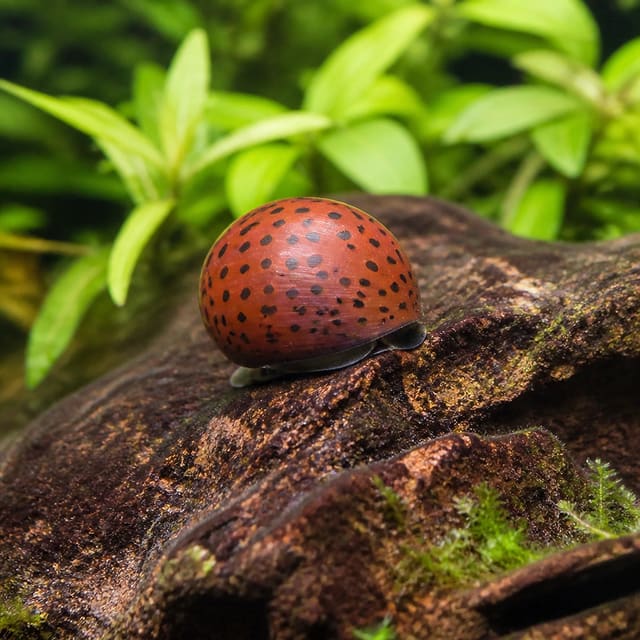
Red Spotted Nerite Snail (Neritina sp.)
17–27°C · pH 6.5–8
£3.99

Add a striking King Koopa nerite snail to your tank for natural algae control and character. Moderate care, ideal for freshwater setups. Order now for UK delivery.
Adult size is the maximum length this species reaches at full maturity (scientific sources). The livestock you receive will be younger and smaller. Product-photo provenance and any image-specific limitations are stated on the listing.
Neritina sp.
Lives in groups: kept together they stay settled, active and show their best colour.
Confirm your email, then we’ll send an availability message for this exact item if it returns within 180 days.
This request is only for this product—no newsletter or other promotions. A mail-provider retry may very rarely duplicate the same availability message. Unconfirmed addresses are removed after 48 hours. See our privacy policy.
Add a striking King Koopa nerite snail to your tank for natural algae control and character. Moderate care, ideal for freshwater setups. Order now for UK delivery.
Adult size is the maximum length this species reaches at full maturity (scientific sources). The livestock you receive will be younger and smaller. Product-photo provenance and any image-specific limitations are stated on the listing.
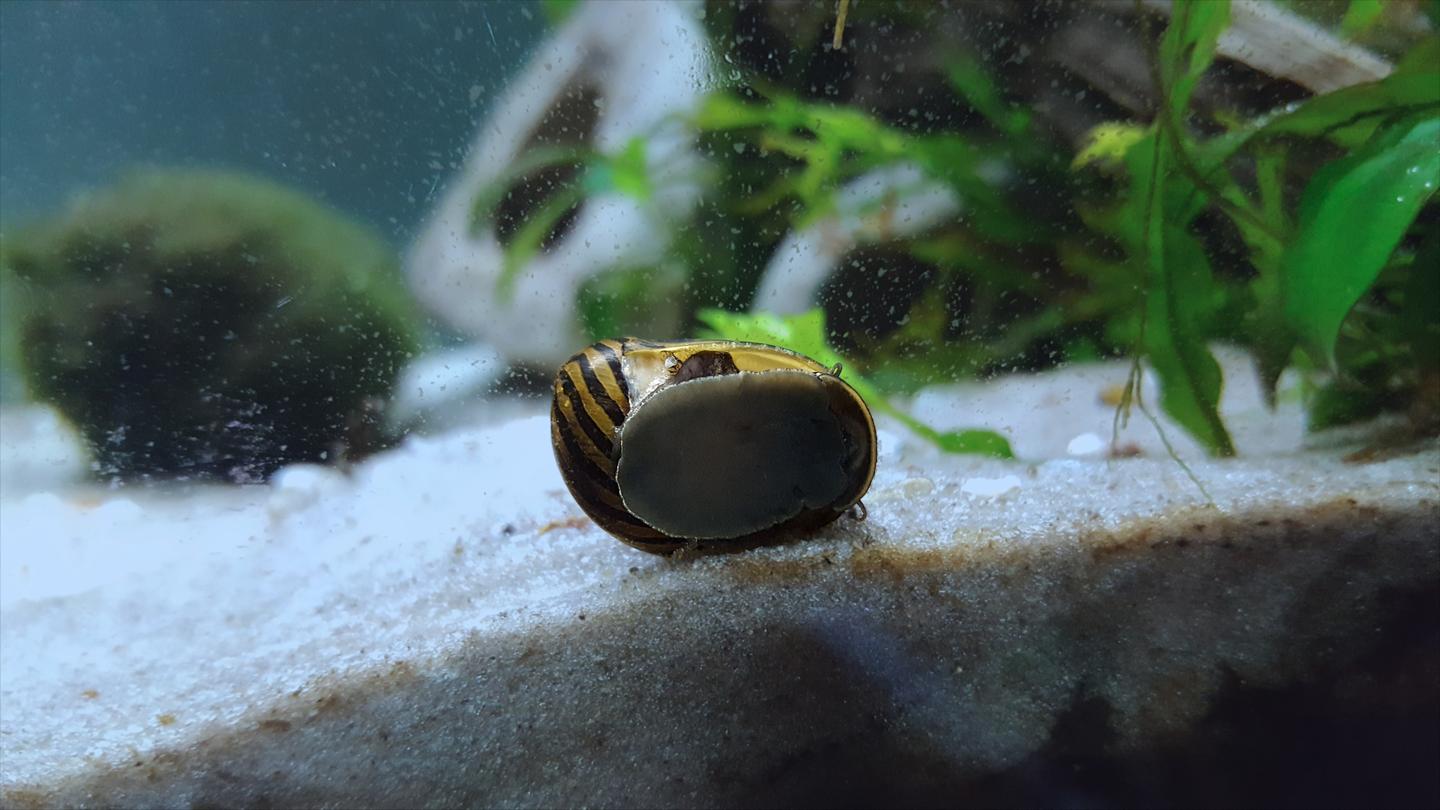
Nerite snail is a trade umbrella, not one species. Confirm the supplied taxon and holding water, use a mature covered aquarium with established grazing surfaces, stock from food availability rather than a litre formula, and treat egg capsules, medicines and tank mates as species-specific decisions.
Maintain these water conditions for optimal health and vibrant colors
The King Koopa Nerite Snail, listed in the hobby as Neritina juttingae (and sometimes as Neritina sp.), is one of the most eye-catching algae grazers you can add to a freshwater aquarium. Its bold shell pattern, horned ridged texture and compact adult size give it the armoured look behind the King Koopa nickname. It is a peaceful freshwater snail that UK keepers value for practical algae control and striking appearance. This king koopa nerite snail stays around 2.5 cm, suits tanks from 10 litres upward, and typically lives up to 3 years in the right conditions. It is popular in the aquarium snail UK market because it combines strong algae-eating ability with a major advantage over pest snails: it will not overrun a freshwater setup. For planted tanks, shrimp communities and peaceful nano aquariums, this nerite snail offers both function and character, making it a reliable snail for sale UK choice with real day-to-day value. For full husbandry detail, see our nerite snail care guide.
The King Koopa Nerite belongs to the Neritidae family, a group of snails valued in aquariums for hard shells, active grazing and excellent algae control. In the hobby these snails are often sold under trade names based on shell pattern rather than strict species-level identification, which is why you may see both "King Koopa Nerite" and Neritina juttingae used for the same animal. Related nerites are among the best-known algae-eating snails in freshwater fishkeeping.
The King Koopa Nerite is associated with tropical coastal and river-influenced habitats across parts of the Indo-Pacific, where nerite snails naturally occur in warm, mineral-rich waters. In the wild, many nerites inhabit streams, estuaries, river margins and rocky shallows where they graze constantly on algae films, diatoms and biofilm. That natural lifestyle explains the snail's ideal aquarium conditions: stable water, hard surfaces to graze, and enough natural growth to support feeding between supplements.
These snails are adapted to areas with dissolved minerals, which is why water hardness matters so much in captivity. Soft, acidic water can slowly damage the shell, while alkaline, harder water supports better long-term shell strength. In nature they spend much of their time attached to stones, wood and submerged surfaces, moving methodically in search of edible film. This is also why a mature tank is far better than a newly set-up aquarium for a live nerite snail.
Mimicking the natural habitat of nerite snails improves shell condition and feeding success. In practice, that means using a mature aquarium with rocks, wood and glass surfaces carrying a light algae film, plus a steady mineral supply from appropriate GH and KH rather than very soft water.
If you are researching how to care for a king koopa nerite snail, start with stability. A King Koopa Nerite may be small, but it does best in a biologically mature aquarium rather than a sterile new setup. The aquarium should provide an algae film, secure décor, a tight-fitting lid and water with enough hardness to support shell health.
The recommended minimum tank size is 10 litres, but a larger tank is easier to keep stable. For a single snail, 10-20 litres works well if the aquarium is mature. For a small group, 25-45 litres is better because it offers more grazing area and more consistent water chemistry. A practical stocking rule is one snail per 15-20 litres in lightly stocked aquariums, with more possible in larger, algae-rich tanks.
The most reliable water parameters are 22-28°C, pH 7.0-8.5, and hardness of 8-20 dGH. The ideal temperature for mixed tropical community tanks is usually 24-26°C. The recommended pH level is slightly alkaline to alkaline, and the best GH and KH involve moderate to high mineral content with enough carbonate hardness to prevent pH swings. If you monitor conductivity, a moderate TDS is preferable to ultra-soft water.
The best tank setup uses gentle to moderate filtration. Sponge filters and small internal filters are excellent because they maintain oxygen and biological stability without producing extreme flow. Nerites are strong climbers, so make sure intake guards are safe and the waterline is not too close to an escape route. If you are building a nano setup, pair this snail with a reliable filter from our aquarium accessories suited to small tropical tanks.
Substrate matters less than surface area, but smooth sand or fine gravel works best. Sharp gravel can trap debris and make maintenance harder. Darker substrates often make the shell pattern stand out more in display tanks. Add rocks, wood and broad-leaf décor so the snail has multiple grazing zones.
Nerites are one of the safest snails for planted aquariums. A king koopa nerite snail in a planted aquarium works very well because the snail grazes algae from leaves without chewing healthy plant tissue. Good companions include live aquarium plants, especially slow-growing leaves and hardscape that collect biofilm. Moss, Anubias-type plants and Java fern-style planting are excellent for grazing coverage.
Moderate lighting for 6-8 hours per day usually supports enough algae film without turning the tank into an uncontrolled algae farm. If the aquarium is spotless, the snail may need more supplemental feeding. If the tank is heavily lit, monitor glass and décor growth so the snail has natural food while water quality remains stable.
Always cycle the tank for 4-6 weeks before adding nerite snails. Even though the species is sold as easy care, the real key to success is a mature biofilm layer and stable mineral content, not just ammonia and nitrite reading zero on the day of arrival.
The king koopa nerite snail diet is mainly herbivorous. In a mature aquarium these snails spend most of the day grazing algae, biofilm and soft microbial growth from glass, rocks, wood and décor. Their reputation for algae eating is well deserved, but they should not be expected to survive on a spotless tank with no natural growth.
The best staple is natural algae film in a mature aquarium. If your tank is too clean, supplement with algae wafers, spirulina foods and soft herbivore pellets. A good feeding routine includes offering food after lights-out if fish outcompete the snail during the day.
Blanched courgette, spinach, cucumber and green beans can all be used in small amounts. Leave them in for 8-12 hours, then remove leftovers. In shrimp and snail communities, many keepers also use specialist sinking foods from our sinking aquarium food range to support biofilm feeders and grazers.
Calcium-enriched snail foods can support shell health, especially in tanks where water hardness is acceptable but natural mineral intake may still be inconsistent. Occasional mineral blocks are useful, though they should complement good water chemistry rather than replace it.
In a well-established aquarium, daily supplemental feeding is not always required. Check the shell growth, body fullness and grazing activity. If the tank has visible algae and biofilm, feed 2-4 times per week. In cleaner display tanks, offer small portions daily. This is an ideal species for beginners, but beginners should still watch closely for starvation in tanks with very little algae.
| Time | Food | Amount |
|---|---|---|
| Morning | Natural algae and biofilm | Free grazing |
| Evening | Algae wafer or blanched veg | Small piece, remove leftovers |
Whether you want to buy a king koopa nerite snail in the UK or are comparing where to order one online, feeding support is one of the biggest differences between success and disappointment. A healthy snail should be active, attached firmly to surfaces and visibly grazing each day.
Useful for tanks that are very clean or newly matured, helping your King Koopa Nerite maintain condition when natural algae levels are low.
Overfeeding causes ammonia spikes, fouled substrate and poor water quality. Nerite snails need small, controlled supplements, not large piles of food. Remove uneaten vegetables promptly and never assume an inactive snail is simply "full".
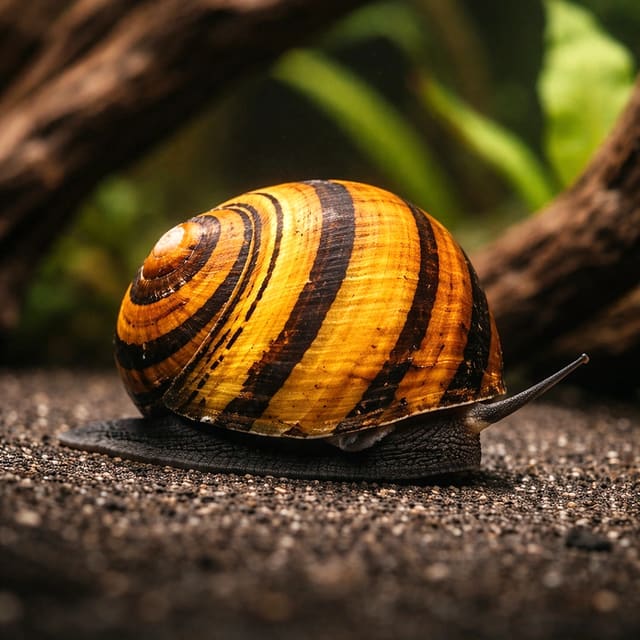
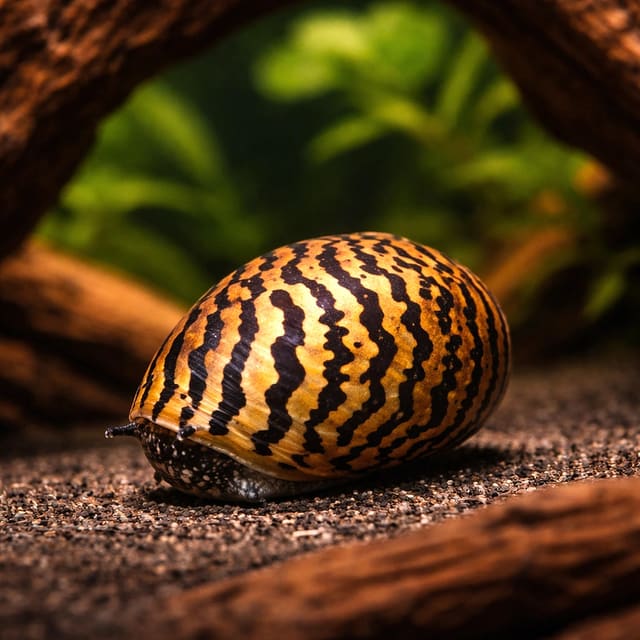
The king koopa snail is named for its bold shell shape and character-like, armoured look. Adults usually reach around 2.5 cm, with a rounded shell that can show dark brown, black, tan, amber and cream patterning. Many specimens have ridges or horn-like projections that create the distinctive sculpted appearance.
In bright aquariums with contrasting décor, the shell can look especially dramatic, standing out far more than a plain nerite. There is little reliable sexual dimorphism visible externally, so males and females are difficult to separate by eye. In mixed groups, you may only realise you have females if small white egg capsules begin appearing on hard surfaces. The main appeal is practical: this is a compact, ornamental nerite with a shell pattern that looks more striking than most standard algae snails.
Choosing tank mates for this snail is straightforward: peaceful community fish, shrimp and other non-predatory invertebrates are the best match. This species is one of the best snails for a community tank because it is calm, useful and non-destructive. It does not harass fish, uproot plants or breed explosively in freshwater.
Good safe tank mates include small rasboras, ember-type tetras, peaceful guppies, endlers, Corydoras and Otocinclus. In mixed invertebrate setups, they pair especially well with Cherry Shrimp, Amano Shrimp, Pygmy Corydoras, Ember Tetra, Otocinclus Catfish and Harlequin Rasbora. These species share similar water preferences and are unlikely to nip at the snail.
Avoid puffers, large loaches, many cichlids, crayfish and any known snail-eating fish. Assassin snails are also unsuitable, as they are predatory and may attack a peaceful nerite. Compared with a mystery snail, the King Koopa stays smaller and is usually better for focused algae control; compared with a ramshorn snail, the nerite is far less likely to become a population issue.
In a 25-litre planted nano tank, one or two King Koopa Nerites can work with a group of nano fish and shrimp. In a 60-litre planted community, 2-4 snails are often enough to provide visible grazing without exhausting the available algae. Remember this is still a nerite snail at heart; the difference from a standard nerite is mainly the distinctive shell style and trade-name identity.
| Species | Compatible? | Notes |
|---|---|---|
| Cherry Shrimp | ✅ Yes | Share peaceful behaviour and similar planted tank conditions. |
| Ember Tetra | ✅ Yes | Small, calm fish that do not bother snails. |
| Assassin Snail | ❌ Avoid | Predatory snail that may attack nerites. |
Always quarantine new arrivals for 2-4 weeks where possible. Many snail losses blamed on "bad stock" are actually caused by sudden pH shifts, copper contamination or aggressive tank mates added without proper planning.
Breeding nerite snails is very different from breeding common pest snails. Adults may mate and females may lay small white egg capsules on hard surfaces in freshwater, but successful reproduction requires brackish conditions for larval development. That is why these snails do not usually multiply in ordinary freshwater community tanks.
A true King Koopa Nerite breeding project is advanced rather than beginner-level. Adults can be conditioned in warm, hard freshwater with excellent feeding, but larvae need a separate brackish rearing system. This is why the species is often described as difficult to breed despite being easy to keep. If you see eggs in your aquarium, that is normal and does not mean a population explosion is coming.
Females deposit tiny white sesame-seed-like capsules on wood, rock, filters and even other shells. Hobbyists sometimes mistake this for disease, but it is simply normal egg laying. Nerite larvae need a saline influence to develop, so freshwater eggs rarely progress.
In freshwater, eggs typically do not hatch into viable young. In dedicated breeding systems, the challenge is managing salinity, microscopic food and larval survival, which is beyond what most community aquarists attempt. For that reason the species remains a favourite for keepers who want algae control without breeding overpopulation.
Larval nerites are not raised like baby mystery snails or ramshorns. They pass through a free-swimming stage and need specialist conditions. This is one reason there is steady demand to buy king koopa nerite snails in the UK rather than breed them at home.
If you want to experiment with nerite breeding, condition adults heavily on algae and mineral-rich foods in hard freshwater first, then move eggs or larvae to a carefully controlled brackish system. Most failures happen because salinity, microscopic food density and larval-stage timing are not matched precisely.
Comparison matters because many hobbyists are trying to solve a specific problem: algae control, easy care, shell beauty or low breeding risk. The King Koopa Nerite is best for aquarists who want a decorative algae grazer that stays small and does not overrun the tank.
| Feature | King Koopa Nerite Snail | Mystery Snail |
|---|---|---|
| Max Size | 2.5 cm | 5-6 cm |
| Care Level | Easy to moderate | Easy |
| Temperature | 22-28°C | 20-28°C |
| Best For | Algae control in planted community tanks | Larger display snail with more visible personality |
| Feature | King Koopa Nerite Snail | Ramshorn Snail |
|---|---|---|
| Breeding in Freshwater | No viable population boom | Yes, often rapid |
| Algae Grazing | Excellent | Moderate |
| Shell Pattern | Bold, armoured, ornamental | Variable but usually simpler |
| Best For | Controlled cleanup crews | Low-cost colonies and detritus cleanup |
| Tank Risk | Escape risk if lid is poor | Population risk if overfed |
Choose the King Koopa if you want one of the best snails for a community tank, where appearance and algae control matter equally. Choose a mystery snail if you want a larger, more interactive snail and have enough space. Choose ramshorns only if you are comfortable managing numbers. For many planted aquariums, the King Koopa's combination of shell beauty, manageable size and low breeding risk justifies its place. Against a standard nerite, this is essentially a decorative nerite variant with the same core care needs but a more unusual shell profile.
A healthy King Koopa Nerite should be firmly attached to surfaces, responsive when touched gently, and actively grazing most days. The body should look full rather than shrunken, and the shell should appear solid rather than chalky or pitted. The biggest long-term issue is usually shell erosion caused by soft or acidic water, not infectious disease.
Good shell health means smooth new growth near the shell opening, no flaking, and no obvious white corrosion patches. The snail should move steadily and seal itself tightly if disturbed. A healthy specimen also shows regular grazing behaviour across glass and décor.
Common issues include shell pitting, inactivity after transport, starvation in overly clean tanks, and death after copper exposure. Snails do not moult like shrimp; what people often notice instead is a pale growth line or shell wear, which relates to minerals and water chemistry rather than moulting.
If the snail is inactive, first test ammonia, nitrite, pH and hardness. Correct water chemistry before assuming disease. Move the snail to a safe, mature tank if the current setup is too new or too soft. For shell issues, improve mineral content and provide calcium-rich foods. Avoid salt treatments unless you fully understand the species and the reason for use.
Stable water, moderate hardness, algae access and copper-free care are the foundations of prevention. Avoid sudden changes in temperature or pH. Acclimate slowly on arrival, especially if the tank runs at the lower or upper end of the temperature range.
NEVER use copper-based medications with nerite snails or other invertebrates. Copper is often lethal even at low concentrations. Always read treatment labels carefully before dosing a community tank.
The behaviour profile of this snail is peaceful, methodical and useful. These snails spend most of their time grazing surfaces rather than interacting directly with fish. They are often most active during calm periods, especially early morning, evening and overnight.
The species is not social in the way schooling fish are, but it tolerates others well, so keeping more than one is fine if the tank has enough food. Always base the number of snails on available algae and surface area rather than litres alone, because too many snails in a spotless tank can lead to slow starvation.
The typical lifespan is around 3 years, and much of that depends on stress-free conditions. A snail that climbs repeatedly above the waterline may be reacting to poor water quality, but occasional exploration is normal. Their steady grazing makes them ideal for aquarists who want visible cleanup activity without aggression or plant damage.
When you are choosing a snail for sale UK listing, this is one species where condition on arrival matters enormously. A healthy King Koopa Nerite should arrive with a solid shell, good foot strength and enough stored energy to begin grazing after acclimation. We focus on supplying active, carefully packed snails suited to tropical community aquariums rather than treating them as simple cleanup extras.
Each live nerite snail order is packed for invertebrate safety with insulated materials, secure containment and seasonal heat protection when needed. The real value is not just price; it is receiving snails that have been checked for activity, shell integrity and suitability for freshwater community life.
We recommend slow acclimation on arrival, especially for pH and hardness differences, and we include practical care guidance covering tank requirements, feeding and shell support. If you are ready to buy a king koopa nerite snail in the UK, this is a species worth buying from a source that understands invertebrate handling rather than treating snails as an afterthought.
Build a more effective cleanup crew or peaceful planted display with compatible companions and essentials. Add Amano Shrimp for extra algae control, Cherry Shrimp for colour and biofilm grazing, or Otocinclus Catfish for soft algae management on leaves and glass. For calm schooling fish, consider Ember Tetras or Harlequin Rasboras. To support long-term success, browse our live aquarium plants for extra grazing surfaces and our sinking invertebrate foods for supplemental feeding in cleaner tanks.
No reviews for this item yet. Bought one? Honest reviews only, good or bad.
What customers say about ordering from us
I have a small group of long finned mountain minnows. So was delighted to be able to order ten of this variety to increase the genetics in my tank . The ones I recieved are healthy but it’s to early to give a verdict on wether they are of a long finned type since they are small currently.
Gordon Walker · 23 Sept 2026
100% success travel and "installation". Pleased with quality of purchase. The Siamese fighter a bit "shy" so have not yet seen him at his best yet but looking good. Happy customer. GG
George E Garratt · 21 Sept 2026
Reviews of our shop, collected by Judge.me, an independent third-party review collector. Newest first.