Gunther's Nothobranch (Nothobranchius guentheri)
22–25°C · pH 6–7
£11.99

A seasonal East African annual killifish with red fin contrast, black-spotted female patterning and specialist substrate-spawning behaviour. Best in a covered species-first setup.
Adult size is the maximum length this species reaches at full maturity (scientific sources). The livestock you receive will be younger and smaller. Product-photo provenance and any image-specific limitations are stated on the listing.
Nothobranchius melanospilus
Save when buying multiple fish. Each quantity is one fish; sex and pair formation are not guaranteed unless the selected variant explicitly states them.
Confirm your email, then we’ll send an availability message for this exact item if it returns within 180 days.
This request is only for this product—no newsletter or other promotions. A mail-provider retry may very rarely duplicate the same availability message. Unconfirmed addresses are removed after 48 hours. See our privacy policy.
A seasonal East African annual killifish with red fin contrast, black-spotted female patterning and specialist substrate-spawning behaviour. Best in a covered species-first setup.
Adult size is the maximum length this species reaches at full maturity (scientific sources). The livestock you receive will be younger and smaller. Product-photo provenance and any image-specific limitations are stated on the listing.
Maintain these water conditions for optimal health and vibrant colors
The Black Spotted Nothobranch (Nothobranchius melanospilus) is a seasonal East African annual killifish for aquarists who enjoy specialist behaviour, fast life cycles and vivid colour in a small, carefully managed aquarium. Our current fish are supplied at about 2.5-3.5 cm; adults can be larger, so plan the aquarium for mature fish rather than only the arrival size.
This is not a generic community fish. It is best kept as a species-first project in a covered, quiet aquarium with soft spawning media, gentle filtration and frequent small feeds. Kept well, it rewards you with active displays, bold red and dark fin contrast, and fascinating annual-killifish breeding behaviour.
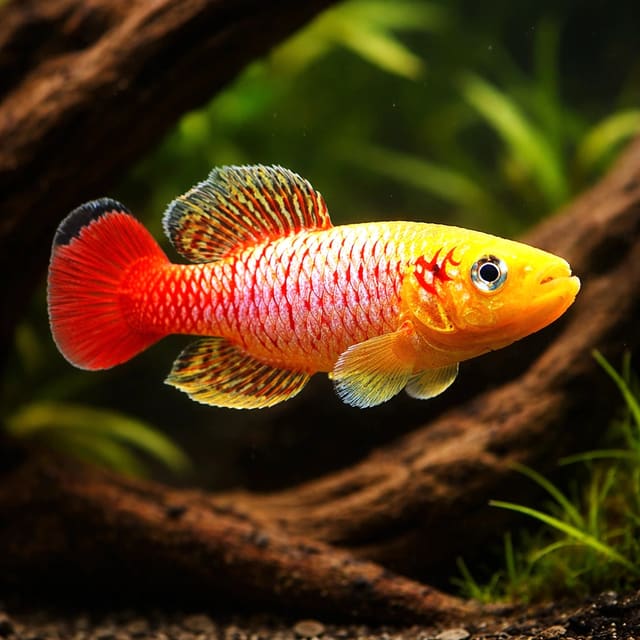
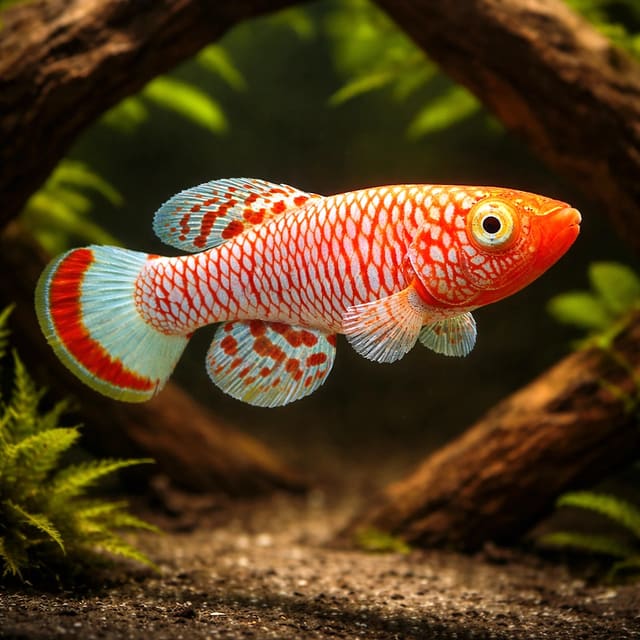
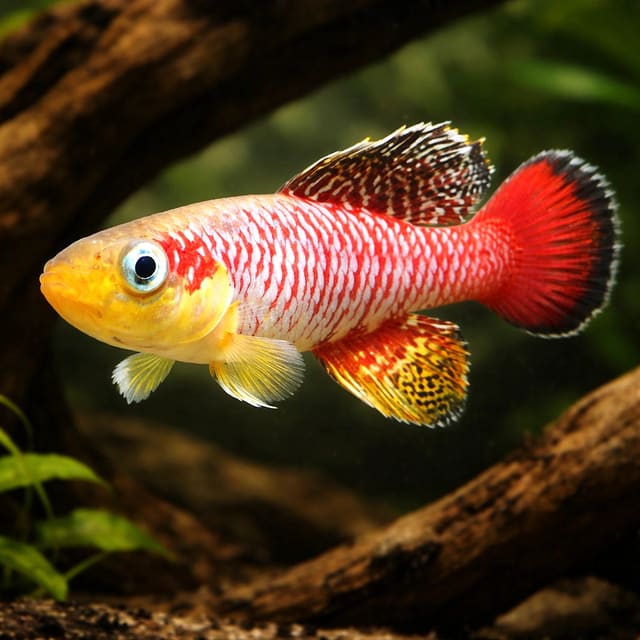
The original reference photo shows a compact fish with a warm peach-to-rose body, pale blue-white scale highlights, a red caudal fin and darker red-brown dorsal and anal fins. Specialist descriptions note that males can show a red caudal fin with dark edging, while females carry the irregular black spotting that gives the species its name. Use subdued lighting, dark background tones and floating plants if you want the metallic scale pattern and fin colour to stand out.
Nothobranchius melanospilus belongs to a group of seasonal Nothobranchius from coastal East Africa. FishBase records temporary pools, floodplains, rice fields, swamps, ditches and small streams. WildNothos gives a newer specialist treatment that narrows true N. melanospilus around coastal Tanzania and Zanzibar after some older Kenya/Tanzania hobby records were revised into related forms. For a retail care page, the practical point is consistent: this fish is adapted to shallow seasonal habitats that fill, warm, grow vegetation and then dry.
Because of that natural cycle, adults grow quickly, spawn in soft bottom material and the eggs survive a dry rest before hatching when water returns. The aquarium should copy the useful parts of that habitat, not the instability: clean warm water, soft spawning media, cover, gentle flow and a secure lid.
A 40 litre aquarium is a sensible starting point for a pair or one male with two females; use more space if keeping multiple males. Add a tight lid, sponge or gentle internal filtration, floating plants, fine-leaved plants or spawning mops, and a soft spawning container with peat substitute, coir or fine fibre if breeding is intended. Keep the layout simple enough that you can remove and check spawning media without disturbing the whole tank.
Use subdued light and avoid strong current. Annual killifish often look best in quiet tanks with dark substrate, leaf-litter-style cover and open feeding space. They are small, fast feeders and can jump, so every gap around cables and filter returns matters.
Aim for 22-26 C, pH 6.0-7.5 and stable, clean water. The species is associated with temporary habitats, but that does not mean poor aquarium water is acceptable. Keep ammonia and nitrite at zero, keep nitrate low, and use regular small water changes rather than large swings. A mature sponge filter is ideal because it gives biological stability without pushing small fish around.
Feed small live and frozen foods such as newly hatched or adult brine shrimp, daphnia, mosquito larvae, chopped bloodworm and similar small carnivore foods. Good micro pellets can be used as a support food, but this fish should not be treated as a dry-food-only species. Small meals once or twice daily are better than heavy feeding, especially in smaller aquariums where waste builds quickly.
Black Spotted Nothobranch are lively, seasonal killifish with male display behaviour. Males may chase each other and can be hard on females in breeding condition, so provide cover and avoid overcrowding. A species-only setup is the safest recommendation. In larger, carefully planned aquariums, only choose calm fish that will not outcompete them for food or nip fins. Avoid shrimp and very small fry with them, and avoid boisterous community fish, large predators, fin nippers and species needing hard alkaline water.
This is a substrate-spawning annual killifish. Condition fish with live and frozen foods, then provide peat substitute, coir or a suitable spawning medium. Eggs are normally stored damp rather than underwater for an incubation period; published hobby guidance varies with temperature, moisture and population, with specialist notes commonly ranging from several weeks to a few months. Fry are usually able to take newly hatched brine shrimp soon after hatching. If you are new to annual killifish, read a dedicated Nothobranchius breeding guide before attempting egg storage.
Your fish are packed for live-animal courier delivery and covered by our Live Arrival Guarantee. New customers can use WELCOME10 for a first-order discount when the code is active at checkout. Please make sure the aquarium is mature, covered and ready before ordering; annual killifish settle best when they can move straight into stable, quiet water with small foods available.
No reviews for this item yet. Bought one? Honest reviews only, good or bad.
What customers say about ordering from us
I have a small group of long finned mountain minnows. So was delighted to be able to order ten of this variety to increase the genetics in my tank . The ones I recieved are healthy but it’s to early to give a verdict on wether they are of a long finned type since they are small currently.
Gordon Walker · 23 Sept 2026
100% success travel and "installation". Pleased with quality of purchase. The Siamese fighter a bit "shy" so have not yet seen him at his best yet but looking good. Happy customer. GG
George E Garratt · 21 Sept 2026
Reviews of our shop, collected by Judge.me, an independent third-party review collector. Newest first.