Advanced
Gunther's Zanzibar Gold Nothobranch (Nothobranchius guentheri)
22–25°C · pH 6–7
£10.99

East African annual killifish with red/green fin colour and seasonal breeding behaviour. Best in a covered species-first setup with small live and frozen foods.
Adult size is the maximum length this species reaches at full maturity (scientific sources). The livestock you receive will be younger and smaller. Product-photo provenance and any image-specific limitations are stated on the listing.
Nothobranchius jubbi
Save when buying multiple fish. Each quantity is one fish; sex and pair formation are not guaranteed unless the selected variant explicitly states them.
Confirm your email, then we’ll send an availability message for this exact item if it returns within 180 days.
This request is only for this product—no newsletter or other promotions. A mail-provider retry may very rarely duplicate the same availability message. Unconfirmed addresses are removed after 48 hours. See our privacy policy.
East African annual killifish with red/green fin colour and seasonal breeding behaviour. Best in a covered species-first setup with small live and frozen foods.
Adult size is the maximum length this species reaches at full maturity (scientific sources). The livestock you receive will be younger and smaller. Product-photo provenance and any image-specific limitations are stated on the listing.
Maintain these water conditions for optimal health and vibrant colors
Jubb's Nothobranch (Nothobranchius jubbi) is an East African annual killifish for keepers who enjoy specialist, short-lived, highly colourful fish. It is not a standard community filler. The attraction is the full annual-killifish story: fast growth, intense male colour, daily substrate spawning and eggs adapted to survive a dry season before the next hatch.
This listing is for young stock around 2.5-3.5 cm.
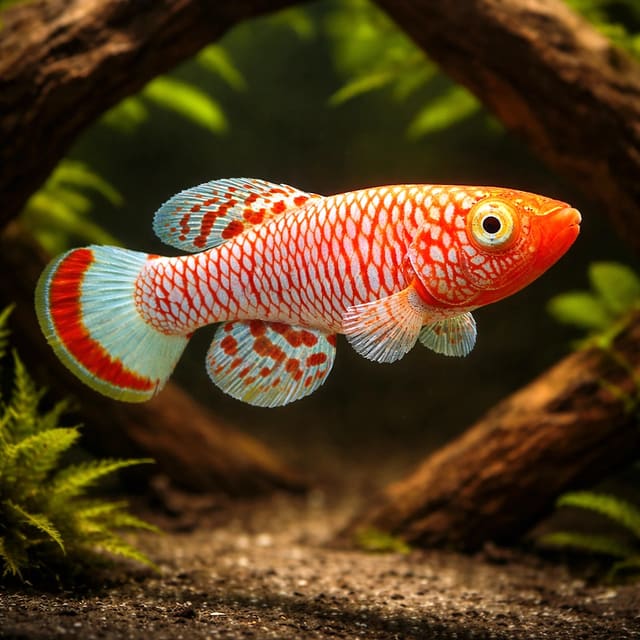
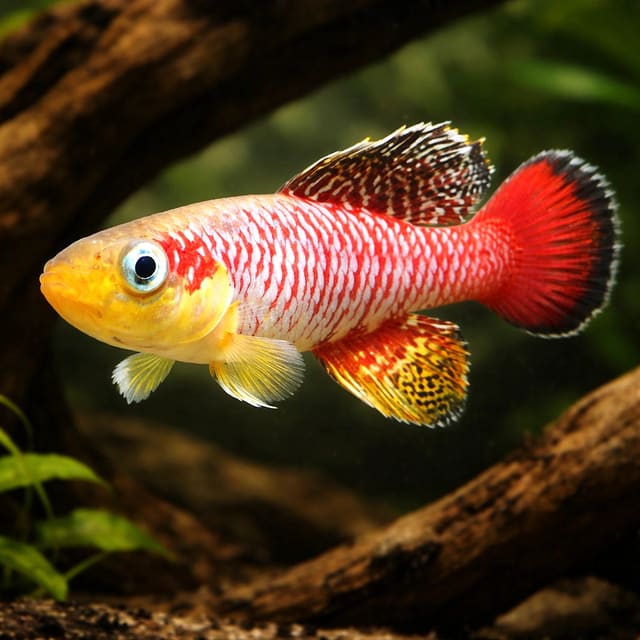
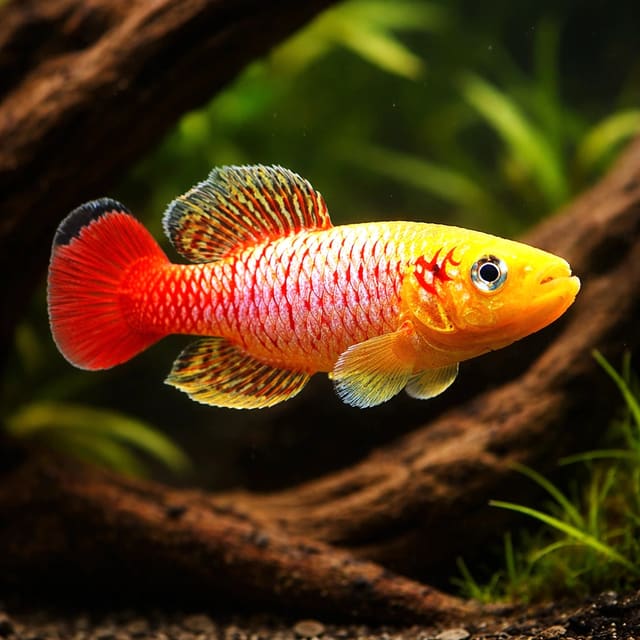
The source fish shows a pale golden body with a blue-pink sheen across the scales, green dorsal and anal fins, and a bold red caudal fin edged darker. WildNothos notes that Nothobranchius jubbi is polychromatic, with red-caudal, blue-caudal and intermediate forms. That matters for buyers: colour expression can vary between strains, sex, maturity and settling condition.
Males are the display fish, especially once settled and conditioned. Females are usually plainer, shorter-finned and less intensely coloured. Use subdued light, plant cover and a darker base if you want the fish to feel secure and show the best colour.
FishBase places Nothobranchius jubbi in the lower Tana and Sabaki river drainages in eastern Kenya and the Juba river drainage in southern Somalia, with reports from the Wabi Shebele basin in Ethiopia. WildNothos gives the type locality as a pool on the road to Garsen north of Malindi in the Kenyan coastal lowlands and describes the species from seasonal freshwater habitats in eastern/coastal Kenya and southern/coastal Somalia.
These fish live in temporary pools, swamps, marshes, ditches and rain pans, often without connection to permanent river channels. Adults grow, feed and spawn while water is present. When the habitat dries, adults die and eggs remain in the substrate until seasonal rains return. That is why aquarium care should focus on a calm, covered, species-first setup rather than a busy mixed community.
Use a mature aquarium of at least 40 litres for a pair, trio or carefully balanced small group. A tight lid is essential because killifish jump. Keep flow gentle, avoid bright bare layouts and use plants, floating cover, Java moss, leaf litter, roots or spawning mops to break sightlines. A small container of peat, coir or fine spawning medium can be added if breeding is planned.
For routine care, aim for stable, clean water rather than chasing extremes. A practical aquarium range is 22-26 C, pH around 6.8-7.8 and soft to moderately hard water. WildNothos field observations include warmer water and a broad pH range, but in a home aquarium cooler, stable conditions usually give better control and reduce stress. Keep ammonia and nitrite at zero and nitrate low with regular small water changes.
Jubb's Nothobranch is a small carnivorous micro-predator. FishBase describes the species as feeding on insects and aquatic invertebrates, and British Killifish Association maintenance guidance for nothos highlights frozen bloodworm, cyclops, black mosquito larvae, live daphnia, white worm and similar foods. Offer small portions of live and frozen food once or twice daily, removing leftovers quickly.
Fine prepared foods may be accepted, but they should not be the whole diet if you want strong colour, breeding condition and steady health. Because annual nothos have a strong appetite and are often kept with gentle filtration, clean feeding habits are part of the care requirement.
This species is better described as peaceful but specialist. Males display to females and may show off or spar with each other, especially in smaller tanks or under bright conditions. Use cover, line-of-sight breaks and a sensible sex ratio. The safest recommendation is a species-first aquarium. If tank mates are attempted, choose only very calm, similarly sized fish in a larger planted setup and watch feeding closely.
Avoid large fish, aggressive cichlids, fin-nippers, fast feeders, boisterous barbs and tiny shrimp that may be eaten. The fish is small, quick and colourful, but it should not have to compete with heavy community fish for food.
Nothobranchius jubbi is a bottom-spawning annual killifish. FishBase records daily spawning over an extended period, with eggs laid a few at a time into bottom sediments. WildNothos describes a semi-annual life cycle and captive peat incubation of about three to four months at room temperature. In practice, breeders use peat, coir or fine media, store eggs damp, and re-wet when embryos are developed.
This breeding style is rewarding, but it needs planning. Fry usually require very small live foods such as newly hatched brine shrimp once they are ready, and water quality must stay excellent. If you only want a display fish, you can still enjoy the species, but expect a naturally short annual rhythm.
You will receive fish from the listed SKU and supplied size band. Use code WELCOME10 for 10% off your first order where the promotion is active. Livestock orders are packed for live-animal courier delivery, and eligible fish are covered by our Live Arrival Guarantee when the delivery instructions are followed.
Care notes draw on reference media/data, FishBase, WildNothos, Nothobranchius Maintenance Group and British Killifish Association maintenance guidance.
No reviews for this item yet. Bought one? Honest reviews only, good or bad.
What customers say about ordering from us
I have a small group of long finned mountain minnows. So was delighted to be able to order ten of this variety to increase the genetics in my tank . The ones I recieved are healthy but it’s to early to give a verdict on wether they are of a long finned type since they are small currently.
Gordon Walker · 23 Sept 2026
100% success travel and "installation". Pleased with quality of purchase. The Siamese fighter a bit "shy" so have not yet seen him at his best yet but looking good. Happy customer. GG
George E Garratt · 21 Sept 2026
Reviews of our shop, collected by Judge.me, an independent third-party review collector. Newest first.