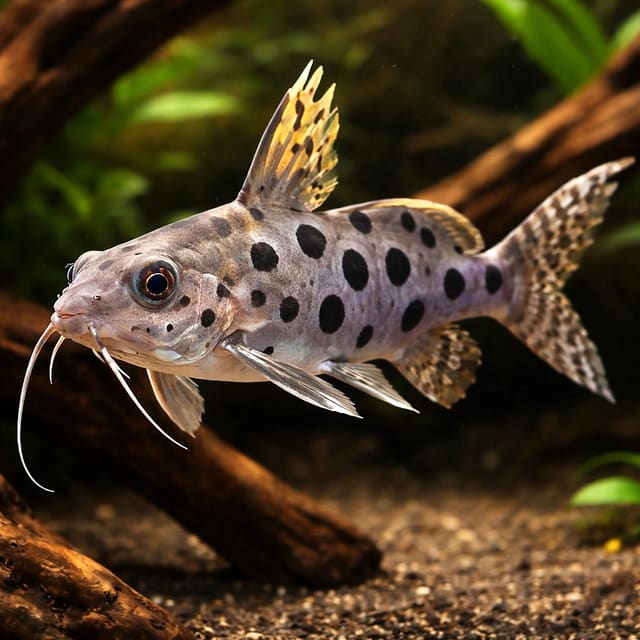
Featherfin Synodontis (Synodontis eupterus)
22–26°C · pH 6.2–7.5
£6.99
A peaceful, social Congo-basin catfish that naturally swims upside down beneath leaves and wood. Best kept in a shaded group aquarium; 22-26C, pH 6.0-7.5.
Adult size is the maximum length this species reaches at full maturity (scientific sources). The livestock you receive will be younger and smaller. Product-photo provenance and any image-specific limitations are stated on the listing.
Synodontis nigriventris
Shoaling fish: kept in a group they feel safer, stay calmer and show their best colour.
Confirm your email, then we’ll send an availability message for this exact item if it returns within 180 days.
This request is only for this product—no newsletter or other promotions. A mail-provider retry may very rarely duplicate the same availability message. Unconfirmed addresses are removed after 48 hours. See our privacy policy.
A peaceful, social Congo-basin catfish that naturally swims upside down beneath leaves and wood. Best kept in a shaded group aquarium; 22-26C, pH 6.0-7.5.
Adult size is the maximum length this species reaches at full maturity (scientific sources). The livestock you receive will be younger and smaller. Product-photo provenance and any image-specific limitations are stated on the listing.
Maintain these water conditions for optimal health and vibrant colors
The Black Upside-Down Catfish (Synodontis nigriventris) is a peaceful, social African catfish best known for swimming and resting upside down beneath leaves, wood and shaded decor. It stays compact for a Synodontis, with FishBase listing a maximum length of about 9.6 cm, so it suits a well-furnished community aquarium when kept with calm tank mates that are too large to be swallowed.
This is the true Upside-Down Catfish, also sold as the Blotched Upside-Down Catfish or black-bellied upside-down catfish. The dark belly and paler back are normal for the species: the reversed colour pattern helps it blend in while feeding from the underside of the water surface, plant leaves and wood. Keep it in a group where possible; a single fish often hides, while a small shoal is much more confident.
| Quick fact | Black Upside-Down Catfish |
|---|---|
| Scientific name | Synodontis nigriventris |
| Other names | Upside-Down Catfish, Blotched Upside-Down Catfish, black-bellied upside-down catfish |
| Family | Mochokidae |
| Origin | Middle Congo River basin, including Congo, Democratic Republic of the Congo and Cameroon records |
| Adult size | About 9-10 cm; FishBase lists 9.6 cm maximum length |
| Temperament | Peaceful, social and mostly nocturnal |
| Best group size | Keep several together where tank space allows; FishBase and UK trade guidance recommend groups |
| Minimum aquarium | 80 litres or more, with shaded cover and stable filtration |
| Temperature | 22-26°C on this listing; source ranges commonly sit around 22-28°C |
| pH / hardness | pH 6.0-7.5; soft to moderately hard water |
| Diet | Omnivore: sinking foods, catfish pellets, frozen foods, small live foods and some plant/algae material |
| Care level | Moderate; hardy once settled, but needs clean water, cover and appropriate companions |
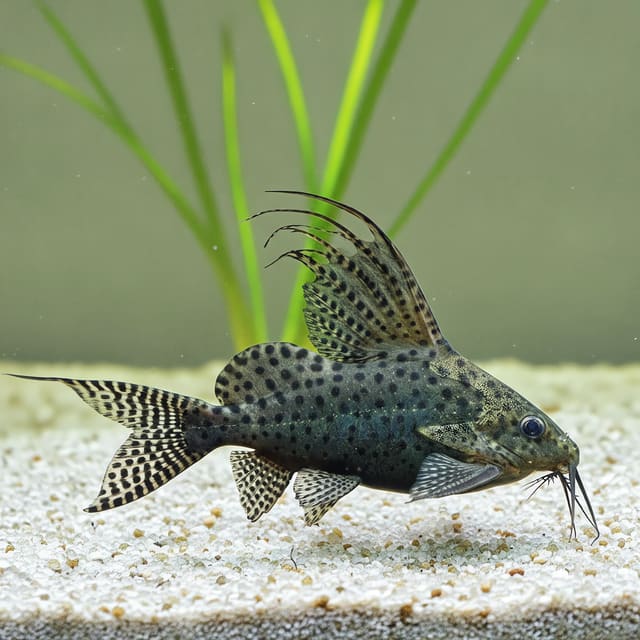
Synodontis nigriventris has a chunky, compact body, large eyes, a tall dorsal fin and long sensory barbels. The mottled brown, black and cream pattern helps it disappear against roots, leaves and shaded surfaces. The key identification feature is the reversed countershading: the underside is darker than the back, which makes sense for a fish that often presents its belly to the light while inverted.
Do not mistake normal upside-down posture for illness in this species. Healthy fish should still be alert, balanced, responsive and able to swim normally when they choose, but resting or feeding inverted is the expected behaviour.
This species is associated with the Congo system and surrounding Central African waters. Reference sources place it in the middle Congo River basin, including Pool Malebo, Kasai and Ubangi drainages, with records from Cameroon, Congo and the Democratic Republic of the Congo. In nature it uses vegetated margins, shaded banks, wood, roots and overhanging structures rather than bright open water.
In the aquarium, that means the best display is not an empty bright tank. Give the fish a shaded, structured layout with wood, caves, sturdy plants and broad leaves or overhangs where it can browse and rest upside down.
| Care point | Good practice | Why it matters |
|---|---|---|
| Cover | Wood, caves, tubes and plant shade | Reduces stress and encourages visible natural behaviour |
| Group | Keep several if space allows | More confidence, less hiding and better social behaviour |
| Water quality | Stable, clean, well-oxygenated water | Synodontis are robust, but poor nitrate control damages long-term health |
| Feeding access | Offer both sinking foods and foods near upper surfaces | This species feeds from below surfaces as well as from the substrate |
The Black Upside-Down Catfish is a peaceful community catfish, but it is still a small omnivorous catfish. Choose companions of similar peaceful temperament and avoid fish that are either tiny enough to be viewed as food or large enough to bully or swallow it.
| Usually suitable | Use caution or avoid |
|---|---|
| Peaceful tetras and rasboras | Large predatory catfish or cichlids |
| Calm barbs of suitable size | Fin nippers and very boisterous species |
| Peaceful dwarf cichlids in compatible water | Tiny fry, very small shrimp or delicate nano fish |
| Other peaceful bottom fish with enough floor space | Aggressive territorial bottom dwellers in cramped tanks |
For more African catfish options, browse the Synodontis catfish collection.
FishBase records this species feeding mainly at night on insects, crustaceans and plant matter. In the aquarium it accepts a broad omnivore diet: quality sinking catfish tablets, small pellets, frozen bloodworm, daphnia, brine shrimp and occasional algae or vegetable-based foods. Feed after lights dim if shy fish are being outcompeted.
A varied diet helps the fish keep good body condition without relying on one rich food. Remove uneaten food and keep the substrate clean, because nocturnal feeding can make it easy to miss leftovers.
Breeding is possible but not common in everyday community aquariums. Reports describe eggs placed in caves, crevices or sheltered areas, often after heavy conditioning and environmental changes that mimic rainy-season triggers. For a display aquarium, treat this species primarily as a long-term social oddball rather than an easy breeding project.
Your Black Upside-Down Catfish is packed with care by a specialist UK aquatics team and sent by licensed live-animal courier where eligible. Livestock orders are supported by our Live Arrival Guarantee, and each fish is checked before dispatch so you receive a healthy, accurately labelled specimen.
Yes. Inverted swimming and resting are normal for Synodontis nigriventris. The darker belly and lighter back are part of its adaptation for feeding and hiding while upside down.
Plan for an adult size of about 9-10 cm. FishBase lists a maximum length of 9.6 cm, which makes it one of the more manageable Synodontis for community aquaria.
They can survive alone, but they are social and normally behave better in a small group. A group gives them confidence and makes their natural upside-down behaviour easier to observe.
Use at least an 80 litre aquarium for a small group, with shaded wood, caves, broad leaves and stable filtration. Larger tanks are better when mixing with active community fish.
Do not rely on them as shrimp-safe. They are peaceful, but tiny shrimp or fry may be eaten, especially after dark.
Offer a varied omnivore diet: sinking catfish foods, small pellets, frozen bloodworm, daphnia, brine shrimp and some plant or algae-based foods. Feed near dusk if they are shy.
Care details were checked against FishBase for size, distribution and diet, Seriously Fish for community behaviour and aquarium care, and Practical Fishkeeping for upside-down feeding behaviour.
No reviews for this item yet. Bought one? Honest reviews only, good or bad.
What customers say about ordering from us
Easy website plenty of info on fish your buying great to pick a time slot
TRACEY DURRANT · 7 Oct 2026
Got some lovely fish thank you
Kevin Mackie · 7 Oct 2026
Reviews of our shop, collected by Judge.me, an independent third-party review collector. Newest first.