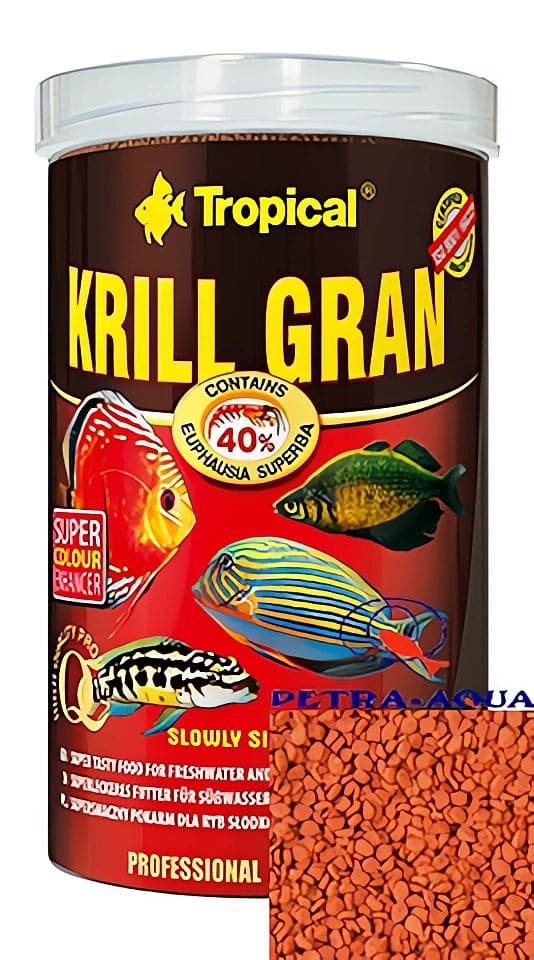
Tropical Krill Gran
£18.29

Tropical Astacolor is a complete colour-enhancing flake food for omnivorous and carnivorous ornamental fish, with astaxanthin, red pepper extract and spirulina.
Tropical Astacolor is a complete colour-enhancing flake food for omnivorous and carnivorous ornamental fish, with astaxanthin, red pepper extract and spirulina.
Tropical Astacolor Flakes are a complete, colour-enhancing food for omnivorous and carnivorous ornamental fish. The formula combines a high declared protein level with astaxanthin, red pepper extract and spirulina, making it a purposeful choice for fishkeepers who want a flake food that supports natural red, orange and warm colour tones. It is suitable for fish that readily feed at the surface or through the water column, including many discus, angelfish, gouramis, rainbowfish, barbs and larger tetras.
This is not a universal food for every aquarium animal. Bottom-feeding fish may miss floating flakes, strongly herbivorous species can need a more plant-led staple, and specialist predators may need a different food form or diet. The guide below explains the current manufacturer specification, the three available container sizes, practical feeding, storage and how to decide whether Astacolor belongs in your feeding rotation.
Astacolor is a prepared dry food in a flake format. Tropical describes it as a complete feed rather than a treat or single-ingredient colour supplement. That distinction matters: the flakes provide the main macronutrients and declared vitamin additives as well as pigmentation ingredients. For suitable fish, they can form a regular part of the diet; they do not need to be sprinkled over another food to work.
The flake form spreads across the surface, softens in water and breaks into smaller pieces as fish bite it. This makes it easy to share among several surface and mid-water feeders, and it also allows the keeper to crush a portion for smaller mouths. It is less suitable when all inhabitants feed from the substrate or when a dominant fish intercepts every flake before slower tank mates can eat.
Astacolor is often associated with discus because colour and body condition are closely watched in display discus aquariums. The manufacturer's scope is broader, however: omnivorous and carnivorous ornamental fish. Species name alone is not enough to decide suitability. Mouth size, normal diet, feeding zone, age and individual acceptance all matter.
A good candidate is an ornamental fish that accepts flake food and eats animal-rich prepared diets. Many discus, angelfish, gouramis, rainbowfish, barbs, livebearers and medium or large tetras fit that description. Some dwarf cichlids and community fish will also take it readily. Introduce a small amount first and watch the whole group rather than assuming every fish in a mixed aquarium has eaten.
Astacolor may be used for discus, but it should not be described as the only possible or automatically best food for every discus. Young fish, breeding adults, recently imported fish and individuals accustomed to granules or frozen food can have different feeding needs. In a warm discus aquarium, offer small fresh portions and remove leftovers promptly because uneaten flakes deteriorate faster at higher temperatures.
| Fish or feeding situation | Fit | Practical note |
|---|---|---|
| Discus and angelfish that accept flakes | Good potential fit | Use an appropriate portion and make sure slower fish receive food. |
| Omnivorous community fish | Often suitable | Match the flake size to the smallest mouth and observe distribution. |
| Carnivorous ornamental fish that take prepared flakes | Potentially suitable | Check the species' full dietary requirements; food form and prey response vary. |
| Bottom feeders | Not sufficient on its own | Add a suitable sinking food where required. |
| Strongly herbivorous or algae-grazing specialists | Usually not the first-choice staple | Use a diet designed around that species' plant and fibre needs. |
| Fry with very small mouths | Only if finely crushed and appropriate | Many fry need a dedicated micro-food or live first food instead. |
| Pond fish, turtles and other non-target animals | No | Choose a food formulated for the species and water temperature. |
Fish cannot manufacture every pigment involved in their visible colour. Colour ingredients in the diet provide compounds that may be deposited in the skin and scales, particularly in red, orange and yellow areas. The current Astacolor specification declares astaxanthin and red pepper extract, while spirulina contributes further natural pigments and nutrients.
Colour food supports the expression of colours a fish is genetically able to show; it does not repaint the fish or create markings that are not present. Results also depend on maturity, sex, social status, stress, health, lighting, background, water conditions and the rest of the diet. A pale or darkened fish should not automatically be given more colour food: first check behaviour, breathing, water quality, aggression and other signs of a husbandry or health problem.
More is not better. Feeding excessive quantities to chase faster colour can pollute the aquarium and unbalance the diet. Use the flakes as directed, assess changes over weeks rather than individual meals, and maintain stable aquarium care alongside nutrition.
The following composition is taken from Tropical's current Astacolor product information. Ingredient lists can change, and stock from another production run or market may carry a different label. The declaration on the container you receive is the authority for that pack, especially where allergies, sensitivities or a tightly controlled breeding diet are relevant.
| Ingredient group | Current manufacturer declaration |
|---|---|
| Animal and marine ingredients | Fish and fish products; molluscs and crustaceans |
| Plant and cereal ingredients | Cereals; vegetable protein extracts; products of vegetable origin |
| Specified colour ingredient | Red pepper extract at 3,500 mg/kg |
| Algae | Algae, including Spirulina platensis at 2% |
| Other declared groups | Yeasts; oils and fats; feed materials of mineral origin |
Because the formula includes fish, mollusc and crustacean materials, it is not a vegetarian feed. Spirulina is present at 2%, but that does not make Astacolor a specialist high-spirulina or herbivore formula. Aquarists caring for algae-grazing species should compare it with a more plant-led option such as Tropical Spirulina Flakes.
Analytical constituents describe measured nutrient categories, not the percentage of each ingredient. They help compare feeds, but the highest protein figure is not automatically the best choice for every species. Digestibility, amino-acid profile, feeding quantity and the animal's natural diet remain important.
| Analytical constituent | Declared amount | How to interpret it |
|---|---|---|
| Crude protein | 48% | A protein-rich prepared food for the intended omnivorous and carnivorous ornamental fish. |
| Crude fat | 7.8% | Contributes dietary energy; portion control is still required. |
| Crude fibre | 3% | This is not a high-fibre herbivore food. |
| Moisture | 6% | Keep the dry food sealed and protected from humidity after opening. |
The manufacturer's current commercial information lists the following additives per kilogram. These figures describe the feed as sold; they are not instructions to add separate vitamin or pigment supplements. Combining multiple highly fortified feeds or supplements without a reason can make the total diet harder to judge.
| Additive | Current declared amount per kg |
|---|---|
| Vitamin A | 48,500 IU |
| Vitamin D3 | 2,850 IU |
| Vitamin E | 175 mg |
| Vitamin C | 1,150 mg |
| Astaxanthin | 100 mg |
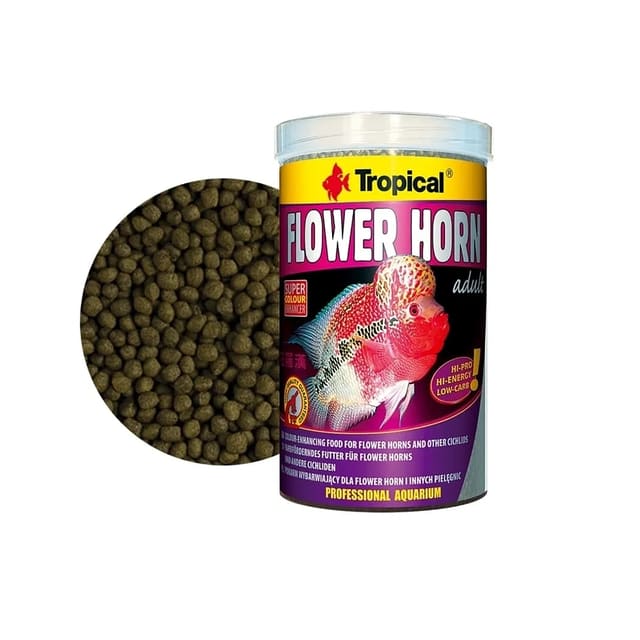
The preserved product image shows a container marked 120 mg, while Tropical's current product page declares astaxanthin at 100 mg/kg. Packaging and formula declarations can vary by production date or market. We use the current manufacturer specification on this page, but you should follow the label on the sealed container supplied to you. The gallery image illustrates the product type and is not a promise that every batch carries identical artwork or the older 120 mg declaration.
Tropical's direction is to feed several times daily in small portions adjusted to the number of fish, with all food eaten within a few minutes. Start conservatively. Add a small pinch, watch it being eaten, and only add more if the intended fish are still actively feeding. A short feeding window is a limit, not a target for keeping flakes continuously in the water.
Crush flakes between clean, dry fingers for smaller mouths. Leave larger pieces for bigger fish when that helps distribute the food, but do not assume a large fish needs a large meal. In a mixed tank, place small portions at two or more points so one dominant fish cannot intercept everything. Sinking-food specialists should receive an appropriate separate food after or away from the surface rush.
There is no universal number of flakes per fish because flake size, fish size, stocking level and appetite vary. Use body condition and measured water quality to refine the routine. Reduce food if the aquarium contains uneaten fragments, faecal waste rises, fish become overweight or nitrate accumulates faster than normal. A sudden appetite change deserves investigation rather than an automatic increase in portion.
Astacolor is declared as a complete feed, so suitable fish can receive it regularly. A complete label does not mean every species in a mixed aquarium has identical requirements, and variety can still be useful for feeding behaviour, food form and species-specific nutrition. The safest rotation is a planned one: choose complementary foods because they solve a real need, not simply because more tubs must be better.
For a broad alternative flake, compare Tropical Vitality & Color Flakes or Tropical SuperVit Flakes. Insect Menu Granules provide a different food form and ingredient emphasis for compatible fish. An occasional suitable frozen food, such as frozen food with garlic, may add variety, but frozen food should be selected for the species and handled hygienically.
Avoid building a schedule in which every meal is a colour-enhancing formula. The goal is a nutritionally suitable diet and good body condition, with colour support as one benefit. If your fish require low-protein, high-fibre, sinking, grazing, fry or medicated food, Astacolor does not replace that requirement.
Discus that already accept flakes can use Astacolor as part of a regular diet. Feed in small, clean portions and allow shy fish time to eat. Adult pairs, growing juveniles and a busy community of discus do not necessarily need the same frequency or food form, so follow the condition of the fish rather than a generic online schedule.
Some discus ignore dry flakes when first introduced, especially after being raised on granules, frozen food or another texture. Do not leave extra food in the hope that hunger will force acceptance. Offer a tiny amount alongside a familiar routine, remove leftovers and make any transition gradually. Persistent appetite loss, rapid breathing, darkening, isolation or abnormal waste calls for a water-quality and health assessment.
Astaxanthin can support the expression of red and orange colour, but it cannot determine the base colour or pattern of a discus. Genetics and environment remain central. A balanced feeding plan, stable warm water, low stress and appropriate social conditions are more important than using a colour food in isolation.
In a community tank, the challenge is distribution. Fast barbs or rainbowfish may clear the surface while slower gouramis, angelfish or tetras receive little. Feed several very small portions across the tank and watch individual fish. If food reaches the substrate, that does not guarantee bottom dwellers can use it: softened flakes may be nutritionally or physically unsuitable for them.
Flake size can be adjusted, but crushing creates fine particles that are harder to remove. Crush only the portion required and keep it coarse enough for the intended fish to see and consume. Turn down excessive surface agitation briefly if flakes disappear into an overflow before fish can reach them, but keep normal oxygenation and filtration running.
When one product is used across a mixed aquarium, check the most specialised inhabitant first. A food that suits the majority can still be wrong for an algae specialist, obligate predator, fry group or animal that is not a fish. Separate feeding methods are normal in a well-planned community.
Dry flakes absorb water and break down quickly. Uneaten food adds organic waste, increases the load on filtration and can contribute to ammonia or nitrite in an unstable aquarium and rising nitrate or phosphate over time. Astacolor is not inherently water-clouding when fed correctly; persistent particles or haze are signs to review portion size, feeding access and maintenance.
Remove obvious leftovers, maintain the filter according to the aquarium's needs and test water rather than judging it only by appearance. Clear water can still contain harmful dissolved compounds. After introducing a new food, note whether waste volume, surface film or filter debris changes and reduce the amount if required.
Colour intensity is not a reason to compromise water quality. Stress caused by poor water conditions can suppress normal colour and appetite, defeating the purpose of the food. Consistent husbandry and modest portions offer a better route than heavy feeding.
Keep the original container tightly closed in a cool, dry place away from direct sunlight, aquarium splashes and condensation. Do not store it on a warm light unit or humid lid. Use clean, dry hands or a scoop, and never return damp or uneaten flakes to the container.
Buy a pack size that can be used sensibly by your stock. A larger container may offer a lower cost per gram, but it is poor value if repeatedly exposed to humid air for far longer than a smaller pack. For a fish room or commercial collection, decant a short working supply into a clean dry container and keep the main tub sealed; retain the original label and batch information.
Follow the best-before and storage instructions on the supplied pack. Discard food that has become damp, mouldy, contaminated, unusually clumped or has developed an abnormal odour. This page does not assign an invented number of months after opening because storage conditions and the manufacturer's dated label are more reliable.
The same listing offers three manufacturer-supported sizes. Select the option in the buy box to see its current price and availability. Inventory can change, so the table describes capacity and likely use rather than promising that a particular size is in stock.
| Container | Declared weight | Usually makes sense for |
|---|---|---|
| 500 ml | 100 g | Trying the food, a modest home aquarium or a rotation with several other foods. |
| 5 L | 1 kg | Multiple aquariums, a large compatible stock or regular higher-volume use. |
| 11 L | 2 kg | Fish rooms and genuinely high-throughput feeding where freshness can be protected. |
Capacity and weight are both shown because flakes are sold in containers with a stated volume as well as a net mass. Do not compare litres alone across foods with different density. Base the decision on how much food your fish actually consume and how often the main tub must be opened.
| Food type | Main reason to choose it | Important limitation |
|---|---|---|
| Astacolor Flakes | Complete flake with a specific colour-enhancing emphasis. | Not a universal fit for bottom feeders, herbivore specialists or every life stage. |
| General tropical flake | Broad everyday feeding for compatible community fish. | May have a different pigment, protein or ingredient profile. |
| Spirulina-led flake | More plant and algae emphasis for fish whose diet calls for it. | Still needs to match the species; the word spirulina alone is not a complete suitability test. |
| Granules or pellets | Different sinking behaviour, particle size and feeding control. | Fish accustomed to flakes may need a gradual transition. |
| Frozen or live food | Variety, conditioning or a natural feeding response for suitable species. | Needs correct storage, hygiene and nutritional balance; not automatically a complete staple. |
Choose by the fish's needs and the role the food must play. Astacolor is the focused choice when a compatible fish accepts flakes and colour support is wanted within a complete prepared food. It is not better simply because it is more specialised, and a general or species-specific product may be more appropriate in another aquarium.
Choose the pack size from the live options above; the buy box shows the current price and stock state for each variant. Orders are dispatched under the current UK delivery terms shown on our delivery page. Dry fish food does not use the live-fish arrival process, so check the displayed delivery service for the complete basket at checkout.
New customers can use WELCOME10 for 10% off a first order, subject to the current discount terms. Current promotions and eligible products are listed under special offers. Keep the sealed product label when it arrives so you retain the batch, date, composition and feeding information for the exact container supplied.
Yes. Tropical currently describes Astacolor as a complete colour-enhancing flake feed for omnivorous and carnivorous ornamental fish. Suitability still depends on the species, life stage, food form and feeding behaviour.
They can be fed regularly to suitable fish because they are sold as a complete feed. Feed small portions, watch body condition and water quality, and add other food only where it improves the diet for the fish you keep.
No. Discus are a common use case, but the manufacturer's intended group is omnivorous and carnivorous ornamental fish. Many other flake-feeding tropical species may be suitable.
No. Pigment ingredients can support colours the fish is genetically capable of displaying. Genetics, age, sex, health, stress, lighting, water conditions and diet all influence the result.
Tropical's current product information declares 100 mg/kg. The preserved package image shows 120 mg, which appears to represent different packaging or a different formula declaration. Follow the label on the container you receive.
Yes. The current declaration includes Spirulina platensis at 2%. It also contains fish, mollusc and crustacean materials, so it is not a vegetarian or specialist herbivore food.
The manufacturer advises several small portions daily, adjusted to the number of fish, with the food eaten within a few minutes. Start with less and adjust from observed feeding and body condition.
Crush only the amount needed when the intact flakes are too large for the intended fish. Very fine crumbs can be missed and pollute the water, and tiny fry may require a dedicated food.
Some may pick at fallen pieces, but a surface-oriented flake should not be relied on as their complete ration. Provide a correctly formulated sinking food when the species needs one.
Correctly sized portions should be eaten promptly. Clouding, trapped particles or persistent debris usually means too much was fed, fish cannot access it, or maintenance and filtration need review.
Choose the smallest size you can use while it remains fresh. The 500 ml / 100 g pack suits lower consumption; 5 L / 1 kg and 11 L / 2 kg are intended for genuinely higher-volume use.
Close it tightly and keep it cool, dry and away from sunlight, heat and aquarium humidity. Use dry hands or a scoop and follow the best-before and storage directions on the supplied label.
No. It shows the Tropical Astacolor product type, but label artwork and declared details can vary between production runs or markets. The live size option is the purchase commitment; the delivered container label governs that batch.
Composition, analytical constituents, additives, sizes and feeding directions were checked against the current Tropical Astacolor manufacturer page. We also preserve the photographed label difference rather than silently treating it as the current formula.
Manufacturer information checked 20 July 2026. Formulas and packaging may change; always retain and follow the label on the product supplied.
No reviews for this item yet. Bought one? Honest reviews only, good or bad.
What customers say about ordering from us
I have a small group of long finned mountain minnows. So was delighted to be able to order ten of this variety to increase the genetics in my tank . The ones I recieved are healthy but it’s to early to give a verdict on wether they are of a long finned type since they are small currently.
Gordon Walker · 23 Sept 2026
100% success travel and "installation". Pleased with quality of purchase. The Siamese fighter a bit "shy" so have not yet seen him at his best yet but looking good. Happy customer. GG
George E Garratt · 21 Sept 2026
Reviews of our shop, collected by Judge.me, an independent third-party review collector. Newest first.