−13%
Moderate
Ocellated Shell-Dweller (Lamprologus ocellatus)
23–27°C · pH 7.5–9 · 40L
£16.52£18.99

Neolamprologus pectoralis is an uncommon 14 cm Tanganyika cichlid for mature hard-water aquariums. One unsexed fish per selected size grade.
Adult size is the maximum length this species reaches at full maturity (scientific sources). The livestock you receive will be younger and smaller — pick a size above for the actual shipping size. Product-photo provenance and any image-specific limitations are stated on the listing.
Neolamprologus pectoralis
Save when buying multiple fish. Each quantity is one fish; sex and pair formation are not guaranteed unless the selected variant explicitly states them.
Confirm your email, then we’ll send an availability message for this exact item if it returns within 180 days.
This request is only for this product—no newsletter or other promotions. A mail-provider retry may very rarely duplicate the same availability message. Unconfirmed addresses are removed after 48 hours. See our privacy policy.
Neolamprologus pectoralis is an uncommon 14 cm Tanganyika cichlid for mature hard-water aquariums. One unsexed fish per selected size grade.
Adult size is the maximum length this species reaches at full maturity (scientific sources). The livestock you receive will be younger and smaller — pick a size above for the actual shipping size. Product-photo provenance and any image-specific limitations are stated on the listing.
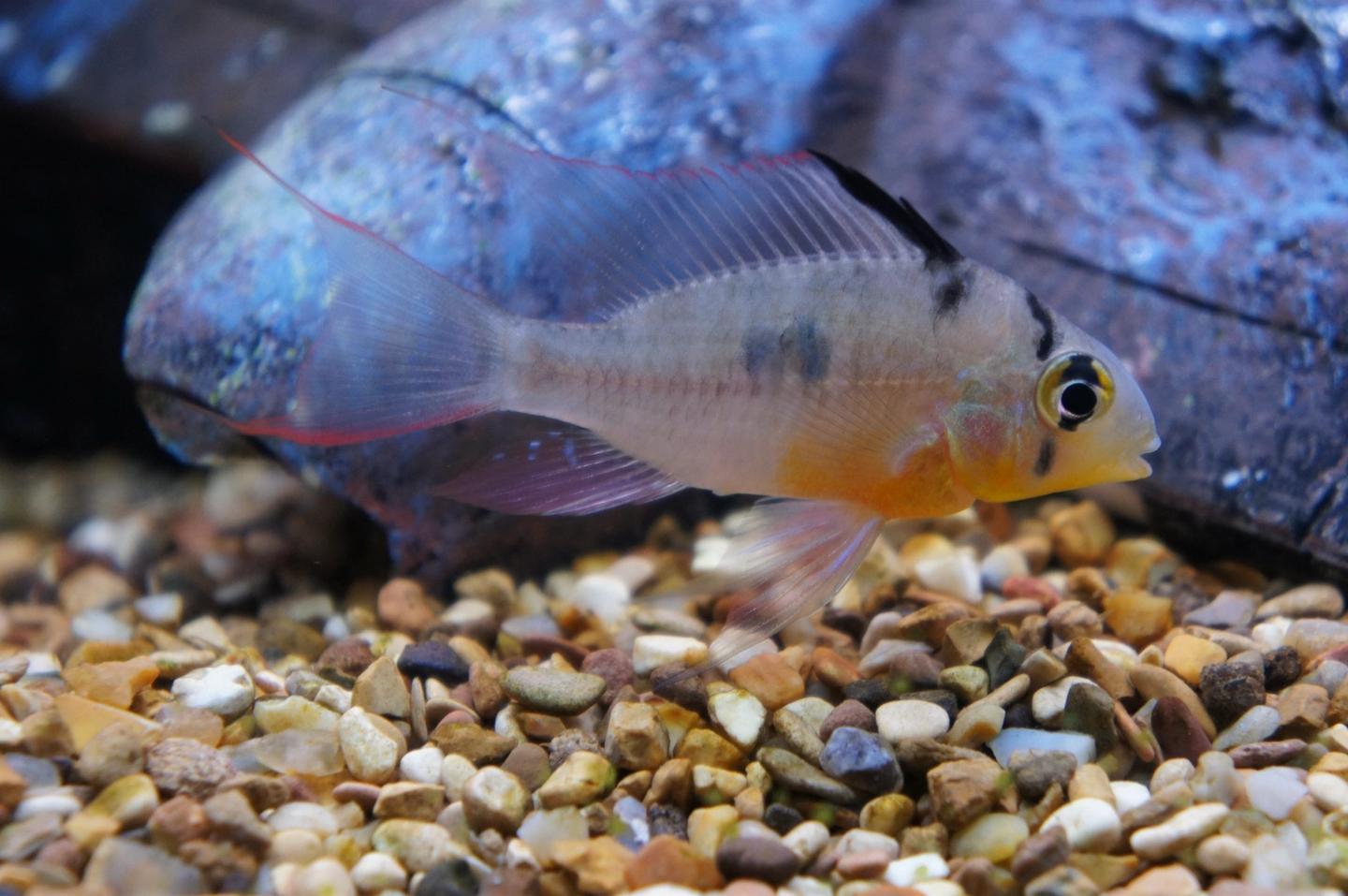
Cichlids are a family of roughly 1,800 accepted species, not one care type. Before buying, identify the exact species and source, then compare adult measurement, usable tank dimensions, social system, territory, tested water, diet and an exit plan. No family-wide minimum tank, water range or tank-mate list is safe.
Maintain these water conditions for optimal health and vibrant colors
Neolamprologus pectoralis is an uncommon rock-associated cichlid from Lake Tanganyika. Published records place it along the lake's southwestern coast in the Democratic Republic of the Congo, where it lives in deeper intermediate habitat: sand interrupted by numerous rocks, usually below 15 metres. It stays remarkably close to the contours of the rocky substrate and uses a highly developed lateral-line system while searching for small prey.
This is a specialist fish for a mature, hard and alkaline Tanganyika aquarium. The accepted published maximum is 14 cm total length, not the 8 cm figure previously shown on this listing. Adult planning must therefore provide a substantial base, secure rockwork, clean oxygen-rich water and room to separate incompatible individuals. This is not a general community fish, a beginner's impulse purchase or a species for a recently cycled aquarium.
Three approximate supplier grades may be offered through the size selector: 4-5 cm, 5-6 cm and 7-9 cm. Each selected quantity is one unsexed live fish in the selected grade. It is not a pair, a fixed group, a guaranteed male or female, or a breeding-ready animal. The grade is a practical dispatch band for a living fish; it does not certify exact millimetres, age, maturity or final adult size.
The supplier identifies the stock to species but does not provide a collection locality, breeder, wild-caught or captive-bred status, lineage, sex ratio or current batch photograph. The care information below separates published species facts from conservative aquarium planning. Where species-specific evidence is limited, the page says so instead of turning assumptions from other Neolamprologus into promises.
| Listing detail | What it means |
|---|---|
| Sale unit | One unsexed live fish per selected quantity |
| Selectable grades | Approximately 4-5 cm, 5-6 cm or 7-9 cm, subject to the live selector |
| Published adult reference | Up to 14 cm total length |
| Pair or group status | Not paired, sexed or sold as a fixed social group |
| Scientific identity | Neolamprologus pectoralis Büscher, 1991 |
| Batch provenance | No collection locality, breeder, lineage or wild/captive origin supplied |
| Gallery | One text-derived representative; not the exact fish supplied or an identification image |
| Current availability | Check the live size and quantity controls before ordering |
Living fish vary in colour, body condition and fin presentation. Juveniles can look different from settled adults, and transport can temporarily suppress colour. Select a grade for the aquarium plan rather than expecting an individual to match a single photograph. If a precise sex, locality or established pair is essential to the project, this unsexed listing does not supply that certainty.
| Care point | Evidence-led planning guidance |
|---|---|
| Family | Cichlidae, tribe Lamprologini |
| Adult size | Up to 14 cm total length in the published species record |
| Adult-planned aquarium | At least a 120 x 45 cm base for one carefully planned territory; substantially larger for any multi-fish or mixed-cichlid attempt |
| Temperature | 24-28°C, stable |
| pH | 7.5-9.0, with stability prioritised over chasing an extreme number |
| Hardness | 10-25 dH in the FishBase range |
| Habitat | Deeper intermediate sand-and-rock zone, with close contact to rocky contours |
| Diet | Invertivore-focused variety based on reported stomach contents, supplemented with suitable quality cichlid foods |
| Social planning | Individual sale; do not assume a pair or group will coexist without observation and separation capacity |
| Care level | Advanced: uncommon species, specialist chemistry, adult size and limited species-specific captive guidance |
The aquarium dimensions above are conservative shop planning guidance, not a claim that one universal minimum has been established by a controlled species study. Rock placement, territorial boundaries, tank mates and the number of fish can make a nominally large aquarium unsuitable. Use dimensions and usable floor area, not litres alone, when deciding whether the finished layout has enough room.
| A good match when... | Choose another species when... |
|---|---|
| The aquarium is mature, cycled and maintained as a hard alkaline system | The only available tank is new, soft, acidic or chemically unstable |
| You can build secure rock structures with several separated retreats | Loose rock piles or unstable decorations are part of the current layout |
| The adult 14 cm size is included in the stocking plan | The fish is being selected only because the dispatch grade is small |
| You can observe behaviour closely and separate an incompatible fish | There is no spare accommodation if territorial conflict develops |
| You are comfortable with uncertainty about sex, pairing and captive breeding | You need a guaranteed pair, locality, sex or breeding project |
| You can supply varied, appropriately sized foods and strong oxygenation | The aquarium depends on one generic food or has weak gas exchange |
An uncommon name does not make a fish a better choice. The right purchase is the one for which adult space, chemistry, equipment and a conflict plan already exist. Browse the Lake Tanganyika cichlid category to compare alternatives, but verify each species separately; fish from the same lake can occupy different habitats and display very different social behaviour.
FishBase recognises Neolamprologus pectoralis as a valid species described by Heinz H. Büscher in 1991. The name refers to a member of the lamprologine cichlids endemic to Lake Tanganyika. The species-level identity is supported by our stock records. No customer-facing supplier code is needed in the title or body.
The original description was published as "Ein neuer Tanganjikasee-Cichlide aus Zaire" in D.A.T.Z. 44(12):788-792 and is catalogued as FishBase reference 93980. That taxonomic source establishes the scientific description; it does not certify the origin of the fish in this commercial batch.
An unsupported scarcity superlative appeared in earlier sales copy but is not retained as a factual status. The species is uncommon in ordinary aquarium retail and has a narrow natural distribution, yet retail scarcity, population status and conservation risk are different concepts. FishBase now records the 2025 IUCN assessment as Least Concern. That category does not make habitat stewardship unimportant, and it does not tell us whether these particular fish were bred or collected.
Scientific records provide useful anchors for size, distribution, water and habitat. Aquarium decisions such as exact footprint, layout and social management still require judgement because published species-specific captive studies are limited. This page labels practical recommendations as planning guidance and avoids inventing certainty about lifespan, pair formation or breeding difficulty.
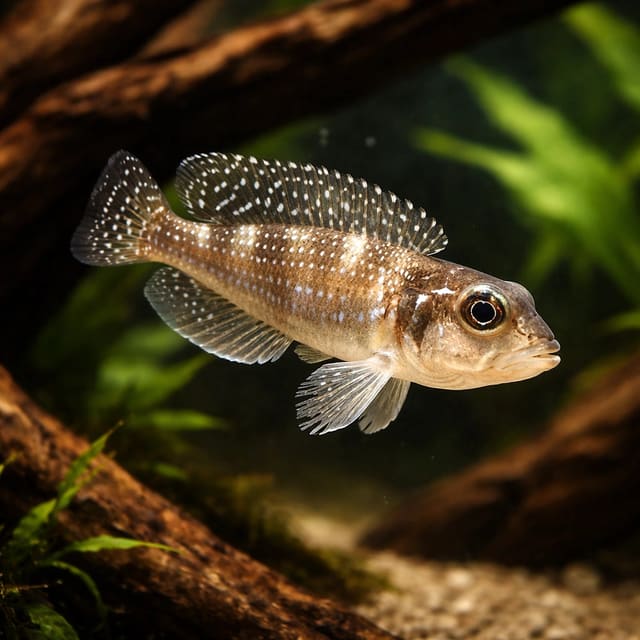
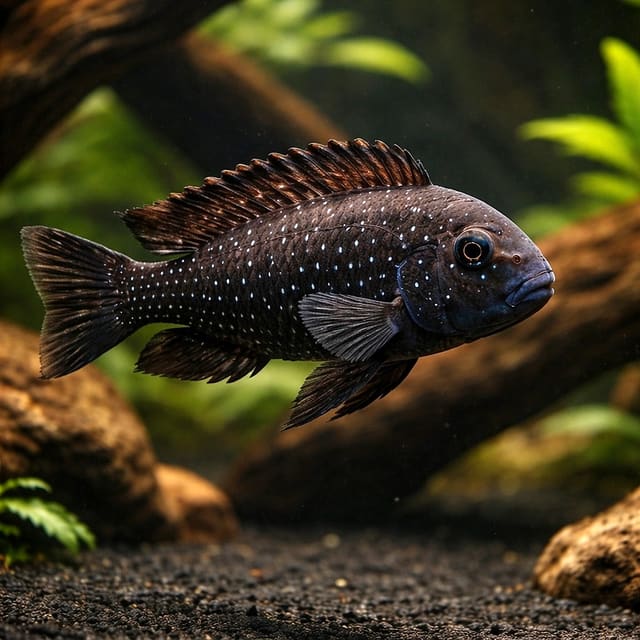
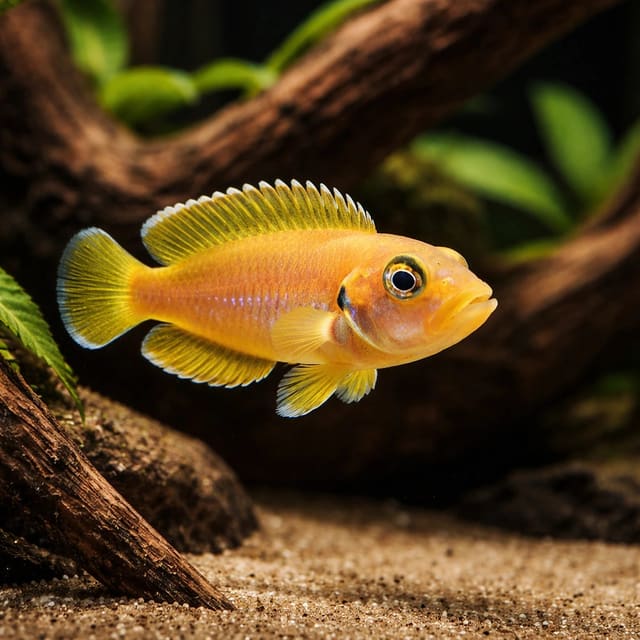
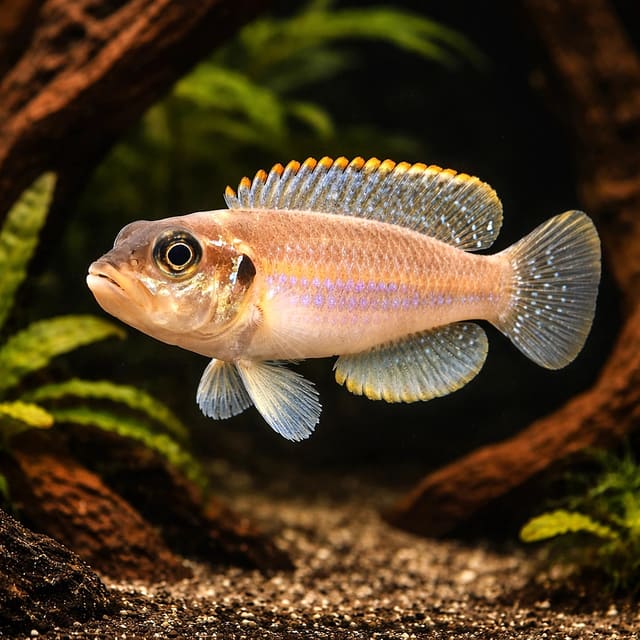
The gallery contains one existing image. It is a site-owned, text-derived representative created from the species wording rather than from a verified photograph of the current fish. Visual review against the privately preserved source reference found meaningful differences in body shape and colour. It must not be used to identify the species, select a sex, judge the dispatch grade or predict the exact fish that will arrive.
The gallery image's image description states the limitation directly. Generated details such as fin shape, eye position, scale pattern, body depth, colour and rock context may be inaccurate even when the scene looks plausible.
Use the written scientific identity and selected centimetre grade as the purchasing references. A real fish may be darker, deeper-bodied, less uniformly coloured or temporarily pale after transport. A future media improvement would require a clean species-faithful reference and manual approval; it should never be achieved by hiding a watermark or deleting protected gallery media.
The accepted maximum is 14 cm total length. Total length includes the tail fin, which makes it different from standard length measurements used in some fish literature. The 4-5 cm, 5-6 cm and 7-9 cm options are approximate living dispatch grades. None is an adult-size guarantee, and none establishes sex or age.
| Measurement | Use it for | Do not infer |
|---|---|---|
| 4-5 cm grade | Selecting the smallest current trade band | A fixed age, juvenile sex or slower final growth |
| 5-6 cm grade | Selecting the middle trade band | Pair compatibility or breeding readiness |
| 7-9 cm grade | Selecting the largest listed trade band | Adult completion, sex or exact maturity |
| 14 cm total length | Planning for the published species-level maximum | A promise that every fish will reach exactly 14 cm |
| Gallery image | General decorative context only | Measured scale, species diagnosis or batch appearance |
Plan the aquarium for the adult before selecting a smaller grade. A 4 cm fish does not justify a temporary small tank unless a fully cycled adult system is already available and the transfer plan is controlled. Moving a territorial cichlid after it has established in cramped rockwork can create avoidable stress and injury.
Differences between the three variant prices or availability states do not change the biological facts. The live selector is the source for current commerce information. Care copy should remain stable rather than embedding a price, stock claim or promotion that can become wrong when Shopify inventory changes.
Published records place the species on the southwestern coast of Lake Tanganyika in the Democratic Republic of the Congo. It is endemic to the lake, which means its natural global distribution is restricted to this single ancient freshwater system. No collection point is supplied for the present stock, so names such as Kapampa, Tembwe or another locality must not be attached without documentation.
Lake Tanganyika is exceptionally old, deep and chemically distinctive. Its cichlids have diversified into specialised habitats and feeding roles. Keeping the water hard and alkaline is therefore more than a generic "African cichlid" convention: it reflects a stable mineral-rich lake, although the exact chemistry experienced by an aquarium fish can differ from one shoreline and depth to another.
The FishBase record links the current IUCN Red List assessment, dated 28 February 2025, as Least Concern. Conservation categories are periodically reassessed and should be read as species-level evidence, not a commercial origin certificate. Responsible keeping still means avoiding release, preventing hybrid or locality records from being mislabelled and maintaining accurate notes if breeding is ever attempted.
Never release an aquarium fish, eggs, water, plants or filter material into a natural waterway. A Tanganyika cichlid cannot survive responsibly in a local pond, and pathogens or invasive organisms can cause harm even when the fish itself does not establish. Rehome through a knowledgeable keeper or retailer if circumstances change.
FishBase describes an intermediate habitat characterised by a sandy bottom with numerous rocks. The recorded depth range is 15-45 metres. This is not a shallow, brightly lit shell bed or an open-water environment. It is a transition zone in which rock faces, crevices, shadows and sand meet.
The species maintains unusually close contact with rocky substrate. Published habitat notes describe the belly travelling only millimetres above the surface while the fish follows each contour. A strongly developed lateral-line system helps it detect prey around the rock. These details explain why broad flat swimming space alone is not enough: the aquarium should offer continuous, secure surfaces and more than one route through the structure.
Depth does not mean the home aquarium must be dark and cold. The recorded temperature range remains tropical, and captive fish need a clear day-night rhythm. Use restrained lighting, shaded overhangs and dark retreats rather than eliminating light. A deep-water context does support avoiding harsh glare and designing places where the fish can withdraw from direct view.
Sand in the natural habitat does not justify a deep dirty substrate. Use a manageable layer that can be inspected and gently cleaned. Rocks should rest securely on the base or a load-spreading support before sand is added; a digging fish must not be able to undermine a top-heavy pile.
For one adult-planned territory, this listing uses a base of at least 120 x 45 cm as a conservative starting point. A larger footprint is strongly preferred where more than one conspecific, another rock cichlid or a substantial catfish is considered. Height adds water volume but cannot replace horizontal territory, visual separation and retreat routes.
| Plan | Starting guidance | Why it may need to increase |
|---|---|---|
| One unsexed fish | At least 120 x 45 cm base, mature and structured | A larger individual or active tank mate may require more usable territory |
| Attempted pair | Substantially larger, heavily divided rockscape and immediate separation capacity | Sex and compatibility are not guaranteed; a rejected fish may be trapped |
| Several Tanganyika cichlids | Plan species by species and expand beyond the single-fish starting point | Territories overlap even when total litres appear generous |
| Mixed lower-level community | Increase floor area and refuge count | Rock users and catfish compete for the same physical space |
| Temporary juvenile tank | Not a substitute for an adult system | Transfer, cycling and territorial disruption create extra risk |
Use the tank-volume tool to calculate real litres, but record length and width separately. Two aquariums with equal volume can have very different bases. Decorations, internal filters and thick backgrounds also reduce usable space, so external dimensions overstate the room available to the fish.
The 120 x 45 cm guidance is not permission to fill every centimetre with rock. Leave a clear sand route, service access and enough open water for circulation. The best layout gives the fish choices while allowing the keeper to see, feed and recover it without dismantling the aquarium.
Choose inert aquarium-safe rock that will not shed sharp fragments. Limestone or other calcareous material can be useful in a Tanganyika system when its effect on hardness and pH is understood. Do not combine unknown decorative stone, metal-bearing rock or garden material without testing. Boiling rock can trap pressure and is unsafe; clean it by brushing and rinsing instead.
Build from the base upward before adding the final sand layer. Large pieces should sit on stable support, not on loose grains that a fish can excavate. Test every structure from several directions. Silicone-bonded modules or securely interlocked stones can reduce collapse risk, but adhesive must be aquarium-safe and fully cured.
| Layout feature | Purpose | Safety check |
|---|---|---|
| Several separated retreats | Lets a fish withdraw without entering another cave | Each route is wide enough for the selected grade and future adult |
| Broken sight lines | Reduces continuous visual pressure between cichlids | Barriers do not create dead circulation zones |
| Open sand lane | Provides feeding and observation space | Food and waste can be removed without collapsing rockwork |
| Overhangs and shaded faces | Reflects the close rock association and deeper habitat | No narrow trap, sharp edge or unstable ceiling |
| Accessible equipment | Allows filter and heater maintenance | A territorial fish cannot be crushed or cornered during service |
Do not create a single prized cave and expect every fish to share it. Multiple entrances do not make one cavity multiple territories. If another cichlid is planned, build distinct zones separated by open sand or tall rock barriers, then watch whether the fish respect those boundaries in practice.
A secure lid is recommended. Cichlids can jump when chased, startled or netted, and openings around cables are often larger than they look. Guard filter intakes and leave no inaccessible chamber behind a background where a fish can become trapped.
The published range is pH 7.5-9.0 and 10-25 dH. This is hard alkaline water, but stability remains more important than forcing the aquarium to the highest number. A tank that repeatedly swings between values is more stressful than one held consistently within a suitable part of the range.
| Measurement | Planning range | Management point |
|---|---|---|
| Temperature | 24-28°C | Use a reliable heater and independent thermometer; avoid rapid change |
| pH | 7.5-9.0 | Interpret with KH and source-water chemistry; never chase pH with repeated guesswork |
| Hardness | 10-25 dH | Use a repeatable mineral or source-water recipe |
| Ammonia | 0 mg/l | Any detectable reading requires immediate investigation |
| Nitrite | 0 mg/l | Never use the fish to test an uncycled aquarium |
| Nitrate | Low and consistent | Control through stocking, measured feeding and matched water changes |
Test the actual tap water before choosing a buffering method. Crushed coral, limestone and commercial Tanganyika salts affect chemistry differently and can continue changing the water after the first dose. If reverse-osmosis water is used, remineralise it to a measured recipe; pure RO is not an appropriate default for this mineral-rich system.
Keep a written record of source water, aquarium pH, GH, KH or conductivity, temperature and water-change proportions. The water-matcher can help compare broad requirements, but it cannot replace test results or prove social compatibility.
Do not make a large chemistry correction immediately before delivery. Establish the intended water and confirm it remains stable through several routine maintenance cycles. A fish arriving into recently altered water faces two changes instead of one.
FishBase gives 24-28°C. Warm water carries less dissolved oxygen, while a rock-heavy layout can create poorly circulated pockets. Use strong biological filtration and visible surface movement without turning the aquarium into a continuous high-velocity jet. The fish should be able to choose calmer water behind structure.
Deep-water habitat does not automatically tell us the exact dissolved-oxygen demand of every captive individual, but it supports a cautious emphasis on clean, well-oxygenated water. Rapid breathing, hanging near the surface or gathering directly in filter flow requires immediate checks of temperature, oxygen, ammonia and nitrite.
Place the heater where guarded circulation distributes warmth. Use a heater guard if contact with rock or fish is possible, and keep an independent thermometer at the opposite side of the tank. A controller can add protection, but it does not remove the need to inspect the reading every day.
During hot weather, increase room ventilation and gas exchange before attempting active cooling. Any temperature reduction should be gradual and measured. Never pour ice or untreated cold water into the aquarium. A battery air pump is one of the most useful contingency items for a warm, densely stocked cichlid tank.
Choose a filter sized for the adult biomass and the amount of food, not only the label volume. External canisters, sumps and large internal filters can all work when intakes are guarded and flow is distributed. Biological media needs oxygen-rich water continuously; a filter that is large but clogged or switched off cannot protect the fish.
Complete regular partial water changes with prepared water of closely matched temperature and chemistry. The exact percentage depends on stocking, feeding, nitrate trend and source water. A repeatable weekly schedule is a sensible starting point, adjusted from measurements rather than from appearance alone.
Vacuum exposed sand gently and remove trapped food around rocks, but do not dismantle all territories at once. Rinse mechanical media when flow falls. Preserve biological media by cleaning it gently in removed aquarium water or another suitable dechlorinated source, and avoid replacing every mature medium on the same day.
| Frequency | Checks | Useful action |
|---|---|---|
| Daily | Temperature, breathing, posture, appetite, filter flow and visible injuries | Record anything that differs from the fish's settled baseline |
| At each meal | Whether food is swallowed and whether another fish blocks access | Adjust particle size, position or separation |
| Weekly | Ammonia when indicated, nitrite, nitrate, pH and equipment condition | Complete the planned matched water change and remove obvious waste |
| Monthly | Rock stability, intake guards, lid gaps, hose condition and body condition | Correct slow trends before they become emergencies |
| After any change | Breathing, colour, hiding and territorial routes | Test first rather than assuming disease |
Stagger major work. Cleaning the filter, rebuilding the rockscape, changing chemistry and adding fish on the same day removes the ability to identify the cause of a problem. An uneventful routine is a sign of good management, not a reason to search for another additive.
Reported stomach contents include crustaceans, insect larvae, copepods and snail fragments, along with plant material and sand grains. That evidence supports a diet focused on small animal prey while recognising that incidental plant matter occurs. It does not support describing the species as a strict predator that should receive only rich meat, nor as a generic plant-eating community fish.
Use a quality cichlid pellet or granule appropriate to the fish's current mouth size as a measured staple. Rotate clean frozen or cultured foods such as mysis, Artemia, daphnia, cyclops and suitable insect larvae. Food must be small enough to swallow whole at the selected grade. Large chunks that are repeatedly taken and spat out create waste and do not provide nutrition.
| Food | Role | Caution |
|---|---|---|
| Quality sinking or slow-sinking cichlid granule | Measured staple with consistent nutrients | Match particle size to the current grade and remove uneaten food |
| Frozen mysis, Artemia or daphnia | Variety and natural feeding response | Thaw and portion; do not pour unnecessary packing liquid into the tank |
| Clean cultured live food | Enrichment and observation of prey-search behaviour | Use reliable cultures that do not introduce predators, parasites or pollution |
| Occasional suitable insect larvae | Reflects published prey categories | Avoid oversized, fatty or contaminated sources |
| Mammalian or poultry meat | Not part of the recommended plan | Poor nutritional fit and unnecessary fat |
| Uneaten food in rock gaps | Warning sign | Reduce the portion and improve delivery or cleaning access |
Feed according to grade, body condition and temperature. Smaller fish often manage more than one modest meal better than one oversized portion; established adults may need less frequent feeding than rapidly growing juveniles. Watch the fish swallow its food. A schedule on paper is not proof that a shy or subordinate individual ate.
Bloodworm can be offered only if it is appropriately sized and sourced, but it should not define the entire diet. Rich foods fed heavily can worsen water quality and body condition. Variety, portion control and observation matter more than advertising one "colour-enhancing" ingredient.
The species is sold here as an individual because the supplier does not sex or pair the fish. There is not enough reliable species-specific evidence in the checked sources to promise that one pair, a small group or a particular sex ratio is the correct universal arrangement. Earlier wording that instructed "one pair or small group" is therefore removed.
Lamprologine cichlids can become highly territorial around rock shelters and reproduction, but intensity varies among species, individuals, sexes, space and layout. Treat compatibility as something to observe, not as a label that guarantees peace. A fish that coexists while juvenile can change as it grows or as a territory forms.
If more than one is attempted, use a substantially larger aquarium with separated rock zones, open escape routes and immediate spare accommodation. Never introduce a second fish into a single-cave layout and assume the first will accept it. The keeper must be able to remove either individual without taking apart an unsafe tower of rock.
Keeping one unsexed individual avoids a false pairing promise, but it does not answer every welfare question about long-term social behaviour. Monitor activity, feeding and use of cover. Future well-documented husbandry or provenance may support a more precise plan; this listing does not invent it in advance.
The safest starting point is a species-focused or carefully researched Lake Tanganyika aquarium. Shared water chemistry is necessary but not sufficient. Fish can still compete for the same cave, sand lane, feeding zone or lower-water refuge. Adult size and body shape also matter when assessing predation or intimidation.
| Candidate type | Assessment | Main question |
|---|---|---|
| Other rock-dwelling lamprologines | High caution | Are there genuinely separate adult territories and a removal plan? |
| Open-water Tanganyika cichlids | Conditional in a substantially larger aquarium | Do adult size, diet and behaviour overlap without crowding the rock zone? |
| Appropriate Tanganyika Synodontis | Conditional | Will nocturnal cave use and feeding create direct competition? |
| Small community fish | Avoid | Could they be swallowed, chased or chronically stressed? |
| Shrimp and small snails | Avoid as intended companions | Natural stomach evidence includes crustaceans and snail fragments |
| Soft-water South American or Asian fish | Poor chemistry match | One side of the community would be kept outside suitable water |
No named fish is automatically compatible. A "Tanganyika community" can fail if several species claim the same rocks. Introduce with the full adult plan in place, feed in observable positions and reassess when any fish matures. Torn fins, exclusion from food, hiding behind equipment or repeated dashes across open water are not normal signs to ignore.
Use the Neolamprologus category for taxonomic browsing, not as a compatibility list. Members of one genus can differ in adult size, habitat and social system.
| Listing | Why compare it | Do not assume |
|---|---|---|
| Ocellated Shell-Dweller (Lamprologus ocellatus) | A smaller shell-associated lamprologine with a different habitat plan | Shell-dweller care applies to this deeper rock-associated species |
| Meleagris Shell-Dweller (Neolamprologus stappersi) | A congeneric species commonly planned around shells | Genus alone predicts adult size or social behaviour |
| Gold Ocellated Shell-Dweller | Shows how colour forms and trade names can sit within a different ecological plan | A gold colour name or small dispatch size makes fishes interchangeable |
| Golden Julie (Julidochromis ornatus) | Another rock-associated Tanganyika cichlid for species-level comparison | Similar rock use guarantees cohabitation |
| Duboisi Cichlid (Tropheus duboisi) | A contrasting Tanganyika specialist with very different feeding and social requirements | All lake cichlids should share one diet |
These links are offered for comparison, not as a ready-made stocking list. Read adult size, diet, water, social and habitat requirements for each candidate. A carefully chosen single-species display is better than a crowded collection assembled from names that merely share a lake.
The species is generally described as relatively subdued rather than brightly coloured. A settled fish can show a grey-brown to darker body, patterning influenced by mood and lighting, and proportions unlike the pale decorative image currently in the gallery. Colour is not a reliable substitute for diagnostic morphology or provenance.
The supplier does not guarantee sex. The three size grades do not map to male, female or maturity, and a fuller abdomen or longer fin in one photograph is not enough to sell a fish as sexed. Avoid choosing two grades and assuming they will become a male and female pair.
Transport stress, dark holding conditions and recent feeding can change appearance. Judge health from breathing, posture, responsiveness, body condition, fin integrity and recovery as well as colour. A pale fish that settles and eats normally may improve over several days; a brightly coloured fish with rapid breathing still needs immediate attention.
If individual identity matters in a multi-fish project, record photographs after acclimation under consistent light. Do not alter them to exaggerate markings. Accurate records help separate real growth or injury from changes caused by camera exposure and background.
No adequate species-specific breeding source is available for this species. The former statements that breeding is "moderate", that beginners can succeed, and that a bonded pair will guard a cave were too certain. They are not carried forward as facts.
The fish are not sold as sexed, paired, mature, conditioned or breeding-ready. An aquarist interested in reproduction should first obtain species-specific literature, provide substantially more territory than a single-fish plan and maintain spare accommodation. Closely related species can offer hypotheses, but their spawning behaviour must not simply be copied into this listing.
If courtship, site defence, eggs or fry are observed, document dates, fish size, water chemistry, layout and behaviour before drawing conclusions. Protect the welfare of both adults. An incompatible fish must not be left under continuous attack merely to preserve a hoped-for pair.
Any offspring should retain accurate parental and locality records. Where locality is unknown, label it unknown. Do not create a locality name from a search result or assume a commercially available fish came from the place shown in somebody else's photograph.
| Before ordering | Ready when... | Pause when... |
|---|---|---|
| Biological filtration | Ammonia and nitrite stay at zero under the intended feeding load | The aquarium is new, recently reset or still cycling |
| Water recipe | Temperature, pH and hardness are measured and repeatable | Buffering is being changed by guesswork |
| Adult space | The 14 cm adult and complete territory plan fit now | The fish depends on a future tank that is not ready |
| Rockwork | Every structure is stable and all routes remain accessible | Rocks rest on loose sand or contain narrow traps |
| Conflict plan | Spare heated, filtered accommodation can be used immediately | There is nowhere to move an injured or rejected fish |
| Food | Several suitable foods match the selected grade | Only oversized pellets or one rich frozen food is available |
| Delivery | Someone can receive, inspect and acclimate the fish promptly | The parcel may remain unattended |
Do not schedule a large water change, filter replacement or rockscape rebuild for the arrival day. Complete routine work in advance and confirm that the system returns to its normal readings. A stable aquarium gives the fish one controlled transition instead of several simultaneous changes.
Prepare a dim room, clean container, net or transfer vessel, thermometer, water tests and the current acclimation instructions. Confirm that every lid gap and intake is safe for the smallest selected grade. Quarantine is strongly preferred where a separate mature system can match the required chemistry.
Inspect the parcel promptly. If there is a genuine arrival concern, follow the current guarantee instructions and take clear photographs while the bag remains sealed. Do not discard packaging or move a visibly affected fish between several containers before documenting the condition.
Dim the aquarium and room. Temperature equalisation is only one part of acclimation; pH and mineral content can also differ. Follow the new-fish acclimation guide and use the acclimation timer as an aid, adjusting the process to the actual water difference and condition of the fish.
Once a shipping bag is opened, carbon dioxide escapes and ammonia toxicity can change. Do not leave the fish in warming opened transport water for an unnecessarily long ritual. Transfer without adding transport water to the display where practical, then keep lighting low and the room quiet.
Offer only a small first meal after normal posture and breathing return. A fish may not feed immediately after transport. Remove uneaten food and avoid repeatedly approaching the glass. The first objective is stable respiration and safe orientation, not forcing display colour for a photograph.
Observe from a distance before each feeding. Record breathing rate, position, response to movement, appetite and whether the fish uses rock routes normally. A written baseline makes it easier to distinguish transport recovery from a developing water-quality or health problem.
| Period | Normal priorities | Warning signs |
|---|---|---|
| First hours | Dim light, stable posture, gradual exploration and calm breathing | Rolling, persistent gasping, inability to remain upright or obvious severe injury |
| First day | Secure retreat, no harassment and minimal disturbance | Continuous chasing, trapping behind equipment or repeated jumping |
| Days 2-3 | Interest in correctly sized food and use of several routes | Complete food refusal with hollowing, clamped fins or rapid breathing |
| Days 4-7 | Increasing confidence and a predictable feeding position | White spots, worsening fin damage, flashing or persistent isolation |
Test immediately if breathing or posture changes. Do not assume every symptom is a parasite: ammonia, nitrite, temperature, oxygen and aggression can produce overlapping signs. Confirm the problem before choosing treatment, calculate real water volume and account for biological filtration and all other animals.
Avoid introducing new tank mates during the observation period. Quarantine protects the established aquarium only when it is itself mature, correctly heated and maintained. A bare emergency container with unstable Tanganyika chemistry can create a new problem.
| Observation | Check first | Response |
|---|---|---|
| Rapid breathing | Temperature, oxygen, ammonia, nitrite and gill irritation | Test immediately and improve gas exchange without violent flow |
| Hiding continuously | Arrival stage, light, aggression, lack of secure retreat and water quality | Reduce disturbance, provide safe cover and remove social pressure |
| Food is taken then spat out | Particle size, food hardness, mouth injury and stress | Offer a smaller suitable item and observe closely |
| Hollow abdomen | Actual food intake, chronic competition and internal disease | Confirm individual feeding and seek fish-experienced veterinary advice if persistent |
| Damaged fins or scales | Sharp rock, trapping and aggression | Remove the cause and separate fish before damage escalates |
| White spots or excess mucus | Water quality, recent additions and diagnostic pattern | Identify before medication; do not combine treatments casually |
| Swollen abdomen | Recent meal, constipation, fluid retention and internal disease | Stop guessing from one symptom and obtain appropriate guidance |
Uncommon fish deserve the same evidence-based restraint as common ones. Do not raise temperature, add salt or dose antibiotics automatically. Tanganyika chemistry, medication sensitivity and the presence of catfish or invertebrates can change risk. A fish-experienced veterinary professional is the best source for persistent or severe disease.
Keep nets and siphons separate for quarantine where possible. Dry equipment completely or disinfect it using an appropriate controlled method before reuse. Never return medicated water to the display or dispose of it where it can enter a natural waterway.
Record the selected grade, arrival date, seller identity, photographs, measured water and any supplied provenance. Keep the Shopify order details privately; do not turn an internal supplier code into customer-facing title text. Useful husbandry records describe the fish and conditions, not internal catalogue mechanics.
Measure growth only with a repeatable non-invasive method. Do not net the fish every month to place it beside a ruler. A marked background, known rock dimension or calibrated photograph can provide a rough trend without repeated handling. Remember that perspective and tail position affect total-length estimates.
| Record | Why it matters | Suggested frequency |
|---|---|---|
| Temperature, pH, GH/KH or conductivity | Confirms the water recipe remains stable | At baseline, each water change initially, then on a consistent schedule |
| Ammonia, nitrite and nitrate | Shows biological performance and waste trend | More often after changes; routine trend thereafter |
| Body condition and appetite | Reveals feeding or disease issues before colour alone does | Daily observation, monthly photograph if useful |
| Aggressive interactions | Identifies routes, times and individuals involved | Every significant event |
| Maintenance and equipment | Links behavioural change to filters, heaters or layout work | At each intervention |
| Provenance | Prevents future locality or lineage claims from being invented | Once, updated only with documentary evidence |
If breeding is observed, add courtship, spawning-site, egg, fry and parental-behaviour notes without assuming they apply to every individual. Share photographs and measurements with context. A carefully documented observation is more useful to future keepers than a confident unsourced care number.
Prepare replacement water before it reaches the aquarium. Match temperature closely and reproduce the mineral recipe by weight or measured volume. If a commercial salt blend is used, follow its instructions and verify the result rather than assuming every scoop produces the same chemistry.
Evaporation leaves minerals behind. Top up with water appropriate to the system's measured needs; do not treat top-up as a water change. Continually adding mineral-rich tap water to replace evaporation can increase hardness over time even when the aquarium began inside the correct range.
When a test result moves unexpectedly, confirm it with a clean sample and an in-date method. Then check source water, missed maintenance, decomposing food, filter flow, dosing and recent rock additions. Correct the cause. Repeated chemical additions aimed only at pH can create a cycle of rise and crash.
Make emergency changes when ammonia, nitrite, chlorine or severe oxygen shortage demands them, but match water as closely as circumstances allow. In ordinary care, smaller predictable corrections are easier on the fish and biological filter than alternating neglect with drastic resets.
Have a plan before equipment fails. A spare heater, battery air pump, dechlorinator, clean containers and enough ingredients for the usual mineral recipe cover many common emergencies. Test spare equipment periodically; an unopened item in a cupboard is not proven to work.
During a power failure, reduce feeding and provide battery aeration. Keep biological media wet and oxygenated. Do not leave a canister sealed with stagnant water for many hours and then pump that water directly into the aquarium. Inspect the filter before restart and monitor ammonia and nitrite afterwards.
During overheating, remove the heat source, increase surface movement and cool the room gradually. Fans can increase evaporation, so watch both temperature and mineral concentration over a prolonged event. Sealed cool packs can be used cautiously with continuous monitoring, but ice or untreated water must not be added directly.
If a rock structure shifts, move the fish to safe heated filtered accommodation before rebuilding. Never reach under an unstable pile while the fish is trapped nearby. A contingency tank does not need decorative rock, but it does need secure cover, matched water and biological support.
The exact captive lifespan is not asserted because no adequate species-specific source was found in the checked evidence. Cichlids can be long-term animals, so plan equipment, holidays, moving home and future rehoming as though the commitment will last years. Uncertainty is not a reason to plan short term.
Choose the size grade only after the adult aquarium is stable. Do not buy several unsexed individuals hoping that compatibility will solve itself. If a breeding or pair project is the goal, source better provenance, build additional space and accept that rejected fish may need permanent separate accommodation.
Keep husbandry claims tied to evidence. Scarcity, ease, peacefulness and pair-status claims can increase clicks, but they are poor substitutes for accurate care. A trustworthy listing should help a customer decide not to buy when the aquarium is unsuitable.
Never cross this species with another fish deliberately or distribute uncertain offspring under a locality name. If provenance is absent, record it as absent. Good data stewardship helps prevent aquarium populations from becoming impossible to identify.
Eligible livestock orders are covered by the current Live Arrival Guarantee when its instructions and reporting window are followed. Delivery days, postcode eligibility, weather restrictions and checkout options can change, so read the current policy and arrange for someone to receive the parcel promptly.
Eligible new customers can use WELCOME10 for 10% off their first purchase. The saving does not change the care decision: the mature adult-planned aquarium, hard alkaline water, secure rockwork and conflict accommodation should be ready before an order is placed.
10.2305/IUCN.UK.2025-2.RLTS.T47956971A47981349.en. Species-level conservation assessment dated 2025; the public endpoint returned an automated-access restriction during link validation, so FishBase is the working conservation reference above.Scientific sources can be revised as taxonomy and conservation assessments change. Aquarium dimensions, layout and social safeguards on this page are conservative Tropical Fish Co planning guidance built around the published adult size and habitat. They are not a substitute for observing the individual fish or for veterinary advice when health problems occur.
No reviews for this item yet. Bought one? Honest reviews only, good or bad.
What customers say about ordering from us
I have a small group of long finned mountain minnows. So was delighted to be able to order ten of this variety to increase the genetics in my tank . The ones I recieved are healthy but it’s to early to give a verdict on wether they are of a long finned type since they are small currently.
Gordon Walker · 23 Sept 2026
100% success travel and "installation". Pleased with quality of purchase. The Siamese fighter a bit "shy" so have not yet seen him at his best yet but looking good. Happy customer. GG
George E Garratt · 21 Sept 2026
Reviews of our shop, collected by Judge.me, an independent third-party review collector. Newest first.