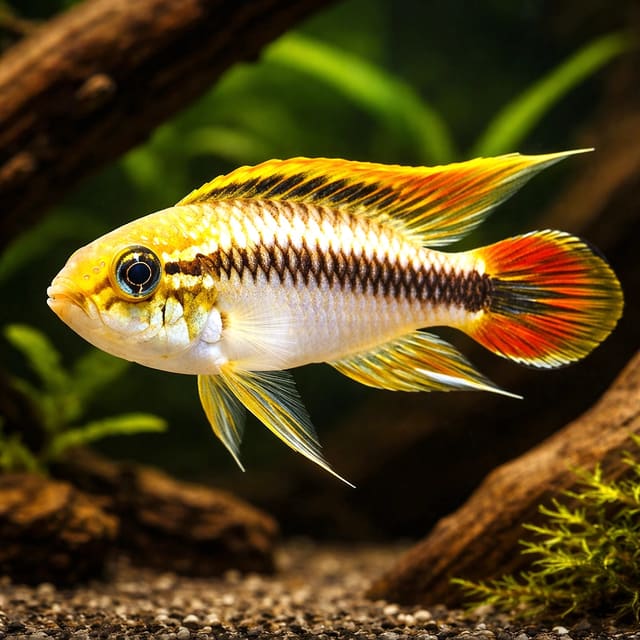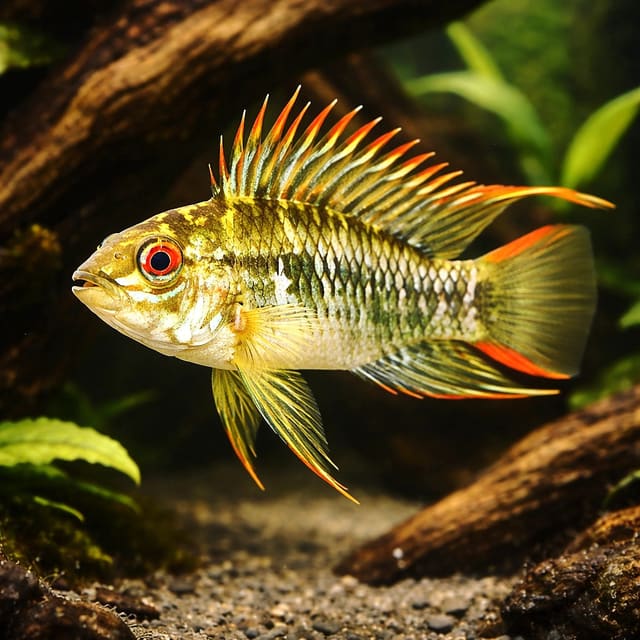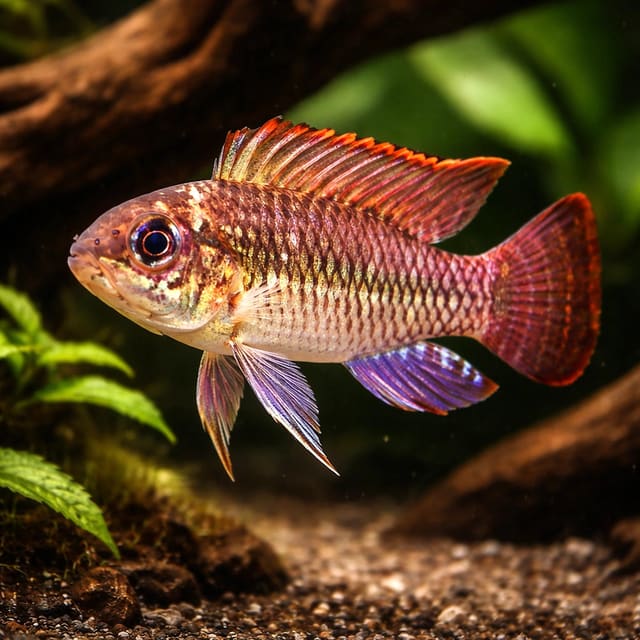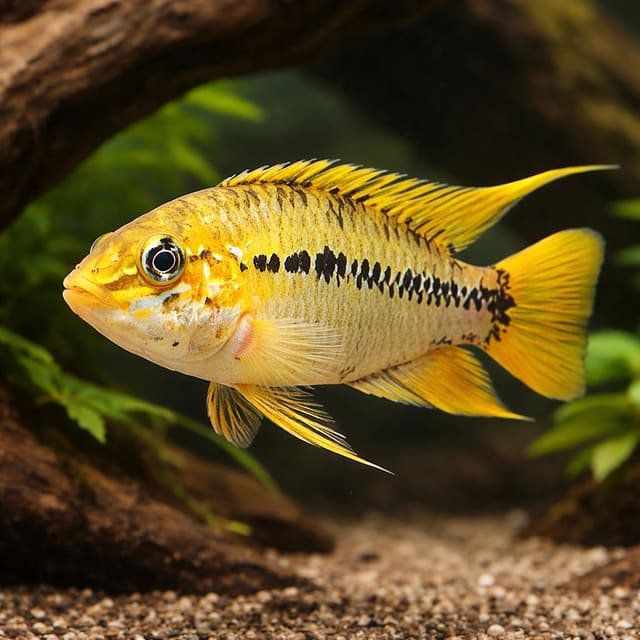
For Stripes Dwarf Cichlid — tropical fish for sale UK — AI hero driftwood view

Apistogramma sp.

For Stripes Dwarf Cichlid (Apistogramma sp.) — 3-4cm

Moderate Care
Semi-Aggressive
£16.99In Stock

A striking, compact South American dwarf cichlid with bold striping and engaging behavior, ideal for a peaceful planted aquarium. Moderate care, semi-aggressive. 24-27C, pH 5.5-7.0.

care:moderatediet:carnivorefamily:cichlidaeorigin:south-americasite:tropical-fish-cosize:smalltemperament:semi-aggressivetype:freshwater-fish

Care at a Glance

Scientific Name
Apistogramma sp.
Adult Size
3 cm
Lifespan
5 years
Care Level
Moderate
Temperament
Semi-aggressive
Temperature
24–27°C
pH Range
5.5–7
Minimum Tank
75L
Diet
Carnivore

Water Parameters

Maintain these water conditions for optimal health and vibrant colors

Temperature
24–27°C
24°CIdeal Range27°C
pH Level
5.5–7
5.5Ideal Range7

Overview

The striking Red Point Dwarf Cichlid (Apistogramma sp.) represents one of the hobby's most sought-after undescribed species, captivating aquarists with vivid red accents and charming personality. This compact South American treasure originates from blackwater tributaries of the Amazon basin, where it has evolved exquisite coloration and fascinating breeding behaviors. Now available for sale UK through specialist dwarf cichlid suppliers, the Red Point Apistogramma brings authentic biotope appeal to planted community aquariums when provided with soft, warm, slightly acidic water conditions. Aquarists seeking a beautiful, engaging species with manageable size and rewarding breeding potential will find this undescribed freshwater fish UK favorite offers exceptional value for those prepared to meet its specialized care requirements.

Appearance

The Red Point Dwarf Cichlid showcases stunning coloration that intensifies dramatically with optimal water conditions and breeding readiness. Males reach approximately 4-5 cm in length, while females remain smaller at 3-3.5 cm, making this one of the more compact Apistogramma species. The species earns its trade name from the vivid red spotting that appears prominently on the body, particularly concentrated along the lateral line and gill covers. Males display a complex pattern of blue, green, and golden spangling across the body, overlaying a base color that shifts from cream to golden-yellow depending on mood and environment. The dorsal fin features impressive extension with red and blue highlights, while the caudal fin may develop a rounded or slightly lyrate profile in prime specimens. The anal and ventral fins display elegant elongation with red accents. Females exhibit more subdued coloration with yellow-cream bodies, though breeding females intensify dramatically to brilliant lemon-yellow. Both sexes possess large, expressive eyes with blue-green iridescence and relatively deep bodies compared to many other dwarf cichlid species.

Water Parameters

  • Temperature: 24-28°C
  • pH Range: 6.0-7.0 (prefer 6.2-6.8)
  • Water Type: Soft to moderately soft
  • Minimum Tank Size: 40 litres (pair minimum)

Natural Habitat

While the precise wild origin of the Red Point Apistogramma remains uncertain in the aquarium trade, the species clearly originates from slow-moving blackwater or clearwater tributaries characteristic of the greater Amazon basin. These specialized environments feature soft, slightly acidic water resulting from tannins leaching from decomposing organic matter including leaves, seed pods, and woody debris. The substrate consists of fine sand overlaid with accumulations of leaf litter creating both the water chemistry these fish require and abundant microhabitats for food organisms. Submerged roots, fallen branches, and overhanging bank vegetation provide structural complexity and territorial boundaries. Water movement is minimal, with gentle current generated primarily by seasonal water level fluctuations rather than permanent flow. Dense canopy vegetation creates dappled lighting conditions reaching the water surface. Temperature remains consistently warm throughout the year, maintaining the 24-28°C range even during cooler periods. The natural diet consists primarily of tiny aquatic invertebrates, insect larvae, and small crustaceans gleaned from leaf surfaces and substrate crevices through constant foraging behavior.

Aquarium Setup

Creating an appropriate environment for the Red Point Dwarf Cichlid requires thoughtful aquascaping and careful water chemistry management. An aquarium of just 40 litres can accommodate a pair, though 60+ litres allows for harem setups (one male with 2-3 females) or modest community arrangements. Substrate must be fine sand 3-4 cm deep to facilitate natural foraging and territory establishment behaviors. Aquascaping should emphasize caves, hiding places, and visual barriers through strategic placement of driftwood pieces, smooth river rocks, and ceramic or coconut shell caves. Add dried leaves (Indian almond, oak, or beech) both as decor and to release beneficial tannins that acidify water naturally. Dense planting in background areas using soft-water adapted species like cryptocorynes, small Amazon swords, and Java fern creates security while maintaining open swimming areas in the foreground. Floating plants help diffuse lighting to create the subdued conditions these fish prefer. Filtration should be efficient yet gentle—sponge filters work excellently, or use canister filters with spray bar outlets positioned to minimize current. Maintain water chemistry using a combination of appropriate source water, tannin supplementation through leaves or commercial blackwater extracts, and minimal limestone-based decor. Target pH 6.2-6.8, GH 3-8, and KH 1-4 for optimal health and breeding success. Perform regular water changes of 25-30% weekly using temperature and chemistry-matched water to maintain the pristine conditions Apistogramma species demand.

Feeding

As specialized micro-predators, Red Point Dwarf Cichlids require varied, protein-rich foods for optimal health and coloration. Quality micro-pellets designed for carnivorous dwarf cichlids should form part of the dietary foundation, though relying solely on prepared foods rarely produces optimal results. Frozen foods must feature prominently: offer daphnia, cyclops, baby brine shrimp, bloodworms, and mosquito larvae in rotation throughout the week. Live foods including grindal worms, micro worms, and live brine shrimp provide excellent conditioning and bring out natural hunting behaviors that prepared foods cannot replicate. Feed small portions 2-3 times daily rather than one large meal, as these small fish have limited stomach capacity and benefit from frequent feeding opportunities matching their natural grazing pattern. During breeding conditioning, increase frequency to 3-4 times daily with emphasis on live and frozen foods to support egg production and parental energy demands. The species may initially show hesitation with new foods, requiring gradual introduction by mixing novel items with accepted foods. Avoid large or hard foods that small Apistogramma struggle to consume, and minimize vegetable matter as these are primarily carnivorous fish. Remove any uneaten food after 3-4 minutes to maintain the critical water quality standards dwarf cichlids require. Monitor body condition carefully—healthy specimens should appear well-rounded without appearing bloated, with good muscle mass visible in the head and shoulder region.

Expert Tip

Maximize the stunning red spotting that gives this species its common name by providing varied frozen and live foods, maintaining slightly acidic pH around 6.5, and using LED lighting with strong red wavelengths that bring out warm coloration in fish. Avoid blue-dominant lighting which can wash out red tones.

Behaviour

The Red Point Dwarf Cichlid exhibits endearing behaviors characteristic of the Apistogramma genus while displaying some species-specific variations. Males establish small territories centered on suitable caves or sheltered areas, defending these spaces through impressive displays involving full fin spreading, lateral body presentations, and rapid color intensification designed to intimidate rivals without resorting to physical combat. True aggression between males is relatively rare, typically limited to brief chases that reestablish territory boundaries. The species spends considerable time near the substrate, investigating every crevice, sifting through sand, and picking at surfaces in constant search for food particles. Swimming style is deliberate and inquisitive rather than frantic, with frequent pauses to assess surroundings. Females range more widely when not breeding but become remarkably bold when guarding eggs or fry, fearlessly defending their cave against all intruders regardless of size—this dramatic behavioral transformation provides one of the most fascinating aspects of keeping these dwarf cichlids. The species demonstrates considerable intelligence, quickly learning feeding schedules, territory locations, and keeper recognition. In well-structured aquariums with appropriate companions, Red Point Dwarf Cichlids remain regularly visible and active, spending much time exploring their environment and interacting with their surroundings.

Tank Mates

Ideal tankmates for the Red Point Dwarf Cichlid must share similar soft, slightly acidic water requirements while occupying different ecological niches to avoid territorial conflict. Small, peaceful shoaling fish that occupy upper and mid-water levels make excellent companions: cardinal tetras, ember tetras, green neon tetras, and rummy-nose tetras all work brilliantly in planted Apistogramma setups. Harlequin rasboras, chili rasboras, and Phoenix rasboras add interest and movement without competing for bottom territory. Very small Corydoras species (C. pygmaeus, C. hastatus) can coexist peacefully in larger aquariums, though monitor for territorial disputes during breeding periods. Pencilfish species like Nannostomus marginatus complement the biotope theme while staying out of the cichlids' way. Otocinclus catfish contribute to algae control while generally avoiding conflict. Avoid all boisterous species, fin-nippers, aggressive feeders, and larger bottom-dwelling fish that might compete directly for territory or food. Never combine with larger cichlids or predatory species. Other Apistogramma species can potentially be housed together only in very large, extensively structured aquariums with clearly defined territories—such combinations require considerable experience and careful monitoring to prevent hybridization, territorial violence, and stress. For breeding setups, consider a species-only arrangement or limit tankmates to a small school of peaceful dither fish in upper water levels.

Breeding

Breeding the Red Point Dwarf Cichlid provides rewarding insights into Apistogramma reproductive biology and parental care behavior. Spawning occurs in small caves that the female selects and meticulously cleans for hours before egg deposition. The male is invited briefly to fertilize the eggs but is then aggressively expelled from the breeding cave, with the female assuming complete responsibility for all subsequent care. She fans the eggs constantly to provide oxygenation and water circulation while removing any that become infertile or fungused. Eggs hatch after approximately 3-4 days depending on temperature, with fry becoming free-swimming 5-7 days post-spawning. The female continues intensive parental care, moving fry to different locations if she perceives threats and herding them in tight clouds during feeding excursions. For breeding success, provide multiple small caves with entrance diameters of 1.5-2 cm—appropriately sized shelters are critical as females reject caves that are too large or too small. Maintain soft, slightly acidic water with pH 6.2-6.8, GH 3-6, and temperature 26-28°C. Condition both sexes heavily for 2-3 weeks with varied live and frozen foods before breeding attempts. Once fry are free-swimming, offer infusoria or liquid fry food for 24-48 hours, then introduce newly hatched brine shrimp which the fry typically accept immediately. Supplement with microworms and continue frequent small feedings 3-4 times daily. Maintain exceptional water quality through gentle daily water changes of 10-15% using chemistry and temperature-matched water. The female may consume the spawn if excessively stressed or if water conditions deteriorate, so minimize disturbance and maintain pristine tank conditions throughout the breeding cycle.

Why Buy from Tropical Fish Co

Tropical Fish Co maintains dedicated soft-water systems specifically for Apistogramma species, ensuring your Red Point Dwarf Cichlid arrives in optimal health and already adapted to appropriate water chemistry. Our specimens undergo comprehensive quarantine protocols in conditions matching their natural habitat requirements, with careful monitoring for disease and behavioral normalcy before offering for sale. We provide accurate sexing for customers establishing breeding pairs or harems, backed by extensive experience distinguishing subtle sexual dimorphism in these compact species. Each fish receives species-appropriate nutrition during its time in our facility, including varied frozen and live foods that promote vibrant coloration and strong condition. Your purchase includes detailed care documentation covering tank setup, water chemistry management, cave sizing, feeding protocols, and breeding guidance specific to Red Point Dwarf Cichlids. We offer ongoing expert telephone and email support from staff who actively maintain and breed rare Apistogramma species in their personal collections. Our packaging system accounts for small fish sensitivity, utilizing appropriately sized bags, secure temperature control, and expedited shipping to minimize transit stress. We understand that success with specialist dwarf cichlids requires both quality livestock and comprehensive knowledge support, and we're committed to providing both to ensure your Red Point Apistogramma thrives in your care.

Premium Quality

Healthy, vibrant fish from trusted suppliers

Expert Care

Detailed care guides and support

Live Arrival Guarantee

Your fish arrives healthy or we'll replace it

Acclimated

Properly quarantined and ready for your tank