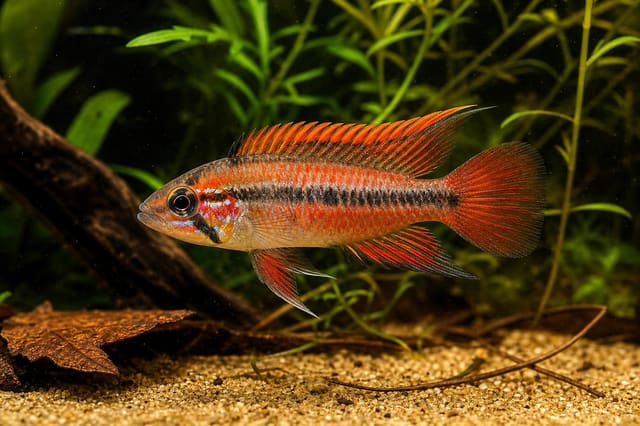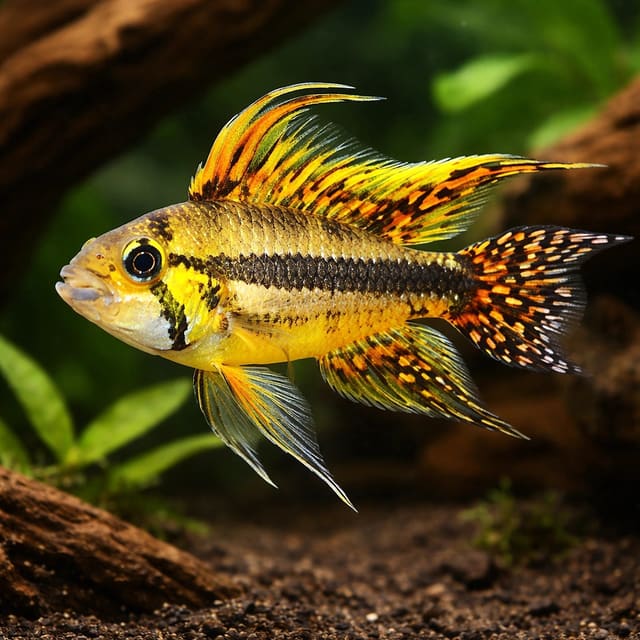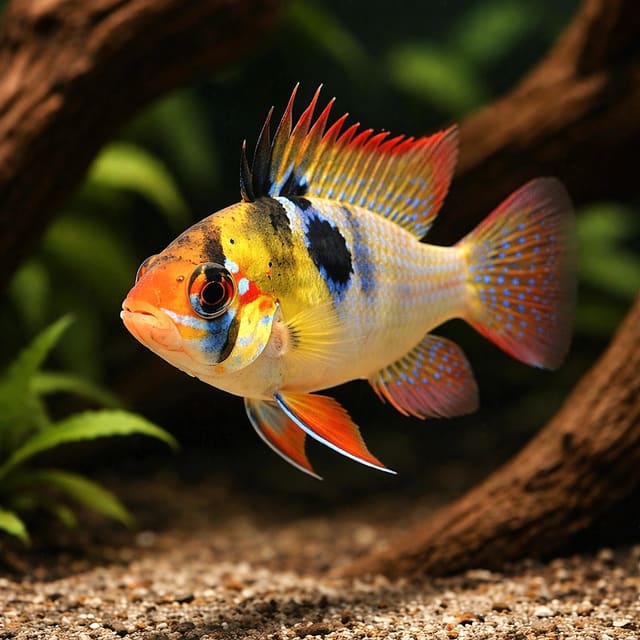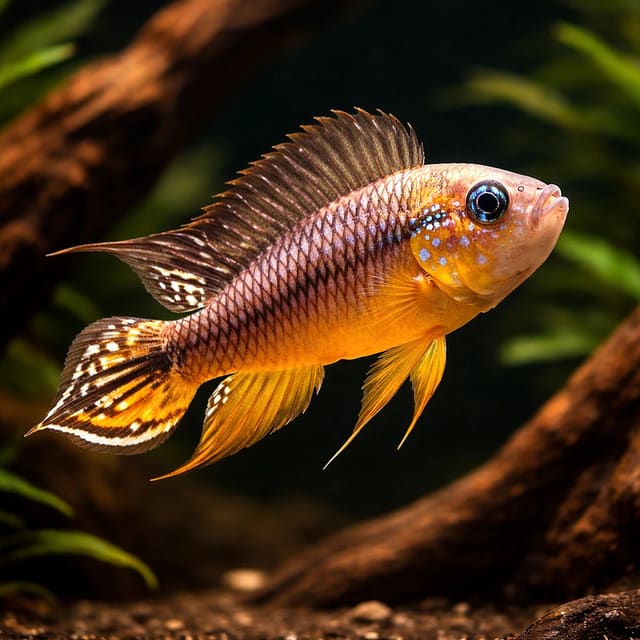
Tucurui Dwarf Cichlid — tropical fish for sale UK — AI hero driftwood view

Apistogramma tucurui

Tucurui Dwarf Cichlid (Apistogramma tucurui) — 3-4cm

Moderate Care
Semi-Aggressive
£9.99In Stock

A beautifully patterned miniature Amazonian cichlid with engaging behavior and rewarding breeding potential. Moderate care, semi-aggressive. 24-29C, pH 5.0-7.0.

care:moderatediet:carnivorefamily:cichlidaeorigin:south-americasite:tropical-fish-cosize:smalltemperament:semi-aggressivetype:freshwater-fish

Care at a Glance

Scientific Name
Apistogramma tucurui
Adult Size
4 cm
Lifespan
5 years
Care Level
Moderate
Temperament
Semi-aggressive
Temperature
24–29°C
pH Range
5–7
Minimum Tank
75L
Diet
Carnivore

Water Parameters

Maintain these water conditions for optimal health and vibrant colors

Temperature
24–29°C
24°CIdeal Range29°C
pH Level
5–7
5Ideal Range7

Overview

The Tucurui Dwarf Cichlid (Apistogramma tucurui) is a beautifully patterned miniature Amazonian cichlid native to the Tucuruí region of Pará state in Brazil. This rare tropical fish UK is highly prized by enthusiasts for its intricate markings, engaging behaviour, and rewarding breeding potential. Available for sale UK from specialist retailers like Tropical Fish Co, this apistogramma for sale UK brings authentic Brazilian biotope character to carefully planned aquariums.

Reaching just 4cm in adult size, the Tucurui Dwarf Cichlid is perfectly suited to planted aquariums and species tanks where their natural behaviours and subtle beauty can be fully appreciated. Males develop stunning breeding colours with extended finnage, while females provide fascinating parental care. This south american dwarf cichlid thrives in soft, acidic water and is best suited to intermediate fishkeepers who can maintain stable parameters. Buy aquarium fish UK from trusted sources to ensure healthy, well-acclimatised specimens ready to thrive in your carefully prepared biotope setup.

Appearance

Apistogramma tucurui showcases the elegant proportions characteristic of compact Apistogramma species, with a streamlined body, proportionally large eyes, and delicate finnage that becomes dramatically extended in mature males. The species exhibits beautiful patterning including a prominent dark lateral stripe, checkerboard body markings, and intricate finnage details that distinguish it from similar species.

Males are particularly impressive when in breeding condition, developing intense colours including golden-yellows, electric blues, and orange-red highlights concentrated on the fins and anterior body. The dorsal fin features extended rays with striking coloration, while the caudal fin develops a distinctive lyre shape in well-conditioned specimens. Body scales possess an iridescent quality that catches light beautifully under subdued aquarium lighting.

Females are smaller and more modestly coloured, typically displaying yellow-brown base tones with darker markings and rounded body proportions. When gravid or in breeding condition, females develop intense yellow coloration, particularly concentrated around the head and belly regions. At 4cm adult size, these dwarf apistogramma are ideally scaled for nano and medium-sized aquariums.

Natural Habitat

Apistogramma tucurui is endemic to the Amazon Basin in Brazil, specifically the Tucuruí region of Pará state. These fish inhabit slow-moving blackwater tributaries, small forest streams, and flooded forest areas characterised by extremely soft, acidic water heavily stained with tannins from decomposing organic matter. Water temperatures remain consistently warm throughout the year, typically between 24-29°C.

The substrate in their natural habitat consists of fine sand or silt overlaid with thick accumulations of fallen leaves, submerged branches, and complex root systems from overhanging rainforest vegetation. Water movement is minimal, and dissolved oxygen levels can fluctuate seasonally. Dense overhead canopy creates deeply shaded conditions with dim, dappled lighting filtering through gaps in the vegetation.

During the wet season, fish move into newly flooded forest floors where they forage among leaf litter and submerged vegetation for small invertebrates, insect larvae, and microorganisms. The construction of the Tucuruí Dam has significantly altered some of their natural habitat, making conservation of wild populations and captive breeding programmes increasingly important for long-term species survival.

Water Parameters

  • Temperature: 24-29°C
  • pH: 5.0-7.0
  • Minimum Tank Size: 75 litres
  • Water Hardness: Very soft (0-5 dGH)

Aquarium Setup

A minimum 75-litre aquarium is recommended for a pair or small harem group of Apistogramma tucurui, with larger tanks of 100+ litres suitable for community setups with compatible tankmates. The aquarium should authentically replicate Brazilian blackwater biotope conditions with fine sand substrate, extensive driftwood creating sheltered caves and visual territories, and generous quantities of leaf litter scattered across portions of the tank floor.

Indian almond leaves, oak leaves, or beech leaves are excellent additions that release beneficial tannins, stain the water a natural amber colour, provide hiding places, and create grazing surfaces for beneficial microorganisms that fry will feed on. Dense planting is essential, particularly around the back and sides of the aquarium—use soft-water adapted species including Cryptocoryne varieties, Java Fern, Anubias, and floating plants such as Amazon Frogbit or Salvinia to diffuse lighting and create security.

Leave open sandy areas in the foreground where fish can display, forage through leaf litter, and establish clear territory boundaries. Subdued lighting is crucial; aim for dim, dappled conditions similar to their shaded forest stream habitat, easily achieved through floating plant cover or dimmed lighting fixtures. Provide multiple small caves or sheltered spawning sites using coconut shells, small terracotta pots, slate caves, or driftwood hollows positioned throughout the lower third of the tank.

Filtration should provide thorough water cleaning without creating strong currents that stress these fish. Sponge filters work excellently in smaller tanks, while canister filters with gentle spray bar output suit larger setups. Perform weekly water changes of 20-30% with soft, temperature-matched, dechlorinated water to maintain the pristine conditions essential for health and breeding success.

Feeding

Apistogramma tucurui is a carnivore requiring a varied, high-protein diet to maintain optimal health, vibrant coloration, and breeding condition. Quality micro pellets formulated specifically for carnivorous dwarf cichlids should form the dietary foundation, supplemented regularly with frozen or live foods including daphnia, brine shrimp, bloodworms, mosquito larvae, and other small invertebrates.

Live foods are particularly valuable for conditioning breeding pairs and enhancing the stunning colours males display during courtship. Live cultures of grindal worms, micro worms, white worms, blackworms, and freshly hatched brine shrimp are enthusiastically accepted and provide excellent nutrition. Frozen alternatives should be thoroughly thawed and rinsed before feeding to remove preservatives and excess nutrients that could degrade water quality.

Feed small portions 2-3 times daily, offering only what can be consumed within 2-3 minutes to prevent uneaten food from polluting the soft, acidic water these fish require. During breeding periods, increase feeding frequency to 3-4 times daily with varied protein sources to support egg production and the considerable energy demands of intensive parental care. Avoid mammal-based foods like beef heart, as these are difficult for tropical fish to digest properly and can contribute to water quality problems. Supplement sparingly with high-quality prepared foods, always prioritizing fresh or frozen options.

Behaviour and Temperament

The Tucurui Dwarf Cichlid exhibits fascinating cichlid behaviours including territoriality, elaborate courtship displays, and intensive parental care, all remarkably condensed into a compact 4cm adult size. Males establish and defend small territories centred around preferred caves or sheltered areas, particularly during breeding periods when their semi-aggressive temperament becomes more pronounced. Aggression is primarily directed at rival males rather than other species, though breeding pairs will defend spawning areas vigorously against all intruders.

Females are more peaceful and secretive outside breeding periods, often remaining hidden among plants, driftwood, and leaf litter until they feel completely secure in their environment. Once established, females become more confident, exploring the aquarium and engaging with males during courtship periods. Males perform spectacular displays to attract females and warn competitors, including dramatic fin-spreading, body-tilting, rapid colour intensification that can happen within seconds, and gentle herding of receptive females toward selected spawning caves.

These fish spend most of their time in the lower levels of the aquarium, meticulously investigating caves, sifting through leaf litter for food particles and microorganisms, and patrolling established territory boundaries. They're moderately active but greatly appreciate calm environments without excessive water movement, bright lighting, or boisterous tankmates that cause constant stress. Best kept as a single male with 2-3 females in tanks of 100+ litres to reduce male-male aggression, or as a proven harmonious pair in smaller species setups of 75 litres.

Top Tip: Gradually build up a mature leaf litter layer over several months before introducing Apistogramma tucurui. As leaves decompose, they create a self-sustaining ecosystem of beneficial microorganisms that fish naturally forage on, improve water chemistry, and provide essential food sources for newly free-swimming fry—significantly increasing breeding success rates.

Tank Mates

Apistogramma tucurui is compatible with small peaceful tetras including Cardinal Tetras, Rummy Nose Tetras, Green Neon Tetras, and Ember Tetras that occupy mid-to-upper water layers without competing for territory or food resources. Small rasboras such as Harlequin Rasboras or Lambchop Rasboras are suitable, as are peaceful dwarf pencilfish species including Nannostomus marginatus, N. eques, or N. beckfordi that share similar water requirements.

Corydoras catfish make excellent bottom-dwelling companions, sharing similar soft-water requirements and occupying different ecological niches that minimize competition. Choose smaller species like C. habrosus, C. pygmaeus, C. hastatus, or C. panda for best compatibility in biotope setups. Otocinclus catfish are ideal additions to planted tanks, grazing continuously on algae and biofilm without interfering with the Apistogramma or competing for food. Peaceful pencilfish and small hatchetfish species are compatible in well-planted, adequately sized community setups.

Avoid large aggressive cichlids that will stress, injure, or prey upon these small fish, fin-nipping fish such as Serpae Tetras or Tiger Barbs that will damage delicate finnage, very boisterous community fish including most larger barb species that create constant disturbance, much larger predatory fish that may eat adults or fry, and multiple male Apistogramma in tanks smaller than 150 litres where territories will overlap constantly, leading to stress and injury. When breeding, even normally compatible tankmates may be chased away aggressively from the immediate spawning area.

Breeding

Apistogramma tucurui is best spawned in soft, acidic water with pH 5.0-6.5, very low hardness (0-3 dGH), and temperature elevated to 26-28°C. Condition pairs separately for 2-3 weeks on varied, high-quality foods including abundant live and frozen options such as bloodworms, brine shrimp, and daphnia to build body condition. Provide multiple small caves, extensive leaf litter cover, subdued lighting, and excellent water quality with minimal fluctuations to encourage natural breeding behaviour.

Females select a suitable cave—typically the smallest, most secluded option with a narrow entrance—and spend 1-2 days meticulously cleaning the interior surfaces before spawning. Males court females persistently with elaborate displays, spreading all fins to maximum extension and performing vigorous body undulations. Once the female signals receptivity by entering and exiting the cave repeatedly, spawning occurs inside the chosen site, with 50-100 small adhesive eggs laid on the ceiling or walls.

The female provides all direct brood care, guarding eggs with extraordinary intensity and fanning them almost continuously to ensure proper oxygenation and prevent fungal infections. Males defend the broader territory encompassing the spawning cave but should not enter or harass the brooding female; if the male becomes overly aggressive or persistent in attempting to enter the cave, consider removing him temporarily. Eggs hatch in 2-3 days at 27°C, and fry become free-swimming after 5-7 days, at which point the female shepherds them closely.

Initial fry foods include infusoria, liquid fry food, and microworms or banana worms, progressing to newly hatched brine shrimp after 4-5 days when fry are large enough to consume them. Maintain pristine water quality with gentle daily water changes of 10-15% using very soft, temperature-matched water prepared in advance. The female may move fry to different locations (pre-dug pits in the substrate) if she perceives threats, defending them fiercely from all intruders. Parents may consume fry if excessively stressed or in poor water conditions, so minimize disturbance, avoid bright lighting, and ensure excellent water quality throughout the critical first 2-3 weeks.

Why Buy from Tropical Fish Co

When you buy aquarium fish UK from Tropical Fish Co, you're choosing a specialist retailer dedicated to providing healthy, carefully selected livestock from reputable sources. Our Apistogramma tucurui specimens are thoroughly quarantined, fully acclimatised to UK water conditions, and feeding confidently on varied foods before dispatch. Each apistogramma for sale UK is individually inspected to ensure excellent health, proper coloration, intact finnage, and overall quality that meets our exacting standards.

We provide comprehensive expert guidance on freshwater tropical fish for sale UK, including detailed advice on water parameter management specific to soft-water blackwater species, tank setup recommendations for Brazilian biotope aquariums, and compatible tankmate selection for your Tucurui Apisto. Fast, secure delivery throughout the UK ensures your rare tropical fish UK arrive safely with minimal stress, carefully packaged with insulation and heat packs when needed to maintain stable temperatures during transit. Our dedicated customer support team is always available to answer questions about feeding, breeding, long-term care, and any concerns about your new fish. All livestock is backed by our comprehensive health guarantee, giving you complete confidence when you buy tropical fish UK from Tropical Fish Co.

Premium Quality

Healthy, vibrant fish from trusted suppliers

Expert Care

Detailed care guides and support

Live Arrival Guarantee

Your fish arrives healthy or we'll replace it

Acclimated

Properly quarantined and ready for your tank