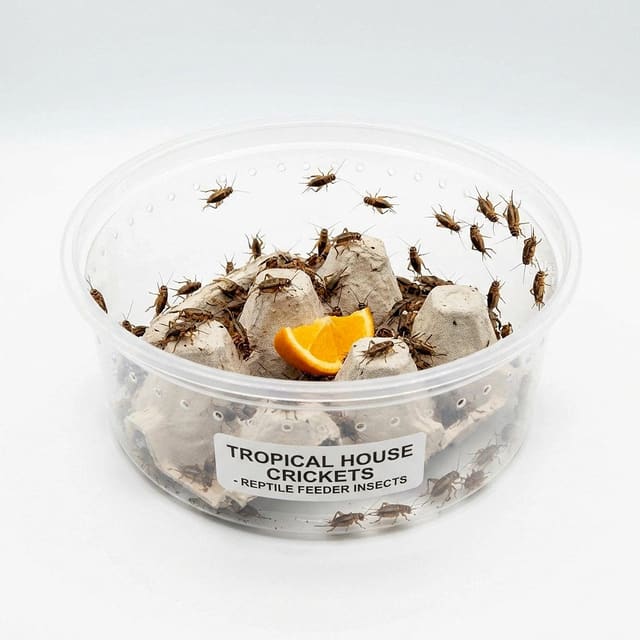
Gryllodes sigillatus Tropical House Cricket Packet
£6.99

A live 1/2 litre culture of small Drosophila melanogaster fruit flies for suitable micro-insectivores. The supplied strain is not documented as flightless, so handle adults as escape-capable.
Drosophila melanogaster
A live 1/2 litre culture of small Drosophila melanogaster fruit flies for suitable micro-insectivores. The supplied strain is not documented as flightless, so handle adults as escape-capable.
Drosophila melanogaster small fruit fly culture is a live 1/2 litre culture for keepers who need very small moving prey. The verified trade identity is Drosophila melanogaster, the small fruit fly. One product quantity means one trade-listed 1/2 litre culture; it does not mean a fixed count of loose adult flies.
This listing deliberately does not promise a flightless or wingless strain. Our stock records identifies the species and culture volume but gives no strain name, mutation or flight-status guarantee. Treat every adult as capable of escaping, open the culture only in a controlled feeding area and close it promptly after use.
A live culture changes from day to day. The visible balance of eggs, larvae, pupae and adults depends on its age and temperature, so the photograph is illustrative rather than a promise of one exact developmental stage or fly count. The guide below explains what the verified sale unit is, how to inspect it, how to use it carefully and where the species-level husbandry information comes from.
| Feature | Verified or practical guidance |
|---|---|
| Scientific name | Drosophila melanogaster Meigen, 1830 |
| Common description | Small fruit fly |
| Sale unit | One live 1/2 litre culture per product quantity |
| Exact fly count | Not fixed or guaranteed; a culture contains changing life stages |
| Flightless or wingless status | Not specified in our stock records; handle as escape-capable |
| Primary use | Small live prey for animals whose established feeding plan accepts D. melanogaster |
| Temperature reference | Stable indoor room conditions; published stock-care data show development changes strongly with temperature |
| Food status | Live feeder, not a complete or sole diet for every animal |
| Research status | Retail feeder culture, not a certified laboratory genotype, axenic stock or teaching strain |
Important strain disclosure: many commercial fruit fly products are advertised as flightless, wingless or vestigial-wing strains, but those are strain-specific claims. This batch documentation does not establish any of them. The high-volume search term is therefore not being used as a product promise.
The ordered item is one live culture in the supplier's 1/2 litre format. The culture medium and climbing material visible inside the supplied container support the colony as it develops. Quantity at checkout multiplies the number of culture units; it does not select an adult-fly count, culture age or guaranteed production date.
Live cultures are dynamic. A newly started culture may show fewer adults and more developing stages. A producing culture may show numerous adults, pupae on the sides or larvae moving through the medium. Temperature before and during transport can alter activity, so a quiet-looking cup immediately after arrival is not by itself proof that the culture has failed.
The retained gallery photograph shows a branded small-fruit-fly culture presentation, but it includes more than one cup for illustration. It must not be read as a multi-cup pack promise. The live Shopify variant and basket quantity are the purchase controls.
Drosophila melanogaster is a species in the fly family Drosophilidae. NCBI records the current name as Drosophila melanogaster Meigen, 1830 and the GenBank common name as fruit fly. The University of Washington describes it as a small common fly associated with unripe and rotting fruit and explains why its small size, short generation time and simple culture have made it important in genetics.
The species undergoes complete metamorphosis: egg, three larval instars, pupa and adult. That changing life cycle is why a culture cannot be represented honestly by one guaranteed adult count. It also explains why activity can appear to pause while much of the colony is in larval or pupal stages.
At a species level, D. melanogaster is smaller than the larger feeder species Drosophila hydei. This listing is for the supplier-described small D. melanogaster culture. It is not a mixed-species product and it does not guarantee a named mutation or laboratory line.
Use prey size and the animal's established husbandry plan, not a broad pet list, to decide. Smithsonian's National Zoo reports fruit flies among the foods given to poison frogs in human care, alongside other small prey. That supports fruit flies as a recognised feeder for poison frogs, but it does not make one feeding schedule suitable for every frog, reptile or invertebrate.
| A reasonable fit when... | Do not assume suitability when... |
|---|---|
| Your animal reliably takes prey at the small D. melanogaster scale. | The animal needs larger prey, ignores tiny prey or has a medically restricted diet. |
| A species-specific care plan already includes fruit flies or equivalent micro-prey. | The only evidence is a generic internet list or the animal is newly acquired and unassessed. |
| You can control escape, portion size and uneaten prey. | The enclosure cannot contain small flies or excess prey cannot be removed. |
| The culture forms one part of a varied and appropriately supplemented feeding programme. | You expect one feeder species to provide a complete diet indefinitely. |
| You can observe feeding response and body condition over time. | You cannot monitor intake, growth, weight or uneaten insects. |
For poison frogs, mantids, spiders, geckos, fish or any other insectivore, confirm that live fruit flies of this size are appropriate for the exact species, age and condition. Seek an experienced exotic vet or qualified keeper when there is uncertainty. Never feed a culture that appears chemically contaminated or heavily infested with unwanted organisms.
Do not rely on the word "flightless" as an escape-control method for this product. Even a genuinely reduced-flight strain can walk, climb or be displaced during handling, and this supplied strain is not documented as flightless at all. Physical control and calm technique are the safer approach.
There is no responsible universal number of flies per animal or per day. Species, age, reproductive state, body condition, enclosure temperature, other foods and supplement plan all matter. Feed to an evidence-based plan and review the animal rather than copying a generic quantity.
Temperature changes the development rate of D. melanogaster. The Bloomington Drosophila Stock Center gives approximate egg-to-adult generation times of 9 days at 25 C, 11 days at 22 C and 19 days at 18 C for laboratory stocks. These are useful species references, not a guarantee that the delivered feeder culture will produce on a particular date.
The culture's age, genotype, density, medium, transport history and local temperature all influence what you see. A warmer shelf is not automatically better: direct sun, a radiator, a heat mat or an enclosed hot cabinet can overheat and dry a culture quickly. Keep it at stable indoor room conditions, away from sunlight and strong local heat. Do not refrigerate it unless a product-specific instruction supplied with the order explicitly says to do so.
| Published reference condition | Approximate egg-to-adult time | How to use the information |
|---|---|---|
| 25 C | About 9 days | A laboratory stock-care reference, not a dispatch-date promise |
| 22 C | About 11 days | Shows that modest cooling slows development |
| 18 C | About 19 days | Shows why a cool room can make a live culture appear slow |
The University of Washington's teaching guide similarly describes a roughly 11-12 day cycle around 22 C, with eggs, larvae, pupae and adults visible at different points. Real feeder cultures need observation: use the appearance and activity of the supplied cup, not a calendar alone.
Store the cup upright on a clean level shelf. Keep the lid and ventilation exactly as supplied, protect the container from knocks and do not wrap it in a way that blocks air exchange. Avoid direct sunlight, strong vibration, aerosols, cleaning sprays and fumes. Do not add water to a culture simply because the surface looks less wet than expected; excess free moisture can trap flies and disrupt the medium.
A live culture is not an indefinite appliance. Production rises, peaks and declines. If your animals depend on micro-prey, maintain more than one culture at different ages or order replacements before the last culture fades. The BDSC notes that older room-temperature stocks are more likely to develop mite or mould problems and sets 30 days as an upper limit for its own laboratory stockkeeping; feeder-culture life at home still varies and should be judged by condition.
The ordered product is a live culture, not a promise of spare containers, dry culture media or a complete breeding kit. Starting a replacement requires a suitable ventilated container, correctly prepared fly medium, climbing or pupation material and a clean transfer technique. Use a reputable culture method and label the new cup with its start date. Keep it separate from older cultures at first so a contaminant is not spread through the whole collection.
Do not repeatedly open and disturb a newly started culture just to check it. Observe through the container where possible. If you transfer adults, work quickly and avoid overcrowding: the BDSC explains that excessive density slows development and can liquefy medium, trap larvae or reduce healthy yield.
| Stage | What you may notice | What it means for the culture |
|---|---|---|
| Egg | Usually difficult to see without magnification | Absence of visible eggs does not prove the culture is inactive |
| Larva | Small pale larvae moving in or over the medium | Active feeding and growth stage |
| Pupa | Small fixed cases, often on the sides or climbing material | Adults are developing but have not yet emerged |
| Adult | Small mobile flies around the cup | Feed-out and reproduction stage; numbers vary through the culture cycle |
Do not mistake every dark speck for a mite or every pale patch for mould. Use good light and magnification if available. Pupae stay fixed in place; larvae move through the medium; mites may move independently over the lid, cup or culture surface. When in doubt, isolate the cup from other cultures and send clear close photographs rather than opening it repeatedly.
Fermentation and yeast are part of fruit fly culture, so a live cup will not look or smell like a sterile dry product. A mild fermenting smell can be normal. Spreading fuzzy growth, heavy discolouration, putrid leakage, visible mites or a collapsing wet medium are different concerns.
The Bloomington Drosophila Stock Center identifies mites, fungi and bacteria as common culture contaminants and emphasises clean work surfaces, tight plugs, regular transfer and separation of affected stocks. A peer-reviewed large-population protocol likewise notes that mites and mould compete for food and reduce culture yield. Home keepers do not need laboratory chemicals: the practical response is cleanliness, isolation and replacement rather than experimenting with treatments around feeder animals.
Do not spray household insecticide, disinfectant, fragrance or cleaner near a culture or vivarium. Residue can affect the feeder insects and may then be carried into the animal enclosure.
The commercial fruit fly market commonly separates small D. melanogaster from larger D. hydei. The correct choice is the prey size your animal can take safely and consistently. This product is the small D. melanogaster option; the comparison does not imply that another species or culture is included.
| Question | D. melanogaster | D. hydei |
|---|---|---|
| Relative feeder size | Smaller | Larger |
| Typical use decision | Chosen where very small prey is required | Chosen where the animal can manage a larger fruit fly |
| Species in this product | Yes, supplier-identified | No |
| Flightless status in this product | Not documented | Not applicable; no D. hydei is included |
Do not choose solely by the animal's common name. Juveniles and adults of the same species may need different prey sizes, and individual feeding response varies. If this small culture is ignored, reassess prey size and husbandry rather than simply adding more flies.
D. melanogaster is famous as a model organism, but that does not make every retail culture a defined research stock. This product is sold as vivarium animal food. It has no supplied genotype certificate, mutation record, sex ratio, sterility statement, microbiological status or axenic guarantee.
It can be observed for general educational interest, including the visible sequence from larva to pupa to adult. It should not be used where an experiment requires a known wild-type line, a specific mutation, genetically stable flightlessness, a controlled genetic background or pathogen-free stock. Schools and laboratories should obtain documented material from an appropriate biological stock centre.
The product image also cannot verify genotype. Wing appearance in a stylised or magnified image is not a substitute for supplier strain documentation. That is why this page retains the verified species name but removes the previous flightless and "cannot escape" guarantees.
| Observation | Possible explanation | Practical next step |
|---|---|---|
| Few adults immediately after delivery | Transport stress, cool conditions or a culture dominated by developing stages | Keep upright at stable room conditions and inspect for larvae and pupae before judging |
| Adults present but culture slows later | Normal ageing, depleted medium, temperature change or excessive feed-out | Prepare or order a replacement before the existing culture is exhausted |
| Heavy condensation | Temperature swing or an overly warm location | Move to a stable room location away from sun and local heat; do not block ventilation |
| Strong abnormal odour or leaking medium | Possible collapse, overheating or contamination | Isolate the cup, stop feeding from it and contact us with photographs if it arrived that way |
| Fuzzy spreading growth | Possible mould rather than normal yeast activity | Separate from other cultures and replace if condition is poor |
| Tiny independent moving dots | Possible mites | Quarantine, inspect under magnification and do not place beside clean cultures |
| Flies escape during feeding | The strain may fly and the handling area was not contained | Close the culture, secure enclosures, remove attractants and use a controlled transfer cup next time |
Order the number of 1/2 litre culture units required and check the live price, availability and basket quantity before payment. The culture is a changing biological product, so no exact adult count, developmental stage, production date or useful lifespan is promised.
Read the current delivery page before checkout and make sure someone can receive and inspect the parcel promptly. Eligible new customers can use WELCOME10 for 10% off a first order while the promotion remains active; current terms are shown on the special offers page.
Scientific references describe the species or controlled laboratory stocks. They support general biology and culture-care context, not an exact count, age, genotype, flightless trait or production guarantee for this individual retail culture.
No reviews for this item yet. Bought one? Honest reviews only, good or bad.
What customers say about ordering from us
I have a small group of long finned mountain minnows. So was delighted to be able to order ten of this variety to increase the genetics in my tank . The ones I recieved are healthy but it’s to early to give a verdict on wether they are of a long finned type since they are small currently.
Gordon Walker · 23 Sept 2026
100% success travel and "installation". Pleased with quality of purchase. The Siamese fighter a bit "shy" so have not yet seen him at his best yet but looking good. Happy customer. GG
George E Garratt · 21 Sept 2026
Reviews of our shop, collected by Judge.me, an independent third-party review collector. Newest first.