Moderate
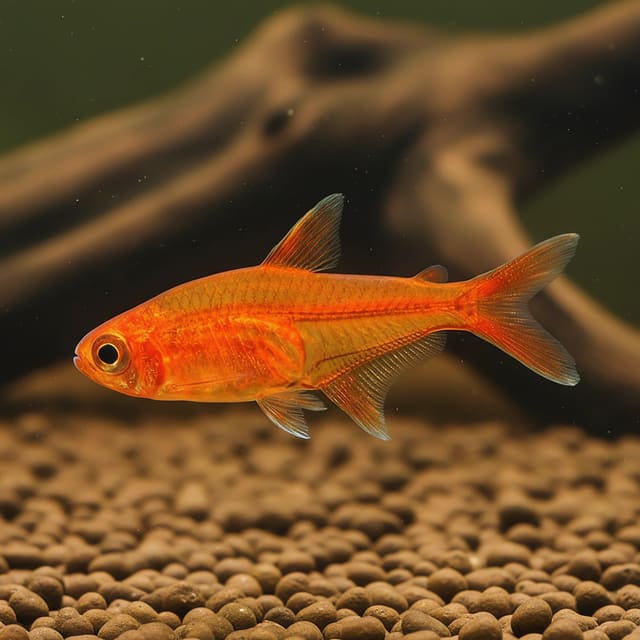
Ember Tetra (Hyphessobrycon amandae)
£3.99

A peaceful yellow-gold Brazilian tetra for planted community aquariums. Keep in a proper shoal, ideally 8-10+, with stable water, gentle flow and room to swim.
Adult size is the maximum length this species reaches at full maturity (scientific sources). The livestock you receive will be younger and smaller. Product-photo provenance and any image-specific limitations are stated on the listing.
Hyphessobrycon bifasciatus
Shoaling fish: kept in a group they feel safer, stay calmer and show their best colour.
Confirm your email, then we’ll send an availability message for this exact item if it returns within 180 days.
This request is only for this product—no newsletter or other promotions. A mail-provider retry may very rarely duplicate the same availability message. Unconfirmed addresses are removed after 48 hours. See our privacy policy.
A peaceful yellow-gold Brazilian tetra for planted community aquariums. Keep in a proper shoal, ideally 8-10+, with stable water, gentle flow and room to swim.
Adult size is the maximum length this species reaches at full maturity (scientific sources). The livestock you receive will be younger and smaller. Product-photo provenance and any image-specific limitations are stated on the listing.
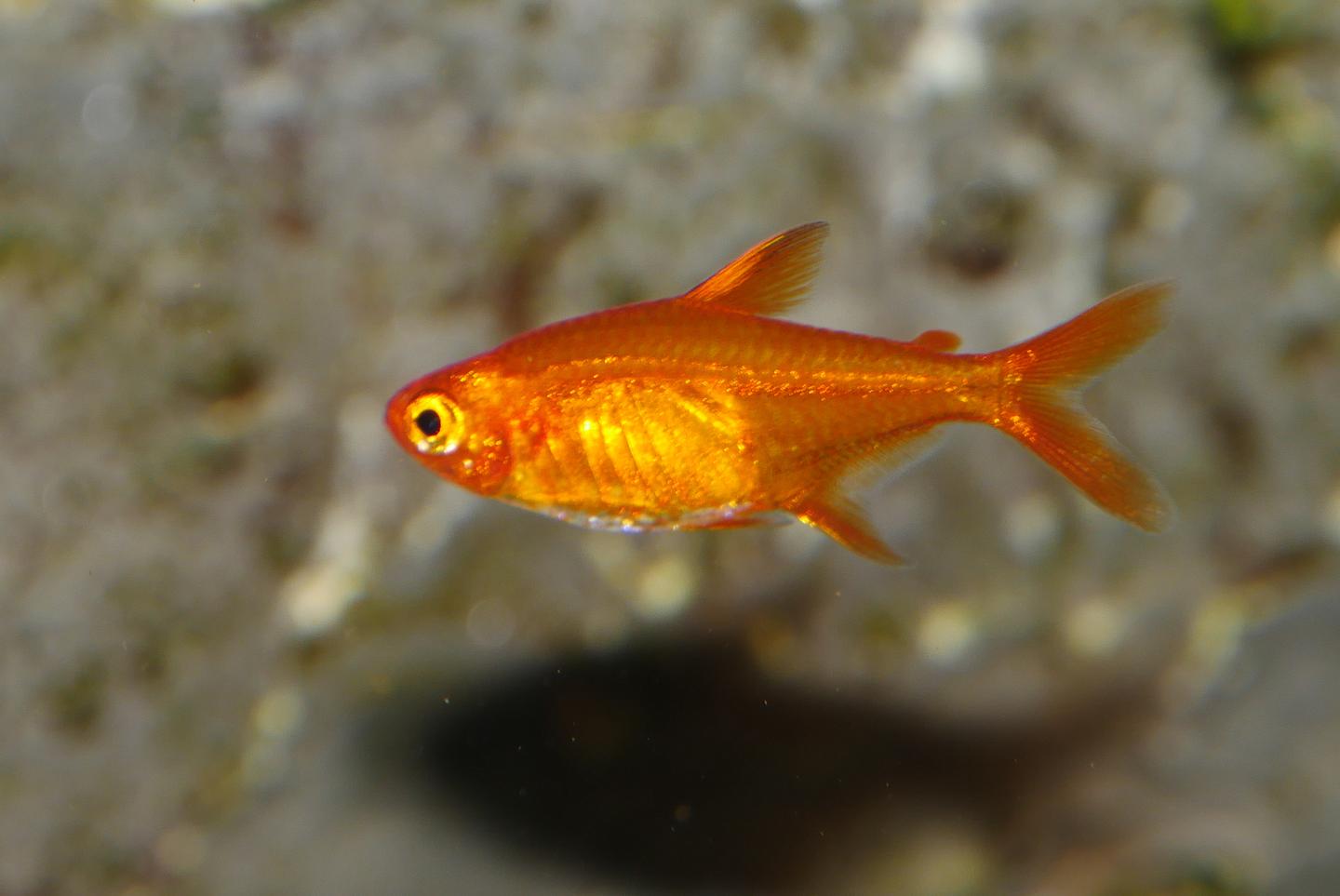
Ember tetras are very small Brazilian social fish, with a maximum recorded length of 2.0 cm excluding the tail. Keep them only in a fully cycled, stable aquarium. We recommend a group of at least 10 and about 45 litres with a 45 × 30 cm footprint rather than using a litres-per-fish formula.
Maintain these water conditions for optimal health and vibrant colors
Brass Tetra (Hyphessobrycon bifasciatus), also known in many care references as the Yellow Tetra, is a small Brazilian characin with a warm brass-yellow sheen, quick shoaling movement and an understated look that improves dramatically in the right aquarium. It is a good choice when you want a peaceful tetra that still feels active and lively, especially in a planted community tank with enough open swimming space for a proper group.
For aquarists comparing small tetras, the Brass Tetra is best understood as a subtle colour fish rather than a neon-bright centrepiece. Its strength is the natural shoal effect: warm yellow flashes, active midwater movement and a calm temperament when kept in the right group.
FishBase places Hyphessobrycon bifasciatus in Acestrorhamphidae and records it from coastal river drainages in Brazil, from Espirito Santo down to Rio Grande do Sul, as well as the upper Parana basin. That matters for care: this is not an Amazon blackwater specialist that needs extreme softness, and it is not a coldwater fish either. Think stable, mature freshwater conditions, gentle to moderate flow, planted cover and a confident shoal.
The Yellow or Brass Tetra comes from south-eastern Brazilian drainage systems rather than the central Amazon. In the wild it is associated with freshwater streams, smaller rivers and vegetated margins where schools can move between cover and open water. Aquarium Glaser describes it as a schooling tetra from coastal rivers in southeast Brazil and notes that it shows especially well over dark ground, with dense planting around the borders and open space for swimming.
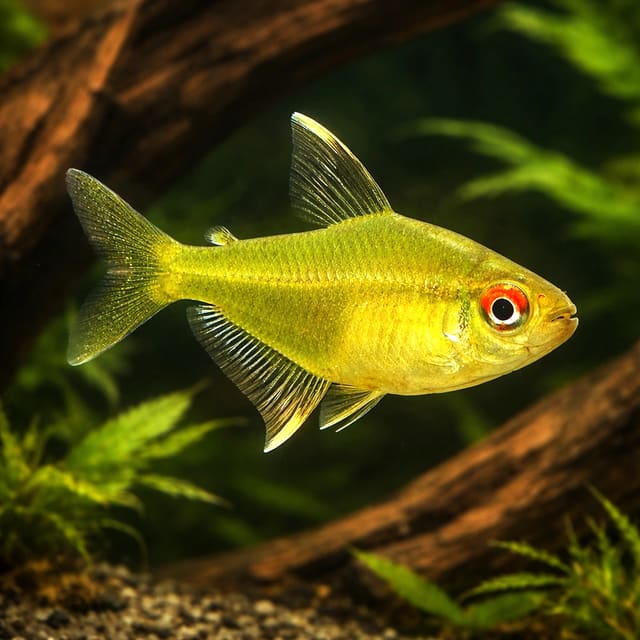
The name can cause confusion because several warm-coloured tetras are sold under similar common names. This listing is for Hyphessobrycon bifasciatus, not Lemon Tetra (Hyphessobrycon pulchripinnis) and not Gold Tetra. Lemon Tetras usually have a clearer lemon tone with more obvious fin markings, while Brass Tetras tend to be subtler: pale yellow, brassy or olive-gold depending on age, light, diet and settling time.
New arrivals may look modest in a retail or holding tank. That is normal for this species. The glow develops best after a few weeks in stable water, with a varied diet, darker substrate and a calm group around them. It is a fish that rewards good aquascaping rather than one that shouts from day one.
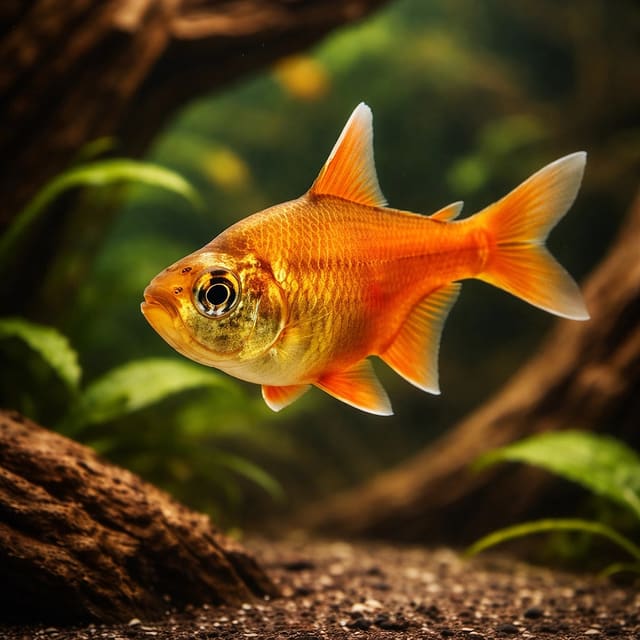
Expect a compact tetra shape with a translucent silver to yellow-gold body, a slightly deeper profile than very slim neon-type tetras, clear to yellowish fins and subtle darker body markings. The species name bifasciatus refers to two bands, though these can be faint and may show more strongly when the fish is stressed or under certain lighting.
In a planted tank the visual effect is soft and natural. A shoal turns together through the middle and upper levels, catching light in short flashes rather than holding one flat colour. Dark substrate, driftwood, leaf litter and green planting all help the brass tone stand out. This makes it especially useful for aquarists who want a golden accent fish that looks realistic rather than artificially bright.
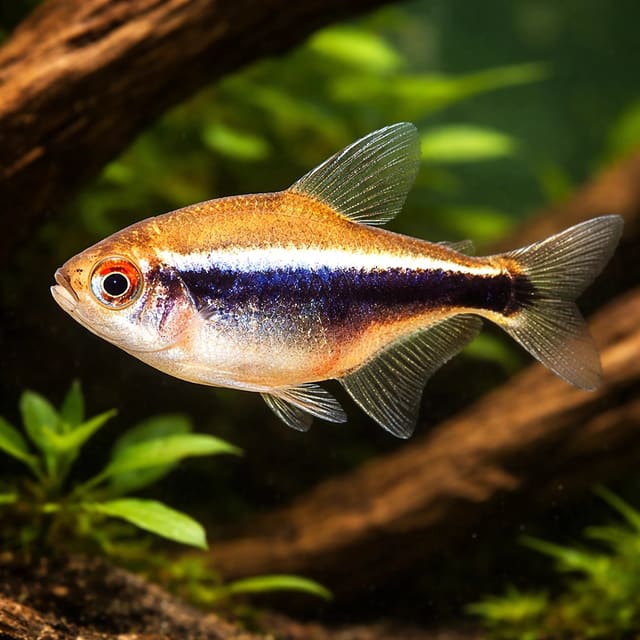
The source photo on this product shows the warmer yellow body and dark shoulder/side markings clearly. Use the gallery to judge the overall body shape and planted-aquarium effect, but expect live fish to vary naturally by age, sex, mood and lighting.
Use a mature aquarium with enough length for shoaling. A 75-80 litre tank is a practical starting point for a sensible group, while a larger aquarium gives a school of 10 or more much better movement and reduces the risk of shy, washed-out behaviour. If the tank is tall but short front-to-back, choose a smaller group or upgrade the footprint; these tetras use swimming length more than vertical height.
Plant the rear and sides, leave an open lane through the centre, and add some structure with driftwood, roots or botanicals. Floating plants can soften bright light, and a darker substrate usually gives better colour. Filtration should be steady but not fierce. The fish can handle normal community flow, but it should not be pinned in a constant blast from the filter outlet.
A secure lid is sensible for most tetras. They can jump when startled, especially after lights change or during maintenance. Keep the tank calm during the first days after arrival and let the group settle before judging final colour.
FishBase lists freshwater, tropical conditions with pH 5.8-8.0 and temperature around 20-25 C. Aquarium care sources also treat the species as adaptable within normal community ranges. For home aquariums, aim for stable conditions rather than chasing a perfect number: around 20-26 C, pH 6.0-7.5 and soft to moderately hard water will suit most settled groups.
They can tolerate more variation than delicate soft-water species, but they still need cycled filtration, zero ammonia and nitrite, controlled nitrate and regular water changes. Avoid sudden pH or temperature jumps. If your tap water is very hard, acclimate carefully and keep changes consistent rather than making large chemical swings.
Brass Tetras are easy to feed. Use a good small flake or micro pellet as the staple, then rotate in frozen or live foods such as daphnia, Artemia, cyclops and small bloodworm. Seriously Fish notes that regular small live and frozen foods help many tetras reach their best condition and colour, and that principle fits this species well.
Feed small portions once or twice daily, only what the group clears quickly. Their mouths are small, so crush larger flakes and choose fine foods for new arrivals. A varied diet keeps the fish fuller, brighter and more confident without forcing heavy feeding that can pollute the tank.
This is a peaceful schooling fish, but peaceful does not mean it should be kept singly or dropped into any busy community. Keep a group of at least 6, and preferably 8-10 or more. In too small a group, Brass Tetras may hide, fade or become more nervous. In a proper shoal they are much more open, active and attractive.
Good companions include similarly sized peaceful tetras, rasboras, small Corydoras, Otocinclus, small peaceful livebearers, small rainbowfish and other calm community fish that enjoy comparable water conditions. Avoid large predators, rough cichlids, persistent fin nippers and very slow or delicate long-finned fish if the group is small or the tank is cramped.
They sit well in a planted community aquarium where the midwater is not already overcrowded. If the tank already has several fast shoals, choose the final group size carefully so feeding remains calm and all fish have room.
Like many small characins, Brass Tetras are egg scatterers and do not guard eggs or fry. Serious breeding attempts are best done in a separate soft-water breeding tank with fine plants, moss or spawning mops, subdued light and sponge filtration. Condition adults on small live and frozen foods, then remove them after spawning so eggs are not eaten.
Most keepers buy this species for display rather than breeding. That is perfectly fine. The most important breeding-related lesson for everyday care is that mature, well-fed fish show better body condition and stronger colour than fish kept in a thin group with a monotonous diet.
When in stock, this is eligible livestock and is covered by the Tropical Fish Co Live Arrival Guarantee. We pack live fish for specialist livestock courier transport, and the safest result still depends on the aquarium being ready before dispatch. The tank should be cycled, temperature-stable and free from aggressive tank mates before the fish arrive.
Acclimate slowly, keep lights subdued at first, and give the shoal cover. Do not judge colour immediately after shipping. Brass Tetras often look paler while stressed, then improve once feeding, lighting and group confidence return.
Choose this fish if you want an adaptable, active, yellow-gold tetra for a planted community, and you can keep a proper group. Choose a different fish if you need a tiny nano species for a very small aquarium, or if your tank is dominated by rough, predatory or fin-nipping fish.
Max adult size is the length this species reaches at full maturity (from scientific sources). The livestock you receive will be younger and smaller. Product-photo provenance and any image-specific limitations are stated on the listing.
Peaceful and community-suitable when kept in a proper shoal with room to swim.
Always research specific species before adding them to your tank. Consider:
No reviews for this item yet. Bought one? Honest reviews only, good or bad.
What customers say about ordering from us
I have a small group of long finned mountain minnows. So was delighted to be able to order ten of this variety to increase the genetics in my tank . The ones I recieved are healthy but it’s to early to give a verdict on wether they are of a long finned type since they are small currently.
Gordon Walker · 23 Sept 2026
100% success travel and "installation". Pleased with quality of purchase. The Siamese fighter a bit "shy" so have not yet seen him at his best yet but looking good. Happy customer. GG
George E Garratt · 21 Sept 2026
Reviews of our shop, collected by Judge.me, an independent third-party review collector. Newest first.