Tropical Koi Probiotic Pellet S
£28.99

One 1000 ml / 320 g can of complete Tropical koi food: floating 2-3 mm Size S pellets with 12% wheat germ and 10% garlic, for 8-30 C water.
Confirm your email, then we’ll send an availability message for this exact item if it returns within 180 days.
This request is only for this product—no newsletter or other promotions. A mail-provider retry may very rarely duplicate the same availability message. Unconfirmed addresses are removed after 48 hours. See our privacy policy.
One 1000 ml / 320 g can of complete Tropical koi food: floating 2-3 mm Size S pellets with 12% wheat germ and 10% garlic, for 8-30 C water.
Tropical Koi Wheat Germ & Garlic Pellet S is a complete floating food for koi, supplied here as one 1000 ml / 320 g can. Size S pellets are approximately 2-3 mm, making them easier to take than larger grades for young koi, smaller koi and fish that prefer a fine pellet. Tropical specifies daily use across a water-temperature range of 8-30 C and says not to feed below 8 C.
The recipe contains 12% wheat germ and 10% garlic, together with fish ingredients, molluscs and crustaceans, cereals, algae, yeast, oils, fats, vitamins and minerals. It is a 38% protein food, not a generic low-protein winter pellet. Its value is the combination of small floating pellets, highly digestible ingredients and an all-season feeding range that includes cooler water when fish are still active.
| Product supplied | One can of Tropical Koi Wheat Germ & Garlic Pellet Size S |
|---|---|
| Pack size | 1000 ml / 320 g |
| Pellet | Floating Size S pellet, approximately 2-3 mm |
| Feed type | Complete feed for ornamental pond fish; formulated for koi |
| Manufacturer range | 8-30 C water temperature |
| Stop point | Do not feed below 8 C |
| Key inclusions | Wheat germ 12%, garlic 10%, MOS and beta-glucan |
| Analysis | 38% protein, 5% fat, 3% fibre, 10% moisture |
This listing is for one 1000 ml can containing 320 g of Size S pellets. Volume and weight both matter because dry pellets are sold in containers by volume while the net mass confirms how much food is inside. The price shown by the live product selector applies to this pack only. It does not buy the 5 litre or 7 kg manufacturer formats.
Check the delivered label before first use. It should identify the Size S formula and pack details, together with the batch and best-before information. Packaging artwork can be updated by the manufacturer without changing the verified formula, so the written pack contract on this page controls the quantity supplied.
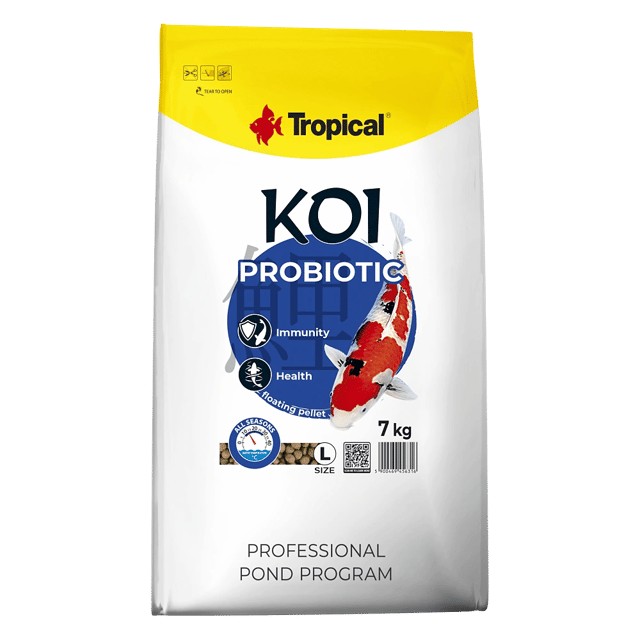
However, the visible bag artwork says 7 kg. That is a bulk professional package used as a manufacturer/reference image. The 7 kg bag pictured is not the pack supplied by this listing.
Your order is for the 1000 ml / 320 g can stated in the title, product facts and our stock records. The image must not be used to infer a different quantity, container or value.
Size S is the manufacturer's small floating pellet, approximately 2-3 mm. It is intended to be manageable for young koi and smaller mouths while remaining visible at the surface. The small grade can also help distribute food more evenly through a mixed-size koi group because more individual pellets are available across the feeding area.
Pellet size does not make the formula suitable for every species. Compare the label and nutritional needs of each pond fish before use. Very small fry may still need a finer food, while very large koi may take a medium or large pellet more efficiently.
| Water temperature | Manufacturer direction | Practical meaning |
|---|---|---|
| Below 8 C | Do not feed | Koi enter winter dormancy; uneaten food becomes a water-quality risk |
| 8-15 C | All Seasons food is appropriate | Feed only while fish are active, at the warmest part of the day |
| Above 15 C | Wheat Germ & Garlic remains within its 8-30 C range | Summer formulas may be introduced according to goals and fish condition |
| Above 30 C | Outside the stated range | Prioritise oxygen, water quality and specialist advice |
This is broader than a spring-and-autumn-only product. It can be used across the stated 8-30 C range, but the portion and frequency must follow water temperature and actual feeding response. Never feed by calendar alone.
Koi are ectothermic: their metabolism and appetite respond to water temperature. A sunny air temperature does not tell you the pond temperature, especially in a deep pond or after a cold night. Use a reliable pond thermometer and look at fish activity before opening the food.
Tropical instructs keepers to feed at the warmest time of day when the fish are active. In cool water, that usually provides the best opportunity to observe a genuine feeding response. If fish do not approach and eat promptly, do not keep adding pellets.
The manufacturer describes this as a complete feed mixture for ornamental fish in garden ponds. That means the recipe is formulated to provide a full nutritional basis when used according to the label, rather than being a single-ingredient treat. Complete status does not remove the need for portion control or good storage.
It is designed primarily around koi. Older Tropical English material also places the Size S line with young koi and large ornamental goldfish, but the current product page leads with koi. For other pond species, check mouth size, feeding zone and dietary needs rather than assuming all pond fish share one formula.
| Declared ingredient group | Detail |
|---|---|
| Products of plant origin | Includes wheat germ 12% and garlic 10% |
| Aquatic animal ingredients | Fish and fish products; molluscs and crustaceans |
| Other carbohydrate and plant sources | Cereals and algae |
| Yeast components | Includes mannan oligosaccharides at 1,000 mg/kg and beta-1,3/1,6-glucan at 1,000 mg/kg |
| Energy and minerals | Oils and fats; feed materials of mineral origin |
| Declared functional classes | Colourants and antioxidants |
The formula contains fish, mollusc, crustacean and cereal ingredients. Keep it away from human food and wash hands after handling if needed. It is animal feed, not food for people.
| Constituent | Declared level | How to read it |
|---|---|---|
| Crude protein | 38.0% | This is not a low-protein product |
| Crude fat | 5.0% | Part of the formula's energy profile |
| Crude fibre | 3.0% | Declared fibre fraction |
| Moisture | 10.0% | Dry-food moisture declaration |
Do not compare foods using protein percentage alone. Digestibility, ingredient composition, pellet size, fish condition, temperature and feeding quantity all affect the practical result. The current page removes the earlier claim that wheat germ automatically makes this a low-protein alternative.
| Additive per kg | Declared amount |
|---|---|
| Vitamin A | 26,000 IU |
| Vitamin D3 | 1,500 IU |
| Vitamin E | 95 mg |
| Vitamin C | 175 mg |
| Iron | 26.5 mg |
| Zinc | 7.0 mg |
| Manganese | 5.4 mg |
| Copper | 1.2 mg |
| Iodine | 0.15 mg |
These figures reproduce the current manufacturer declaration for the formula.
Wheat germ is declared at 12%. Tropical uses it as one of the easily digestible raw materials and says the formula's nutrients remain accessible to fish at lower water temperatures within the feeding range. That is why this product is placed in the All Seasons group rather than only with high-temperature growth feeds.
Wheat germ does not make overfeeding harmless. Excess pellets still add organic load, and fish that are inactive should not be encouraged to eat merely because the food is described as digestible.
Garlic is declared at 10%, and beta-1,3/1,6-glucan at 1,000 mg/kg. Tropical states that beta-glucan, garlic and wheat germ support the koi's natural resistance and recommends the formula around recovery from winter dormancy, convalescence and quarantine.
Those are manufacturer nutrition claims, not a promise that food will prevent or cure infection. This product is not a veterinary medicine. Sick koi still require water testing, isolation where appropriate and advice from a fish-experienced veterinary professional or qualified aquatic specialist.
Tropical says the formula's high digestibility reduces the negative effect of fish waste on water quality. The careful wording matters: it does not mean the food cleans the pond or prevents ammonia. Every food creates waste, and uneaten pellets add a direct pollution load.
Keep filtration mature, test water and remove leftovers. A digestible formula supports a sensible feeding plan; it cannot compensate for excessive portions, high stocking, weak aeration or an undersized filter.
The manufacturer does not support one fixed portion for every pond. Fish number, body size, temperature, filtration, health and recent feeding all change the amount. Observation is more reliable than a generic scoop instruction.
| Observation | Response |
|---|---|
| Fish approach and clear pellets promptly | Continue only in small measured additions |
| Pellets remain after the group slows | Stop, remove leftovers and reduce next time |
| One large koi controls the feeding point | Distribute pellets across a wider surface area |
| Small fish cannot take pellets | Use a finer suitable food rather than soaking indefinitely |
| Fish remain inactive | Do not feed; check temperature and water quality |
| Water is below 8 C | Do not feed this product |
Yes, 15-30 C remains within Tropical's stated range. Above 15 C the manufacturer says Summer Season products can be introduced for more intensive growth or colour goals, but that does not make Wheat Germ & Garlic invalid. The right choice depends on the fish and the keeper's aim.
For a warm-season Size S alternative, compare Tropical Koi Silkworm & Astaxanthin Pellet S. Change foods gradually and avoid combining products in a way that doubles the intended total ration.
Only while the measured water temperature is 8 C or above and the fish are active. Below 8 C, Tropical says not to feed. The word winter on a competitor's category or a general wheatgerm guide does not override the exact label for this formula.
At the lower end of the range, use the warmest time of day and very close observation. If pellets are ignored, remove them. Do not try to keep dormant koi eating for the sake of a schedule.
The 2-3 mm Size S pellet is particularly practical for young koi and smaller individuals. In a mixed-size koi group, spread the floating pellets over more than one area so dominant fish cannot take every piece. Watch the smallest animals rather than judging feeding success from the largest koi.
Large koi can eat a small pellet, but a larger grade may be more efficient for them. Pellet choice should reduce waste and competition, not merely match a marketing label.
Introduce a new complete food gradually when practical, particularly if the koi have been eating one formula for a long period. Begin with a small proportion of the new pellets within the existing ration, then increase it while watching appetite, waste and body condition. The combined portion must not become larger merely because two foods are present.
A transition is also the right time to reassess pellet size. If Size S disperses too widely for very large koi, or if another fish cannot take 2-3 mm pellets, use a more appropriate grade instead of changing the entire pond's diet around one individual. Keep a note of the start date so any feeding or water-quality change has a clear timeline.
| Label area | What to confirm |
|---|---|
| Product name | Koi Wheat Germ & Garlic Pellet Size S |
| Net content | 1000 ml / 320 g for this listing |
| Pellet description | Small floating pellet |
| Batch and date | Readable lot and best-before information |
| Feeding direction | Follow the current physical label if a newer manufacturer revision differs |
| Container condition | Seal and can intact, dry and uncontaminated |
The physical pack is the final batch-specific source because recipes, artwork and regulatory declarations can change. Contact support before feeding if the name, quantity or seal does not match the order.
The current Tropical product page formulates the food for koi, and the label classifies it as complete feed for ornamental pond fish. Older official English material mentions young koi and large veiltail goldfish. That supports careful use with suitable ornamental carp, but it is not a universal species list.
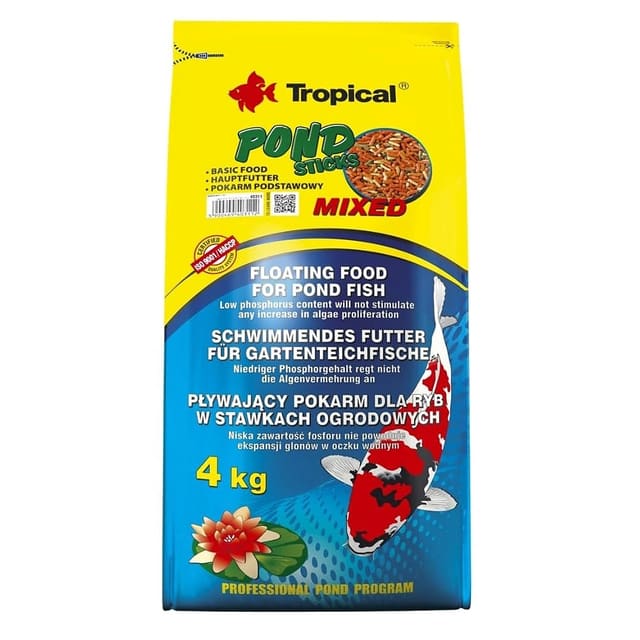
Before feeding another pond species, check whether a floating 2-3 mm, 38% protein complete food matches its normal diet. Use Tropical Pond Sticks Mixed as a separate comparison for a more general mixed-pond format.
| Product | Primary distinction | When to compare it |
|---|---|---|
| Wheat Germ & Garlic S | 2-3 mm floating all-season koi food, 8-30 C | Current product |
| Koi Probiotic Pellet S | Size S formula centred on probiotic support | When comparing digestive-support approaches |
| Koi Silkworm & Astaxanthin S | Warm-season growth and colour direction | When water is above 15 C and that goal is appropriate |
| Pond Sticks Mixed | General floating sticks for mixed pond feeding | When koi-specific pellets are not the only need |
Keep the food in its original labelled container, tightly closed in a cool, dry place away from direct sun, pond spray, pests and strong odours. Do not leave the can open beside the pond. Moisture can soften pellets and encourage spoilage, while heat and light can reduce quality over time.
Use clean, dry hands or a dedicated dry scoop. Do not return wet pellets to the container. Follow the best-before date and batch information on the delivered can, and discard food that smells rancid, shows mould, has become wet or is contaminated.
Browse the fish-food shop, the dried fish-food category or the broader fish-food category to compare formats, but keep the total daily ration controlled when rotating products.
When the parcel arrives, check that the product is Size S and the physical label states 1000 ml / 320 g. Inspect the seal, container and best-before information before opening. If the pack is damaged, leaking or not the ordered size, retain the packaging and photograph the issue.
Read the current delivery information before ordering and the returns and problem-reporting policy if anything is wrong. The live product selector and checkout are the current commercial truth; descriptive care copy does not hardcode a price.
One 1000 ml can containing 320 g of Tropical Koi Wheat Germ & Garlic Pellet Size S.
No. The picture is a preserved bulk-pack formula reference. This listing supplies the 1000 ml / 320 g can.
Size S pellets are approximately 2-3 mm and float at the surface.
Tropical states 8-30 C. Feed when fish are active at the warmest part of the day and do not feed below 8 C.
No. It is an All Seasons formula across the stated 8-30 C range, although it is particularly relevant when cooler-water digestibility is useful.
No. The declared crude protein level is 38%. The earlier low-protein comparison was incorrect.
The manufacturer declares 12% wheat germ and 10% garlic.
Yes. Tropical describes it as a complete feed mixture for ornamental fish in garden ponds, formulated for koi.
No. It is food, not veterinary medicine. Manufacturer resistance-support claims do not replace diagnosis, treatment or good water quality.
Older official Tropical material includes young koi and large ornamental goldfish, but mouth size and dietary suitability should still be checked for the individual fish.
Routine soaking is not required by the manufacturer. Keep the container dry; choose a finer food if fish cannot take 2-3 mm pellets.
Keep it sealed in the original labelled can in a cool, dry place. Prevent moisture, heat, sunlight, pests and wet scoops from reaching the food.
Tropical Koi Wheat Germ & Garlic Pellet S is a complete floating 2-3 mm koi food supplied as 1000 ml / 320 g. Its verified formula combines 12% wheat germ, 10% garlic, MOS and beta-glucan with 38% protein, 5% fat, 3% fibre and 10% moisture. Use it only while water is 8-30 C and fish are active, feeding at the warmest part of the day without leaving waste.
The preserved image shows a 7 kg reference bag, not the pack sold. The written title and product facts correctly define the supplied can. Store it dry, follow the delivered label and treat manufacturer health-support language as nutritional context rather than a medical promise.
No reviews for this item yet. Bought one? Honest reviews only, good or bad.
What customers say about ordering from us
I have a small group of long finned mountain minnows. So was delighted to be able to order ten of this variety to increase the genetics in my tank . The ones I recieved are healthy but it’s to early to give a verdict on wether they are of a long finned type since they are small currently.
Gordon Walker · 23 Sept 2026
100% success travel and "installation". Pleased with quality of purchase. The Siamese fighter a bit "shy" so have not yet seen him at his best yet but looking good. Happy customer. GG
George E Garratt · 21 Sept 2026
Reviews of our shop, collected by Judge.me, an independent third-party review collector. Newest first.