Dwarf Pencilfish (Nannostomus marginatus)
24–26°C · pH 6.5–7 · 41L
£6.99

A peaceful surface-holding pencilfish for mature planted aquariums. Often supplied as Nannobrycon eques and indexed as Nannostomus eques, it suits calm soft-water communities, fine foods and secure group care.
Adult size is the maximum length this species reaches at full maturity (scientific sources). The livestock you receive will be younger and smaller. Product-photo provenance and any image-specific limitations are stated on the listing.
Nannostomus eques
Save when buying multiple fish. Each quantity is one fish; sex and pair formation are not guaranteed unless the selected variant explicitly states them.
Confirm your email, then we’ll send an availability message for this exact item if it returns within 180 days.
This request is only for this product—no newsletter or other promotions. A mail-provider retry may very rarely duplicate the same availability message. Unconfirmed addresses are removed after 48 hours. See our privacy policy.
A peaceful surface-holding pencilfish for mature planted aquariums. Often supplied as Nannobrycon eques and indexed as Nannostomus eques, it suits calm soft-water communities, fine foods and secure group care.
Adult size is the maximum length this species reaches at full maturity (scientific sources). The livestock you receive will be younger and smaller. Product-photo provenance and any image-specific limitations are stated on the listing.
Maintain these water conditions for optimal health and vibrant colors
Tube-Mouthed Pencilfish (Nannostomus eques) is a peaceful, surface-holding pencilfish for mature planted aquariums with gentle flow and calm tank mates. It may arrive in supplier data as Nannobrycon eques, and older aquarium literature still uses that name, so this page keeps both terms in a natural way while using the accepted Nannostomus eques wording for customers and search.
This is the fish also known as the Brown Pencilfish, Diptail Pencilfish or Hockeystick Pencilfish. The appeal is not loud colour or high activity. The appeal is the odd, elegant posture: the fish often holds itself near the surface at a slant, hovering under floating plants or beside roots with the body angled like a small pencil in the water. In the right tank a group looks refined, quiet and very different from standard mid-water tetras.
Choose this listing for a settled, soft-water community or blackwater-style planted display. It is not the best match for bright, high-flow aquariums, rough cichlids, large predatory fish, or very fast feeders that will push it away from small foods. For aquarists who enjoy subtle behaviour, shaded planting and peaceful shoals, it is a beautiful specialist choice.
| Current scientific name | Nannostomus eques |
|---|---|
| Supplier / synonym name | Nannobrycon eques |
| Common names | Tube-Mouthed, Brown, Diptail or Hockeystick Pencilfish |
| Adult size | Usually around 4-6 cm depending on source and age |
| Minimum aquarium | 60 litres for a small group; larger and longer is better |
| Group size | Keep 6 or more, ideally 8-12 in a calm display |
| Water | 23-28C, soft to moderately soft, acidic to near neutral |
| Tank level | Upper water and surface cover |
| Care level | Moderate - stable mature water matters |
FishBase and GBIF currently list this species as Nannostomus eques, with Nannobrycon eques treated as a synonym or older combination. That is why the product has been cleaned from the old "Pencelfish" buyer-keyword title into clearer Tube-Mouthed Pencilfish wording. Customers searching either name should still understand they have reached the right fish.
In nature this pencilfish is associated with South American freshwater habitats, including central and upper Amazon waters and aquarium-trade material from countries such as Brazil, Peru and Guyana. Care sources describe slow or quiet waters, vegetation, roots, leaf litter and shaded surface cover. Those habitat clues are more useful than a generic community-fish label: they tell us to provide security, low stress, small foods and stable warm water.
The species is harmless to people and used in the aquarium trade, but it is still a delicate small fish. A mature filter, low waste load and careful acclimation are much more important than chasing a dramatic aquascape. Think soft light, plant cover and a stable routine rather than strong current or exposed open water.
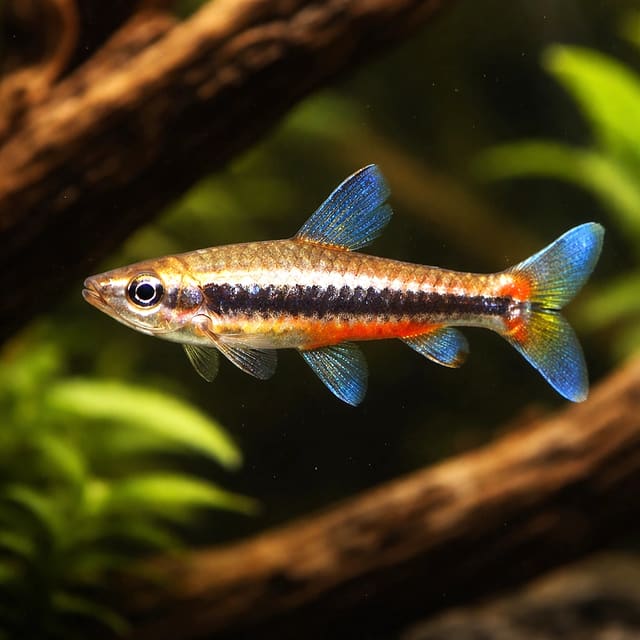
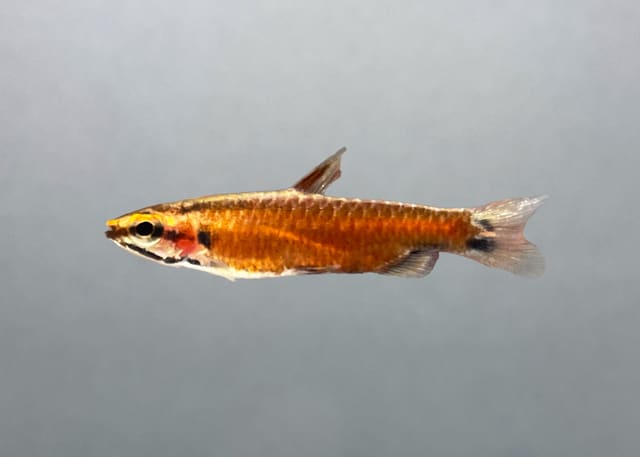
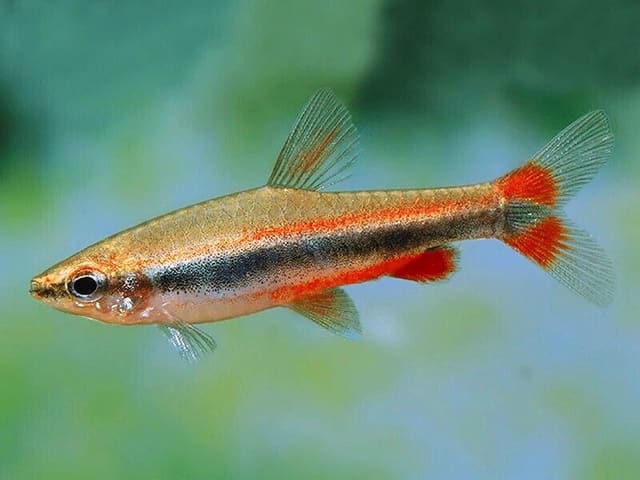
Tube-Mouthed Pencilfish has a long, narrow body, small mouth and a distinctive oblique swimming posture. The source photo shows the drawn-out body, fine dark markings and pointed head shape that separate it from rounder, more active tetras. In the aquarium, its best feature is movement: groups hover, tilt, rise gently for food and return to the cover near the surface.
Colour is subtle rather than flashy. Expect warm brown to golden tones, fine stripe work and clearer patterning when the fish is settled. Dark substrate, floating plants and a tannin-stained or softly lit aquarium help it feel secure and make those markings easier to see. In a bright bare tank the same fish can look washed out and nervous.
Because the fish occupies the upper layer, it pairs well visually with bottom dwellers such as Corydoras or Otocinclus and with peaceful mid-water tetras that do not harass it. A layered community gives the pencilfish room to behave naturally without being chased away from its preferred zone.
Start with a fully cycled aquarium of at least 60 litres for a small group. A longer footprint is useful because these fish hold position and move along the upper water rather than spending all day in caves. Use a secure lid: startled pencilfish can jump, especially during maintenance or when new fish are settling in.
Planting should give cover without closing the whole surface. Floating plants, tall stems, Java fern, Anubias, fine-leaved plants, branch wood and leaf litter all suit the species. Leave some open feeding space at the top so the group can rise for small foods without competing with faster fish. A dark substrate or shaded background will usually make the fish appear calmer and better coloured.
Filtration should be reliable but not turbulent. The aim is clean, oxygenated water with gentle movement, not a river-tank current. Sponge pre-filters, spray bars angled against glass, or outflows softened by plants can all help. Keep nitrate low with regular maintenance, and avoid sudden chemistry swings when changing water.
A sensible working range is 23-28C, with the warmer middle of that range suiting most tropical community setups. FishBase gives a narrower acidic pH range, while aquarium-care sources allow a broader range; for the home aquarium, the safest target is stable soft to moderately soft water from about pH 5.5-7.0. If your tap water is very hard and alkaline, this is not the easiest pencilfish to force into it.
Do not chase numbers aggressively with quick chemical changes. Stability is the real success factor. If you use botanicals, catappa leaves, alder cones or driftwood for tannins, introduce them gradually and keep testing. Ammonia and nitrite must stay at zero. Weekly partial water changes are better than occasional large corrections after water quality has already slipped.
When the fish arrives, acclimate slowly and keep the lights low. Float the bag to equalise temperature, then add small amounts of aquarium water over 30-45 minutes before release. Avoid pouring bag water into the display. After release, leave the group in peace and offer only a tiny first feed once they are settled.
This is a small-mouthed surface feeder, so food size matters. Use high-quality micro pellets, fine flake and tiny floating foods as the base, then add small frozen or live foods such as daphnia, baby brine shrimp, mosquito larvae and similar invertebrate foods. FishBase notes worms, crustaceans and insects in the diet, which matches the way these fish pick at small prey near the surface.
Feed small portions once or twice daily, or very small portions more often if the tank is lightly stocked and water quality is carefully managed. The fish should eat within a few minutes. Large foods that sink quickly will be missed, and heavy feeding will spoil the soft-water environment the species needs.
Watch competition. Fast danios, large tetras, barbs and boisterous livebearers may grab food before the pencilfish feed properly. In a mixed community, feed in more than one spot or use small floating foods that stay accessible near the surface.
Tube-Mouthed Pencilfish is peaceful and should be kept with similarly gentle fish. Good companions include small peaceful tetras, pencilfish already known to be calm, hatchetfish in suitable covered tanks, Corydoras, Otocinclus, dwarf cichlids that are not breeding aggressively, and small rasboras with compatible water needs.
Avoid large predatory fish, aggressive cichlids, fin-nipping barbs, very fast feeders and large catfish that may swallow small fish after dark. Even if the pencilfish is not attacked, stress from chasing and competition can stop it feeding properly. A quiet group in a calm aquarium is far better than a single fish hidden in a busy community.
Keep at least six. A larger group gives the fish confidence, spreads natural social attention and makes the surface behaviour more visible. Single specimens often look nervous and do not show the same character.
Breeding is possible but should be treated as a specialist project. Females are often fuller-bodied, while males may appear slimmer and more colourful. Soft, warm, clean water, fine-leaved plants or spawning mops, and a diet rich in small live or frozen foods give the best chance of natural spawning behaviour.
Like many small characins, adults may eat eggs, so serious breeding attempts usually use a separate breeding tank and careful removal of adults after spawning. Fry are tiny and need very small first foods, excellent water quality and gentle filtration. For most keepers, the main goal is not breeding but maintaining a settled display group in excellent condition.
Livestock orders are packed for a licensed live-animal courier service where available and are covered by the Tropical Fish Co Live Arrival Guarantee. Because this is a delicate upper-water species, plan the delivery day so the parcel can be received promptly and the fish can be acclimated without hurry.
Keep the first week calm. Dim the lights, avoid major rescapes, and do not mix the new group with aggressive feeders straight away. Check that every fish is reaching food and holding normal posture near the surface. If they remain hidden, reduce disturbance, add floating cover and confirm that water chemistry is stable.
Max adult size is the length this species reaches at full maturity (from scientific sources). The livestock you receive will be younger and smaller. Product-photo provenance and any image-specific limitations are stated on the listing.
Best kept as a proper group in a calm, mature, planted soft-water aquarium with surface cover.
Always research specific species before adding them to your tank. Consider:
No reviews for this item yet. Bought one? Honest reviews only, good or bad.
What customers say about ordering from us
I have a small group of long finned mountain minnows. So was delighted to be able to order ten of this variety to increase the genetics in my tank . The ones I recieved are healthy but it’s to early to give a verdict on wether they are of a long finned type since they are small currently.
Gordon Walker · 23 Sept 2026
100% success travel and "installation". Pleased with quality of purchase. The Siamese fighter a bit "shy" so have not yet seen him at his best yet but looking good. Happy customer. GG
George E Garratt · 21 Sept 2026
Reviews of our shop, collected by Judge.me, an independent third-party review collector. Newest first.