Discus Life Basic Frozen Blister Food 6 x 100g
£26.99

Six 100g flash-frozen blisters of Discus Life Garlic Plus compound feed for ornamental fish. The printed formula includes mussel, shrimp, lobster eggs, spinach, wolffia, spirulina, garlic and salmon oil; store at -18 C and feed as part of a varied, species-appropriate diet.
Six 100g flash-frozen blisters of Discus Life Garlic Plus compound feed for ornamental fish. The printed formula includes mussel, shrimp, lobster eggs, spinach, wolffia, spirulina, garlic and salmon oil; store at -18 C and feed as part of a varied, species-appropriate diet.
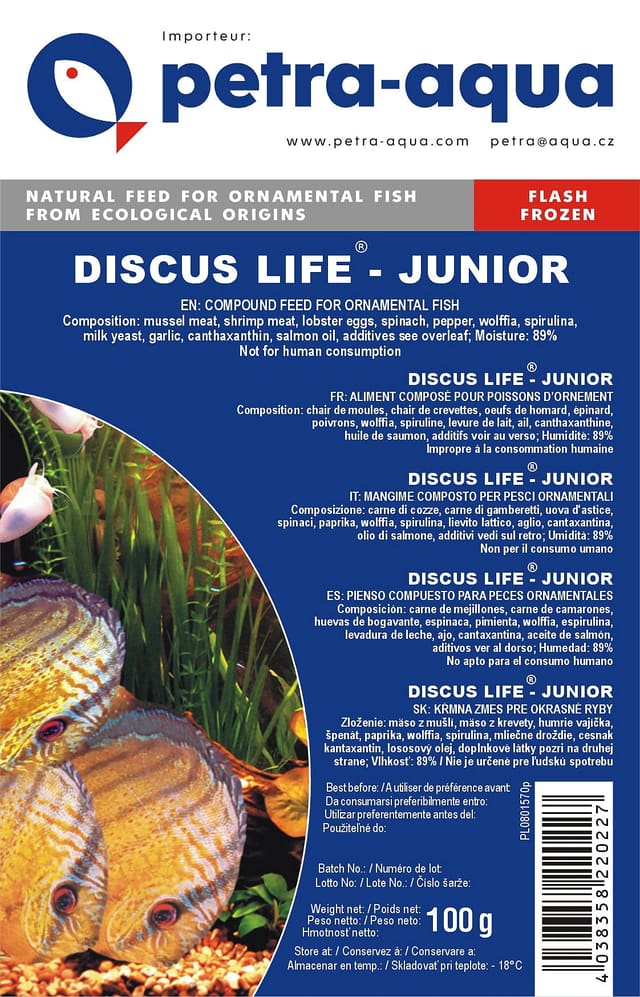
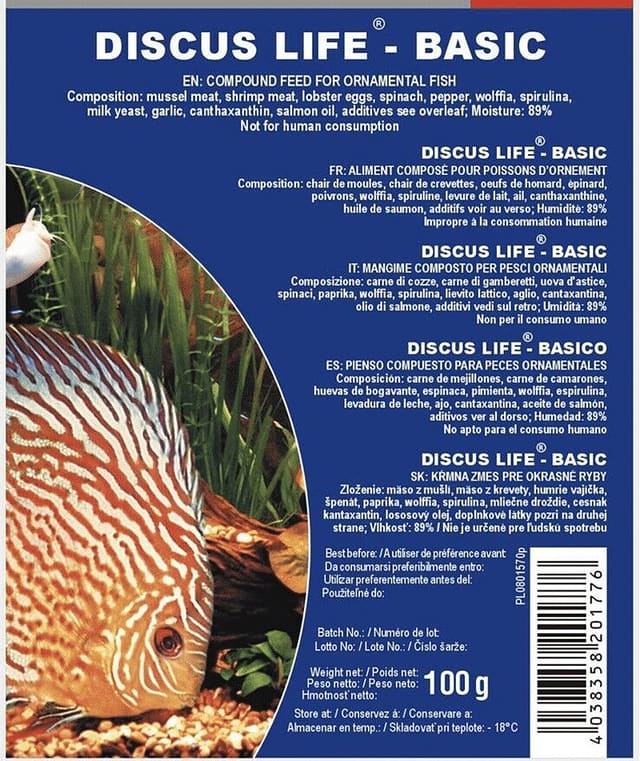
Discus Life Garlic Plus is a flash-frozen compound feed for ornamental fish, sold here as six 100g blister packs with 600g total product. The formula is named for discus and includes mussel meat, shrimp meat, lobster eggs, spinach, pepper, wolffia, spirulina, milk yeast, garlic, canthaxanthin and salmon oil. Those details come from the protected product label, rather than from a generic frozen-fish-food description.
This is a practical option for keepers who want a portionable frozen discus food and who have suitable freezer space. Each labelled unit is 100g, so one pack can be handled without exposing all six units to repeated temperature changes. The label instructs storage at -18°C, gives moisture as 89%, and states that the feed is not for human consumption.
The page deliberately does not call garlic a medicine, promise that every fish will eat the food, or claim guaranteed growth, colour, immunity, breeding condition or parasite control. Garlic is one declared ingredient in this particular feed. Research on garlic in aquaculture uses defined species, forms, concentrations and trial conditions; it cannot be converted into a treatment claim for an ornamental-fish product whose garlic percentage is not printed on the visible label.
| Product question | Verified answer |
|---|---|
| What is it? | Flash-frozen compound feed for ornamental fish |
| Sale format | 6 x 100g blister packs; 600g total |
| Named use | Discus Life formula; suitability for any fish still depends on its normal diet and mouth size |
| Declared moisture | 89% |
| Storage | Keep frozen at -18°C, following the printed label |
| Main declared ingredients | Mussel meat, shrimp meat, lobster eggs, plant ingredients, spirulina, garlic and salmon oil |
| Human food? | No; the label states not for human consumption |
| Barcode on the label | 4038358220234 |
The listing quantity is six labelled 100g blister packs, which gives a total nominal weight of 600g. That distinction matters when comparing prices: the visible label on the protected image is for one 100g unit, while the Shopify product is the six-unit sale pack. The page title and selector describe the quantity being purchased; the photograph helps identify the individual labelled unit.
A blister format is useful because it separates the food into smaller sections than a single large slab. It does not make every cube a complete meal or establish a universal portion. The amount appropriate for one aquarium changes with fish size, stock level, water temperature, the rest of the diet and how much food reaches each animal. Use the blister as a portioning aid, then judge the actual amount by observation.
| Format | Practical advantage | Boundary to remember |
|---|---|---|
| Six separate 100g packs | Only one unit needs to be handled at a time | Keep the other units fully frozen |
| Blister portions | Easier to remove a small amount than from a large solid slab | A blister section is not automatically the right amount for one tank |
| 600g total | Useful for regular frozen-food users | Check freezer capacity and likely use before buying |
The protected image shows the following composition: mussel meat, shrimp meat, lobster eggs, spinach, pepper, wolffia, spirulina, milk yeast, garlic, canthaxanthin, salmon oil and additives, with the label directing the buyer to the reverse for additive details. This page preserves the printed order. It does not invent percentages or move one ingredient to the front to make the formula sound stronger.
| Declared group | Ingredients printed on the visible label | What can safely be concluded |
|---|---|---|
| Animal-derived ingredients | Mussel meat, shrimp meat, lobster eggs and salmon oil | These ingredients are present; their individual percentages and nutrient contribution are not shown |
| Plant and algae ingredients | Spinach, pepper, wolffia and spirulina | The formula contains plant and microalgal material; the label does not give a plant-to-animal ratio |
| Other declared ingredients | Milk yeast, garlic and canthaxanthin | They are listed ingredients, not proof of a guaranteed health or colour outcome |
| Additives | The visible panel says to see the reverse | Do not infer an additive list that is not visible in the current gallery |
| Analytical information | Moisture 89% | No visible protein, fat, fibre or ash values are available on this label image |
The words compound feed are printed on the label. That tells us the product is a mixture of feed materials, but it is not the same as a visible declaration that the food is nutritionally complete as the only diet. Unless the current packaging or manufacturer documentation in your possession says otherwise, use this frozen aquarium food within a varied, species-appropriate feeding plan.
It means garlic is present in the printed composition and is part of the product identity. Garlic has a noticeable aroma, so a food containing it may smell different from a plain formula. Individual fish can still react differently according to previous diet, stress, health, social competition and how the portion is presented. Promising an automatic increase in feeding interest would turn a possibility into a claim that the label does not make.
Published aquaculture research has examined garlic in feed and immersion treatments, but the studies use specified concentrations, preparations and species. Results cannot be transferred directly to this blister without knowing the dose and without veterinary diagnosis. In particular, feeding Discus Life Garlic Plus is not a substitute for quarantine, water testing, appropriate husbandry or professional advice when fish show signs of disease.
That evidence boundary is important for both buyers and search engines. The product can accurately be described as fish food with garlic or garlic-containing frozen discus food. It should not be described as a cure, dewormer, antibiotic, immunity treatment or guaranteed conditioning food.
Choose this formula because its declared ingredients and frozen format fit your feeding plan. Do not choose it as a medicine. If a fish stops eating, first test the aquarium water, observe breathing and behaviour, review recent changes, and seek qualified fish-health advice when the problem persists.
The product is named Discus Life Garlic Plus, so discus are the clearest intended group. The label itself uses the broader phrase "ornamental fish" rather than printing a complete species list. A keeper may consider it for another appropriately sized ornamental fish only after checking that species' normal diet, life stage, feeding behaviour and ability to take the offered pieces.
Words such as "cichlid food" or "angelfish food" should not be used as blanket approval for every member of a large group. Cichlids include animals with very different feeding ecologies, from plant-grazing specialists to predators. Marine angelfish can also have specialised diets unlike freshwater discus. Match the declared ingredients to the actual species rather than treating a broad common name as nutritional evidence.
| Decision | Use this check |
|---|---|
| Discus aquarium | Confirm that the fish already accept or can safely be introduced to a soft frozen compound feed, and keep the rest of the diet varied |
| Other freshwater ornamental fish | Check species diet, mouth size and whether all individuals can reach a suitable portion |
| Herbivorous specialist | Do not assume the presence of spinach and spirulina makes an animal-rich mixture suitable as a regular food |
| Very small fry | The normal pieces may be too large; use a food designed for the fry's developmental stage unless expert guidance says otherwise |
| Fish showing illness or food refusal | Investigate water quality and health instead of relying on the garlic ingredient as treatment |
Start with less than you think the aquarium needs. Remove a small piece with a dedicated clean tool while the product is still frozen, return the unused pack to the freezer promptly, and place the portion in a clean cup used only for aquarium food. It can then be allowed to soften or thaw enough to divide safely. Avoid using kitchen utensils that will return to human-food preparation.
Offer a small amount and watch where it goes. In a discus group, dominant fish may reach the first portion while quieter fish hang back. Dividing one measured feed between more than one location can help, provided the total amount stays controlled. The goal is not to create a feeding frenzy; it is to let the intended fish eat without leaving food to settle behind wood, in plants or under filter intakes.
Remove obvious remains. Uneaten animal feed decomposes and adds to the biological load, which can affect ammonia, nitrite, nitrate and oxygen demand. A tank's response depends on its filtration and stocking, so a clear-looking aquarium is not proof that the portion was harmless. Test water regularly and reduce the next feed if residue is left.
One blister section is not a universal dose. A juvenile discus group, an adult display pair and a mixed community have different requirements. Portion size also changes when another food is fed on the same day. Observation, body condition, waste and water tests are more useful than copying a cube count from a different aquarium.
The visible label does not provide a universal frequency, and this listing does not invent one. Build a schedule around the fish's life stage, species, body condition, water temperature and all other foods offered. Juveniles and adults can have different feeding patterns, but more frequent feeding also creates more opportunities to overfeed and must be supported by appropriate husbandry.
Use the product as one part of a documented routine rather than adding it whenever a fish approaches the glass. A varied plan may include a suitable complete prepared food and other frozen items chosen for the species. Variation should be purposeful: rotating several rich foods does not automatically create a balanced diet if each one has the same nutritional gaps.
| What you observe | What to review |
|---|---|
| Food disappears immediately but one fish loses condition | Competition and distribution, not just total quantity |
| Pieces remain after the fish lose interest | Reduce the next portion and remove residue |
| Cloudiness or rising waste readings after feeding | Portion size, thawing liquid, mechanical filtration and maintenance |
| Fish refuse a food they previously ate | Water quality, temperature, social stress and health; do not simply add more garlic food |
| Body condition increases too quickly | Review the energy density and frequency of the whole diet with an experienced adviser |
The label instruction is direct: store at -18°C. Keep the product in a freezer that can maintain that temperature, protect the packaging from damage, and minimise time outside the freezer. If a unit has thawed unexpectedly, do not rely on appearance alone to decide that it is safe to refreeze and feed; seek current product or retailer guidance.
The composition includes seafood-derived ingredients, and the label states that the food is not for human consumption. Store it separately from human food where practical, use dedicated tools and a dedicated thawing cup, wash hands after handling, and clean food-contact surfaces. Do not let children handle the frozen feed unsupervised. These precautions are about sensible cross-contamination control, not a claim that this specific batch is contaminated.
Do not use a microwave, hot water or direct heat to speed thawing. Rapid heat can create unevenly warm areas and makes portion control harder. Do not leave thawed food at room temperature for a later feed, and do not pour an unused thawed portion back into the blister. The easiest low-waste routine is to remove less at the start and take another small piece only if the fish genuinely need it.
Frozen food is not automatically cleaner or dirtier than dry food. Water-quality impact comes from the amount offered, how much is eaten, the composition, how the food is handled, the aquarium's biological load and the effectiveness of filtration and maintenance. A carefully measured frozen feed can be tidy; an oversized portion can disappear into the substrate and decompose out of sight.
Before increasing food because fish appear eager, check body condition and stock distribution. Many aquarium fish learn to approach people and may beg even when they have received enough. Keep ammonia and nitrite at zero, monitor nitrate in the context of the aquarium, and maintain oxygenation. In warm discus aquariums, good gas exchange is especially important because warmer water holds less dissolved oxygen than cooler water.
Rinse or strain thawing liquid only when that fits the product directions and the feeding objective; the current visible label does not provide a specific instruction. If you choose to discard liquid, do it consistently so you can judge the aquarium's response. Avoid presenting any single technique as mandatory when the manufacturer has not printed it.
Garlic Plus is one route within a broader frozen-food range. Compare declared ingredients, fish suitability, unit size and current availability rather than choosing from colour words alone. The related pages below have been checked as live internal routes, but their formulations should be read on their own labels because the name of one product is not evidence for another.
| Related option | When to compare it | Verified route |
|---|---|---|
| Discus Life Basic | When you want to compare the standard named formula with Garlic Plus | View Discus Life Basic |
| Discus Life Junior | When the life-stage wording is relevant to younger discus | View Discus Life Junior |
| Discus Life Intensive Red | When comparing another named formula in the same line; verify its own label claims | View Intensive Red |
| Discus Life Vegetable Plus | When comparing a plant-emphasis product name; do not infer ingredients from the name alone | View Vegetable Plus |
| Frozen Artemia | When a single named feed organism better fits the species and feeding plan | View Frozen Artemia |
| Frozen Daphnia | When comparing a different natural prey item and particle profile | View Frozen Daphnia |
| Cichlid Mix | When comparing a broadly named mixed formula; check the actual species requirements first | View Cichlid Mix |
Browse the full frozen food in blisters category to compare current pack sizes and availability. Do not assume that a product containing one attractive ingredient is automatically more suitable than a simpler food. The right comparison starts with the animal's nutritional needs and the information actually printed for each formula.
The live product selector is the source of truth for price and stock.
Frozen-goods delivery needs a maintained cold chain, and the current general delivery page is written specifically for live-fish transport. This listing therefore does not promise a specific frozen-delivery speed or claim that a live-arrival guarantee applies to food. Check the delivery information shown during checkout, or contact Tropical Fish Co before ordering if the frozen-goods service to your postcode is unclear.
The verified code WELCOME10 provides 10% off a first order under the current active promotion. Enter the code at checkout and confirm that it applies before paying, because promotions and checkout eligibility can change. The discount does not alter the need to be ready to receive and freeze the product promptly.
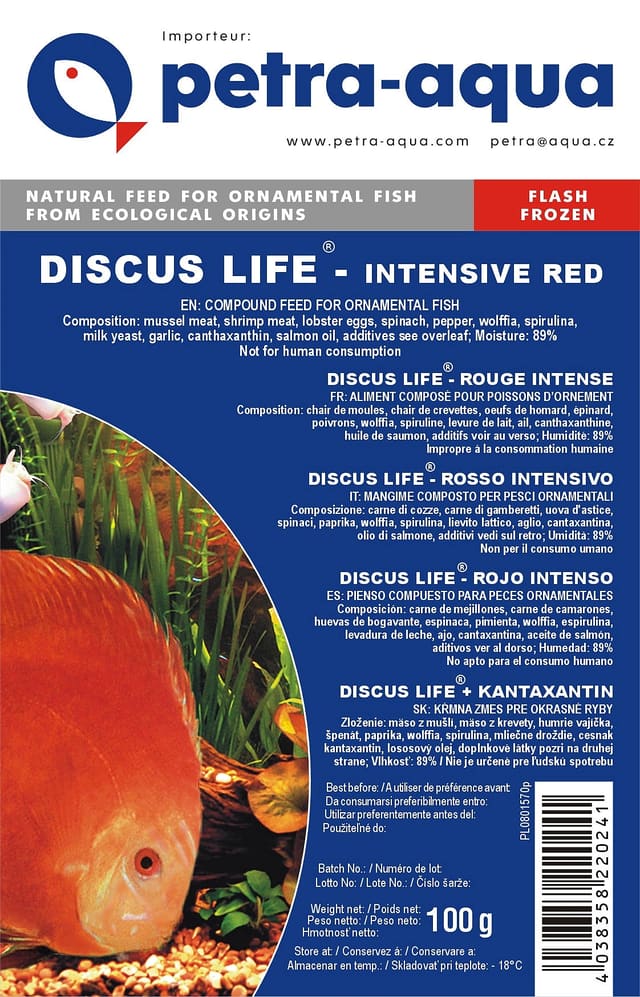
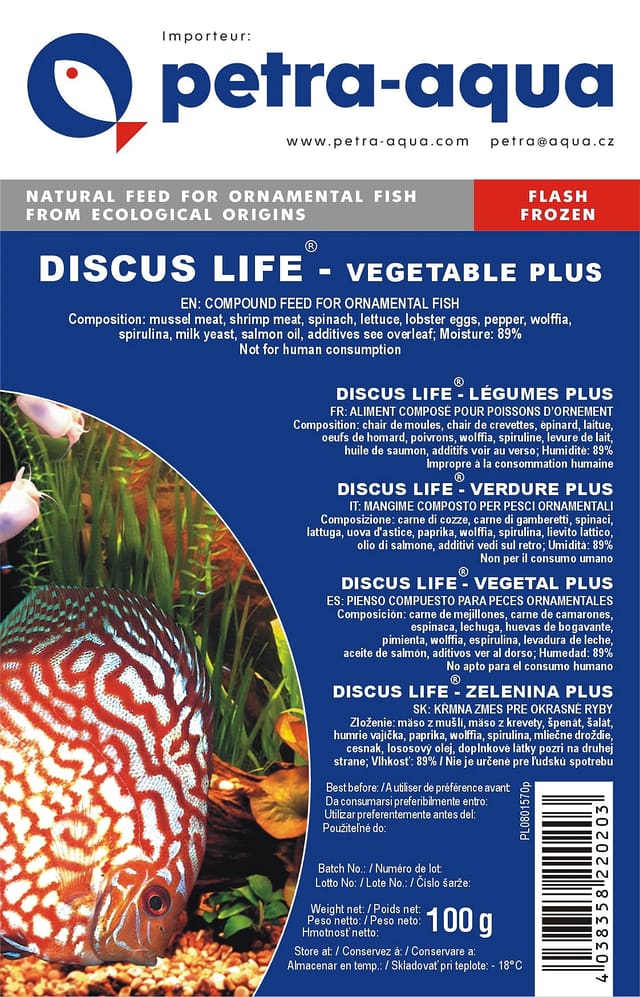
The Shopify listing is for six 100g blister packs, giving 600g total. The protected image shows one 100g label. The formula is flash frozen and the label describes it as compound feed for ornamental fish.
The visible composition lists mussel meat, shrimp meat, lobster eggs, spinach, pepper, wolffia, spirulina, milk yeast, garlic, canthaxanthin, salmon oil and additives, with additive details directed to the reverse. The visible panel does not give ingredient percentages.
The label confirms that garlic is present, but it does not print a percentage or say that garlic is the main ingredient. The composition order should be read as printed without converting it into a quantity claim.
No. Aquaculture research on garlic uses specified doses, preparations and species, which are not interchangeable with an undeclared amount in this formula. Use proper diagnosis, water testing and qualified fish-health advice rather than treating this feed as medication.
The label says compound feed, but the visible information does not say that it is nutritionally complete as the only food. Use it within a varied, species-appropriate plan unless the physical packaging or current manufacturer guidance explicitly says otherwise.
The label says ornamental fish, while the product name points most clearly to discus. For another fish, compare its normal diet and mouth size with the declared ingredients. Do not assume suitability for every cichlid, angelfish, catfish or community species.
Removing a small portion into a dedicated cup and allowing it to soften makes division and controlled feeding easier. Do not heat it, leave it out for a later feed or return thawed remains to the blister. Follow any additional directions on the physical pack.
There is no universal cube count. Start with a small portion, watch that the intended fish eat, stop before food accumulates, and adjust future amounts using body condition, waste and water tests. The rest of the day's diet also matters.
The printed instruction is to store at -18°C. Keep unused units fully frozen, limit time outside the freezer, protect the packaging and avoid repeated thawing and refreezing. Follow the date and any extra storage text on the delivered pack.
It is the one analytical value visible on the label. It does not tell you the dry-matter protein, fat, fibre or ash content, and it does not justify a high-protein claim without a fuller analysis.
No. The label states not for human consumption. Keep it separate from human food where practical, use dedicated utensils and a dedicated cup, wash hands, and clean surfaces after handling.
Frozen delivery availability and handling should be checked in the live checkout or with the team because the general delivery page describes live-fish transport rather than a frozen-goods promise.
The exact product facts above were transcribed from the protected label image and checked against the existing Shopify product identity. The barcode, composition, moisture, unit weight and storage statement were also cross-checked against independent exact-product catalogue records. Those retailer records support identity; they are not treated as scientific proof of health outcomes.
Where the current evidence does not answer a question, the page says so rather than guessing or repeating an unverified claim.
No reviews for this item yet. Bought one? Honest reviews only, good or bad.
What customers say about ordering from us
I have a small group of long finned mountain minnows. So was delighted to be able to order ten of this variety to increase the genetics in my tank . The ones I recieved are healthy but it’s to early to give a verdict on wether they are of a long finned type since they are small currently.
Gordon Walker · 23 Sept 2026
100% success travel and "installation". Pleased with quality of purchase. The Siamese fighter a bit "shy" so have not yet seen him at his best yet but looking good. Happy customer. GG
George E Garratt · 21 Sept 2026
Reviews of our shop, collected by Judge.me, an independent third-party review collector. Newest first.