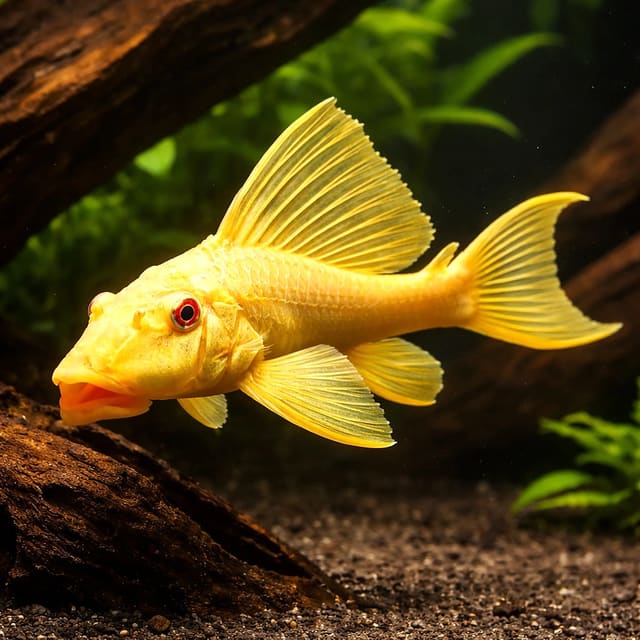
L018 Baryancistrus sp. Golden Nugget
22–27°C · pH 6–8
£80.00

L177 irri-yellow-seam pleco with yellow fin seams. Peaceful 8 cm grazer for warm, fast-flowing, well-oxygenated tanks of 275 L or more.
Adult size is the maximum length this species reaches at full maturity (scientific sources). The livestock you receive will be younger and smaller. Product-photo provenance and any image-specific limitations are stated on the listing.
Baryancistrus sp. L177
Confirm your email, then we’ll send an availability message for this exact item if it returns within 180 days.
This request is only for this product—no newsletter or other promotions. A mail-provider retry may very rarely duplicate the same availability message. Unconfirmed addresses are removed after 48 hours. See our privacy policy.
L177 irri-yellow-seam pleco with yellow fin seams. Peaceful 8 cm grazer for warm, fast-flowing, well-oxygenated tanks of 275 L or more.
Adult size is the maximum length this species reaches at full maturity (scientific sources). The livestock you receive will be younger and smaller. Product-photo provenance and any image-specific limitations are stated on the listing.
Maintain these water conditions for optimal health and vibrant colors
A band of yellow tracing the fin edges gives this catfish its trade name — the irri-yellow-seam form of L177 Baryancistrus. It is one of the more specialised loricariids on our list, carrying a Difficult care rating not because it is fragile to keep fed but because its water has to be right: warm at 26–30°C, fast-flowing and highly oxygenated, with pH between 6.0 and 7.5 and hardness from 1–12 dGH. Get the current and oxygen right and you have a genuinely distinctive bottom-dweller.
Compact for the group at roughly 8cm adult length, this yellow-seam strain still asks for room — we list 275 litres as the minimum, which buys the water volume and flow stability the strain depends on. Feeding follows the classic grazer-detritivore pattern, primarily herbivorous shading into omnivorous, with the fish patrolling the lower levels of the tank. Temperament is peaceful: small to medium tetras, rasboras, peaceful dwarf cichlids and other midwater fish that leave the bottom alone all make sound company. Skip aggressive cichlids, large predatory fish, fin-nipping species and overcrowded community tanks where the catfish would be hassled off its feeding grounds. With around ten years of life expectancy, this is a long-term resident rather than an impulse purchase.
It helps to think of the care rating as a flow rating. Nothing else on the spec sheet is extreme — the pH window is ordinary, hardness reaches down to a very soft 1 dGH, and feeding a grazer-detritivore is straightforward — but the demand for moving, oxygen-rich water at the top of the tropical range never relaxes. The 275-litre minimum exists to serve exactly that requirement: bigger water holds temperature and oxygen more steadily, and gives the yellow-seam proper patrol routes along the bottom.
Set up powerheads or a generous filter return ahead of arrival so the current is already established, and confirm your heater can hold the upper-tropical range around the clock. Tankmates should be calm, midwater-focused and uninterested in the substrate. Orders ship across the UK with a licensed live-animal courier, and every shipment carries our live arrival guarantee.
No reviews for this item yet. Bought one? Honest reviews only, good or bad.
What customers say about ordering from us
I have a small group of long finned mountain minnows. So was delighted to be able to order ten of this variety to increase the genetics in my tank . The ones I recieved are healthy but it’s to early to give a verdict on wether they are of a long finned type since they are small currently.
Gordon Walker · 23 Sept 2026
100% success travel and "installation". Pleased with quality of purchase. The Siamese fighter a bit "shy" so have not yet seen him at his best yet but looking good. Happy customer. GG
George E Garratt · 21 Sept 2026
Reviews of our shop, collected by Judge.me, an independent third-party review collector. Newest first.