−10%
Easy
Astraea (Astrea) Snail
22–26°C · pH 8.1–8.4 · 60L
£10.79£11.99
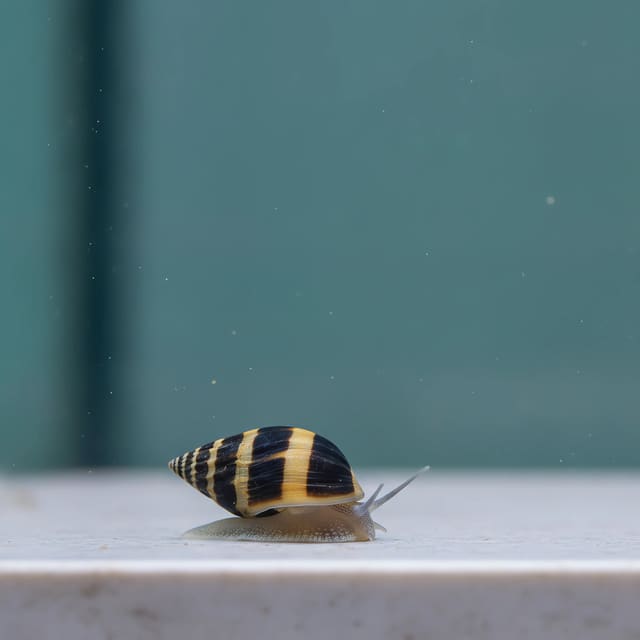
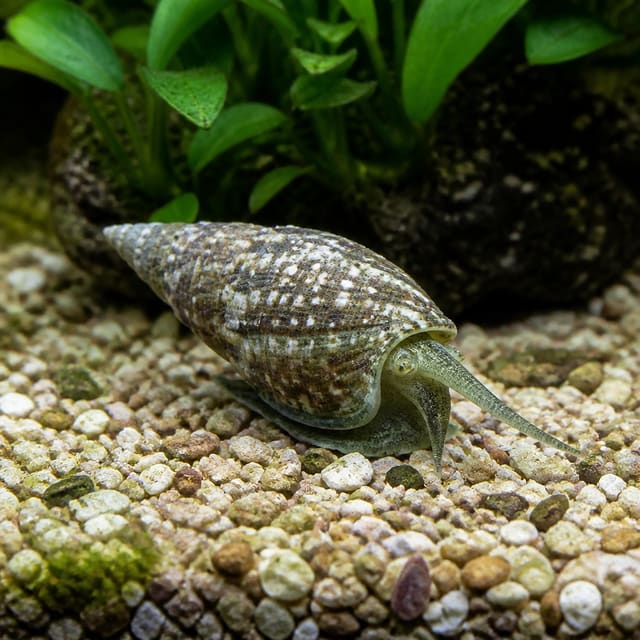
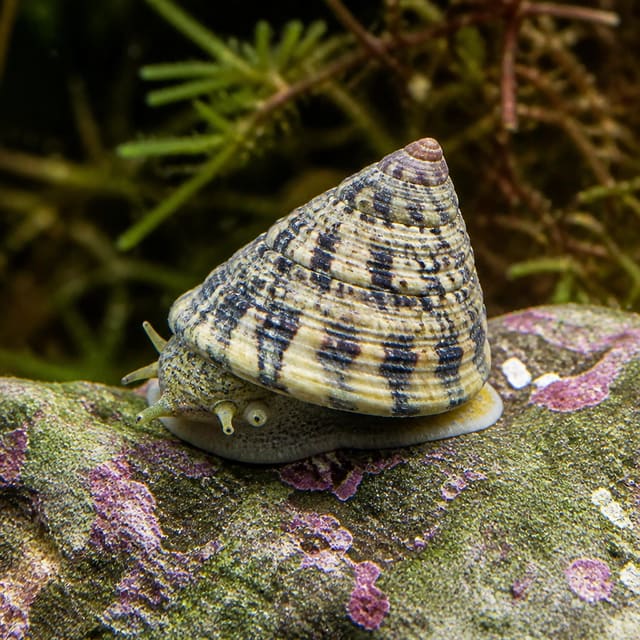
The Brown Turbo Snail (Turbo bruneus) is a marine turban snail that grazes algae and small organisms from rock and other hard surfaces in established saltwater aquariums. It suits matured tanks with steady algae growth and reef-safe fish, and each purchase is one live snail.
Turbo bruneus
The Brown Turbo Snail (Turbo bruneus) is a marine turban snail that grazes algae and small organisms from rock and other hard surfaces in established saltwater aquariums. It suits matured tanks with steady algae growth and reef-safe fish, and each purchase is one live snail.
Maintain these water conditions for optimal health and vibrant colors
The Brown Turbo Snail, Turbo bruneus, is a marine turban snail for saltwater aquariums that already grow a steady film of algae on their rock and glass. It belongs to the family Turbinidae and is also known as the brown (Pacific) dwarf turban or the little burnt turbo. Each purchase is one live snail, and the condition that matters most before ordering is simple: the aquarium should be matured, stable and free of fish that prey on molluscs.
You may see this snail sold as Turbo brunneus, spelt with a double n. The World Register of Marine Species lists that spelling as unaccepted and gives the accepted name as Turbo bruneus (Röding, 1798). Both names point to the same animal. The title uses the accepted spelling, and the trade spelling appears in the text so that keepers searching under either name find the same snail.
As Wikipedia's species account explains, turbo snails earn their name by moving quite quickly for a snail. A muscular foot carries them over rock and other hard surfaces while they scrape off algae and other small organisms. In an aquarium that makes the Brown Turbo Snail a working grazer rather than an ornament that sits in one place: it travels across rockwork and other surfaces, feeding as it goes. How much it achieves depends on how much algae your tank produces, so it supports good maintenance rather than replacing it.
| Suits | Established marine aquariums with algae on the rock and reef-safe fish |
|---|---|
| Not suited to | Brand-new set-ups, or tanks with fish that prey on snails |
| Family | Turbinidae, the turban snails |
| Diet | Algae and small organisms grazed from surfaces; nori when algae runs short |
| Water | Marine salinity 1.023–1.026, 24–26°C and pH 7.9–8.3 in OATA's mollusc guide |
| Aquarium | At least 40 litres, the OATA figure for smaller species such as snails |
| Sold as | One live snail per purchase |
This listing sells one live Brown Turbo Snail at a time, with no separate size grades to pick from. Shell size, colour and markings differ a little from snail to snail, so the animal you receive will have its own pattern of brown, cream and darker bands.
Sex is guaranteed only when the selected option explicitly states male or female. This Turbo brunneus listing has no sex-guaranteed option.
Gallery images have been digitally enhanced to improve image quality. Natural colour, pattern, size and maturity can vary between live animals.
If you are putting together a mixed group of marine invertebrates, you can browse our marine invertebrates collection. Check each animal's diet and needs against your fish before combining them.
Turbo snails are one of the mollusc groups OATA singles out for the grazing role they play in aquariums, readily consuming algae. That is the practical appeal: a snail that keeps working over the rock between your maintenance sessions and reaches surfaces a scraper does not. It also brings steady movement to the aquascape. It is a helper rather than a cure, though: the snail grazes what grows, and the reasons a tank grows a lot of algae still need attention through testing, water changes and careful feeding.
The Brown Turbo Snail suits a keeper who already runs a marine aquarium, tests the water and wants a grazer that keeps working on rock and glass between maintenance sessions. It is a poor fit for a tank that is still cycling, a set-up that is cleaned so thoroughly that no algae ever grows, or a community built around fish that eat molluscs.
A grazing snail depends on food that grows in the aquarium, so it belongs in a tank that has been running long enough for algae to appear on the rock and glass. Maturity matters for water quality too. Before adding any invertebrate, check that ammonia and nitrite both read zero. Add new livestock slowly, because the beneficial bacteria established when the filter was matured need to increase each time more animals are added and feeding rises.
Overstocking, or stocking too quickly, can lead to what OATA calls new tank syndrome: there are not enough nitrifying bacteria to cope with the extra waste, ammonia and nitrite climb to unhealthy levels, and invertebrates may become ill or die. One snail is a small addition, but it often arrives as part of a wider order, so plan the whole delivery rather than the snail on its own.
OATA recommends an aquarium of at least 40 litres for smaller species such as snails or nudibranchs, and around 200 litres for the larger molluscs. The general rule is to buy, within reason, the largest aquarium you can, because a bigger body of water keeps temperature and water quality more stable. For a grazer there is a second benefit: more rock means more surface on which algae can grow between visits.
Whatever the size, a filter is essential. In a marine set-up it can be live rock with enough water flow, an internal or external filter, or a sump-based system. The RSPCA's aquarium welfare guidance explains why: a working biological filter lets beneficial bacteria grow, and those bacteria convert toxic ammonia into nitrite, which is also toxic, and then into nitrate, which is safer.
A protein skimmer can also help. It removes dissolved organic waste before that waste breaks down into more harmful substances, which is useful in a tank where uneaten food or supplementary nori might otherwise linger.
Marine molluscs need very little décor. Live or artificial rock is the main requirement, because it provides grazing surfaces for a snail that feeds by scraping algae and small organisms from hard surfaces. Arrange the rock so that it is stable and gives the snail continuous routes to travel along; a turbo snail moves steadily across the whole aquascape rather than staying in one corner.
OATA describes marine molluscs as usually undemanding of water chemistry and publishes a set of suggested values for the whole group in its guide to looking after marine molluscs. Treat these as a general guide for molluscs rather than figures measured for this one species, and keep the aquarium steady inside them.
| Parameter | OATA mollusc guide |
|---|---|
| Salinity (specific gravity) | 1.023–1.026 |
| Temperature | 24–26°C |
| pH | 7.9–8.3 |
| Ammonia | Zero mg per litre |
| Nitrite | Zero mg per litre |
| Nitrate | Not above 50 mg per litre |
| Carbonate hardness | 8–12 dKH |
| Calcium | 380–450 ppm |
| Magnesium | 1250–1350 ppm |
OATA points out that when these invertebrates are kept in a reef aquarium, some parameters will need to be altered to accommodate more sensitive species. In practice the snail fits into the water you already keep for your corals and other reef animals, provided that water stays within the mollusc ranges above and changes slowly.
Stability is the thread that runs through every value. A larger aquarium, a mature filter and a regular testing routine all serve the same purpose: they stop the conditions around the snail from swinging between checks.
The Brown Turbo Snail feeds on algae and other small organisms that it scrapes off rocks and other surfaces. Turbo species are among the molluscs OATA names for the grazing role they play in aquariums, readily consuming algae as they travel. In a well-established tank most of the snail's diet grows in place, on live rock, glass and décor, and the snail works through it continuously.
A grazer can only eat what the tank produces. OATA advises that if the algae runs out, the diet will need to be supplemented with nori algae sheets. The signs that supply is running short are easy to read: surfaces the snail travels over stay bare and new growth is not returning between maintenance sessions. That is the moment to add a small piece of nori rather than waiting until the snail is visibly searching.
Because many molluscs graze throughout the day, OATA explains that it is not possible to give a fixed number of feeds. The right amount depends on what natural food your aquarium grows. Treat supplementary nori as a top-up for a lean tank rather than a routine meal, and err on the side of too little: overfeeding leaves uneaten food that breaks down and damages water quality, which harms the snail far more than a lean week.
Every algae grazer in the aquarium draws on the same supply. If you already keep other grazing snails, a second or third grazer increases the demand on the rock without increasing what grows there, so plan the combined numbers against your algae growth and be ready to supplement.
Every order is hand-packed by our team: the snail is bagged in pure oxygen and packed in an insulated poly box, with a heat pack when the weather calls for it. We email the tracking number and your confirmed Thursday or Friday delivery date, and a licensed live-animal courier carries the parcel to your door. The full terms are on our delivery and Live Arrival Guarantee page.
If anything has gone wrong, contact us the same day, with WhatsApp the fastest route, and send your order number and the unboxing video. We will then arrange a replacement or refund under the Live Arrival Guarantee.
Test the aquarium in the days before delivery so there are no surprises. Ammonia and nitrite should both read zero, and salinity, temperature and pH should sit steadily within the ranges in the water section. If your order includes several animals, remember that each addition raises the load on the filter.
Leave the snail to find its own way around the rock. A healthy turbo snail attaches to a surface and moves across the aquascape, and the clearest early warning is loss of attachment or long spells without moving. Test ammonia and nitrite a few days after arrival, because every new animal and every extra feed adds to the load on the filter. Hold back on nori while algae is still visible: the growth on the rock is the food the snail is built to graze, and nori is meant for when that runs out.
By now you can judge the balance between grazing and growth. Look at the rock and glass the snail has worked over. If algae returns between water changes, it has enough to eat; if surfaces stay bare, start small nori top-ups and remove what is left. Keep to the weekly partial water change and your testing routine, and add any further livestock gradually rather than in one batch.
A short log of water-change dates, test results and any nori offered makes trends easy to spot. A nitrate reading that rises a little each week, or rock that is bare sooner after each change, tells you what to adjust long before the snail shows any sign of stress.
OATA strongly recommends a 25% partial water change at least once every week. A siphon is useful for removing solid waste from the gravel at the same time. As a worked example, a 25% change in a 40-litre aquarium is 10 litres, and in a 200-litre aquarium it is 50 litres. Prepare the replacement salt water to match the aquarium's salinity and temperature so that each change keeps conditions steady rather than jolting them.
Good husbandry matters because molluscs can be stressed by even the smallest amounts of ammonia and nitrite, and that stress may then allow disease to develop. Test ammonia, nitrite and nitrate, together with pH, on a regular schedule and after any change to the aquarium, such as new livestock, a filter clean or a change in feeding. Keep a note of the results; a steady record makes a slow drift obvious long before it becomes a problem.
A turbo snail is not a substitute for maintenance, and maintenance should not leave the snail hungry. Scraping every pane and rock back to bare surfaces at each water change removes the food it depends on. Clean the front glass for viewing, consider leaving some growth on the rockwork and back glass for grazers, and add nori during lean spells.
All marine molluscs vary slightly in behaviour and appearance, but OATA lists the changes worth watching so that problems are caught before they become a real health issue. For a turbo snail, the most useful checks are how it moves, how it holds on and how its shell and body look.
Most of these signs start with the water, so test ammonia, nitrite, nitrate, pH and salinity straight away and compare them with the guide values. Look for an obvious cause such as a recent large addition of livestock, a missed water change, a filter that has been cleaned too hard or food left to decay. Correct any problem gradually.
The shell is part of the living animal, made by the mantle, and OATA lists shell erosion and shell damage among its warning signs. If you notice new erosion, pitting or chips, check calcium, carbonate hardness and pH against the guide values, and watch whether any fish or other animal is picking at the snail.
A snail that has lost its grip or stopped moving needs attention the same day. Check the water, make sure no fish is harassing it, and contact us with photographs and your test results if you would like a second opinion on what you are seeing.
Marine molluscs will generally mix with all fish considered reef-safe. Fish that are not reef-safe are likely to prey on snails, and OATA's advice is that the two should not be kept together. Before adding a Brown Turbo Snail, go through every fish in the aquarium and on your future stocking list and confirm that each one is considered reef-safe. A single snail-eating fish makes the aquarium unsuitable, however well the rest of the tank is set up.
Marine mollusc species can generally be mixed, but OATA advises avoiding combinations of species that rely on the same food source unless you are sure you can provide for all of them. Turbo snails and other algae grazers compete for the same growth on the rock and glass. In a tank with limited algae, adding several grazers at once can strip the surfaces bare and leave every snail short of food.
Not every mollusc competes with a turbo snail. OATA describes berghia nudibranchs, which need live Aiptasia anemones, and clams and scallops, which take phytoplankton and zooplankton from the water column. Their food is not the algae a turbo snail grazes, so the shared-food concern does not arise in the same way, although each of those animals has demanding needs of its own that must be met before it is added.
Turbo snails can be kept in reef aquariums. OATA notes that in a reef set-up some water parameters will need to be altered to accommodate more sensitive species, so the tank's values are normally set by the corals and other delicate animals, and the snail needs those values to stay steady and within the mollusc ranges.
For shrimps, crabs and other invertebrates, judge each species on its own care needs and diet before combining it with a snail. Always check that a new mollusc will mix with your current tank mates before you buy; if you are unsure about a particular combination, message us with your stocking list.
Yes. Turbo brunneus, spelt with a double n, is the name this snail is often traded under. The World Register of Marine Species records that spelling as unaccepted and gives the accepted name as Turbo bruneus (Röding, 1798), in the turban snail family Turbinidae. Wikipedia also lists the common names brown (Pacific) dwarf turban and little burnt turbo.
It grazes algae and other small organisms that it scrapes off rocks and other surfaces, so in an established tank most of its food grows on the rockwork and glass. If that algae runs out, OATA advises supplementing with nori algae sheets. Offer small amounts and take out anything left uneaten, because decaying food releases toxic waste into the water.
OATA recommends an aquarium of at least 40 litres for smaller species such as snails, and advises buying as large a tank as is reasonable, because a bigger volume keeps temperature and water quality more stable. The filter should be fully matured, with ammonia and nitrite at zero, before the snail goes in.
Use OATA's general guide for marine molluscs: salinity 1.023–1.026, temperature 24–26°C, pH 7.9–8.3, carbonate hardness 8–12 dKH, ammonia and nitrite at zero and nitrate no higher than 50 mg per litre. OATA notes that a reef aquarium may need some values adjusted for more sensitive animals, so keep the tank steady within the range your other livestock need.
Marine molluscs generally mix with fish that are considered reef-safe. Fish that are not reef-safe are likely to prey on snails and should not share the aquarium, so check every fish on your stocking list before adding the snail.
Marine mollusc species can generally be mixed, but OATA advises against combining species that rely on the same food unless you are sure you can provide for all of them. Grazers share the same algae, so match their numbers to the algae your aquarium grows and add them gradually rather than all at once.
It is better added to an established aquarium. A new tank has little algae to graze, and adding livestock before the filter bacteria have built up can cause new tank syndrome, where ammonia and nitrite rise to levels that can make invertebrates ill or kill them.
It is hand-bagged in pure oxygen and packed in an insulated poly box, with a heat pack when the weather calls for it, then carried by a licensed live-animal courier on your confirmed Thursday or Friday delivery date. Be in to receive it, film a continuous unboxing video from the sealed parcel onwards, open and inspect it the same day, then float the bag for 20–30 minutes before releasing the snail. Our Live Arrival Guarantee needs that video for any claim.
Turbo snails get their name because they can move quite quickly for a snail, gliding on a muscular foot. The Brown Turbo Snail uses that pace to cover a lot of rock while it grazes, which is why it is more often seen on the move than sitting in one place.
No single grazer can promise that. The snail eats algae and small organisms from the surfaces it travels over, so it helps keep rock and glass tidy, but how much it clears depends on how quickly algae grows. Regular water changes, testing and careful feeding still do most of the work.
Watch for loss of attachment to surfaces, long periods without moving, excessive withdrawal into the shell or failure to emerge, a darker or paler colour, and damage such as shell erosion, lesions or excessive mucus. Test ammonia and nitrite first, because molluscs can be stressed by even the smallest amounts.
Packing, delivery days and the Live Arrival Guarantee follow our store delivery policy, linked in the arrival guidance above.
No reviews for this item yet. Bought one? Honest reviews only, good or bad.
What customers say about ordering from us
Easy website plenty of info on fish your buying great to pick a time slot
TRACEY DURRANT · 7 Oct 2026
Got some lovely fish thank you
Kevin Mackie · 7 Oct 2026
Reviews of our shop, collected by Judge.me, an independent third-party review collector. Newest first.