−15%
Nassarius sp. - Marine Aquarium Livestock UK
24–26°C · pH 7.9–8.3
£8.49£9.99
Bumble Bee Snail (Engina sp.) is a marine sea snail with a boldly banded black and yellow shell, sold as one live snail per purchase. It needs a mature saltwater aquarium with a working filter, zero ammonia and nitrite, and fish that are considered reef-safe.
Engina sp.
Save when buying more. Each quantity is one snail; sex is not guaranteed unless the listing explicitly states it.
Bumble Bee Snail (Engina sp.) is a marine sea snail with a boldly banded black and yellow shell, sold as one live snail per purchase. It needs a mature saltwater aquarium with a working filter, zero ammonia and nitrite, and fish that are considered reef-safe.
Maintain these water conditions for optimal health and vibrant colors
The Bumble Bee Snail (Engina sp.) is a marine sea snail whose shell carries bold alternating bands of black and yellow, the pattern behind its trade name. This listing supplies one live snail per purchase. It is a saltwater animal only: it belongs in an established marine aquarium with stable water, a mature filter and fish that are considered reef-safe, and it has no place in a freshwater or tropical community tank.
The exact species has not been identified, so the care advice here follows the genus Engina and its care group. In practice that means two things. The identity is certain at genus level: Engina is an accepted genus of sea snails in the family Pisaniidae. The day-to-day care plan draws on the marine mollusc guidance published by the Ornamental Aquatic Trade Association (OATA), backed by general aquarium welfare advice. Where the right answer depends on which species you have, such as its final size or its exact diet, this guide says so plainly and gives you a safe way to proceed.
| Suits | Mature marine aquariums with live or artificial rock, a working filter and zero ammonia and nitrite |
|---|---|
| Poor fit | Freshwater tanks, newly set-up saltwater tanks and aquariums holding fish that are not reef-safe |
| Supplied | One live Bumble Bee Snail per purchase |
| Identity | Genus Engina, family Pisaniidae; species not identified |
| Aquarium size | At least 40 litres, the OATA figure for smaller molluscs such as snails |
| Water guide | OATA marine mollusc values: 24–26°C, pH 7.9–8.3, specific gravity 1.023–1.026 |
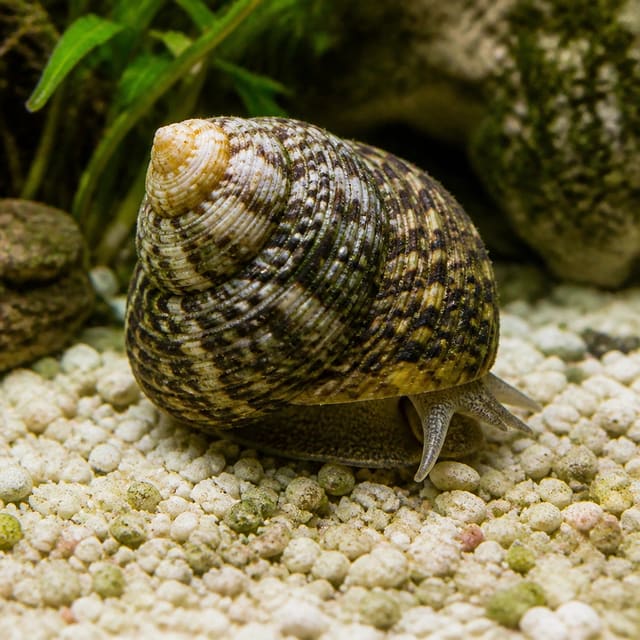
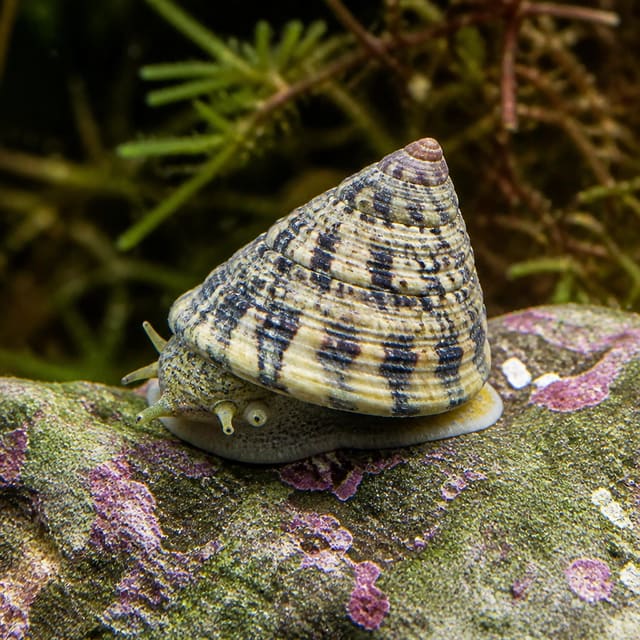
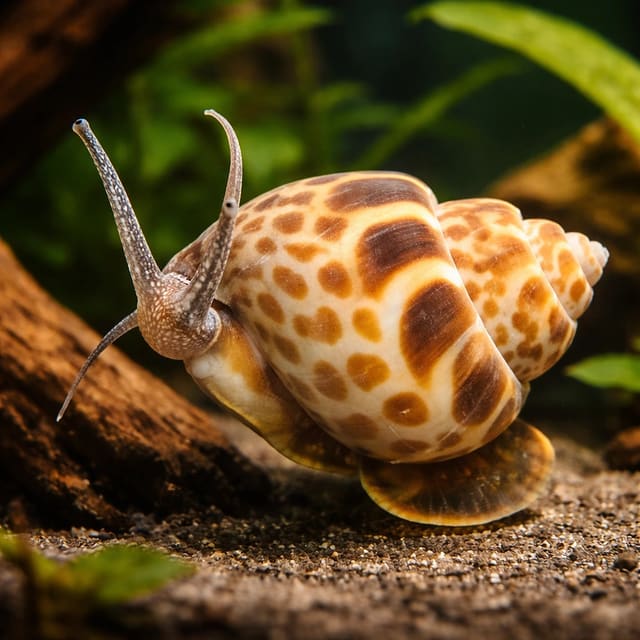
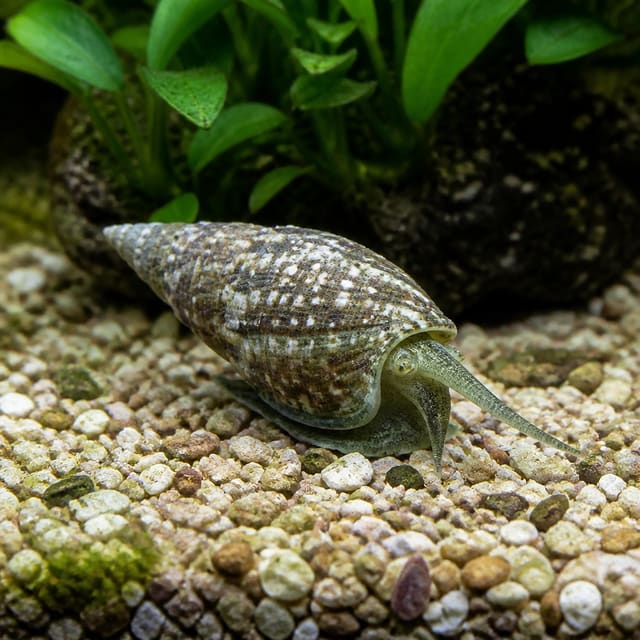
Some marine snails are chosen mainly for a job, such as grazing algae. The Bumble Bee Snail's main appeal is its looks: a neat, strongly patterned shell that stands out against rock, sand and glass. The photographed snail carries its banded shell on a pale, speckled foot with slender tentacles held out in front. It adds interest to a reef or marine invertebrate aquarium without elaborate décor, since OATA notes that marine molluscs need very little décor at all.
What it does need is a settled, well-run system. Marine molluscs are usually undemanding of water chemistry, but OATA warns that they can be stressed by even the smallest amounts of ammonia and nitrite. If your aquarium is mature, tested regularly and stocked with peaceful, reef-safe fish, this snail is an attractive addition that fits easily into a well-run routine.
You receive one live snail. Shell pattern and body colour differ a little between individual animals, and the snail you receive may be smaller or larger than the one photographed. Gallery images have been digitally enhanced to improve image quality. Natural colour, pattern, size and maturity can vary between live animals. Sex is guaranteed only when the selected option explicitly states male or female. This Bumble bee snail listing has no sex-guaranteed option.
The sections that follow cover identity, aquarium set-up, water values, arrival and introduction, feeding, maintenance and health, then tank mates and the questions buyers ask most often.
"Bumble bee snail" is a shop and hobby name inspired by the black and yellow banding of the shell. Names like this are useful when you are browsing, but they are not scientific identifications, and the same common name can be applied to different animals that look alike. The scientific label on this listing, Engina sp., tells you exactly how far the identification goes: the genus is known, the species is not.
The World Register of Marine Species (WoRMS) lists Engina as an accepted genus in the family Pisaniidae, part of the gastropod group Neogastropoda. Wikipedia's Engina article describes the genus in the same terms: sea snails, marine gastropod molluscs in the family Pisaniidae. Everything in the genus is a saltwater animal, which is why this snail is sold for marine aquariums only.
OATA explains that all molluscs share a mantle, a layer of tissue on top of the body. In snails the mantle builds the shell, although you are unlikely to see much of it, unlike the exposed mantle of a clam. The shell is part of the living animal, which is why its condition is worth watching: OATA lists shell erosion and shell damage among the changes that can signal a problem.
The photographed snail shows the look buyers know the name for: broad black and yellow bands running around each whorl of a pointed shell, with finer bands towards the tip. Individual snails vary in how bright the yellow is and how wide each band runs, so treat the photograph as a guide to the pattern rather than a portrait of your snail.
The group is remarkably varied. OATA notes that some snails, such as Collonista species, grow to only 6 mm, while giant clams can reach 45 cm in aquariums. Some molluscs, including turbo snails and sea hares, graze algae; the berghia nudibranch eats pest Aiptasia anemones; clams and scallops take plankton from the water. That range is the reason this guide keeps species-dependent details open instead of borrowing figures from a different animal.
OATA's general rule is to buy as large an aquarium as is reasonable. A bigger volume of water holds its temperature and quality more steadily, which is exactly what a marine invertebrate needs.
For smaller species such as snails or nudibranchs, OATA recommends an aquarium of at least 40 litres. Larger molluscs need approximately 200 litres. Treat 40 litres as the floor for a Bumble Bee Snail and remember that the rest of the livestock sets the final size: a reef with fish, corals and several invertebrates will need far more room than the snail itself.
Whatever the size, a filter is essential. OATA lists three workable routes for marine systems:
A protein skimmer can also help, because it removes dissolved organic waste before it breaks down into more harmful substances. The RSPCA's guidance on aquarium environments explains why the filter matters so much: animals release ammonia, which is toxic; a working biological filter grows beneficial bacteria that convert ammonia to nitrite, which is also toxic, and then to nitrate, which is safer. A snail added before those bacteria are established is exposed to exactly the compounds molluscs tolerate worst.
Marine molluscs are undemanding of décor and need very little. Live or artificial rock gives them surfaces to graze and explore, and it also forms part of the biological filter in many marine set-ups. Beyond that, arrange the aquarium to suit your fish and corals; the snail will make use of the rock, glass and substrate it finds.
Every item below exists to hold one of OATA's values steady or to let you check it:
The figures below come from OATA's care sheet on marine molluscs. OATA presents them as a general guide for this group of invertebrates and asks keepers to check for any species-specific needs; because this snail is identified to genus only, they are the targets used throughout this guide.
| Parameter | OATA marine mollusc guide |
|---|---|
| Salinity (specific gravity) | 1.023–1.026 |
| Temperature | 24–26°C |
| pH | 7.9–8.3 |
| Ammonia | Zero mg per litre |
| Nitrite | Zero mg per litre |
| Nitrate | Not to exceed 50 mg per litre |
| Carbonate hardness | Hard, 8–12 dKH |
| Calcium | 380–450 ppm |
| Magnesium | 1250–1350 ppm |
OATA adds an important note: when these invertebrates live in a reef aquarium, some parameters will need to be altered to accommodate more sensitive species. In a mixed reef, set the parameters for your most demanding animals and keep them steady. The snail needs consistency far more than it needs any one reading at the centre of a range.
Ammonia and nitrite should read zero every time you test. OATA notes that molluscs can be stressed by even the smallest amounts of either, and that stress can open the door to disease. Nitrate is less toxic but still needs keeping in check, below the 50 mg per litre ceiling in the table.
The snail's shell is made by its mantle, and OATA's mollusc guide includes values for carbonate hardness, calcium and magnesium alongside the nitrogen compounds. Test them as part of your normal routine so you know the water is holding the steady marine chemistry the guide describes, rather than finding out only when something looks wrong.
Hold the aquarium steadily between 24 and 26°C. A reliable heater and a thermometer you check daily do more for an invertebrate than chasing an exact number; what matters is avoiding swings from one day to the next.
Our team hand-packs every order. Animals are bagged in pure oxygen and packed in an insulated poly box, with a heat pack when the weather calls for it, then carried by a licensed live-animal courier on a tracked service. We email the tracking number and your confirmed delivery date so you know when to be in. Full terms are on our delivery and Live Arrival Guarantee page.
Contact us the same day your parcel arrives; WhatsApp is fastest. Send your order number and the unboxing video showing the sealed parcel being opened, and we will arrange a replacement or refund. The Live Arrival Guarantee depends on someone being at the address to receive the parcel, the parcel being opened and inspected on the day it arrives, and that continuous video. The video exists because our courier may ask for continuous unboxing evidence when we raise a claim, and it lets us settle genuine problems quickly and fairly.
OATA's introduction advice starts before the order: make sure the aquarium suits the mollusc you want and that ammonia and nitrite read zero. After that, increase livestock slowly. The beneficial bacteria in a matured filter must grow each time animals are added and feeding increases. Stock too many animals too quickly and the bacteria cannot keep up, a situation known as new tank syndrome, in which ammonia and nitrite rise to levels that can make invertebrates ill or kill them.
For the first few weeks, check on the snail daily. A healthy marine snail moves, holds on to surfaces and emerges from its shell. Test ammonia and nitrite more often than usual while the aquarium adjusts to its new resident, and hold back on any other additions until the readings stay at zero.
Feeding is where a genus-level identity matters most. OATA stresses that marine molluscs vary in their dietary requirements. Many are herbivores that graze algae in the aquarium. Others are specialists: the berghia nudibranch needs live Aiptasia anemones, and clams and scallops take phytoplankton and zooplankton from the water column. Since the species of this Engina has not been identified, the sensible approach is to rely on a mature aquarium, watch the snail closely and adjust from what you see.
Adding any animal increases the waste the filter has to process, and OATA links rising feeding and stocking to the bacteria needing time to catch up. So resist the urge to feed the aquarium more heavily just because a snail has joined it. Keep your normal feeding for the fish, watch whether the snail forages across rock and substrate, and test ammonia and nitrite more often until you are confident the system has absorbed the new arrival.
If your main reason for adding a snail is algae, choose one known as a grazer. OATA names turbo snails as molluscs that perform a grazing function and readily consume algae. The Bumble Bee Snail is best bought for its striking shell and its interest as a marine gastropod, with any contribution to tidiness treated as a bonus.
OATA advises against mixing mollusc species that require the same food sources unless you are sure you can provide for all of them. In a tank with several snails, watch whether each one stays active and in good condition, and keep total mollusc numbers in step with what the aquarium can support.
Good husbandry is essential. Changes in a snail can be subtle, so a steady routine and regular testing are how you keep problems small.
| When | Task |
|---|---|
| Daily | Check the thermometer, count your animals and note whether the snail is moving, attached and emerging normally |
| After feeding | Remove any food left uneaten |
| Weekly | Partial water change of 25%, siphon the substrate and test ammonia, nitrite, nitrate and pH |
| Regularly | Inspect and clean the filter and protein skimmer, and test carbonate hardness, calcium and magnesium |
Every marine mollusc behaves and looks slightly differently, but OATA lists changes that help you spot a problem before it becomes a real health issue:
| Sign | What to look for |
|---|---|
| Movement | Reduced activity, long periods without moving, difficulty moving, loss of attachment to surfaces or abnormal movement |
| Colour | Turning darker or paler than normal |
| Behaviour | Excessive withdrawal, failure to emerge, reduced responsiveness or unusual activity |
| Breathing | Altered mantle movement or gill activity, or more time spent in areas of higher water flow |
| Appearance | White spots, lesions, discolouration, abnormal growths, tissue damage, shell erosion, shell damage or excessive mucus |
Start with the water. Test ammonia, nitrite and nitrate straight away, because OATA links stress from even small amounts of ammonia and nitrite to disease in molluscs. Check temperature and salinity against the guide, and look back over feeding in case uneaten food has built up. Carry out a partial water change if readings have drifted, and keep testing until they settle. If the snail still looks wrong once the water is back in range, seek advice from an OATA retailer before adding any treatment to the aquarium.
OATA gives a clear rule for marine molluscs: they will generally mix with all fish considered reef-safe, but fish that are not reef-safe are likely to prey on them and should not be kept with them. That single test answers most tank-mate questions for a Bumble Bee Snail.
| Tank mates | Guidance |
|---|---|
| Fish considered reef-safe | Generally suitable companions for marine molluscs |
| Fish that are not reef-safe | Avoid: likely to prey on molluscs |
| Other molluscs | Can generally be mixed; take care where they rely on the same food |
"Reef-safe" describes each individual fish rather than the aquarium as a whole, so check the description of every fish already in the aquarium and every fish you plan to add. OATA also advises consulting your retailer before buying any marine mollusc to make sure it will mix with your current tank mates. If a fish in your system is not considered reef-safe, keep the snail elsewhere.
Marine mollusc species can generally be kept together. The caution is food. Mixing molluscs that need the same food sources only works when there is enough for all of them, so add new snails one at a time and watch that each stays active and in good condition. When you plan other animals from our marine invertebrates collection, check each description for its own diet and companion needs rather than assuming that one invertebrate suits another.
The same tank-mate test applies in both. In a reef, the snail shares the aquarium with corals and other invertebrates, and OATA notes that reef parameters may need adjusting for the more sensitive species; set them for the most demanding animals and keep them steady. In a fish-only marine aquarium, the deciding factor is the fish list. A fish-only system stocked with fish that are not reef-safe is the wrong home for this snail, however good the water quality.
Compatibility is also about pace. New animals add waste and increase feeding, so spread additions out and let the filter catch up in between, as described in the arrival section. A calm, well-stocked system in which every inhabitant has enough to eat is the best setting for this snail.
Adult size differs between species of Engina, and this snail is sold at genus level, so we do not quote a maximum length for it. OATA places snails among the smaller marine molluscs when it sets out aquarium sizes, and that is the planning basis used here.
OATA recommends an aquarium of at least 40 litres for smaller marine molluscs such as snails, and advises buying as large a tank as is reasonable because a bigger volume keeps temperature and water quality more stable. The tank also needs a working filter whose beneficial bacteria are fully established before the snail goes in.
Build numbers up gradually rather than adding several animals at once, so the filter bacteria can keep pace with the extra waste. OATA also advises against mixing molluscs that rely on the same food sources unless you are sure you can provide for all of them, so let the amount of food in your aquarium set the limit.
It suits a keeper whose marine aquarium is already established, with zero ammonia and nitrite, steady salinity and a routine of weekly partial water changes and testing. A newly set-up saltwater tank, or one that is still settling, is the wrong home for any marine mollusc.
Marine molluscs range from algae grazers to specialist and plankton feeders, and the species of this Engina has not been identified. Let a mature aquarium with established rock be its main larder, add only small extra feeds when you do feed, and remove anything left uneaten. If algae control is your aim, choose a snail known as a grazer.
OATA's general guidance for marine molluscs is 24–26°C and pH 7.9–8.3, with salinity (specific gravity) of 1.023–1.026, zero ammonia and nitrite, and nitrate not exceeding 50 mg per litre. These are group values for marine molluscs rather than an optimum for one species, so aim for steady readings inside them.
Fin-nipping and chasing are fish behaviours rather than something a snail does. The compatibility risk runs the other way: fish that are not considered reef-safe are likely to prey on marine molluscs, so choose its companions with that in mind.
Marine molluscs generally mix with fish that are considered reef-safe. Fish that are not reef-safe are likely to prey on them and should not share the aquarium. Other molluscs can generally be mixed as well, provided they are not competing for the same food.
Our team hand-packs each order, bagging the animals in pure oxygen inside an insulated poly box with a heat pack when the weather calls for it, and a licensed live-animal courier delivers it on the date we confirm by email. Someone must be in to receive it. Record a continuous unboxing video from the sealed parcel before opening, then float the bag for 20–30 minutes before releasing the snail. Live Arrival Guarantee claims need that video, sent the same day.
This guide draws on the following public sources:
No reviews for this item yet. Bought one? Honest reviews only, good or bad.
What customers say about ordering from us
Easy website plenty of info on fish your buying great to pick a time slot
TRACEY DURRANT · 7 Oct 2026
Got some lovely fish thank you
Kevin Mackie · 7 Oct 2026
Reviews of our shop, collected by Judge.me, an independent third-party review collector. Newest first.