
Pethia conchonius
Rose Barb (X Rosy Barb) - UK
Add lively Rose Barb tropical fish to your aquarium for a colourful, active shoal. Moderate care and ideal for community tanks. Buy online with UK delivery.
Care at a Glance
Premium Quality
Healthy, vibrant fish from trusted suppliers
Expert Care
Detailed care guides and support
Live Arrival Guarantee
Your fish arrives healthy or we'll replace it
Acclimated
Properly quarantined and ready for your tank
Quick Care Guide
Water Parameters
Maintain these water conditions for optimal health and vibrant colors
Why Choose This Fish?
Add lively Rose Barb tropical fish to your aquarium for a colourful, active shoal. Moderate care and ideal for community tanks. Buy online with UK delivery.
The Rose Barb, Pethia conchonius, is one of the most rewarding community fish you can keep if you want colour, movement, and resilience in one school. This hardy subtropical cyprinid comes from India, Nepal, and Pakistan, where it lives in lakes, slow rivers, and fast-flowing margins with cool, oxygen-rich water. In the aquarium, the rosy barb is famous for its active swimming, peaceful nature, and the way males intensify to a rich red during breeding condition. If you have been searching for a rosy barb aquarium fish that is easy to care for, adaptable, and ideal for a planted tank, this species is a standout choice for both beginners and experienced keepers.
Adult rosy barbs usually reach around 10.2-14 cm, with a rosy barb lifespan of up to 5 years when kept in stable water and fed a varied diet. They are schooling fish, so the best results come from a group of 6 or more in a tank with plenty of open swimming space. Their rosy barb temperature range is broader than many tropical fish, which is why they are often considered a best barb for unheated tank setups in cooler rooms. See our detailed photos showing the natural body shape, fin pattern, and colour changes that make this species so popular. If you want a colourful barb for large tank displays, a reliable community fish UK option, and a fish that brings life to the middle water zone, the Rose Barb delivers all three.
🔹 Quick Facts
- Scientific Name: Pethia conchonius
- Care Level: Easy
- Min Tank Size: 120 litres (26 gallons)
- Temperature: 18-25°C (64-77°F)
- pH Range: 6.0-8.0
- Lifespan: Up to 5 years
- Temperament: Peaceful, active, schooling
- Diet: Omnivore
Classification
- Order: Cypriniformes
- Family: Cyprinidae
- Genus: Pethia
Rosy barbs sit within the classic barb family, alongside fish such as the cherry barb, black ruby barb, Odessa barb, and ruby barb. In the aquarium hobby, they are valued as a robust, colourful species that tolerates a wide range of conditions, making them a practical choice for mixed community aquariums and cooler freshwater setups.
Where Do Rose Barbs Come From? Natural Habitat Explained
The rosy barb native range stretches across southern Asia, especially India, Nepal, Pakistan, Afghanistan, and Bangladesh. In the wild, the rosy barb habitat includes lakes, ponds, floodplain channels, and flowing streams, where water movement keeps oxygen levels high and food sources varied. Their rosy barb natural habitat is seasonal, with warmer monsoon periods and cooler dry periods, which helps explain why the species adapts so well to a broad rosy barb water temperature range in captivity. Many aquarists ask where do rosy barbs live, and the answer is simple: they are a flexible freshwater species that thrives in both still and moving water as long as conditions stay clean and stable.
In nature, rosy barb origin areas often have soft to moderately hard water, with a pH of roughly 6 to 8 and hardness around 5-19 dGH. Their wild diet includes worms, insects, crustaceans, algae, and plant matter, so they are naturally omnivorous and always active foragers. This is why rosy barb requirements are not complicated, but they do benefit from a mature aquarium with good filtration, oxygenation, and regular water changes. A planted tank with open swimming lanes closely mirrors their natural environment and encourages natural colour, shoaling, and breeding behaviour. If you are wondering rosy barb for planted tank or rosy barb in planted tank, the answer is yes, provided the plants are sturdy and the fish are kept well fed.
Conservation concerns are not a major issue for this species in the hobby, but responsible sourcing still matters. We recommend keeping them in conditions that reflect their natural habitat rather than forcing them into overly warm, cramped, or under-filtered systems. That approach reduces stress and helps prevent rosy barb diseases linked to poor water quality.
💡 Expert Tip
Mimicking the rosy barb natural habitat is one of the easiest ways to improve health and colour. Use a dark substrate, moderate flow, and a group of 6+ fish so they feel secure enough to display natural schooling behaviour.
How to Set Up the Perfect Tank for Rose Barbs
What is the right tank size for rosy barbs?
The rosy barb tank size should start at 120 litres for a proper group, but a longer aquarium is even better because these fish are active swimmers. The rosy barb minimum tank size is not just about water volume; it is also about length. A tank around 90 cm or longer gives the school room to move, turn, and establish a natural hierarchy. If you want the best rosy barb for community tank results, aim for 150 litres or more, especially if you plan to keep other mid-water fish.
Rosy barb tank requirements are straightforward: stable water, space to swim, and enough cover to reduce stress. A rosy barb tank setup should include a secure lid, because these fish can be fast and may leap when startled. The species is also a good fit for a rosy barb community tank in homes that prefer cooler water, since the rosy barb ideal temperature is 18-25°C and many keepers find the fish happiest around 20-23°C. If you are asking what temperature do rosy barbs like or what temperature for rosy barbs, the answer is a stable middle ground rather than the upper end of the range.
Which water parameters should you aim for?
For rosy barb temperature, keep the water between 18 and 25°C, with rosy barb minimum temperature around 18°C for long-term care. Their rosy barb temperature range makes them more versatile than many tropical fish, and the species can even suit an unheated room in some UK homes. The rosy barb tank temperature should avoid sudden swings, because rapid changes are more stressful than a slightly cooler steady temperature. The rosy barb ph level should sit between 6.0 and 8.0, while hardness can range from 5 to 19 dGH. These rosy barb tank temperature and water chemistry parameters are forgiving, but consistency still matters.
What filtration and decor work best?
Choose a filter that provides strong biological filtration and gentle-to-moderate flow. Rosy barbs appreciate oxygen-rich water, but they do not need a torrent. A canister or large hang-on-back filter is ideal for a rosy barb tank setup, especially in a rosy barb planted tank where debris can collect around plant roots. For substrate, dark gravel or fine sand helps the fish show stronger colour, and it also makes the tank feel more natural. If you are building a planted display, include hardy species such as Rosy Barbs as the focal school, plus broad-leaved plants, driftwood, and open water in the centre.
Lighting should be moderate and run for 6-8 hours daily. Too much light can make the fish skittish and encourage algae, while softer lighting often improves colour contrast. Rosy barb eating plants is usually not a major issue if the fish are fed properly, but like many barbs, they may nibble tender leaves when hungry. That is why do rosy barb eat plants and do rosy barbs eat plants are common questions from new keepers: they can sample soft growth, but a well-fed group in a mature tank usually leaves established plants alone. For aquascaping, combine fast growers with tougher plants and use open swimming lanes so the school can move naturally.
💡 Pro Tip
Always cycle the tank for 4-6 weeks before adding rosy barbs. A mature filter, steady temperature, and low ammonia are more important than fancy decor when it comes to long-term success.
🔹 Quick Setup Checklist
- 120 litres or larger, with a long footprint
- Stable rosy barb water temperature of 18-25°C
- Dark substrate and open swimming space
- Live plants, wood, and hiding areas
- Strong filtration with good oxygenation
- Secure lid to prevent jumping
Useful companion products for setup include a reliable Rosy Barb display group, a quality Gold Barb for mixed barb tanks, and a Odessa Barb if you want a more vivid contrast species. For planted aquariums, pair them with hardy aquascaping choices and a nutrient-rich substrate rather than delicate carpeting plants alone.
What Do Rose Barbs Eat? Complete Feeding Guide
The rosy barb diet is classic omnivore fare, which means these fish thrive on a mix of protein, vegetable matter, and quality dry foods. If you are asking what do rosy barbs eat or what food do rosy barbs eat, think of flakes, micro pellets, frozen daphnia, brine shrimp, bloodworm, spirulina-based foods, and blanched vegetables. In the wild they graze on worms, insects, crustaceans, and plant matter, so a varied captive diet keeps them healthy, colourful, and active. What to feed rosy barbs depends on their life stage, but a balanced rotation is always best.
Staple foods should be a high-quality tropical flake or small pellet. Supplement with frozen or live foods two to three times per week to support growth and breeding condition. Many aquarists ask can rosy barbs eat goldfish flakes, and while they can nibble them in a pinch, goldfish foods are usually too low in protein and not ideal for long-term care. Better choices are species-appropriate foods made for tropical fish for sale uk setups, especially when you want strong colour and healthy fins. If you are conditioning fish for rosy barb breeding, increase the protein slightly and offer more frequent small meals.
| Time | Food | Amount |
|---|---|---|
| Morning | Quality flake or small pellet | Small pinch, fully eaten in 1-2 minutes |
| Evening | Frozen daphnia or brine shrimp | Small portion, once or twice weekly |
| 2-3 times weekly | Vegetable supplement | Very small amount |
Questions like do rosy barb eat shrimp, do rosy barbs eat shrimp, rosy barb eat shrimp, do rosy barbs eat snails, and will rosy barb eat my plants are all tied to their opportunistic feeding style. They are not dedicated predators, but they may eat very small shrimp fry, weak snails, or tender plant growth if underfed. Will rosy barbs eat cherry shrimp and will rosy barbs eat amano shrimp? Adult shrimp are usually safer in large, heavily planted aquariums, but tiny shrimp can be at risk. If you keep rosy barb and cherry shrimp together, provide dense moss and plenty of cover. The same caution applies to rosy barb eating other fish; they are not true fin-nippers when kept in a proper school, but they may chase slow, long-finned tank mates.
⚠️ Feeding Warning
Overfeeding causes ammonia spikes, cloudy water, and bloating. Rosy barbs act hungry all the time, so feed only what they finish quickly. Small, controlled meals are better than large portions.
Good food options include Tropical Fish Food for daily nutrition and Frozen Brine Shrimp for conditioning and variety. A high-quality Spirulina Flake Food also helps support colour and digestion in planted tanks.
Rose Barb Appearance: Colors, Patterns & Varieties
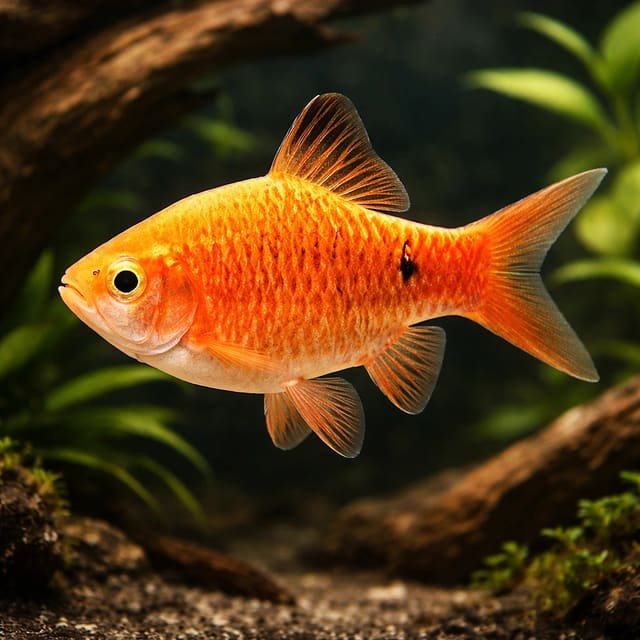
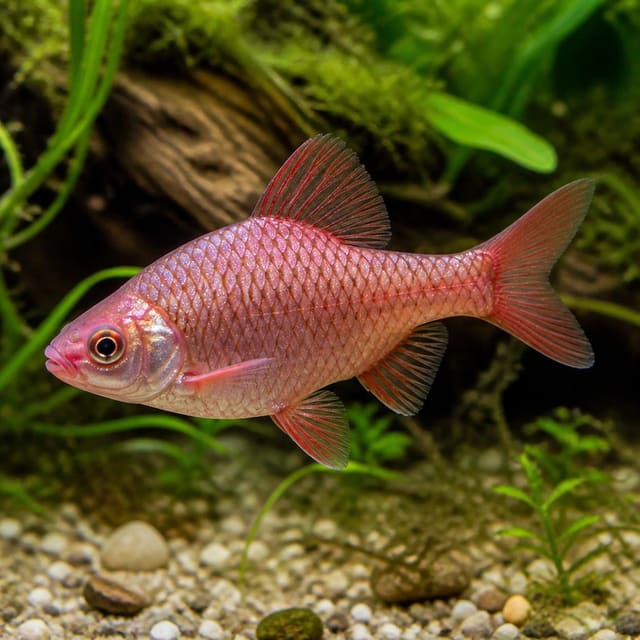
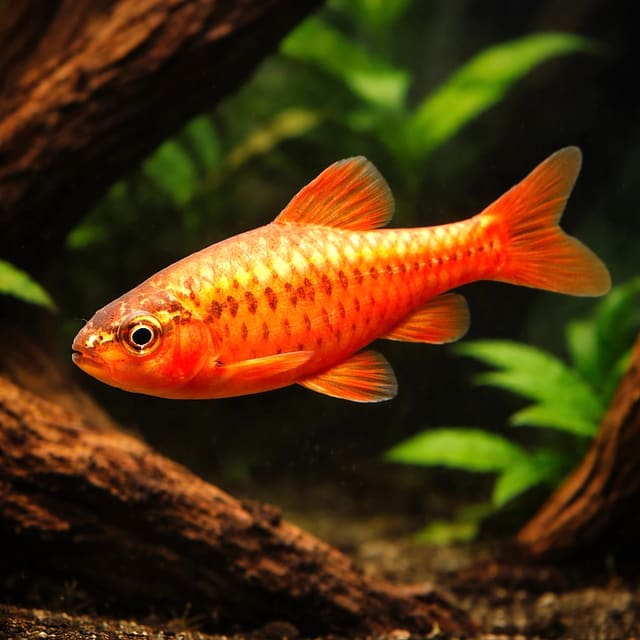
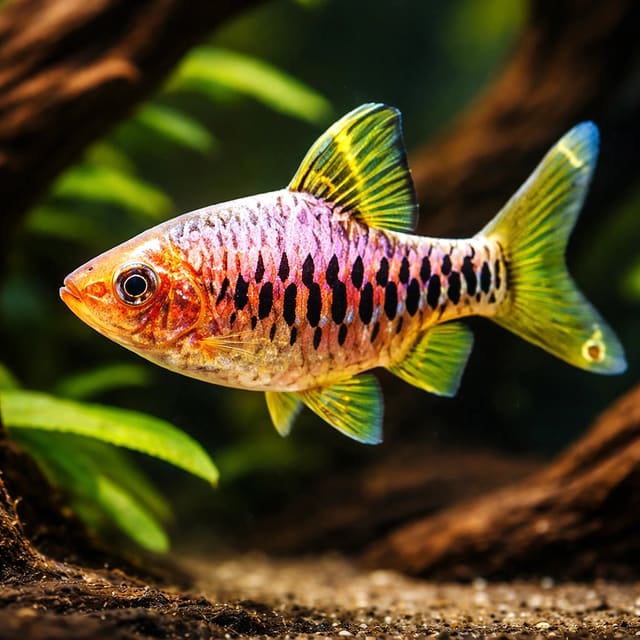
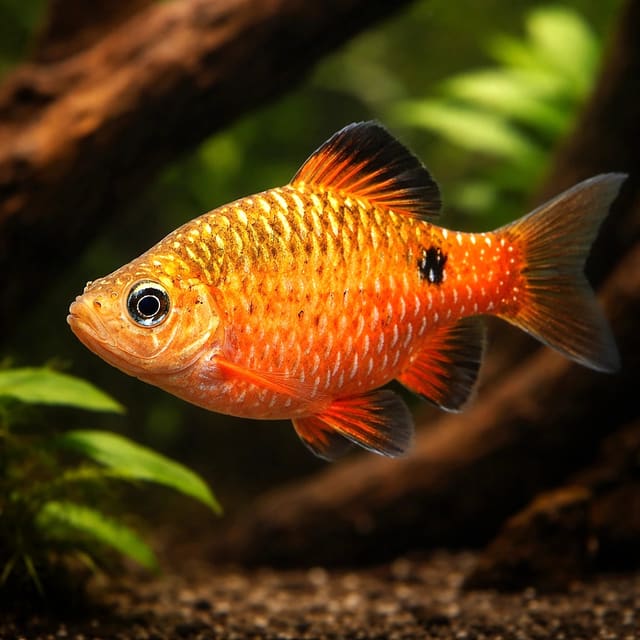
The rosy barb fish size is usually around 10-14 cm full grown, with males often appearing slimmer and more intensely coloured than females. The body is torpedo-shaped, with a deeply forked tail, a strong dorsal line, and a metallic sheen that becomes more obvious under good lighting. If you are searching for rosy barb full grown photos, you will notice that mature males develop a richer red or pink tone, while females stay more golden-olive with a softer blush. This is the most common rosy barb male female difference, along with the female’s rounder belly and the absence of black in the fins.
People often ask why is my rosy barb changing colour. In most cases, colour shifts are linked to age, stress, dominance, breeding condition, substrate colour, or lighting. A darker base and a calm school often bring out stronger colour. The species has several hobby forms, including long-fin lines and gold varieties, and it is often compared with the cherry barb and black ruby barb because all three offer attractive colour in community aquariums. The cherry barb is smaller and more delicate, while the black ruby barb is darker and more dramatic; the rosy barb sits nicely between those two in size, activity, and hardiness.
Our photos show how the intense breeding colour can deepen when males are well conditioned and the tank has a dark background. If you want a fish that stands out without being difficult, this species is a very practical choice.
What Fish Can Live With Rose Barbs? Compatibility Guide
Are rosy barbs community fish? Yes, when kept in a proper school and in the right tank mates. Are rosy barbs good community fish? Absolutely, but only with species that can handle their active nature. Are rosy barb fish aggressive? They are usually peaceful, yet they can become pushy, especially if kept in too small a group or with slow, long-finned fish. The best rosy barb school size is 6-10 individuals, which spreads out their energy and reduces fin-nipping. If you are asking what fish can rosy barbs live with or what can live with rosy barbs, choose similarly sized, active species that enjoy the same water range.
Excellent rosy barb compatible fish include other barbs, danios, rasboras, rainbowfish, and sturdy community species. Good options for a rosy barb community tank are Rosy Barbs, Gold Rosy Barbs, Odessa Barbs, and Ruby Barbs, which all share a similar pace and water preference. A larger setup can also house Long Fin Rosy Barbs if the school is sufficiently large and not overcrowded. For contrast, some keepers mix them with Golden Barbs in a spacious community display.
| Species | Compatible? | Notes |
|---|---|---|
| Gold Rosy Barb | ✅ Yes | Same temperament and water range; great mixed school display |
| Odessa Barb | ✅ Yes | Active, colourful, and suited to similar conditions |
| Betta splendens | ❌ Avoid | Long fins may trigger chasing and stress |
Can rosy barbs live with angelfish? Usually not recommended, because angelfish have long fins and a slower pace. Can rosy barbs live with bettas? Also a poor match in most cases. Can rosy barb live with goldfish or can rosy barb fish live with goldfish? No, because goldfish prefer cooler, heavier-bioload systems and are not ideal tank mates for a tropical barb. Can rosy barbs live with neon tetras? Only in a very large tank, but the tetras may be intimidated. Can rosy barb live with shrimp? Adult shrimp can work in a heavily planted aquarium, but can rosy barbs live with shrimp depends on the shrimp size and cover. Can rosy barbs live with goldfish is a common search, but the answer is still no for long-term welfare. Can rosy barbs live with shrimp, especially cherry shrimp or Amano shrimp, is possible only with caution and dense planting.
For a balanced community, think of schooling fish UK setups with active mid-water species, not slow or fragile tank mates. If you want a fish that works in a larger, mixed display, the rosy barb is one of the most reliable options. It is also a strong choice for keepers looking for the best rosy barb for community tank layouts that stay lively without becoming chaotic.
💡 Compatibility Tip
Always quarantine new arrivals for 2-4 weeks before adding them to a rosy barb community tank. This reduces the risk of introducing rosy barb diseases or stress-related outbreaks into an established school.
How to Breed Rose Barbs: Complete Breeding Guide
Rosy barb breeding is considered easy, which is why many aquarists use this species as a first breeding project. Yes, do rosy barb fish lay eggs and do rosy barbs lay eggs? They do. Does rosy barb lay eggs? Absolutely. Rosy barb fish breeding usually begins when a well-conditioned pair or group is moved into a dedicated breeding tank with fine-leaved plants or spawning mops. When do rosy barbs breed? In captivity, they can breed whenever conditions are right, but rosy barb breeding season often aligns with warmer, stable water and abundant food. The breeding difficulty is easy, and rosy barb breeding behaviour is easy to recognise once the female becomes fuller with eggs and the males begin circling and nudging her.
For rosy barb breeding in tank success, use a separate 40-60 litre setup with soft lighting, 22-25°C water, and a bare or lightly planted bottom so eggs are easier to protect. The rosy barb male female difference is useful here: males are slimmer and more colourful, while females are rounder and less intensely marked. During spawning, the pair may release several hundred rosy barb fish eggs, which are usually scattered among plants. Because the parents may eat the eggs, remove the adults after spawning.
The eggs typically hatch in 24-36 hours, depending on rosy barb temperature and water quality. Fry become free-swimming in about six days and can be fed infusoria, liquid fry food, and then newly hatched brine shrimp. If you are asking are rosy barbs easy to breed or do rosy barbs breed easily, the answer is yes, provided the fish are well conditioned and the tank is calm.
Advanced Breeding Tip
Condition the adults for 10-14 days with small live and frozen foods before spawning. A slight water change with cooler water can help trigger rosy barb breeding behaviour, especially in mature fish that have already settled into a routine.
Rose Barb vs Similar Species: Which Should You Choose?
Comparing barbs helps you choose the right fish for your tank size, water temperature, and community goals. The rosy barb is a great all-rounder, while the cherry barb is smaller and calmer, and the black ruby barb offers a darker, more dramatic look. If you want a hardy cold water barb that still brings colour, the rosy barb is usually the better everyday choice.
| Feature | Rose Barb | Cherry Barb |
|---|---|---|
| Max Size | 10-14 cm | 4-5 cm |
| Care Level | Easy | Easy |
| Temperature | 18-25°C | 23-27°C |
| Best For | Active community tanks and cooler setups | Smaller planted aquariums |
Choose the rosy barb if you want a colourful barb for large tank displays, a species that tolerates a wider temperature band, and a fish that is less delicate than many smaller barbs. Choose a cherry barb if you need a smaller footprint and a softer social profile. For more contrast, many keepers compare the rosy barb with the black ruby barb, which is darker and more dramatic but usually less versatile in mixed community layouts. If your goal is a fish that is hardy, attractive, and easy to feed, the rosy barb is hard to beat.
Common Health Problems in Rose Barbs & How to Prevent Them
Healthy rosy barbs are active, alert, and eager to feed. Their fins should be intact, their colour should be even, and their school should move together confidently. Common rosy barb diseases are usually linked to poor water quality, stress, or sudden temperature changes rather than weak genetics. Ich, fin rot, and bacterial infections can appear if the tank is overcrowded or the filter is underpowered. If you search tropical fish for sale uk healthcare, the most important thing to remember is that prevention is easier than treatment.
Good prevention starts with stable water, varied food, and a sensible stocking level. If a fish isolates itself, clamps its fins, or stops eating, move it to quarantine immediately. Treatment often includes improved water changes, salt where appropriate, and targeted medication based on the symptom. Never use copper-based medications with invertebrates nearby, because they can be lethal to shrimp and other sensitive species. If you keep rosy barb and cherry shrimp together, treat the display tank carefully and avoid unnecessary chemical exposure.
⚠️ Health Warning
NEVER use copper-based medications with invertebrates - lethal to shrimp! If you need treatment, move affected fish to a separate hospital tank first.
🔹 Quarantine Protocol
- Separate tank for 2-4 weeks
- Observe appetite, swimming, and fin condition daily
- Keep temperature stable at 20-23°C
- Use gentle aeration and simple decor
- Treat only when symptoms are clear
Understanding Rose Barb Behavior in the Aquarium
Rosy barb schooling fish are active, social, and constantly on the move. They spend much of the day cruising the middle water zone, exploring plants, and responding to food. Are rosy barbs schooling fish? Yes, and rosy barb schooling is strongest when they are kept in groups of 6 or more. A lone fish often becomes shy or restless, while a proper school shows bolder colour and more natural behaviour. Rosy barb schooling also reduces chasing, because the fish spread out their attention across the group.
They are not nocturnal and are most active during the day. They may flash colour during feeding, display to each other, or flare slightly when establishing rank. In a well-planned rosy barb community tank, the fish should look confident rather than frantic. That is why group size, open swimming room, and a stable environment matter so much for rosy barb care guide success.
Why Buy from Tropical Fish Co?
Our Rose Barbs are selected for strong health, clean finnage, and reliable colour development, so you receive fish that settle quickly into UK aquariums. Each group is quarantined before sale, monitored for feeding response, and packed with care for safe travel. We acclimate fish to typical UK water conditions so they are better prepared for homes using neutral to slightly alkaline tap water. That attention to detail helps reduce stress during the first week, which is when many new fish struggles begin.
If you are browsing tropical fish for sale UK, buy tropical fish UK, freshwater tropical fish for sale uk, or live aquarium fish for sale uk, choosing a species like the rosy barb gives you a dependable, attractive addition to a community tank. We use tracked delivery, insulated packaging, and heat packs in colder months when needed. Every order includes practical care support and a live arrival guarantee when our shipping instructions are followed. Whether you are comparing aquarium fish for sale online uk, aquarium fish for sale uk, or tropical fish for sale uk delivered, this species is a smart choice for hobbyists who want colour without high risk.
Why Choose Tropical Fish Co for Rose Barb
- Carefully selected schooling groups for strong health and even size distribution
- Quarantined and observed before dispatch to reduce the risk of disease
- Packed for safe UK delivery with insulated materials and temperature support
You Might Also Like
Complete your barb display with Gold Rosy Barbs for a brighter school, Odessa Barbs for extra red-orange contrast, or Ruby Barbs for a more intense colour theme. For feeding, pair them with Tropical Fish Food and Frozen Brine Shrimp. If you are building a planted setup, a quality Spirulina Flake Food and a mature filter will help the school thrive.
You Might Also Like


Black Ruby Barb - UK

X Mahecola Barb - UK

X Gold Checkered Barb - Tropical Fish for Sale UK

X Green Tiger Barbs (Puntigrus tetrazona) - UK

Gold Barb (X Golden Barb) - UK

Gold Barb (X Gold Rosy Barb) - UK

Tiger Barb - Moderate Care | UK
Popular Right Now

Yellow Vampire Crab (Geosesarma sp.) - UK

Aulonocara sp. 'Firefish' - Tropical Fish for Sale UK

Yellow Lepturus Cichlid - UK

Apistogramma agassizii “Super Red” - UK

Endler Gold Guppy Breeding (Poecilia wingei) - UK

X Neon Green Rasbora - UK

Rasbora Heteromorpha (Trigonostigma heteromorpha) - UK