Frozen Herbivore Fish Food 6 x 100g
£21.99

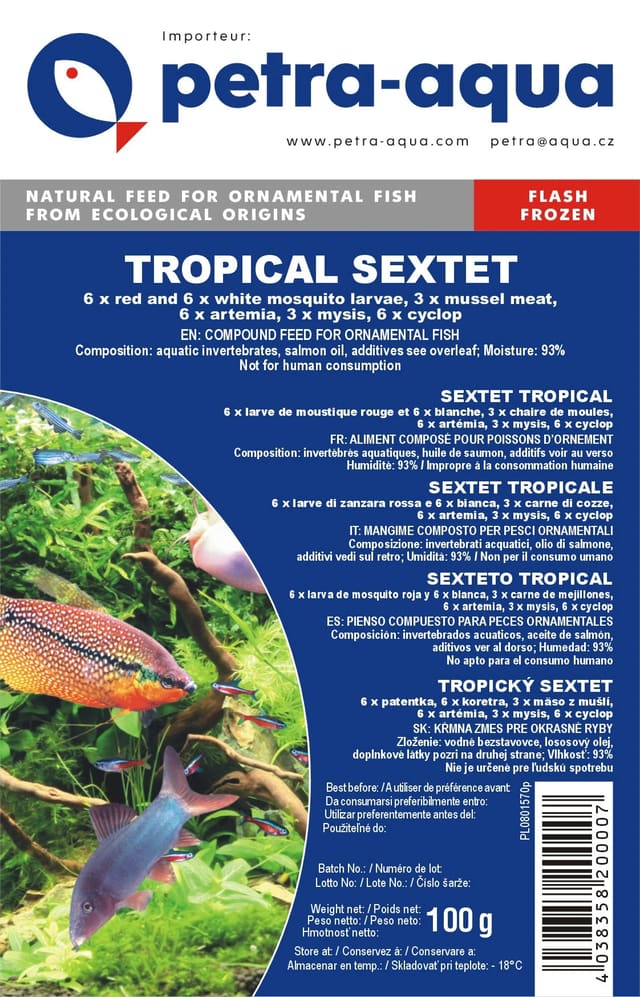
Six 100g flash-frozen blister sheets of compound ornamental-fish feed with shrimp meat, mussel meat, marine copepods, marine algae, vegetables, spirulina and salmon oil. Store at -18 C.
Six 100g flash-frozen blister sheets of compound ornamental-fish feed with shrimp meat, mussel meat, marine copepods, marine algae, vegetables, spirulina and salmon oil. Store at -18 C.
Six 100g frozen blister sheets of Crustacean Food for ornamental fish. The visible label declares shrimp meat, mussel meat, marine copepods, marine algae, vegetables, spirulina and salmon oil in a high-moisture compound feed. The sheets are flash frozen and must be stored at -18°C. This is aquarium feed only and is not for human consumption.
The formula combines animal and plant-origin ingredients, but that does not make it a universal food for every tropical or marine species. Use it as part of a varied, species-appropriate feeding plan. Check the fish's natural diet, mouth size, health and any manufacturer guidance available on the pack overleaf before deciding portion size or frequency.
One product unit contains six frozen sheets, each labelled at 100g, for 600g total declared pack weight. The product has one Shopify variant; the six sheets are the pack format rather than six separately selectable products. Keep enough freezer space available before ordering so the delivery can be placed at the correct temperature promptly.
| Pack detail | Meaning |
|---|---|
| 6 x 100g | Six individual 100g frozen sheets |
| One product variant | The full six-sheet pack is purchased together |
| Flash frozen | Supplied as frozen ornamental-fish feed |
| 92% moisture | A high-moisture food, not a dry pellet equivalent |
| -18°C storage | Keep continuously frozen until a portion is needed |
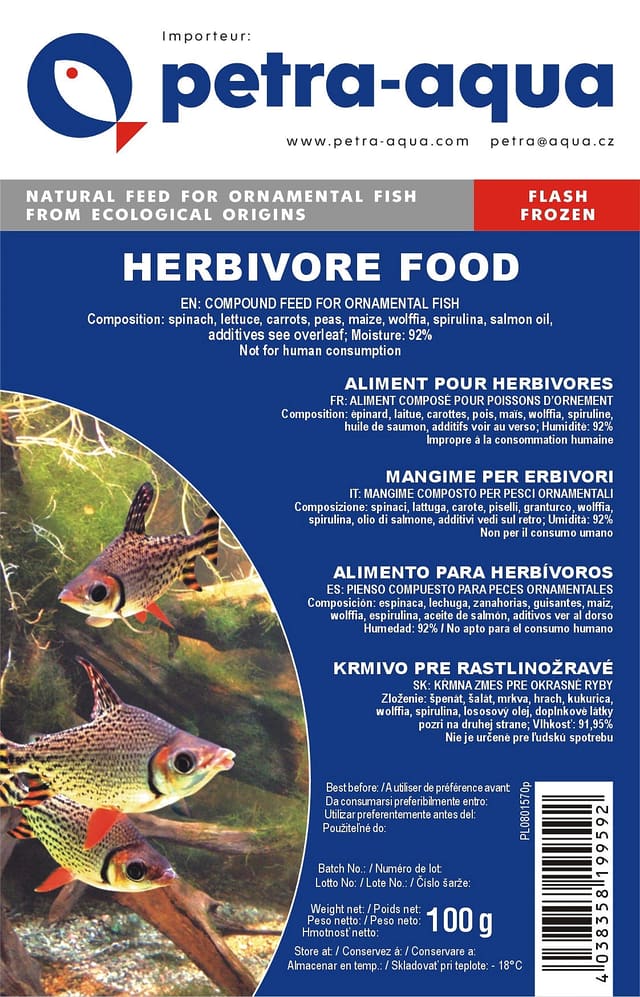
The front label lists more than shrimp, mussel and algae. The visible English declaration is: shrimp meat, mussel meat, marine copepods, marine algae, lettuce, spinach, peas, carrots, soya, maize, spirulina, salmon oil, plus additives identified on the overleaf. Moisture is declared at 92%.
| Ingredient group | Labelled ingredients | Practical meaning |
|---|---|---|
| Crustacean and mollusc | Shrimp meat, mussel meat, marine copepods | Animal-origin aquatic ingredients |
| Marine plant material | Marine algae, spirulina | Algal material within a mixed formula |
| Vegetables | Lettuce, spinach, peas, carrots | Plant-origin ingredients and varied texture |
| Other plant ingredients | Soya, maize | Part of the compound-feed formulation |
| Oil | Salmon oil | Fish-derived oil within the formula |
| Additional declaration | Additives: see overleaf | Do not invent the additive list from the front image |
This food contains crustacean, mollusc, fish, soya and maize ingredients. It is not vegetarian, vegan, single-protein or a pure algae food. If a fish has a specialised dietary plan, do not substitute this blend without checking its full label and obtaining species-specific advice.
The visible pack does not promise colour enhancement, faster growth, disease prevention, breeding improvement or suitability for every freshwater and marine fish. It also does not provide a universal cube count, dose per litre, daily feeding schedule or opened-pack shelf life on the visible side. Those claims have therefore been removed.
Product pages should help customers use a feed safely without turning general aquarium advice into manufacturer instructions. The practical guidance below is deliberately based on observation: start small, watch whether every intended fish can eat the particles, remove leftovers and adjust from body condition and water quality.
The pack is labelled broadly for ornamental fish. The mixed composition may fit many omnivorous fish and some species that accept aquatic animal matter plus plant ingredients. It may also be useful as one component in the rotation for fish whose normal care guidance includes suitable crustacean, mollusc, copepod or algal foods. That is not the same as saying the product is complete or ideal for all of them.
Before feeding, check three things: the species' dietary category, the particle size after thawing and the fat/protein richness of its existing menu. A food can be accepted eagerly and still be inappropriate as a frequent staple. Herbivorous specialists, strict predators, fry, filter feeders and fish under veterinary dietary management each need a more specific decision.
| Situation | Approach |
|---|---|
| General omnivorous ornamental fish | Consider as one food in a varied rotation after checking species guidance |
| Specialist herbivore | Do not assume the algae makes the full mixed formula suitable |
| Specialist carnivore | Check whether vegetables, particle size and nutrient profile fit the species |
| Fry or very small mouths | Assess thawed particle size; use a purpose-made fry food when needed |
| Marine aquarium | Check each species rather than relying on the word marine in ingredient names |
| Sick or recovering fish | Follow aquatic-veterinary or species-specialist advice |
Remove only the amount required for the current feed and return the remaining sheet to the freezer immediately. Thaw the portion in a clean cup using a little aquarium water. This makes it easier to inspect the food, break it into suitable particles and distribute it across the tank without dropping one large frozen mass into a single territory.
Begin with less than you expect to need. Add a small amount, watch the fish, then add more only while the food is being eaten. The correct portion is determined by the number, size, species and condition of the fish, not by aquarium litres alone. Stop before fragments settle into gravel, rockwork or filter dead zones.
For mixed communities, distribute the thawed feed in more than one location so dominant fish cannot take everything. Use a pipette or feeding tool for shy, bottom-dwelling or target-fed species when appropriate. Do not use the same tool between quarantine and display tanks without proper cleaning.
There is no universal frequency on the visible label. Some fish may receive a suitable frozen blend regularly as part of a balanced rotation; others need it only occasionally or not at all. Consider the complete weekly diet, including flakes, pellets, fresh foods and other frozen products, rather than treating each feed in isolation.
Monitor body condition, growth, waste, appetite and water tests. Reduce the amount or frequency if fish gain excessive weight, leave particles, produce abnormal waste or if nitrate rises faster than expected. Growing juveniles and breeding fish can have different energy needs, but more food is not automatically better nutrition.
| Observation | Adjustment to consider |
|---|---|
| All food eaten promptly and body condition stable | Keep the current modest portion |
| Food reaches the floor uneaten | Reduce the portion and improve distribution |
| Dominant fish take everything | Feed smaller amounts in several locations |
| Fish are gaining excess weight | Review the whole diet and reduce rich foods |
| Nitrate or detritus rises quickly | Reduce waste, improve maintenance and reassess stocking |
| One species refuses the food | Do not starve it into acceptance; check species requirements |
The label states storage at -18°C. Place the pack in a functioning freezer as soon as it arrives. Do not leave it in a hallway, car, parcel box or warm kitchen while unpacking the rest of an order. Keep the sheets sealed and protected from repeated temperature changes.
Use clean, dry hands or a dedicated utensil to remove a portion. Close or wrap the remaining sheet to reduce freezer damage and cross-contamination. Do not refreeze food that has fully thawed. If the pack arrives warm, leaking, badly damaged or with evidence of prolonged thawing, photograph it and contact Tropical Fish Co before feeding it.
Do not feed a pack when its frozen condition or storage history is uncertain. The label's -18°C instruction is a product requirement, not an optional serving suggestion.
Frozen food is high in moisture and can fragment through the tank. Uneaten material contributes organic waste, which can increase ammonia risk in an immature system and add to nitrate and detritus in an established one. Good filtration helps, but it does not make overfeeding harmless.
Check that ammonia and nitrite remain at zero, track nitrate and inspect low-flow areas after feeding. Siphon visible leftovers rather than leaving them for the filter. In a marine aquarium, also watch phosphate and the response of the clean-up crew. In a small aquarium, one oversized portion can have a much larger effect than it would in a mature high-volume system.
This product's strength is its mixed composition. A single-ingredient artemia, daphnia, bloodworm or mussel product can make dietary tracking simpler and may match a particular species more closely. The crustacean formula offers several aquatic animal ingredients, vegetables, algae and oil together, which can be convenient for a compatible mixed feeding plan but less suitable when you need precise ingredient control.
| Food style | Main advantage | Main caution |
|---|---|---|
| Crustacean mixed formula | Broad ingredient variety in one blister | Not appropriate for every specialist diet |
| Single-ingredient artemia or daphnia | Clearer ingredient identity and particle profile | May not provide broad dietary variety alone |
| Prepared dry staple | Consistent dosing and easy storage | Acceptance and moisture differ from frozen feed |
| Species-specific prepared food | Designed around a narrower care need | Still requires correct portioning and label reading |
Browse the frozen fish food blister collection to compare ingredient profiles. A rotation should be planned from the fish's needs, not from a target number of different products.
The formula contains shrimp, mussel, salmon oil and soya. Use separate utensils from human food preparation and wash hands after handling. The product is clearly labelled not for human consumption. Keep it away from children and do not allow frozen-feed packaging to contact household food.
Marine-derived ingredients do not make aquarium water salty in the way marine salt mix does, but they do add organic matter. Never use this food to alter water chemistry. Likewise, spirulina and marine algae are ingredients, not medication and not a substitute for correct lighting, filtration, water parameters or veterinary care.
A useful rotation has a reason for each food. Do not add products simply to make the menu look varied. Start with the species' nutritional needs, then choose particle sizes and ingredients that complement rather than duplicate each other. Record which fish eat each food, how much is actually used and whether body condition remains stable.
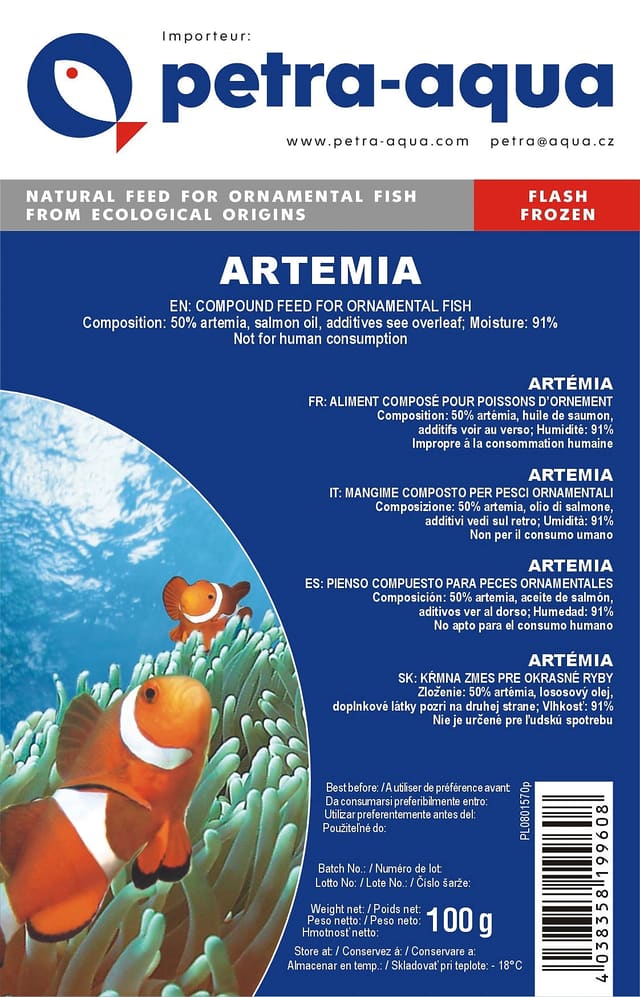
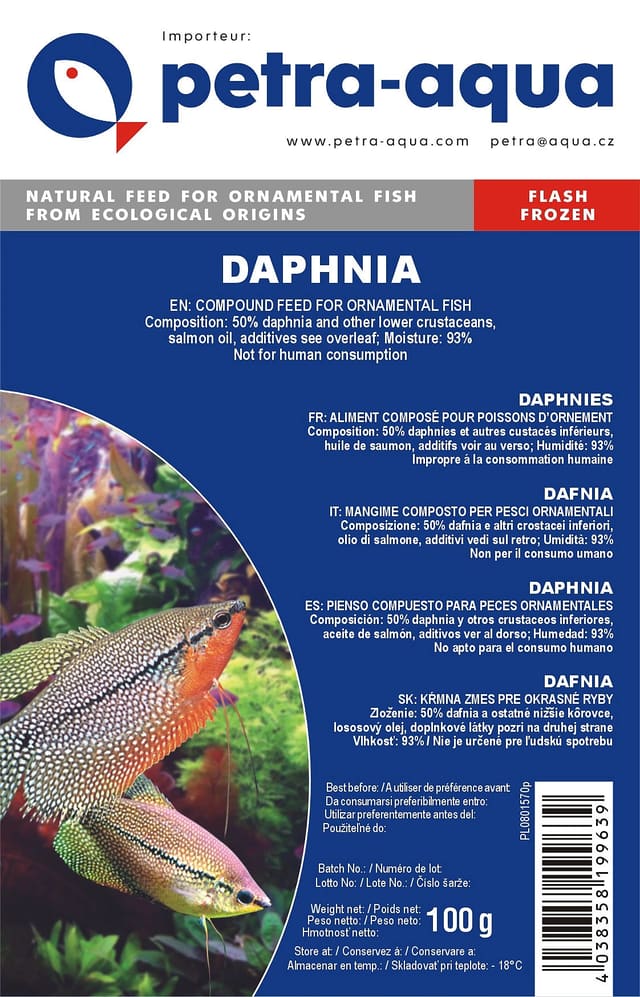
For smaller mouths, compare the 6 x 100g Frozen Artemia Blister. The 6 x 100g Frozen Daphnia Blister offers a different single-food profile. Larger fish whose care guidance supports shellfish may be better matched to the 6 x 100g Cockle Meat Blister or Cocktail Shrimp Meat Blister. These links are comparisons, not a recommendation to feed all four.
Keep a simple weekly record with product, thawed portion, fish response and leftovers. That makes overfeeding easier to spot and helps identify a food that one species cannot process well. Change one part of the menu at a time when investigating appetite or waste, otherwise it is difficult to know what produced the change.
Frozen food does not automatically replace a nutritionally complete dry staple, nor does dry food automatically make frozen food unnecessary. The right balance depends on the species and the declared purpose of each product. For a specialist or medically managed fish, use a qualified care plan rather than a generic rotation.
Check the current delivery information before ordering, particularly when combining frozen food with live fish or dry goods. Be available to receive the parcel and move the pack into the freezer promptly. Delivery estimates do not change the storage instruction.
On arrival, inspect the outer package and the blister sheets. Photograph damage, leakage or thawing before discarding packaging. Keep the order details available when contacting support. Do not taste the product or use smell alone as proof of safety.
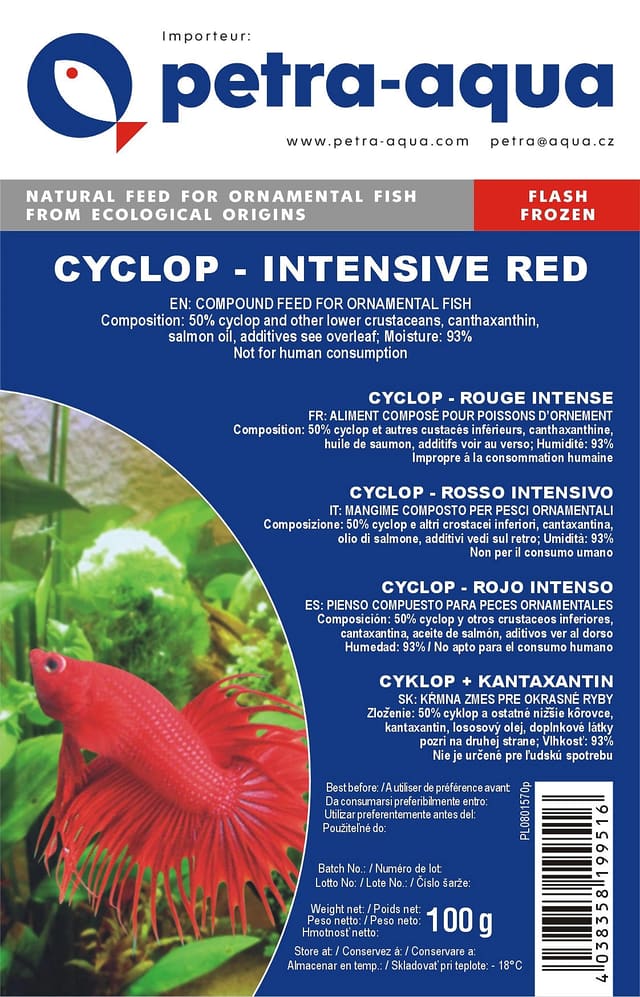
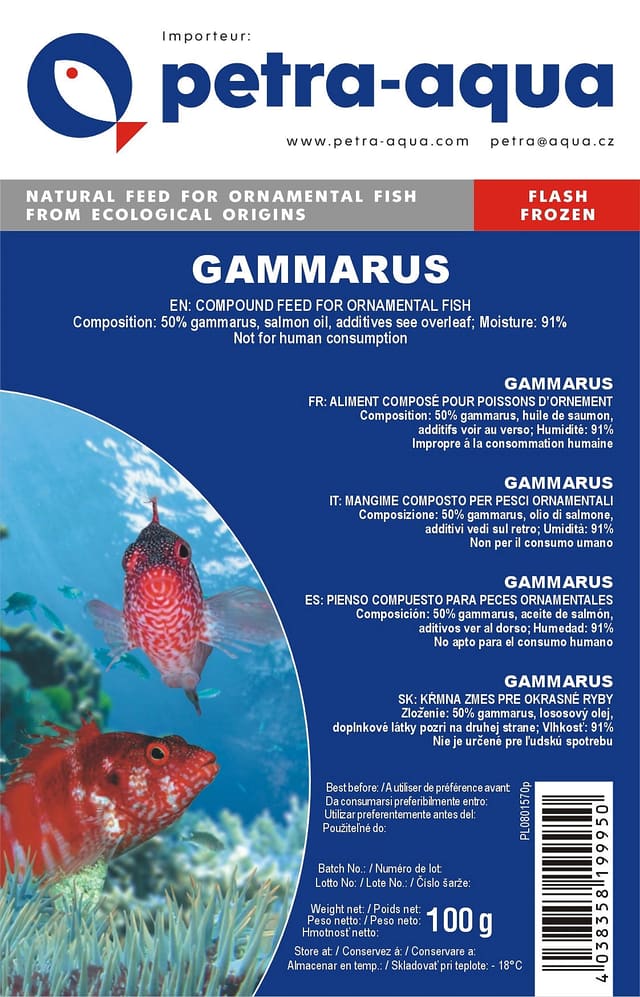
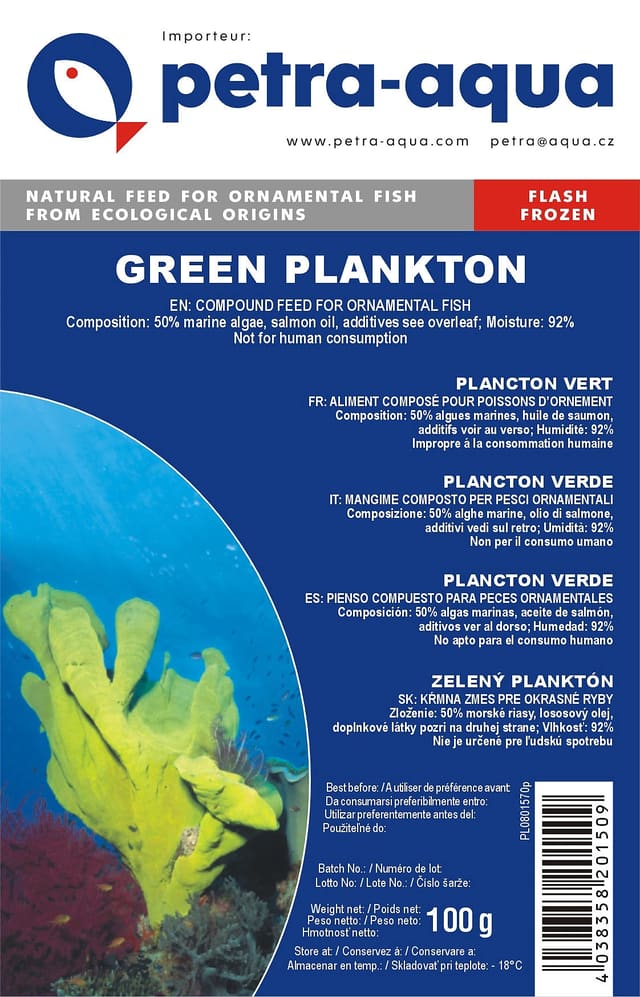
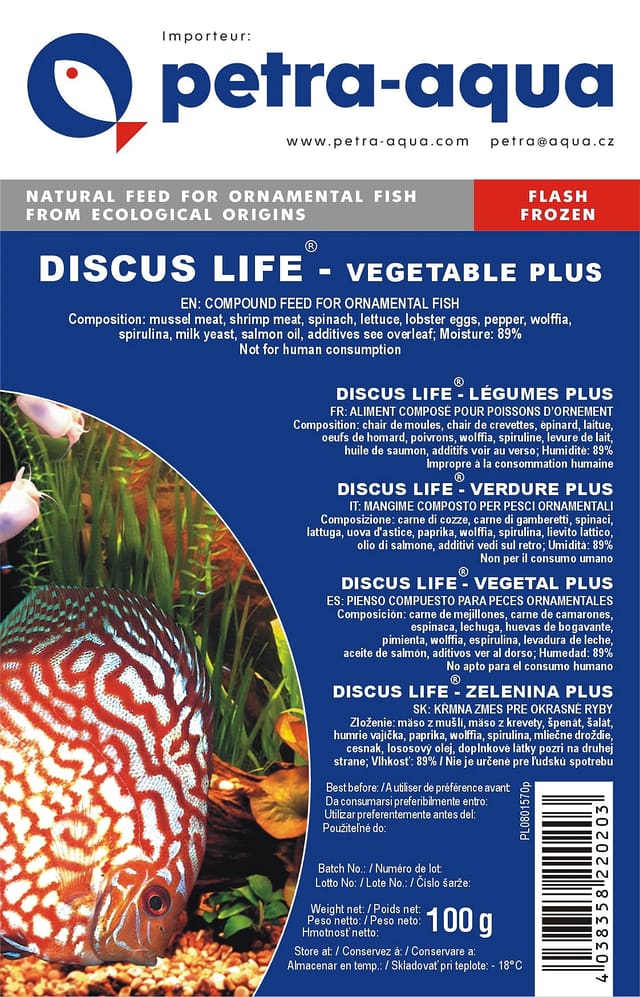
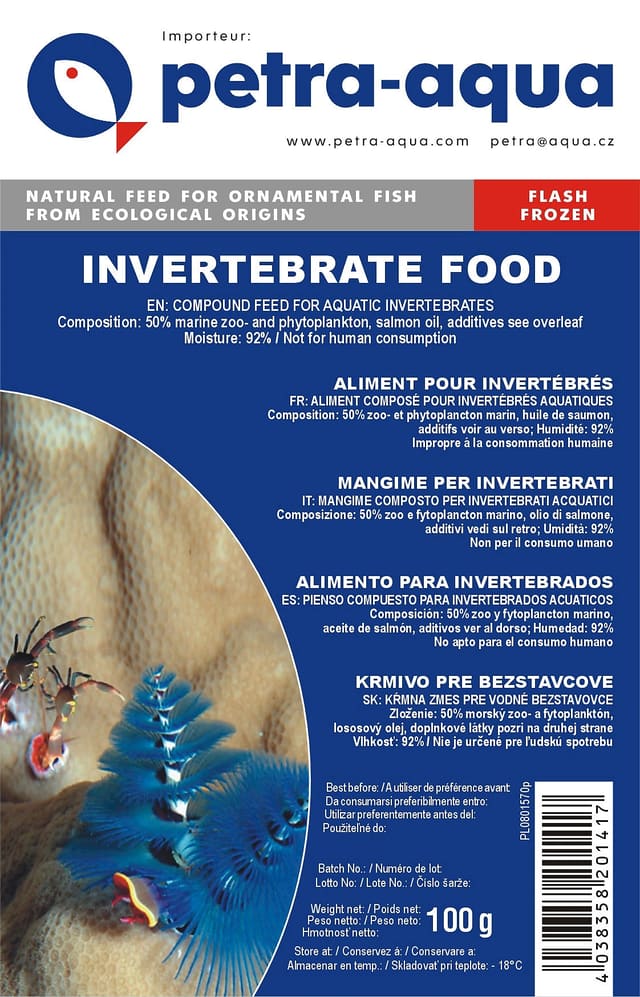
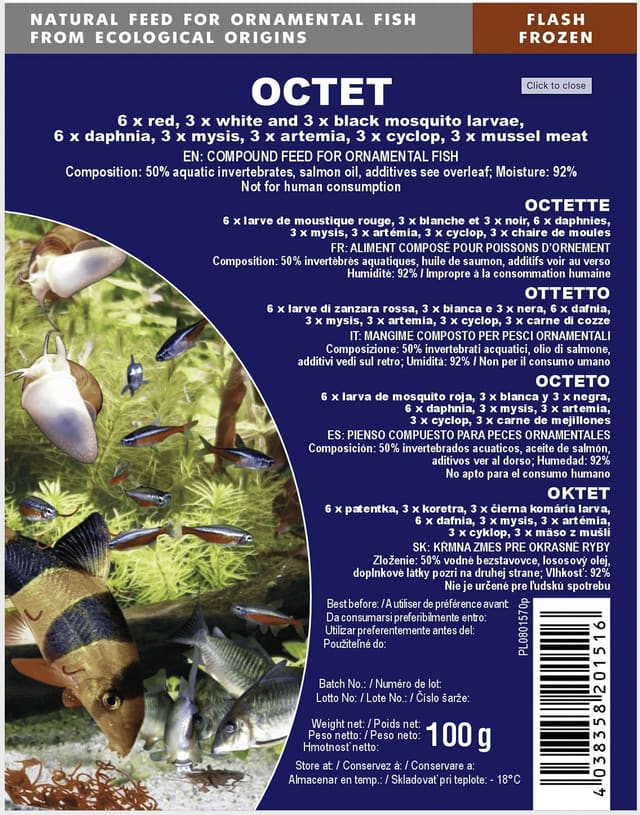
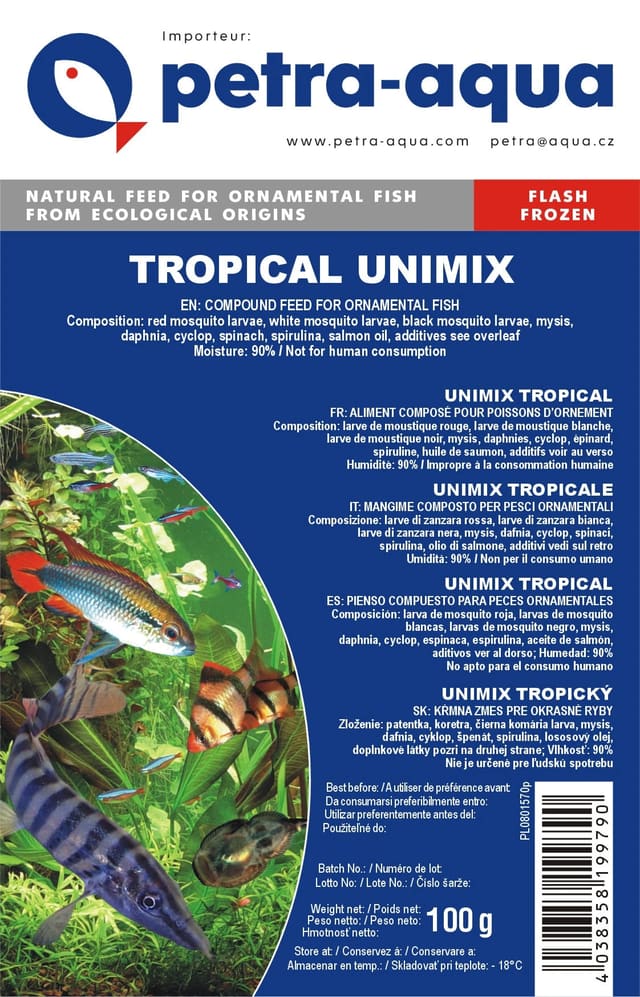
The gallery image is the preserved same-product label. It shows the importer branding, Crustacean Food name, flash-frozen declaration, composition, moisture, net weight and storage temperature. It is useful evidence for the formula, but it does not show the overleaf additive list, best-before date for the individual batch or the exact shape of every frozen portion.
Always read the physical pack received because labels and batch information can change. Contact us if the delivered declaration differs materially from this page.
The page gives the full visible composition rather than reducing the product to three headline ingredients. It also separates verified label facts from practical feeding guidance, so you can decide whether the blend suits your fish without exaggerated health or growth promises.
The live buy box shows the current price and stock. The six-sheet format is suitable for keepers who use frozen food regularly or run several compatible aquariums. Store the pack correctly, feed by observation and use our support routes if the cold chain or delivered label raises a concern.
The retail unit contains six 100g frozen sheets, giving 600g total declared weight.
No. One purchase is the complete 6 x 100g pack. The product has one Shopify variant.
The visible label lists shrimp meat, mussel meat, marine copepods, marine algae, lettuce, spinach, peas, carrots, soya, maize, spirulina, salmon oil and additives shown on the overleaf.
No. It is a mixed compound feed with crustacean, mollusc, algae, vegetables, grains, soya, spirulina and salmon oil.
No universal suitability is claimed. Match the full formula, particle size and feeding frequency to the exact species.
Some marine ornamental fish may accept a suitable mixed frozen feed, but marine ingredients alone do not prove species suitability. Check the fish's diet first.
Do not assume so just because it contains algae and vegetables. It also contains shrimp, mussel, copepods and salmon oil.
Remove only what is needed, thaw it in a clean cup with a little aquarium water, break it into suitable particles and feed gradually.
Pre-thawing gives better control of portion size and distribution and lets you inspect the feed before it enters the tank.
Start with a small amount and stop while the food is still being eaten. The visible label does not provide one universal dose.
Frequency depends on species and the complete weekly diet. Use it only where the formula fits, and monitor body condition and water quality.
The label states -18°C. Move the pack into a functioning freezer promptly after delivery.
Do not refreeze a fully thawed portion. Remove only what you need and keep the remaining sheets frozen.
No. The label states that it is not for human consumption. Use separate utensils and wash hands after handling.
No reviews for this item yet. Bought one? Honest reviews only, good or bad.
What customers say about ordering from us
I have a small group of long finned mountain minnows. So was delighted to be able to order ten of this variety to increase the genetics in my tank . The ones I recieved are healthy but it’s to early to give a verdict on wether they are of a long finned type since they are small currently.
Gordon Walker · 23 Sept 2026
100% success travel and "installation". Pleased with quality of purchase. The Siamese fighter a bit "shy" so have not yet seen him at his best yet but looking good. Happy customer. GG
George E Garratt · 21 Sept 2026
Reviews of our shop, collected by Judge.me, an independent third-party review collector. Newest first.