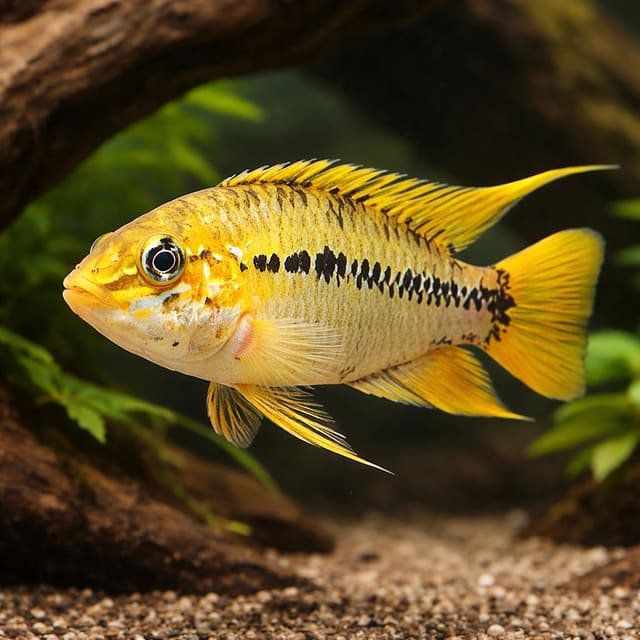
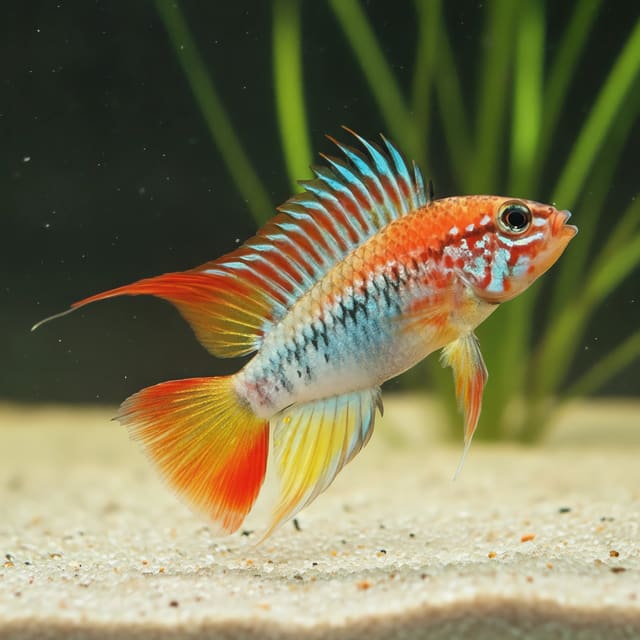
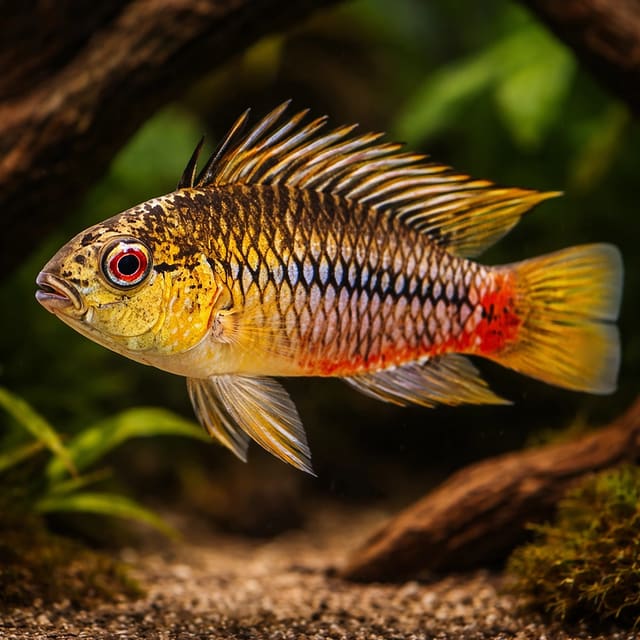
Spadetail Checkerboard Cichlid (Dicrossus maculatus)
26–30°C · pH 4.8–5.4 · 68L
£25.99
A beautifully patterned dwarf cichlid from blackwater South America, prized for its delicate appearance and fascinating breeding behavior. Difficult care, peaceful. 24-29C, pH 4.5-6.8.
Adult size is the maximum length this species reaches at full maturity (scientific sources). The livestock you receive will be younger and smaller — pick a size above for the actual shipping size. Product-photo provenance and any image-specific limitations are stated on the listing.
Dicrossus filamentosus
Save when buying multiple fish. Each quantity is one fish; sex and pair formation are not guaranteed unless the selected variant explicitly states them.
Confirm your email, then we’ll send an availability message for this exact item if it returns within 180 days.
This request is only for this product—no newsletter or other promotions. A mail-provider retry may very rarely duplicate the same availability message. Unconfirmed addresses are removed after 48 hours. See our privacy policy.
A beautifully patterned dwarf cichlid from blackwater South America, prized for its delicate appearance and fascinating breeding behavior. Difficult care, peaceful. 24-29C, pH 4.5-6.8.
Adult size is the maximum length this species reaches at full maturity (scientific sources). The livestock you receive will be younger and smaller — pick a size above for the actual shipping size. Product-photo provenance and any image-specific limitations are stated on the listing.
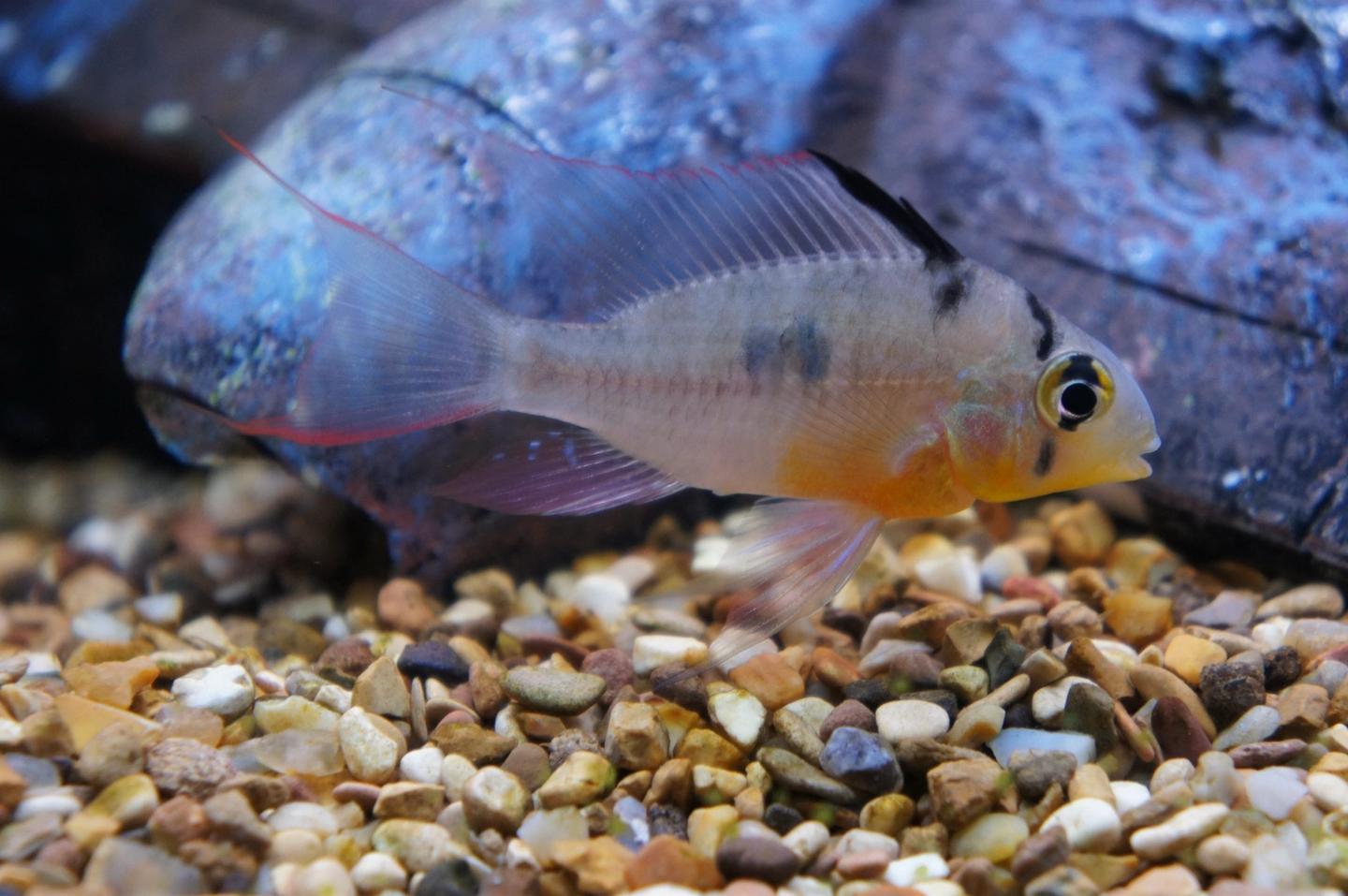
Cichlids are a family of roughly 1,800 accepted species, not one care type. Before buying, identify the exact species and source, then compare adult measurement, usable tank dimensions, social system, territory, tested water, diet and an exit plan. No family-wide minimum tank, water range or tank-mate list is safe.
Maintain these water conditions for optimal health and vibrant colors
The Dicrossus filamentosus, commonly known as the Chessboard Cichlid, is a beautifully patterned dwarf cichlid from the blackwater rivers of South America. This delicate species is endemic to the Rio Negro and Orinoco basins of Colombia, Venezuela, and Brazil, where it inhabits soft, acidic waters rich in tannins and leaf litter. Available as rare tropical fish for sale UK, D. filamentosus is highly prized among experienced aquarists for its intricate checkerboard patterning, peaceful temperament, and fascinating breeding behavior. With an adult size of around 9 cm, this species is larger than many other dwarf cichlids, requiring a well-planned aquarium with pristine water quality and carefully chosen tankmates. For those willing to meet its demanding care requirements, the Chessboard Cichlid offers a rewarding and elegant addition to a blackwater biotope aquarium.
Dicrossus filamentosus displays a distinctive checkerboard pattern of dark squares or blotches against a pale, silvery-gold background. Males are more colorful and develop elongated filamentous extensions on the dorsal and caudal fins, giving the species its common name. The fins may also show iridescent blue or green highlights, particularly during courtship. Females are smaller and less ornate, with shorter fins and more subdued coloration, often displaying a yellowish hue when guarding fry. The overall appearance is graceful and elegant, best showcased in a naturalistic aquarium with dark substrate and subdued lighting that enhances the fish's subtle beauty.
This species inhabits slow-moving blackwater streams and flooded forest areas in the Rio Negro and Orinoco basins. The water is extremely soft and acidic, stained dark brown by tannins from decomposing leaves and wood. The substrate is typically fine sand or mud, covered with a deep layer of leaf litter, submerged roots, and fallen branches. Water flow is minimal, and the environment is shaded by overhanging vegetation. These habitats are exceptionally stable in terms of temperature and chemistry, but highly sensitive to pollution and disturbance. Replicating these specific conditions is critical for the health and breeding success of D. filamentosus.
Provide a carefully designed blackwater biotope aquarium with soft, acidic water, subdued lighting, and abundant cover. Use a sand substrate with a generous layer of dried Indian almond leaves, oak leaves, or alder cones to provide tannins and replicate the natural habitat. Driftwood, live plants such as Cryptocoryne or Echinodorus, and floating plants will further enhance the environment. Filtration should be efficient but gentle, with regular water changes using soft, acidic water. A minimum tank size of 90 litres is recommended for a pair or small group. Avoid bright lighting, strong currents, and all forms of water parameter instability.
As a carnivore, Dicrossus filamentosus requires a varied, protein-rich diet. Offer small live and frozen foods such as daphnia, brine shrimp, bloodworms, mosquito larvae, and other tiny meaty foods daily. High-quality micro pellets or flakes may be accepted by well-acclimated individuals, but live and frozen options should always be the primary diet. Feed small portions multiple times per day to maintain optimal health and conditioning, especially if breeding is desired. Poor nutrition is a common cause of failure with this delicate species.
Dicrossus filamentosus is a peaceful species, making it one of the most suitable dwarf cichlids for calm community setups. Males are territorial during breeding but rarely engage in serious aggression, preferring displays and posturing over physical combat. Females are especially gentle outside of the breeding period, though they become fiercely protective when guarding eggs and fry. This species spends much of its time near the substrate, sifting sand and exploring leaf litter. In the right environment, their natural behavior—courtship displays, substrate digging, and parental care—is a delight to observe.
Choose tankmates with extreme care to avoid stressing this delicate species. Small, peaceful tetras, rasboras, and small peaceful catfish such as Otocinclus or Corydoras pygmaeus are suitable. Other gentle dwarf South American fish may also coexist in larger, well-structured tanks. Avoid all large or aggressive cichlids, fin-nipping fish, boisterous community fish, and large predatory species. In many cases, a species-only setup or a carefully planned blackwater biotope aquarium offers the best results for long-term health and breeding success.
Dicrossus filamentosus is a substrate or leaf spawner. The female typically lays eggs on a broad leaf or directly on the substrate, then guards them alone after driving off the male. Eggs hatch in approximately three days, and fry become free-swimming several days later. Fry are very small and require infusoria or newly hatched brine shrimp as first foods. Breeding success is highest in soft, acidic water (pH 5.0-6.0) with excellent water quality, live foods for conditioning adults, and minimal disturbance. The female's dedicated maternal care is one of the species' most fascinating traits.
Tropical Fish Co is the UK's premier destination for rare and delicate South American dwarf cichlids, including the exquisite Chessboard Cichlid. We work exclusively with ethical suppliers who prioritize sustainable collection and expert handling, ensuring every fish arrives in optimal health. Our rigorous quarantine protocols and expert acclimation process guarantee your Dicrossus filamentosus is ready to thrive in your carefully prepared aquarium. With detailed care guidance, ongoing support from our knowledgeable team, and a live arrival guarantee, we make it easy to succeed with even the most demanding species. Order today and experience the unmatched quality and service that sets Tropical Fish Co apart.
No reviews for this item yet. Bought one? Honest reviews only, good or bad.
What customers say about ordering from us
Easy website plenty of info on fish your buying great to pick a time slot
TRACEY DURRANT · 7 Oct 2026
Got some lovely fish thank you
Kevin Mackie · 7 Oct 2026
Reviews of our shop, collected by Judge.me, an independent third-party review collector. Newest first.