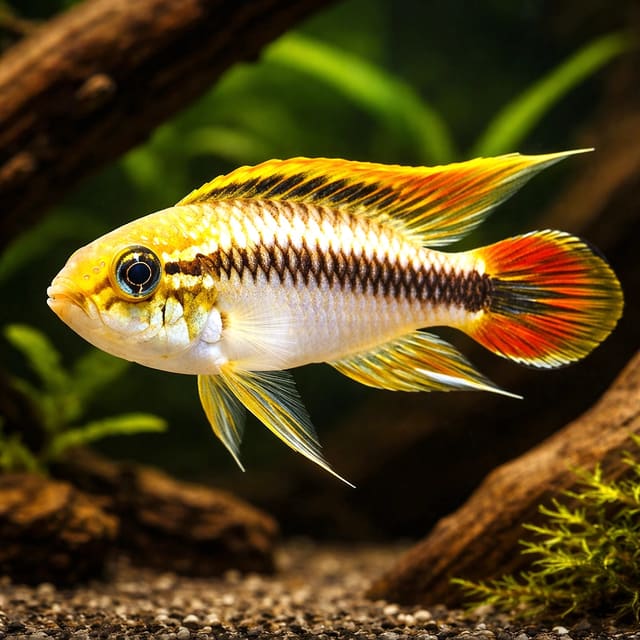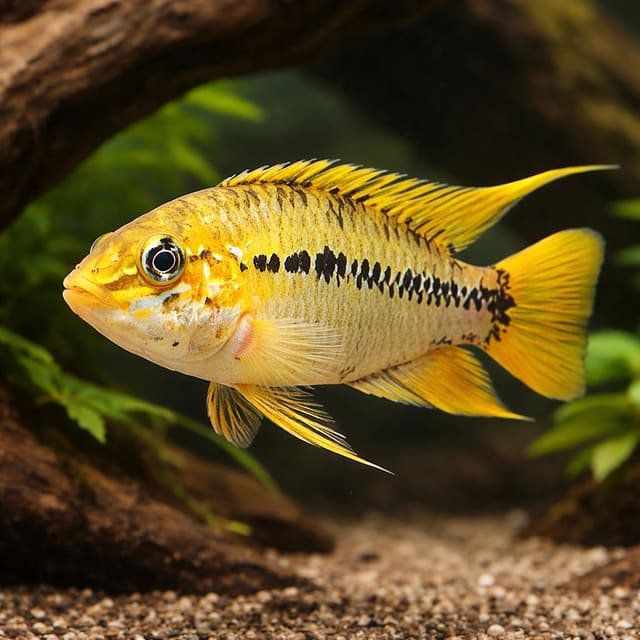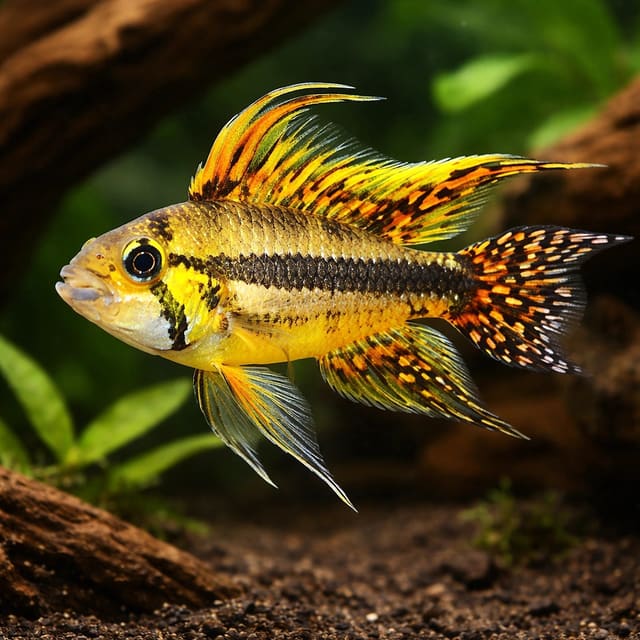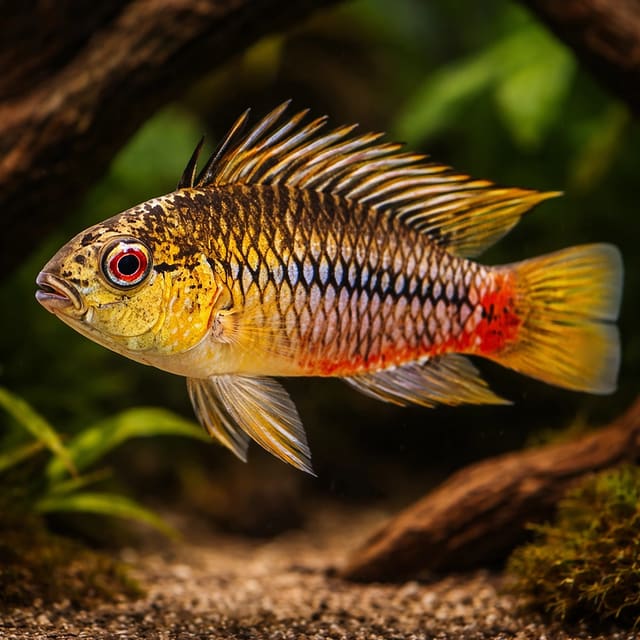
Red stroke Dwarf Cichlid (Apistogramma sp. red stroke)
22–27°C · pH 6–8
£41.99
Orange strain of the Banded Dwarf Cichlid for soft, warm water. Around 3.5 cm, moderate care, best with peaceful Amazonian tankmates.
Adult size is the maximum length this species reaches at full maturity (scientific sources). The livestock you receive will be younger and smaller. Product-photo provenance and any image-specific limitations are stated on the listing.
Apistogramma bitaeniata
Save when buying multiple fish. Each quantity is one fish; sex and pair formation are not guaranteed unless the selected variant explicitly states them.
Confirm your email, then we’ll send an availability message for this exact item if it returns within 180 days.
This request is only for this product—no newsletter or other promotions. A mail-provider retry may very rarely duplicate the same availability message. Unconfirmed addresses are removed after 48 hours. See our privacy policy.
Orange strain of the Banded Dwarf Cichlid for soft, warm water. Around 3.5 cm, moderate care, best with peaceful Amazonian tankmates.
Adult size is the maximum length this species reaches at full maturity (scientific sources). The livestock you receive will be younger and smaller. Product-photo provenance and any image-specific limitations are stated on the listing.

Cichlids are a family of roughly 1,800 accepted species, not one care type. Before buying, identify the exact species and source, then compare adult measurement, usable tank dimensions, social system, territory, tested water, diet and an exit plan. No family-wide minimum tank, water range or tank-mate list is safe.
Maintain these water conditions for optimal health and vibrant colors
Warm, soft and gently acidic — that is the water Apistogramma bitaeniata orange asks for, and keepers who provide it are rewarded with one of the most characterful dwarf cichlids South America has produced. This is the orange form of the Banded Dwarf Cichlid, a compact apisto that matures at around 3.5 cm and spends its day patrolling the lower levels of the aquarium, inspecting the substrate and keeping watch over its chosen patch of territory.
Small body, big personality. Rated semi-aggressive, this fish can turn territorial — particularly towards rival bottom-dwellers — so furnish the floor of the tank with caves, sight breaks and structure that let it hold a territory without constant disputes. Aim to give it the lowest level largely to itself, with the mid-water and surface left to shoaling species. The classic pairing is a quiet Amazonian community: small peaceful tetras, rasboras, Corydoras catfish, Otocinclus and gentle pencilfish all make sensible neighbours. Large aggressive cichlids, fin-nipping species, very active boisterous fish and big predators belong nowhere near it, and squeezing several territorial dwarf cichlids into a small footprint is asking for trouble.
Feeding follows its nature as a carnivore, and the water must stay warm even by tropical standards: 26–30 °C, with a pH of 5.0–6.5 and hardness from 0–10 dGH. A 40-litre aquarium is the workable minimum for this bottom-dweller, and with moderate-level attention a healthy specimen should live in the region of five years.
Choose this orange strain when you want true apisto behaviour without the space demands of larger cichlids — a soft-water 40-litre-plus setup with one territory per fish is the formula that works. Check your tankmates against the lists above before ordering, keep the heater set high, and your new arrival will settle quickly. Every order travels with our live arrival guarantee, carried by a licensed live-animal courier.
No reviews for this item yet. Bought one? Honest reviews only, good or bad.
What customers say about ordering from us
Easy website plenty of info on fish your buying great to pick a time slot
TRACEY DURRANT · 7 Oct 2026
Got some lovely fish thank you
Kevin Mackie · 7 Oct 2026
Reviews of our shop, collected by Judge.me, an independent third-party review collector. Newest first.