Expert
Whitecheek Surgeonfish (Acanthurus nigricans)
24–27°C · pH 8–8.3 · 500L
£96.99
The Lined Surgeonfish (Acanthurus lineatus) is a striking Indo-Pacific reef surgeonfish that reaches 38 cm and grazes algae almost constantly. It suits experienced marine keepers with a very large, mature aquarium, is best kept singly because it is territorial, and carries venomous spines at the base of its tail.
Adult size is the maximum length this species reaches at full maturity (scientific sources). The livestock you receive will be younger and smaller. Product-photo provenance and any image-specific limitations are stated on the listing.
Acanthurus lineatus
Save when buying multiple fish. Each quantity is one fish; sex and pair formation are not guaranteed unless the selected variant explicitly states them.
The Lined Surgeonfish (Acanthurus lineatus) is a striking Indo-Pacific reef surgeonfish that reaches 38 cm and grazes algae almost constantly. It suits experienced marine keepers with a very large, mature aquarium, is best kept singly because it is territorial, and carries venomous spines at the base of its tail.
Adult size is the maximum length this species reaches at full maturity (scientific sources). The livestock you receive will be younger and smaller. Product-photo provenance and any image-specific limitations are stated on the listing.
Maintain these water conditions for optimal health and vibrant colors
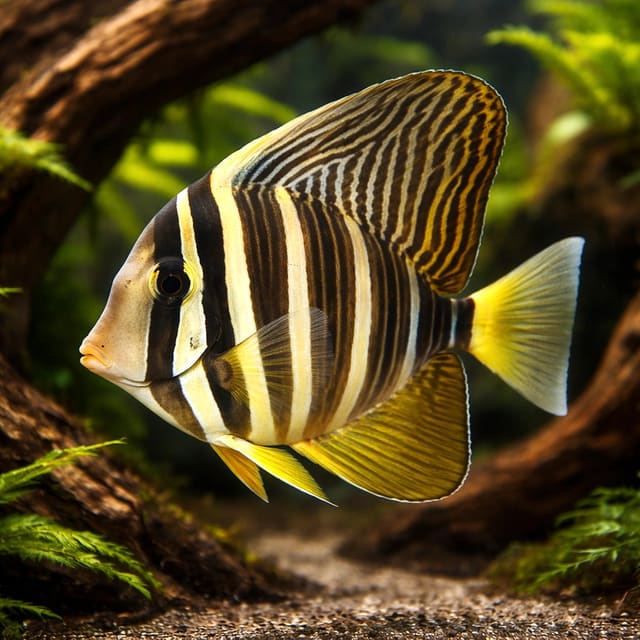
The Lined Surgeonfish (Acanthurus lineatus) is a marine surgeonfish from the coral reefs of the Indo-Pacific, and its pattern is unmistakable. Blue stripes edged in black alternate with yellow along the upper three-quarters of the body, the stripes on the head run mainly on the diagonal, and the lower quarter is a pale lavender to bluish white. The body is deep and flattened from side to side, and the tail fin is deeply crescent-shaped. It is also called the blue banded, clown, striped or zebra surgeonfish, and the pyjama tang. The World Register of Marine Species lists it as an accepted species in Acanthuridae, the family of surgeonfishes, tangs and unicornfishes.
Its natural range is enormous. FishBase records it from East Africa and the Mascarene Islands east to the Hawaiian, Marquesas and Tuamotu islands, north to southern Japan and south to the Great Barrier Reef and New Caledonia; in the Red Sea its place is taken by the closely related Acanthurus sohal. It lives in shallow water, from the surface down to about 15 m and usually just 1–3 m deep, and is common in the surge zones of exposed seaward reefs.
This is a fish for experienced marine keepers with a genuinely large aquarium. It reaches a recorded maximum of 38 cm, it is almost always on the move, and it guards its own grazing ground. It also carries a venomous spine on each side of the tail base, which matters every time your hands are in the water. If you are still planning a first saltwater aquarium, this is a species to admire now and to keep once you have the space and experience it needs.
| Suits | Experienced marine keepers with a very large, fully matured saltwater aquarium |
|---|---|
| Adult size | Up to 38 cm total length; 25 cm is a common length |
| Aquarium | At least 2,500 litres as a rough starting point, with a secure lid |
| Keep | One per aquarium |
| Water | Marine: specific gravity 1.020–1.025, 24–26 °C and pH 7.9–8.3 (OATA tang guidance) |
| Diet | Algae grazer: nori, algae-based flake and grazing tabs, plus small meaty frozen foods |
| Temperament | Territorial; add it late in stocking and keep it away from shy fish and look-alike tangs |
| Handling | Venomous tail spines, so work in the aquarium with great care |
Each purchase supplies one live Lined Surgeonfish. The 38 cm figure is the species' recorded maximum length, not the size of the fish that arrives, so plan the aquarium for the adult from the start rather than for the fish in the bag. Moving a large tang with venomous spines into a bigger aquarium later is a difficult job, so starting with the right volume is the safer plan.
Sex is guaranteed only when the selected option explicitly states male or female. This Lined Surgeonfish listing has no sex-guaranteed option.
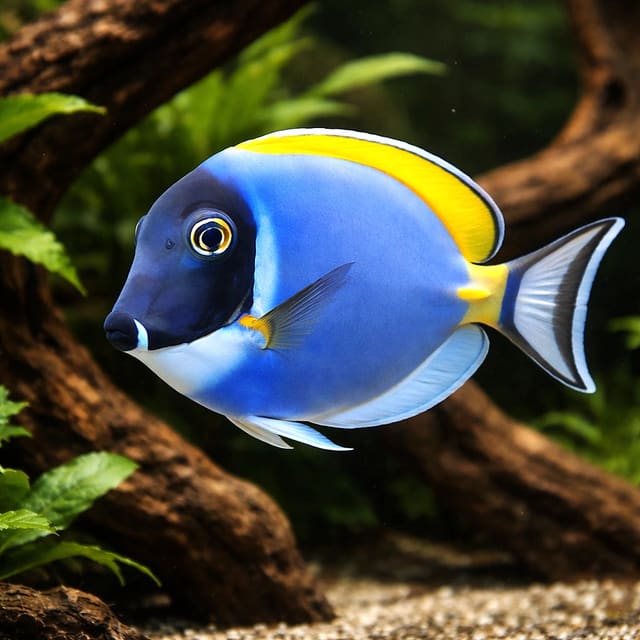
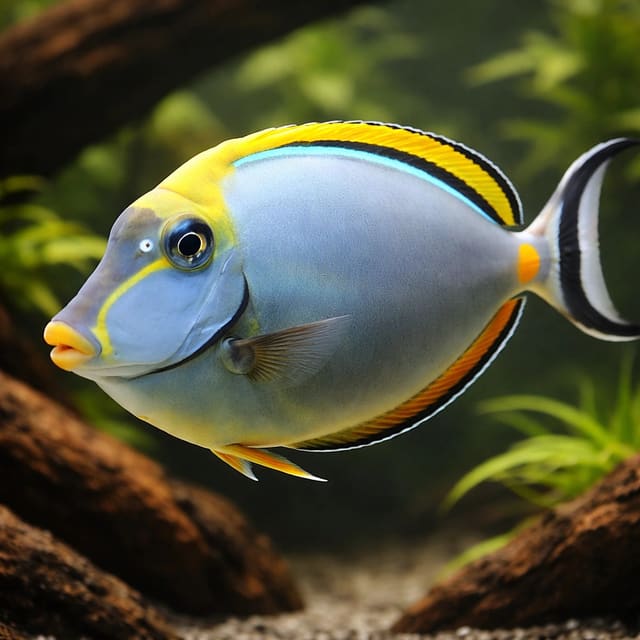
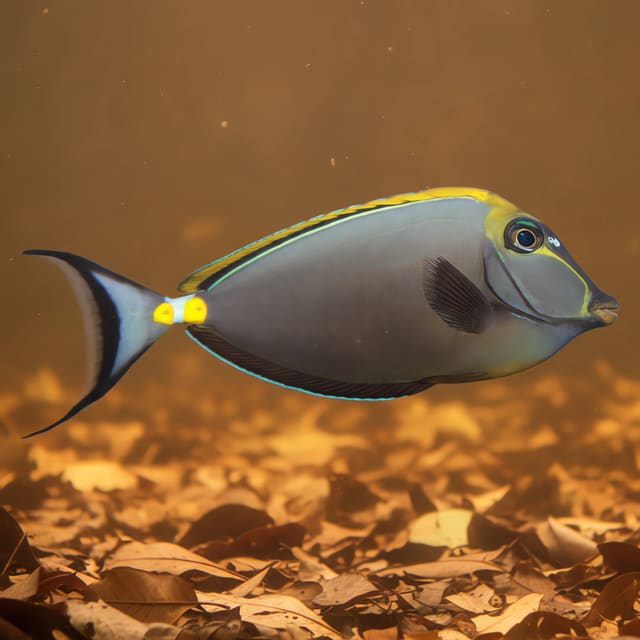
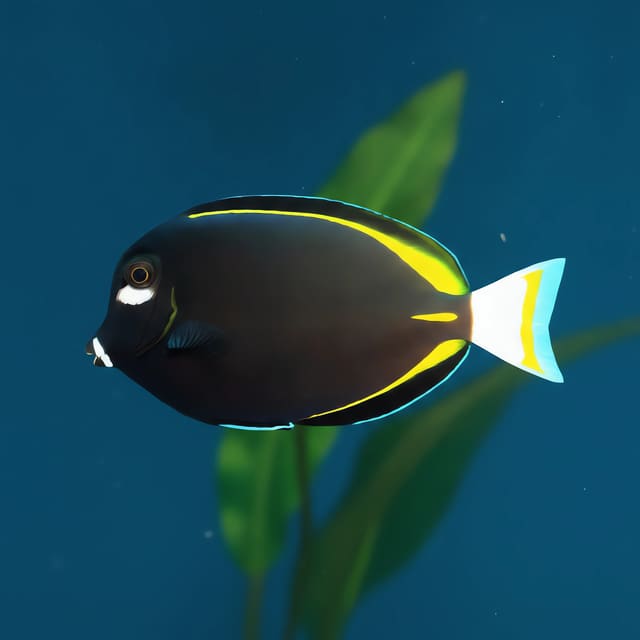
Gallery images have been digitally enhanced to improve image quality. Natural colour, pattern, size and maturity can vary between live animals. The photograph shows the features that identify the species: black-edged blue stripes on a yellow body, a pale belly and a deep, crescent-shaped tail fin.
In a large display it is a fish you watch rather than search for. FishBase describes it as active by day and almost continually in motion, and it spends much of that time grazing, so it covers the whole length of the aquarium many times over and rarely tucks itself away.
In a collection it works best as the centrepiece of a very large marine aquarium stocked with active fish, and it should be one of the last fish added rather than the first. OATA names angelfish, damsels and some butterflyfish as good company for tangs; shy species and tangs that look like it are the ones to leave out. Corals and invertebrates need separate thought, which the compatibility section covers.
Before ordering, check three things: that your aquarium is marine, fully matured and large enough for a 38 cm adult; that none of the fish already living in it are shy species or tangs of a similar look; and that someone will be at home to receive the parcel. The care and compatibility sections explain each point in turn.
Meerwasser-Lexikon, a German marine aquarium encyclopedia, rates Acanthurus lineatus as suitable only for experienced keepers. That rating follows from five demands the fish makes at once, and each one deserves an honest answer before you buy.
If you already run a large, mature marine system and can meet all five, the Lined Surgeonfish rewards the effort: a constant, colourful patrol of open water that brings the movement of a shallow reef into the room. If any one of the five is uncertain, it is better to wait until it is settled than to buy the fish and hope.
Aquarium volume is the first decision, and for a large tang it is the one that matters most. OATA's care sheet for tangs and rabbitfish recommends at least 300 litres for a single individual under 20 cm and states that larger and more active species need a larger aquarium. The Lined Surgeonfish grows to 38 cm and FishBase describes it as almost continually in motion, so the 300-litre figure does not describe what it needs. Plan around the species figure of at least 2,500 litres instead, and treat that as a starting point rather than a generous allowance.
Because it is almost always moving, give it as much open length as the aquarium allows, with a clear swimming lane from one end to the other. OATA's general advice to buy an aquarium as large as possible carries real weight here: extra volume gives this fish room to cruise and gives its tank-mates room to keep out of its way.
OATA's tang sheet sets out the essentials:
The wild habitat is worth knowing, but it is not a blueprint. The species is common in surge zones on exposed seaward reefs, and adults are often found in shallow gutters, while juveniles keep to shallow rubble. In the aquarium, OATA's moderate flow with good surface movement is the target, together with open swimming space; there is no need to recreate breaking surf.
The Lined Surgeonfish is a coral-reef fish and needs properly mixed, stable salt water. The table gives OATA's water requirements for tangs and rabbitfish. OATA describes them as a general guide for this group of fish, not a species-specific optimum, and notes that some values need adjusting in a reef aquarium.
| Measure | OATA tang guidance |
|---|---|
| Salinity (specific gravity) | 1.020–1.025 |
| Temperature | 24–26 °C |
| pH | 7.9–8.3 |
| Ammonia | Zero |
| Nitrite | Zero |
| Nitrate | No more than 50 mg per litre |
| Carbonate hardness (KH) | 8–12 dKH |
| Calcium | 380–450 ppm |
| Magnesium | 1,250–1,350 ppm |
Two points are worth spelling out. First, the hardness value is carbonate hardness in dKH, the measure of the water's buffering capacity, not the general hardness (dGH) figure quoted for many freshwater fish. Second, FishBase records the species in tropical water of 24–30 °C on the reef. That is the range the fish meets in the wild, not a target for the aquarium, so hold the aquarium within OATA's 24–26 °C.
Measure these values rather than estimating them. OATA suggests testing ammonia, nitrite, nitrate, pH and carbonate hardness every week and keeping a regular eye on salinity. Our guide to aquarium water parameters and what to test explains what the common tests measure and why each reading matters, and the water parameter matcher lets you compare your own readings with a stated range such as the one above. Note each result with the date, so a slow drift in pH, KH or nitrate shows up in your records rather than in the fish.
Fish release ammonia, which is toxic. The RSPCA explains that a working biological filter grows beneficial bacteria that convert ammonia to nitrite, which is also toxic, and then to nitrate, which is safer. Those bacteria take time to build up, and a tang that can be stressed by even small traces of ammonia and nitrite should only go into a system where both read zero consistently, over repeated tests.
Our step-by-step guide to setting up and maturing a first tropical tank explains how a filter matures before any livestock goes in. It is written around freshwater set-ups, so take the maturing principle from it and the salinity and other marine values from the water table on this page.
The testing, water-change, filter-media, skimmer and top-up steps come from OATA's tang sheet; treat them as the minimum routine. Keep ammonia and nitrite at zero throughout; if either appears, find the cause and put it right before you add more food or more fish.
In the wild the Lined Surgeonfish is a daytime grazer. Wikipedia notes that most of its diet is algae, grazed during the day, and FishBase describes it as herbivorous but also taking crustaceans. In an aquarium that translates into a menu weighted heavily towards algae, with a smaller share of meaty food.
OATA's routine for tangs is to feed only what the fish can eat within a few minutes, twice a day, and to leave algae sheets or grazing tabs in the aquarium for longer so the fish can graze between meals. Do not overfeed: uneaten food adds to the waste the filter has to process, and this is a fish that tolerates poor water badly.
A clip holds a nori sheet in place while the fish grazes, and offering it at a similar time each day makes it easy to see how quickly it disappears. A settled grazer works at the algae with obvious interest; a fish that ignores food it usually takes is a signal to test the water. Because tangs are active fish and should not share an aquarium with shy species, also check at each meal that every fish in the aquarium is getting its share.
Tangs carry sharp, modified scales near the tail that OATA likens to a scalpel. FishBase describes the Lined Surgeonfish's version as a long, lancet-like spine on each side of the tail base that folds into a deep horizontal groove, and records it as venomous, able to cause painful wounds. Wikipedia likewise describes this species' spines as venomous and capable of wounding handlers.
Most of the risk comes during maintenance and whenever the fish has to be caught or moved, so plan both with the spine in mind. A long-handled tool for scraping glass or moving rock keeps your hands out of the water for many routine jobs.
Everything this fish needs has to be in place before it is ordered, because none of it can be improvised once the fish is in the house. Work through the list and tick each line honestly.
If every line is ticked, you are ready. If one is missing, sort it out first: a fish of this size and sensitivity is far better served by a system that was ready before the order was placed.
Your fish is hand-bagged in pure oxygen and packed in an insulated poly box, with a heat pack when the weather calls for it, then carried by a tracked, licensed live-animal courier. We email the tracking number and your confirmed delivery date. The full terms are on our delivery and Live Arrival Guarantee page, and the steps below follow them.
The Live Arrival Guarantee also requires the parcel to be opened and inspected on the day it arrives; clear photos are accepted and an unboxing video is optional. We strongly recommend an unboxing video when practical: it helps us investigate arrival concerns faster, resolve them with less back-and-forth and understand packing or transit issues so we can reduce recurrence. Video is optional and clear photos are accepted. Never delay necessary animal care to record evidence.
Close the lid as soon as the fish is released, since tangs can jump if startled. Offer algae foods from the first day and watch how the fish swims, breathes and feeds, using the health signs in the next section as your checklist.
OATA also notes that quarantining new livestock for at least a week can reduce the risk of disease. That is general keeper guidance. If you use a separate quarantine aquarium, follow the same arrival steps with it, match its salinity and temperature to the display, and make sure it gives a fish of this size room to swim.
OATA's tang sheet describes a healthy fish as having:
A healthy Lined Surgeonfish spends most of the day out in the open, swimming steadily and grazing. FishBase describes the species as active by day and almost continually in motion, so a fish that hides for long periods, hangs in one spot or stops grazing is behaving out of character and deserves a closer look.
Feeding time is the easiest moment to run through the list above every day, because the fish comes into view and you can see it eat. When something changes, test the water before anything else, since any ammonia or nitrite is the first thing to rule out with a tang. Then check that the fish has been grazing on its algae foods.
OATA notes that tangs are very difficult to sex unless they are in breeding condition, and that breeding in the home aquarium is unlikely. In the wild the species forms spawning aggregations, according to FishBase. Treat the Lined Surgeonfish as a display fish to enjoy for its colour and movement rather than as a breeding project.
On the reef the Lined Surgeonfish has a complicated social life. FishBase describes a territorial species in which a large male controls well-defined feeding territories and harems of females, while adults usually form schools, are commonly found in shallow gutters and gather in large numbers to spawn. Juveniles are solitary and secretive on shallow rubble.
A home aquarium cannot offer that kind of space. OATA's advice for tangs is that shoals can be kept only in an aquarium large enough for them, with at least six of the same species to spread aggression, and that tangs which cannot be kept in such a group should be kept singly to avoid bullying of smaller or less dominant fish. For a species that reaches 38 cm and needs around 2,500 litres on its own, a group of six would need space on a scale few private aquariums can offer, so the practical choice is a single Lined Surgeonfish.
Do not add a second one later or buy two as a pair. Two fish of the same shape and pattern competing for the same grazing space is exactly the combination OATA warns against.
OATA's tang sheet gives short, practical compatibility advice, and it applies directly to this species.
| Tank-mate type | Guidance |
|---|---|
| Angelfish, damsels and some butterflyfish | Named by OATA as good tank-mates for tangs, given an aquarium with room for everyone |
| Shy species | Avoid, because tangs are active fish and should not be mixed with shy species |
| Tangs that look too similar | Avoid, because tangs mix only when they do not look too alike |
| Tangs with a similar body shape | If more than one is planned, add them at the same time |
The last two rows cover different things. Overall appearance, the colour and pattern a fish shows, decides whether two tangs can share an aquarium at all. Body shape decides the order: tangs of a similar outline that are going to live together should arrive together.
If the Lined Surgeonfish is joining an established aquarium, look at the current residents with those rules in mind:
OATA advises adding tangs towards the end of stocking, because they can be territorial and may bully new additions. Add the Lined Surgeonfish after the rest of the community is established, so that it arrives as the newcomer rather than defending ground against later arrivals.
We make no reef-safe or invertebrate-safe promise for this fish. It is mainly an algae grazer, but FishBase notes that it also takes crustaceans, and OATA points out that some water values need adjusting in a reef aquarium. If you keep corals, shrimps or crabs, plan the mix with that in mind and be ready to separate animals if problems appear.
Every combination still depends on individual temperament and aquarium size, so watch the first days after any introduction closely, especially at feeding time.
FishBase records a maximum length of 38 cm total length, with 25 cm given as a common length, and Wikipedia and Meerwasser-Lexikon also put the adult at about 38 cm. Plan the aquarium for that adult size, not for the size of the fish when it arrives.
Meerwasser-Lexikon recommends at least 2,500 litres for the Lined Surgeonfish and treats that figure as a rough starting point. OATA's 300-litre recommendation covers only a single tang under 20 cm, so it is far too small for this species. A secure lid is essential because tangs can jump, especially when startled.
Keep one. The species is territorial, and in the wild a large male defends a feeding territory and a harem of females. OATA advises that tangs kept as a group need at least six of the same species in an aquarium large enough for them, and should otherwise be kept singly to avoid bullying. For a fish that reaches 38 cm, a single specimen is the practical plan.
No. Meerwasser-Lexikon rates it as suitable only for experienced keepers. It needs a very large, fully matured marine aquarium, consistently clean water, an algae-rich diet and careful handling because of its venomous tail spines.
It grazes algae through the day and also takes some crustaceans in the wild. Offer algae-rich foods such as nori sheets, algae-based flake and grazing tabs, with small meaty frozen foods such as mysis, enriched brine shrimp or krill. Feed what it eats within a few minutes twice a day, leave algae sheets and grazing tabs in for longer, and avoid overfeeding.
OATA's group guidance for tangs is 24–26 °C, pH 7.9–8.3 and a specific gravity of 1.020–1.025, with zero ammonia and nitrite and carbonate hardness of 8–12 dKH. These values apply to tangs as a group; FishBase's 24–30 °C describes the wild reef, not an aquarium target.
It is territorial and may bully new additions, so add it towards the end of stocking and avoid tangs that look similar to it. Each side of the tail base carries a long spine that FishBase and Wikipedia describe as venomous and able to cause painful wounds, so take great care whenever your hands are in the aquarium.
OATA names angelfish, damsels and some butterflyfish as good tank-mates for tangs. Avoid shy species and tangs that look too similar; if you plan more than one tang with a similar body shape, add them at the same time and towards the end of stocking. Aquarium size and individual temperament still decide whether a particular mix works.
It is hand-bagged in pure oxygen, packed in an insulated poly box with a heat pack when the weather calls for it, and carried by a licensed live-animal courier. Someone must be at home to receive it. If practical, film a continuous unboxing video from the sealed parcel to the fish still in its bag, float the bag for 20–30 minutes, then release the fish without pouring the bag water into your aquarium. If anything is wrong, contact us the same day with your order number and clear photos or an optional video.
Our delivery and Live Arrival Guarantee terms are linked in the arrival section of the care guide above.
No reviews for this item yet. Bought one? Honest reviews only, good or bad.
What customers say about ordering from us
Easy website plenty of info on fish your buying great to pick a time slot
TRACEY DURRANT · 7 Oct 2026
Got some lovely fish thank you
Kevin Mackie · 7 Oct 2026
Reviews of our shop, collected by Judge.me, an independent third-party review collector. Newest first.