Advanced
Naso elegans (Elegant Unicorn Tang)
24–26°C · pH 7.9–8.3
£91.99
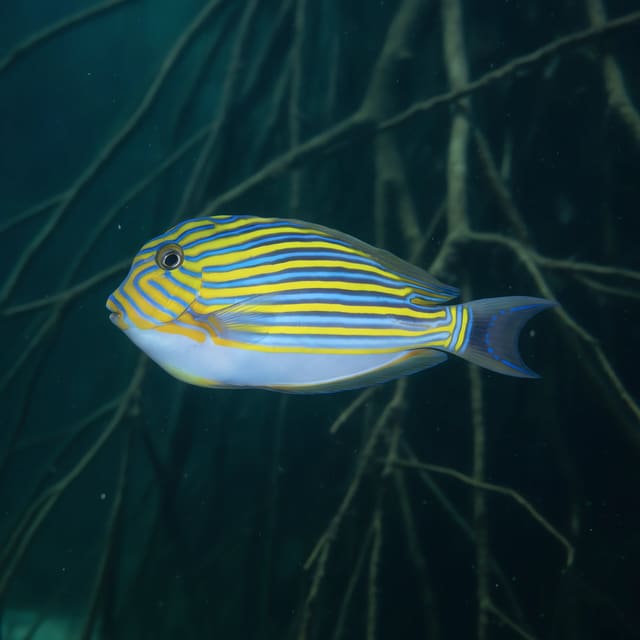
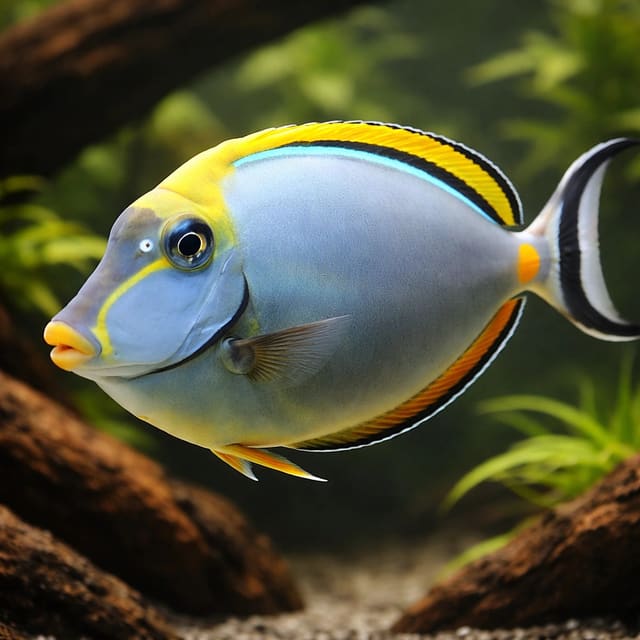
The Orangespine Unicornfish (Naso lituratus) is a Pacific and eastern Indian Ocean unicornfish of the surgeonfish family that reaches 46 cm standard length. It suits experienced marine keepers with a very large, mature aquarium, kept at 24–26°C and pH 7.9–8.3 under OATA's tang guidance. Sold individually as one live fish.
Adult size is the maximum length this species reaches at full maturity (scientific sources). The livestock you receive will be younger and smaller. Product-photo provenance and any image-specific limitations are stated on the listing.
Naso lituratus
The Orangespine Unicornfish (Naso lituratus) is a Pacific and eastern Indian Ocean unicornfish of the surgeonfish family that reaches 46 cm standard length. It suits experienced marine keepers with a very large, mature aquarium, kept at 24–26°C and pH 7.9–8.3 under OATA's tang guidance. Sold individually as one live fish.
Adult size is the maximum length this species reaches at full maturity (scientific sources). The livestock you receive will be younger and smaller. Product-photo provenance and any image-specific limitations are stated on the listing.
Maintain these water conditions for optimal health and vibrant colors
The Orangespine Unicornfish (Naso lituratus) is a marine unicornfish in the surgeonfish family Acanthuridae, the family that also holds the tangs. It comes from coral and rocky reefs of the Pacific and the eastern Indian Ocean, and FishBase records a maximum length of 46 cm standard length. That one figure shapes every decision on this page: whatever its length when it arrives, you are planning for a large, strong-swimming reef fish.
It suits an experienced marine keeper with a big, well-matured aquarium, efficient filtration and the time to feed algae-rich foods every day. In the wild it grazes leafy brown algae and moves over the reef in small groups or pairs, so in an aquarium it spends its day on the move rather than tucked into rockwork. We class it as an advanced fish: a centrepiece for a system built around it, not an early addition to a young tank.
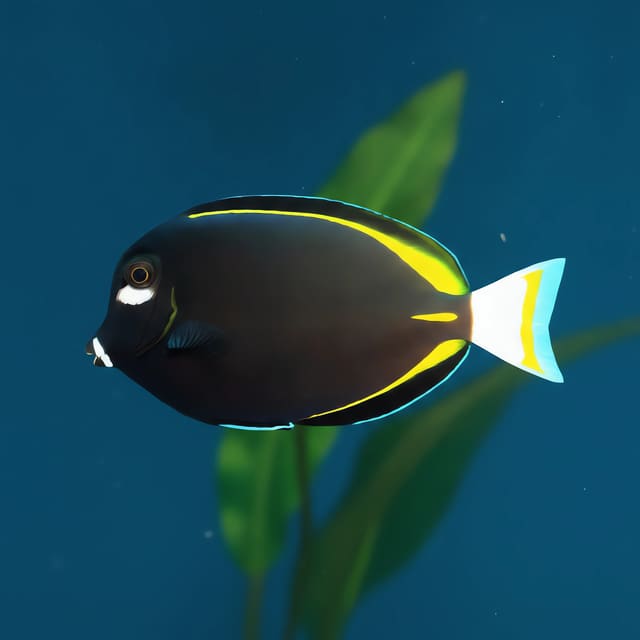
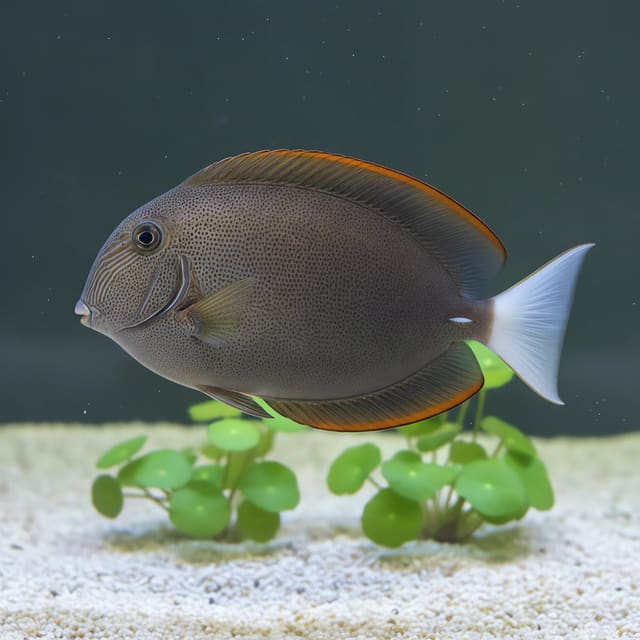
Its many common names describe the look it is known for. Wikipedia lists it as the orangespine, orangespined, clown, black-finned and stripefaced unicornfish, and OATA's tang and rabbitfish care sheet calls it the naso tang. The same sheet warns that tangs carry sharp, scalpel-like modified scales near the tail, so this fish needs careful handling as well as space.
| Suits | Not suited to |
|---|---|
| Mature marine systems with room for a 46 cm fish | Small or newly set-up aquariums |
| Keepers who can feed algae-based foods twice a day | Anyone wanting an easy first marine fish |
| Active communities of angelfish, damsels or some butterflyfish | Tanks built around shy fish |
| Plans that add similar-shaped tangs together, late in stocking | Tanks already holding a very similar tang or rabbitfish |
The planning numbers in brief: an adult length of up to 46 cm standard length; routine water of 24–26°C and pH 7.9–8.3 from OATA's group guidance for tangs and rabbitfish; salinity of 1.020–1.025; and ammonia and nitrite at zero at all times. Each is explained in the care tab, with the reasons behind it.
Each purchase supplies one live Orangespine Unicornfish, packed and sent on its own. Its length on arrival is not its adult size. Plan the aquarium around the maximum of 46 cm standard length from the start, rather than buying it for a smaller system and hoping to upgrade before it outgrows the space. A surgeonfish of this size is a long-term commitment, and OATA notes that tangs can live for many years in a well-matured set-up with good water quality.
If any answer is no, get that part of the system right first.
Sex is guaranteed only when the selected option explicitly states male or female. This Orangespine unicornfish listing has no sex-guaranteed option. Choose it for the species and the role it will play in your aquarium. FishBase notes that pair-spawning has been observed in the wild; treat this fish as a single display animal rather than a breeding project.
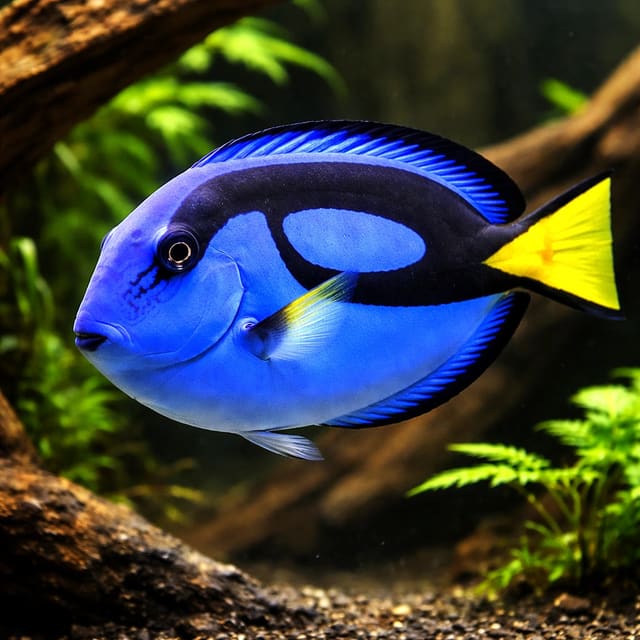
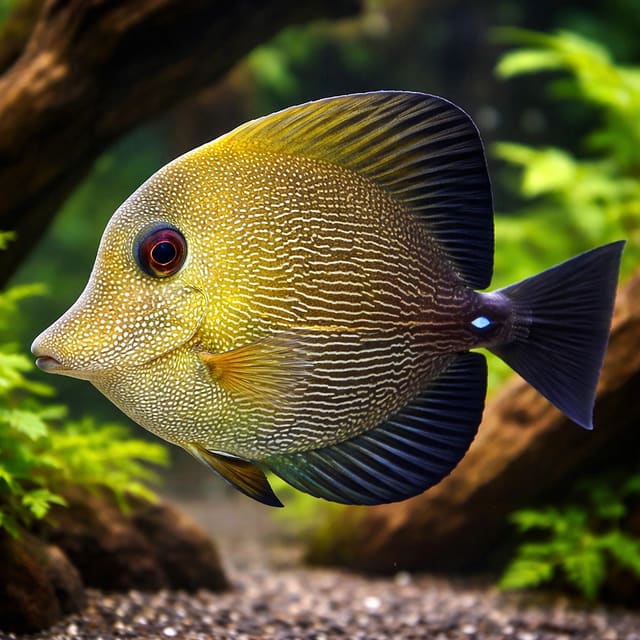
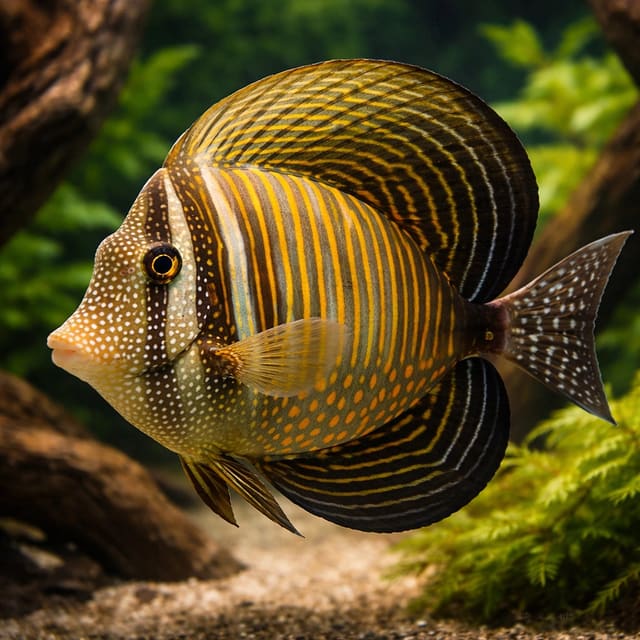
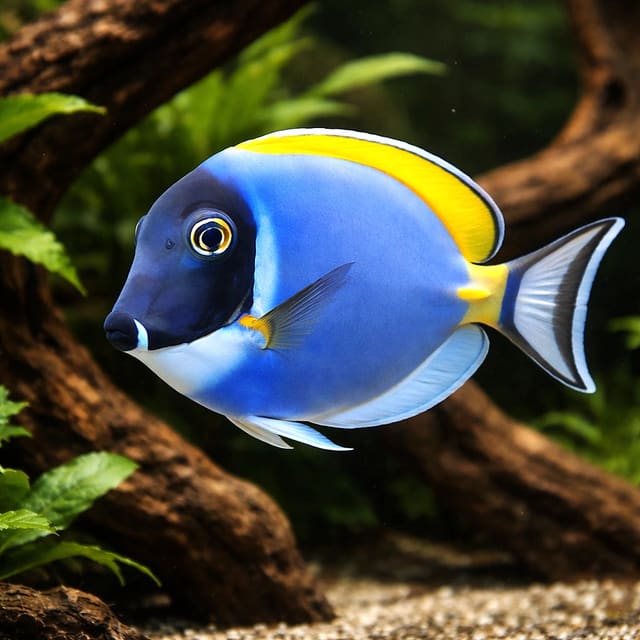
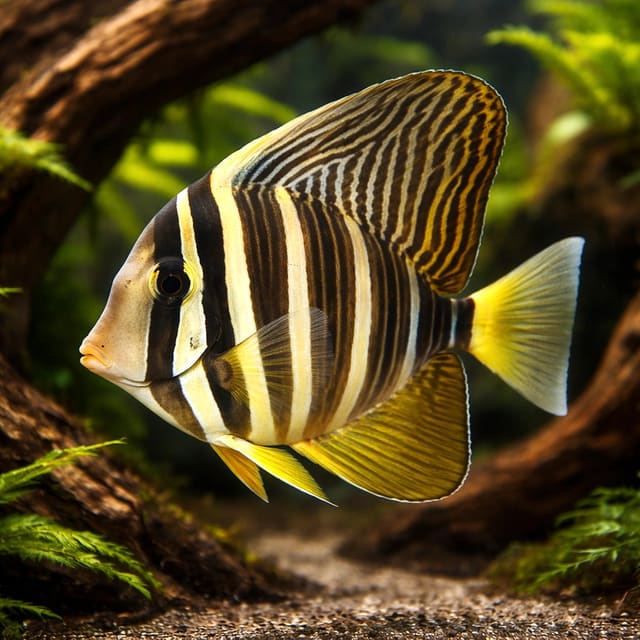
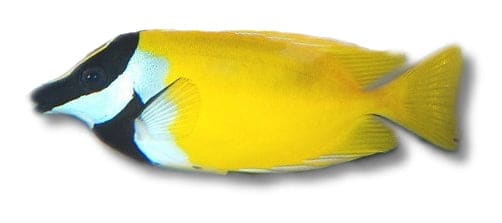
Expect the fish you receive to differ in detail from the photograph on this page. Gallery images have been digitally enhanced to improve image quality. Natural colour, pattern, size and maturity can vary between live animals.
In shops you will also see it called the naso tang, the name OATA uses, or the lipstick tang. All of these refer to the same species, Naso lituratus. FishBase notes that it was once regarded as a species ranging right across the Indo-Pacific; the range it now gives runs from the eastern Indian Ocean at Christmas Island across the Pacific, which is worth knowing if you compare it with closely related unicornfish.
If you are still building the stocking list, browse our marine fish collection with this fish's adult size and grazing diet in mind. The most useful order of decisions is aquarium size first, filtration and water stability second, companions third, and the unicornfish itself last, added to a system that is already running smoothly.
FishBase describes Naso lituratus as a reef-associated, benthopelagic fish: it swims over and around the reef rather than living inside the rockwork. Its wild depth range runs from the surface to 90 m, usually at 5–30 m. Those depths are records of where wild fish are found, not settings for an aquarium, but they explain why the species is used to bright, open water with room to cruise.
The recorded range covers the eastern Indian Ocean from Christmas Island and a wide sweep of the Pacific: north to Honshu in Japan, south to the Great Barrier Reef and New Caledonia, and east to the Hawaiian Islands, French Polynesia and Pitcairn, with an eastern Pacific record from Clipperton Island. Wikipedia adds that it is found on coral reefs, often in pairs. The IUCN lists it as Least Concern.
Adults usually live in small groups and are sometimes seen in large aggregations. Juveniles live on shallow rocky reefs, sometimes in small mixed groups with other surgeonfish of a similar size. The adult diet is mainly leafy brown algae, with Sargassum and Dictyota named by FishBase. Pair-spawning has been observed in the wild.
Keeping these habits in mind turns the care advice that follows into a set of clear decisions rather than a list of rules. When something in the aquarium is not working, asking how the fish lives on the reef is often the quickest way to find the cause.
OATA's advice for tangs is to buy an aquarium as large as possible, within reason. Its care sheet recommends at least 300 litres for a single individual under 20 cm and says larger, more active species will need a larger aquarium. The Orangespine Unicornfish reaches 46 cm standard length, more than twice that 20 cm threshold, and it is an active swimmer. Treat 300 litres as the starting point for a much smaller tang, never as a target for this one.
A larger aquarium also brings stability. OATA points out that more water holds temperature and water quality more steadily, which matters for a fish that is stressed by even small amounts of ammonia and nitrite. In practice, the aquarium that gives this fish enough swimming room is also the one that gives you the widest margin for error.
Tangs are relatively undemanding about décor. Give the fish long, open swimming lanes along the front and middle of the aquarium, and build live or artificial rockwork, as OATA recommends, to provide cover without blocking the route. A long footprint serves this fish better than extra height, because the space it uses is the length it can swim before turning.
Imagine choosing between two aquariums of the same volume, one tall and one long. For this fish the long one wins every time: the extra length becomes swimming distance, while the extra height of the other adds water it will rarely use. Then check the long option against the 46 cm adult, not the fish in the bag. If a fully grown unicornfish could only manage a few body lengths before turning, keep looking, or choose a smaller species for that aquarium.
The RSPCA's aquarium guidance is clear that no fish should be kept without a well set up and maintained filter. For a marine system, OATA lists three routes: live rock with sufficient water flow, an internal or external filter, or a sump-based filter. A protein skimmer is also beneficial because it removes dissolved organic waste before it breaks down into more harmful substances. A large herbivore eating two meals a day produces a steady load of waste, so size the filtration for the adult fish rather than for the juvenile you unpack.
Keep the Orangespine Unicornfish at 24–26°C, pH 7.9–8.3 and a salinity of 1.020–1.025. These figures come from OATA's tangs and rabbitfish sheet and are group-level values for fish that OATA describes as usually undemanding of water chemistry. They are not a species-specific optimum for this unicornfish, so steadiness within them matters more than chasing an exact number.
| Parameter | OATA value for tangs and rabbitfish |
|---|---|
| Temperature | 24–26°C |
| pH | 7.9–8.3 |
| Salinity | 1.020–1.025 |
| Ammonia | Zero mg per litre |
| Nitrite | Zero mg per litre |
| Nitrate | Not to exceed 50 mg per litre |
| Carbonate hardness | Hard, 8–12 dKH |
| Calcium | 380–450 ppm |
| Magnesium | 1250–1350 ppm |
If the unicornfish will live in a reef aquarium, OATA notes that some parameters will need to be altered to accommodate more sensitive species. Check what your corals and other invertebrates need as well, and let the most sensitive animal in the system guide any adjustment.
Fish release ammonia, which is toxic. In a working biological filter, beneficial bacteria convert it to nitrite, which is also toxic, and then to nitrate, which is safer. OATA warns that tangs and rabbitfish can be stressed by even the smallest amounts of ammonia and nitrite, which may then lead to disease. That is why both must read zero before this fish goes in and every time you test afterwards.
The wild diet sets the menu. FishBase records that the Orangespine Unicornfish feeds mainly on leafy brown algae, naming Sargassum and Dictyota. OATA describes tangs and rabbitfish as mainly herbivores and says their diet should reflect this with foods high in algae, such as nori sheets, algae-based flake and grazing tabs. It also warns that if enough algal foods are not provided, these fish may become ill. For this species, algae is the staple, not a side dish.
Meaty foods still have a place. OATA notes that tangs will also eat small meaty frozen feeds such as mysis shrimp, enriched brine shrimp or krill. Use them to add variety around the algae-based core rather than as a replacement for it.
OATA advises feeding tangs and rabbitfish only what they can eat within a few minutes, twice a day. Algae sheets and grazing tabs are the exception: they can stay in the aquarium longer, because the fish grazes on them. Take care not to overfeed, since uneaten food breaks down and releases toxic waste into the water.
Feeding is also your daily health check. OATA lists reduced intake, lack of interest in food and changes in body weight among the signs to watch for. A unicornfish that grazes eagerly at both meals and holds its body condition is telling you the diet and the water are right. If it starts to pick at food or looks thinner, test the water first, then review the balance of algae foods, because a herbivore short of algae is one of the problems OATA specifically warns about.
Keep the routine steady across the week. A large grazer copes best with two predictable meals, a constant source of algae-based food and a keeper who notices small changes early.
Every order is hand-packed by our team: the fish is hand-bagged in pure oxygen inside an insulated poly box, with a heat pack when the weather calls for it, and carried by a licensed live-animal courier. We email the tracking number and your confirmed delivery date so you know when to be in. Read our delivery and Live Arrival Guarantee policy before you order.
Before this fish goes in, OATA advises confirming that ammonia and nitrite are at zero. Add fish to an aquarium slowly, because the beneficial bacteria in a matured filter need to increase every time more fish are added and feeding increases. Overstocking, or stocking too quickly, can cause new tank syndrome, where there are not enough nitrifying bacteria to cope with the extra waste and ammonia and nitrite rise to unhealthy levels. A 46 cm grazer adds a lot of waste, so give the filter time to catch up after it goes in.
OATA describes a healthy fish as having clear, bright eyes, undamaged fins, intact scales, no ulcerations or bumps and appropriate swimming behaviour. Use that as your checklist, offer algae-based foods from the first feed, and hold back on adding any further fish until the readings stay steady.
If a checkpoint slips, go back to the water tests before anything else, then to the feeding routine.
Good husbandry is what keeps a large surgeonfish healthy. OATA strongly recommends a partial water change of 25% at least once every week, using a siphon to remove solid waste from the substrate. Keep filters well maintained, with regular checks and cleaning to prevent blockages.
If the filter needs cleaning, do not run it under the tap: any chlorine or chloramine present may kill the beneficial bacteria established in the media. Rinse it lightly in the tank water you have just removed during the water change instead. Clean the protein skimmer regularly so it keeps performing. Test the water for ammonia, nitrite and nitrate as part of the routine, not only when something looks wrong.
| Task | When |
|---|---|
| Two algae-based feeds and a look at behaviour | Every day |
| Partial water change of 25%, with siphoning | At least once every week |
| Ammonia, nitrite and nitrate tests | As part of the weekly routine, and whenever behaviour changes |
| Filter check for blockages | Regularly; rinse media in removed tank water only when it needs cleaning |
| Protein skimmer clean | Regularly |
As a worked example, a 25% change means removing 25 litres for every 100 litres of system water, so the large aquarium this fish needs also means a large volume of replacement salt water each week. Prepare it in advance and match it to the aquarium's salinity and temperature, so the change itself never becomes a sudden swing.
All fish vary slightly in behaviour and appearance, but OATA lists the changes worth noticing early:
If you see one of these changes, test the water quality first, because a problem there is often the cause. If the readings are right and the change continues, contact us with what you are seeing and your test results.
OATA warns that tangs have sharp modified scales near the tail that resemble a scalpel and can injure people, and that some species may have venom glands at their base. Move this fish with care during maintenance, keep hands clear of the tail base, and never grab it by hand. When you net it, be ready for a strong, sudden swimmer.
The companions that work best share the unicornfish's active lifestyle. OATA names angelfish, damsels and some butterflyfish as good tank-mates for tangs, and describes tangs and rabbitfish as active fish that should not be mixed with shy species. A 46 cm grazer swimming the length of the aquarium all day can overwhelm fish that need calm, quiet water.
Other surgeonfish are possible, with limits. OATA says tangs and rabbitfish can be mixed, provided they do not look too similar. In the wild, FishBase records juvenile Orangespine Unicornfish in small mixed groups with other surgeonfish of a similar size, but an aquarium removes the space those fish have on a reef, so similar shapes and colours are where problems start.
| Companion | What to check |
|---|---|
| Angelfish | Named by OATA as good tang companions; match adult size and space needs |
| Damsels | Named by OATA; choose ones robust enough to live beside a large, active fish |
| Butterflyfish | OATA says some make good companions, so check the species first |
| Rabbitfish | Can mix with tangs if the two do not look too similar |
| Other tangs | Only ones that look clearly different; similar shapes go in together, late |
| Shy fish | Avoid |
These kinds come from OATA's advice for tangs as a group, so still check each species you plan to add: its adult size, its own space needs and whether it will cope with a large neighbour. If you would like a second opinion on a stocking list, ask us with the aquarium's volume and the fish already in it.
When the unicornfish goes in matters as much as what it lives with. OATA advises that tangs with similar body shapes should be added simultaneously and towards the end of stocking an aquarium, because they can be territorial and may bully any new additions. Adding this fish late, to a settled community, avoids making it the established resident that later arrivals have to face.
Suppose you want an Orangespine Unicornfish and one other similar-shaped tang in a very large, mature system that already holds angelfish and damsels. Stock the aquarium's other fish first and let the readings settle. Then add both tangs at the same time, late in the plan, so neither has claimed the aquarium before the other arrives. If a similar-shaped tang is already living there, that order is no longer possible, and the safer choice is a different kind of companion.
In a reef aquarium, remember OATA's note that some water parameters will need to be altered for more sensitive species, and plan the unicornfish's needs alongside those of the corals and invertebrates. Its wild diet of leafy brown algae is also worth considering: if you grow brown macroalgae, expect a fish recorded grazing Sargassum and Dictyota to treat them as food rather than décor.
OATA's watch list includes changes in temperament, such as more aggression or more hiding than normal. After adding the unicornfish, or any fish after it, watch feeding times closely. If one fish is kept away from food, harried around the aquarium or starts hiding, rethink the mix at that point rather than waiting to see whether it settles.
Every addition increases waste. OATA's advice to increase fish numbers slowly applies to the whole community, not only to the unicornfish, so build up gradually and let the filter catch up between additions. A calm, stable aquarium with plenty of space is the best protection against the territorial friction tangs can show.
FishBase records a maximum length of 46 cm standard length, so plan the aquarium, the filtration and the companions around a fish of that size, whatever its length when it arrives.
Choose the largest aquarium you reasonably can. OATA's tang guidance recommends at least 300 litres for a single tang under 20 cm and says larger, more active species need more; this fish reaches 46 cm standard length, so it needs a substantially larger, long aquarium with open swimming space.
Wild adults usually live in small groups or pairs, but we suggest planning for one in all but the largest aquariums. If you add another tang with a similar body shape, OATA advises adding them at the same time and towards the end of stocking, because tangs can be territorial and may bully new additions.
No. We class it as an advanced fish because it reaches 46 cm standard length, needs a large, mature marine system with ammonia and nitrite at zero, and depends on algae-rich foods every day.
In the wild it feeds mainly on leafy brown algae such as Sargassum and Dictyota. Base its diet on algae-rich foods such as nori sheets, algae-based flake and grazing tabs, add small meaty frozen foods such as mysis shrimp, enriched brine shrimp or krill, and follow OATA's advice to feed tangs what they can eat within a few minutes, twice a day.
Keep it at 24–26°C, pH 7.9–8.3 and salinity 1.020–1.025, following OATA's group guidance for tangs and rabbitfish, with ammonia and nitrite at zero and nitrate no higher than 50 mg per litre.
Its main conflicts are with other tangs: OATA notes that tangs can be territorial and may bully new additions, so similar-shaped tangs should go in together near the end of stocking. It is also very active, so keep it away from shy fish.
OATA names angelfish, damsels and some butterflyfish as good tank-mates for tangs. Avoid shy species and tangs or rabbitfish that look very similar, and choose every companion to share a very large aquarium with a fish that reaches 46 cm standard length.
It is hand-bagged in pure oxygen, packed in an insulated poly box with a heat pack when the weather calls for it, and carried by a licensed live-animal courier, with tracking and a confirmed delivery date sent by email. Someone must be in to receive it. Start a continuous unboxing video with the parcel still sealed, keep filming until the fish is visible in its sealed bag, then float the bag for 20–30 minutes before releasing it, and never pour the bag water into your tank. Our Live Arrival Guarantee needs that video and a message the same day with your order number.
No reviews for this item yet. Bought one? Honest reviews only, good or bad.
What customers say about ordering from us
Easy website plenty of info on fish your buying great to pick a time slot
TRACEY DURRANT · 7 Oct 2026
Got some lovely fish thank you
Kevin Mackie · 7 Oct 2026
Reviews of our shop, collected by Judge.me, an independent third-party review collector. Newest first.